Crypto Push In Korea: Hana Financial And Standard Chartered Unveil New Deal

bitcoinistPublished on 2026-03-16Last updated on 2026-03-16

Abstract

One of South Korea's largest financial groups, Hana Financial, has partnered with UK-based Standard Chartered to strengthen cooperation in global finance and crypto assets. The two institutions signed a memorandum of understanding (MOU) on March 15, aiming to develop stablecoins and digital assets as new growth drivers alongside their traditional banking operations. The agreement covers areas including stablecoins, deposit tokens, and tokenized financial instruments. Hana’s Chairman, Ham Young-joo, emphasized the importance of building a comprehensive ecosystem for won-denominated stablecoins, from issuance to circulation. Standard Chartered’s CEO, Bill Winters highlighted South Korea’s key role in Asian financial markets. This partnership reflects a broader trend among major Korean banks to develop regulated digital asset infrastructure—such as stablecoins and tokenized bonds—rather than focusing on retail crypto speculation. Both institutions have prior experience in the digital asset space, with Hana having established a crypto custody venture and Standard Chartered actively involved in tokenization projects and stablecoin initiatives in Asia.

One of the largest South Korean financial conglomerates has partenerd up with a major UK-based global bank to deepen cooperation in global finance and crypto assets.

A Transnational Crypto Deal

Incumbents are keen not to be left behind on the crypto curve, so much so that some of them are now joining forces. That seems to be the case for Hana Financial Group and Standard Chartered Group as on March 15th they announced the signing of a MOU (memorandum of understanding). By teaming up, the two lenders aim to turn stablecoins and other digital assets into a new growth engine alongside their existing international banking business.
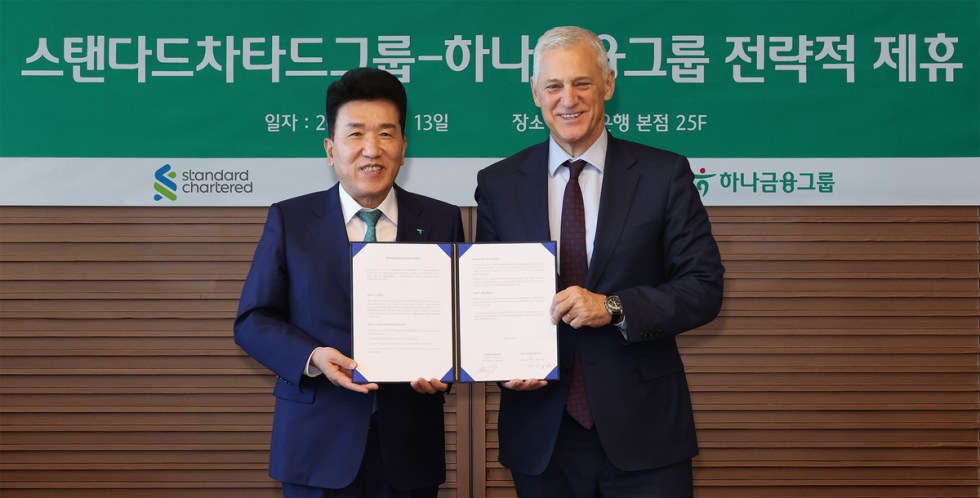
Chairman Ham of Han Financial Group and Bill Winters, CEO of Standard Chartered Group, at the signing ceremony in Seoul. Source: Seoul Economic Daily.

According to The Korea Times, the signing ceremony took place at Hana’s Bank’s headquarters on March 13th. It was attended by Ham Young-joo, Chairman of Hana Financial Group, and Bill Winters, CEO of Standard Chartered Group. Seoul Economic Daily reports that Ham and Winters exchanged views on cooperation in global and digital assets. Chairman Ham stated that:

The partnership between Hana Financial Group and Standard Chartered Group, leveraging their extensive global networks and diverse financial know-how, will serve as a strong competitive edge in the global financial sector. We will create new growth opportunities by generating synergies in future financial domains, including digital assets.

Winters emphasized on the capital importance that South Korea has in Asian financial markets, regarding the country as a “key hub”.

Shared Goals

The MOU covers stablecoins, deposit-token experiments, and future tokenized instruments, tying in Hana’s domestic stablecoin plans and pilots.

The Seoul Economic Daily contextualizes this move with Chairman Ham views of stablecoins as “core future business”. His goal with Hana Financial points to the building of an “ecosystem encompassing the issuance, distribution, use and circulation of (won-denominated stable) coins”, as he stated in his New Year’s address in January. In 2024, Hana Bank, BitGo, and SK Telecom set up BitGo Korea as the local arm focused on institutional crypto custody. In 2025, the Korean lender had an all-time high net profit of ₩4 trillion.
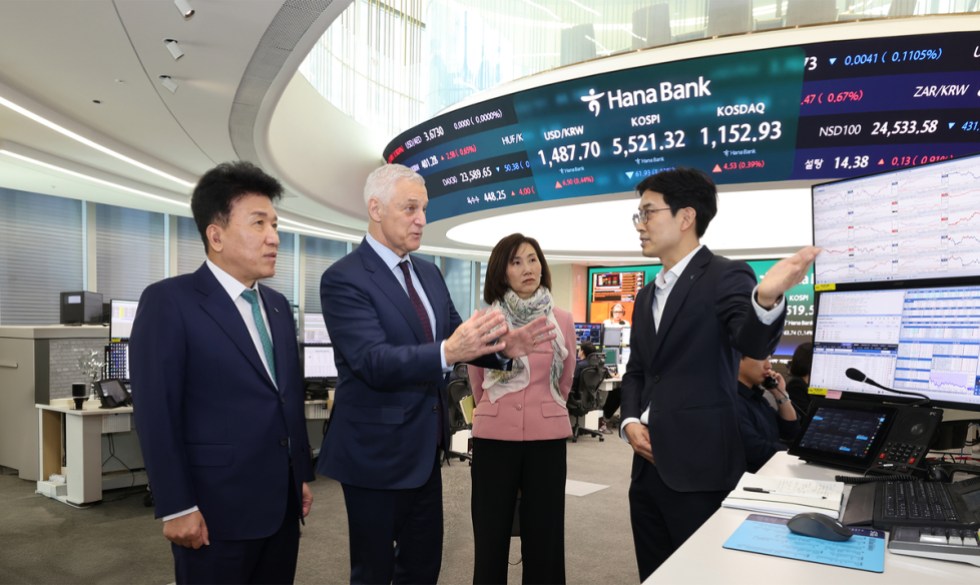
Chairman Ham and Bill Winters at Hana’s Bank’s headquarters, Source: Seoul Economic Daily.

Standard Chartered already has a growing crypto footprint, from institutional custody services to pilots with tokenized bonds and other blockchain-based assets. The bank has also backed several stablecoin ventures in markets like Hong Kong.

This is not the first time Hana Bank and Standard Chartered team up. In December 2025, the UK-based global bank announced that it was facilitating Hana Securities first venture with digital assets.

A Crypto Race

Instead of chasing pure spot exposure, the South Korea’s big banks are now racing to build compliant rails around stablecoins, tokenized notes, and digital bonds that can plug directly into the regulated financial system, nudging the market away from retail speculation toward more structured corporate and banking participation.

This new deal marks another milestone in the latest wave of efforts by TradFi institutions to keep up with a rapidly evolving digital financial system.
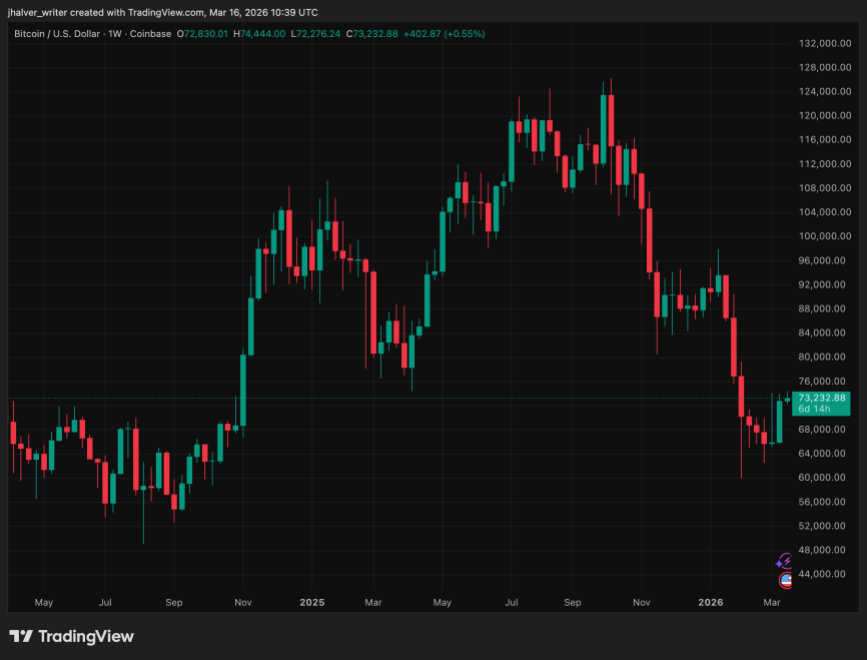
BTC’s price trends to the upside on the daily chart, reaching the $73K. Source: BTCUSD on Tradingview

Cover image from Perplexity, BTCUSD chart from Tradingview

Related Questions

QWhat is the main purpose of the partnership between Hana Financial Group and Standard Chartered Group?

AThe partnership aims to deepen cooperation in global finance and crypto assets, turning stablecoins and other digital assets into a new growth engine alongside their existing international banking business.

QWhen and where did the signing ceremony of the MOU between Hana Financial Group and Standard Chartered take place?

AThe signing ceremony took place on March 13th at Hana Bank's headquarters in Seoul.

QWhat specific areas does the MOU between the two financial institutions cover?

AThe MOU covers stablecoins, deposit-token experiments, and future tokenized instruments, tying in Hana's domestic stablecoin plans and pilots.

QWhat did Chairman Ham of Hana Financial Group identify as a 'core future business' in his New Year's address?

AChairman Ham identified stablecoins as a 'core future business' and expressed his goal to build an ecosystem encompassing the issuance, distribution, use, and circulation of won-denominated stablecoins.

QHow is Standard Chartered Bank involved in the crypto space, according to the article?

AStandard Chartered has a growing crypto footprint, including institutional custody services, pilots with tokenized bonds and other blockchain-based assets, and backing several stablecoin ventures in markets like Hong Kong.

Related Reads

In-Depth Report on the On-Chain Lending Market: When Off-Chain Credit Meets On-Chain Liquidation

The on-chain lending market has evolved from a peripheral DeFi niche into core financial infrastructure. As of early 2026, total value locked (TVL) in on-chain lending protocols has reached $64.3 billion, accounting for 53.54% of total DeFi TVL, making it the largest and most mature vertical within decentralized finance. Aave dominates the sector with approximately $32.9 billion in TVL, commanding nearly half of the market—a leadership position that is unlikely to be challenged in the foreseeable future. However, the path of on-chain lending forward is not without risk. Liquidation cascades, credit defaults, and cross-chain vulnerabilities remain systemic threats hanging over the industry. At the same time, a deeper structural transformation is underway: on-chain lending is shifting from a “leverage tool for crypto-native users” to a “compliant gateway for institutional capital”. The scale of RWA (Real World Asset) lending has surpassed $18.5 billion, with U.S. Treasuries and government securities increasingly serving as core collateral. Institutional capital inflows are reshaping both the user base and risk appetite of the sector. This report systematically analyzes the evolution of on-chain lending definitions, competitive dynamics, core risks, and future trends, providing a comprehensive industry outlook for investors and trade practitioners. Key findings suggest that the “one dominant player with several strong challengers” structure will persist in the short term, while fixed-rate lending, compliant collateral, and institutional credit underwriting will define the next phase of competition. For investors focused on DeFi infrastructure, three key opportunity tracks stand out, namely, the Aave ecosystem (Morpho, Spark), RWA lending protocols (Ondo, Maple) and fixed-rate innovation (Notional, Pendle).

HTX Learn27m ago

In-Depth Report on the On-Chain Lending Market: When Off-Chain Credit Meets On-Chain Liquidation

HTX Learn27m ago

Fu Peng's First Public Speech in 2026: What Exactly Are Crypto Assets? Why Did I Join the Crypto Asset Industry?

Fu Peng, a renowned macroeconomist and now Chief Economist at New火 Group, delivered his first public speech of 2026 at the Hong Kong Web3 Festival. He explained his perspective on crypto assets and why he joined the industry, framing it within the context of macroeconomic trends and financial evolution. Fu emphasized that crypto assets are transitioning from an early, belief-driven phase to a mature, institutionally integrated asset class. He drew parallels to the 1970s-80s, when technological advances (like computing) revolutionized traditional finance, leading to the rise of FICC (Fixed Income, Currencies, and Commodities). Similarly, current advancements in AI, data, and blockchain are reshaping finance, with crypto assets becoming part of a new "FICC + C" (C for Crypto) framework. He noted that institutional capital, including traditional hedge funds, avoided early crypto due to its speculative nature but are now engaging as regulatory clarity emerges (e.g., stablecoin laws, CFTC classifying crypto as a commodity). Fu predicted that 2025-2026 marks a turning point where crypto becomes a standardized, financially viable asset for diversified portfolios, akin to commodities or derivatives in traditional finance. Fu defined Bitcoin not as "digital gold" in a simplistic sense but as a value-preserving, financially tradable asset. He highlighted that crypto's future lies in regulated, institutional adoption, moving away from retail-dominated trading. His entry into crypto signals this maturation, where traditional finance integrates crypto into mainstream asset management.

marsbit1h ago

Fu Peng's First Public Speech in 2026: What Exactly Are Crypto Assets? Why Did I Join the Crypto Asset Industry?

marsbit1h ago

Justin Sun Sues Trump Family: What $75 Million Bought Was Only a Blacklist

Justin Sun, founder of Tron, has filed a lawsuit in federal court against World Liberty Financial (WLF), alleging he was made the "primary target of a fraudulent scheme" after investing $75 million. Sun claims the investment secured him an advisor title and WLFI tokens, which were later frozen by WLF, causing "hundreds of millions in losses." The dispute began in late 2024 when Sun's investment helped revive WLF's struggling token sale, which ultimately raised $550 million. Shortly after, the SEC dropped its lawsuit against Sun following Donald Trump's inauguration. However, relations soured when Sun refused WLF's demands for additional funding. In August 2025, WLF added a "blacklist" function to its smart contract, allowing it to unilaterally freeze tokens. Sun's holdings, worth approximately $107 million, were frozen, and he was threatened with token destruction. The lawsuit highlights WLF's structure, which directs 75% of token sale profits to the Trump family, who had earned $1 billion by December 2025. WLF's CEO is Zach Witkoff, son of U.S. Middle East envoy Steve Witkoff. The project faces scrutiny for opaque operations, including a controversial loan arrangement on the Dolomite platform, co-founded by a WLF advisor. Despite Sun's history with the SEC, the case underscores centralization risks within DeFi, as WLF controls governance and holds powers to freeze assets arbitrarily. Sun's tokens remain frozen as legal proceedings begin.

marsbit1h ago

Justin Sun Sues Trump Family: What $75 Million Bought Was Only a Blacklist

marsbit1h ago

Trading

Spot
Futures

Hot Articles

How to Buy PUSH

Welcome to HTX.com! We've made purchasing Push Protocol (PUSH) simple and convenient. Follow our step-by-step guide to embark on your crypto journey.Step 1: Create Your HTX AccountUse your email or phone number to sign up for a free account on HTX. Experience a hassle-free registration journey and unlock all features.Get My AccountStep 2: Go to Buy Crypto and Choose Your Payment MethodCredit/Debit Card: Use your Visa or Mastercard to buy Push Protocol (PUSH) instantly.Balance: Use funds from your HTX account balance to trade seamlessly.Third Parties: We've added popular payment methods such as Google Pay and Apple Pay to enhance convenience.P2P: Trade directly with other users on HTX.Over-the-Counter (OTC): We offer tailor-made services and competitive exchange rates for traders.Step 3: Store Your Push Protocol (PUSH)After purchasing your Push Protocol (PUSH), store it in your HTX account. Alternatively, you can send it elsewhere via blockchain transfer or use it to trade other cryptocurrencies.Step 4: Trade Push Protocol (PUSH)Easily trade Push Protocol (PUSH) on HTX's spot market. Simply access your account, select your trading pair, execute your trades, and monitor in real-time. We offer a user-friendly experience for both beginners and seasoned traders.

3.3k Total ViewsPublished 2024.03.29Updated 2025.04.02

How to Buy PUSH

Discussions

Welcome to the HTX Community. Here, you can stay informed about the latest platform developments and gain access to professional market insights. Users' opinions on the price of PUSH (PUSH) are presented below.

活动图片













