Crypto Prediction Markets Face Existential Threat — 3 States Move To Shut Traders Out

bitcoinistPublished on 2026-04-03Last updated on 2026-04-03

Abstract

The U.S. federal government, through the CFTC and DOJ, is suing Illinois, Arizona, and Connecticut to block their attempts to shut down crypto prediction markets like Polymarket and Kalshi. The federal agencies argue they have exclusive jurisdiction to regulate these markets as derivatives, while the states classify them as illegal gambling. This legal clash represents a significant existential threat to the industry. A federal victory would centralize oversight under the CFTC, creating a single regulatory framework. If the states prevail, platforms would face a fragmented landscape of state gambling laws, potentially pushing markets offshore and increasing costs for traders.

Illinois, Arizona and Connecticut are trying to regulate crypto predictions markets, such as Polymarket and Kalshi. The Commodity Futures Trading Commission and the Justice Department are coming to the rescue.

For The First Time, The Scale Moves In Crypto Prediction Markets’ Favor

As contradictory as it may sound, the Trump administration is trying to save crypto prediction markets from the State itself. The coordinated lawsuits the CFTC and the DOJ have filed against the three states argue that only the federal derivatives regulator can police prediction markets.

The lawsuits go as far as to claim the three states are bypassing the CFTC’s authority by trying to shut down “federally regulated DCMs” (designated contract markets). Regarding Illinois, the federal regulator said the state spent the past year issuing cease‐and‐desist letters to Kalshi, Crypto.com, and Polymarket, which the complaint argues are all under CFTC authority:

Illinois’s attempt to shut down federally regulated DCMs intrudes on the exclusive federal scheme Congress designed to oversee national swaps markets.

Related Reading: Crypto Traders On Edge As Korea Stalls Key Law — Is The “Kimchi Premium” At Risk Next?

Put simply, Washington says prediction markets are federally regulated derivatives. States insist, however, that prediction markets are just unlicensed gambling products harming local consumers.

CFTC Chairman Michael Selig explained that this is not the first time states “have tried to impose consistent and contrary obligations on market participants”. Just this past month, a bipartisan Senate bill targeting sports‐style bets on platforms like Polymarket and Kalshi was introduced by Senators Adam Schiff (D-CA) and John Curtis (R-UT).

Also on March, democratic representative Seth Moulton of Massachusetts (MA-06) formally banned all his staff from participating in prediction markets. That same day, Congressman Adrian Smith (R-NE-03) and Congresswoman Nikki Budzinski (D-IL-13) from Nebraska introduced the PREDICT Act, banning members of Congress from trading on political and policy outcome markets.

These are the first lawsuits by the CFTC to block state gaming regulators ​from policing operators of prediction markets, according to Reuters. The outlet also highlighted the fact that all the defendants are Democrats.

Market Implications

The CFTC’s lawsuits build on its recent push to assert “exclusive jurisdiction” over event contracts, including sports and politics, reversing the Biden‐era move that tried to ban broad categories of prediction markets.

Prediction markets are morphing into an information layer and hedging tool for traders, with liquidity increasingly coming from crypto‐native capital and exchange integrations.

A federal win would likely centralize rule‐making at the CFTC, potentially clearing a single regulatory path for crypto prediction platforms, but also tightening surveillance and enforcement. Conversely, if states prevail, platforms may face a patchwork of gambling rules that fracture liquidity, push some markets offshore, and raise operational risk premia for traders.

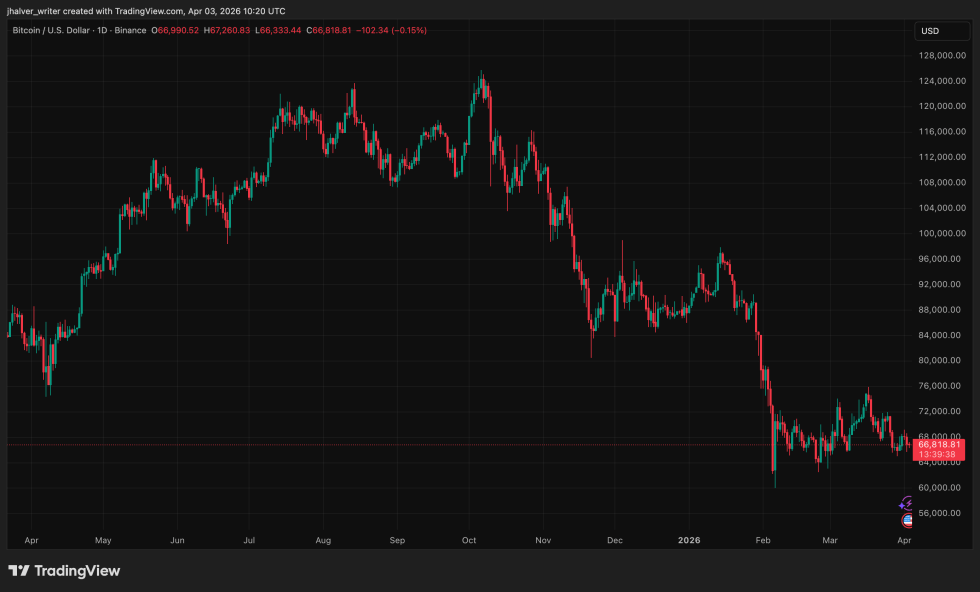
At the moment of writing, BTC trades for almost $67k on the daily chart. Source: BTCUSD on Tradingview.

Cover image from Perplexity. BTCUSD chart from Tradingview.

Related Questions

QWhich three states are mentioned as trying to regulate crypto prediction markets in the article?

AIllinois, Arizona, and Connecticut.

QWhat federal agencies are taking legal action against these states to protect crypto prediction markets?

AThe Commodity Futures Trading Commission (CFTC) and the Department of Justice (DOJ).

QAccording to the CFTC, what is the core legal argument against the states' actions?

AThe CFTC argues that it has exclusive federal jurisdiction to regulate prediction markets as derivatives, and the states are intruding on this federal regulatory scheme.

QWhat is the name of the bipartisan Senate bill mentioned that targets sports-style bets on platforms like Polymarket?

AThe article mentions a bipartisan Senate bill but does not provide its specific name. It was introduced by Senators Adam Schiff and John Curtis.

QWhat are the two potential outcomes for crypto prediction markets discussed, depending on who wins the legal battle?

AA federal win would centralize rule-making at the CFTC, creating a single regulatory path. If states prevail, platforms would face a patchwork of state gambling rules, fracturing liquidity and pushing some markets offshore.

Related Reads

You Bet on the News, the Pros Read the Rules: The True Cognitive Gap in Losing Money on Polymarket

The article explains that the key to profiting on Polymarket, a prediction market platform, lies not just predicting real-world events correctly, but in meticulously understanding the specific rules that govern how each market will be resolved. It illustrates this with examples, such as a market on Venezuela's 2026 leader, where the official rules defining "officially holds" the office overruled the intuitive answer of who was in practical control. Other examples include debates over the definition of a "token" or what constitutes an "agreement." The core argument is that a "reality vs. rules" gap creates pricing discrepancies that savvy traders ("车头" or "whales") exploit. The platform has a formal dispute resolution process managed by UMA token holders to settle ambiguous outcomes. This process involves proposal submission, a challenge window, a discussion period, and a final vote. However, the article highlights a critical flaw in this system compared to a traditional court: the lack of separation between the arbiters (UMA voters) and the interested parties (traders with financial stakes in the outcome). This conflict of interest undermines the discussion phase, leads to herd mentality, and results in opaque final decisions without explanatory rulings. Consequently, the system lacks a body of precedent, making it difficult for users to learn from past disputes. The ultimate takeaway is that success on Polymarket requires a lawyer-like scrutiny of the rules to identify and capitalize on the cognitive gap between how events appear and how they are contractually defined for settlement.

marsbit35m ago

You Bet on the News, the Pros Read the Rules: The True Cognitive Gap in Losing Money on Polymarket

marsbit35m ago

Will the Fed Still Cut Interest Rates? Tonight's Data Is Crucial

The core debate surrounding the Federal Reserve's potential interest rate cuts is intensifying amid geopolitical conflict and rebounding inflation. The key question is whether high energy prices will cause persistent inflation or weaken consumer demand enough to force the Fed to cut rates. Citigroup presents a bullish case for cuts, arguing that oil supply disruptions from the Strait of Hormuz are temporary and will not lead to lasting inflationary pressure. They point to receding bond yields and oil prices as evidence the market is pricing in a short-lived shock. Citi's data also shows tightening financial conditions, a stabilizing labor market, and healthy tax returns, supporting their view that the path to lower rates remains open. Conversely, Deutsche Bank offers a starkly contrasting, more hawkish outlook. They argue the Fed's current policy is already neutral and expect rates to remain unchanged indefinitely. Their view is based on stalled disinflation progress and a shift toward more hawkish rhetoric from key Fed officials like Waller, who cited risks from prolonged Middle East conflict and tariffs. Other officials, including Williams and Hammack, signaled rates would likely stay on hold for a "considerable time." The market pricing has shifted dramatically, now forecasting zero cuts in 2026. The imminent release of the March retail sales "control group" data is highlighted as a critical test. This metric, which excludes gas station sales, will reveal if high gasoline prices are eroding consumer spending in other areas. A weak reading could support the case for imminent rate cuts, while a strong one would bolster the argument for the Fed to hold steady. This data is pivotal for determining the near-term policy path.

marsbit56m ago

Will the Fed Still Cut Interest Rates? Tonight's Data Is Crucial

marsbit56m ago

Trading

Spot
Futures
活动图片