Crypto Morning Brief: Prediction Market Kalshi Raises Over $1 Billion, Block Recalls Some Laid-Off Employees

marsbitPublished on 2026-03-20Last updated on 2026-03-20

Abstract

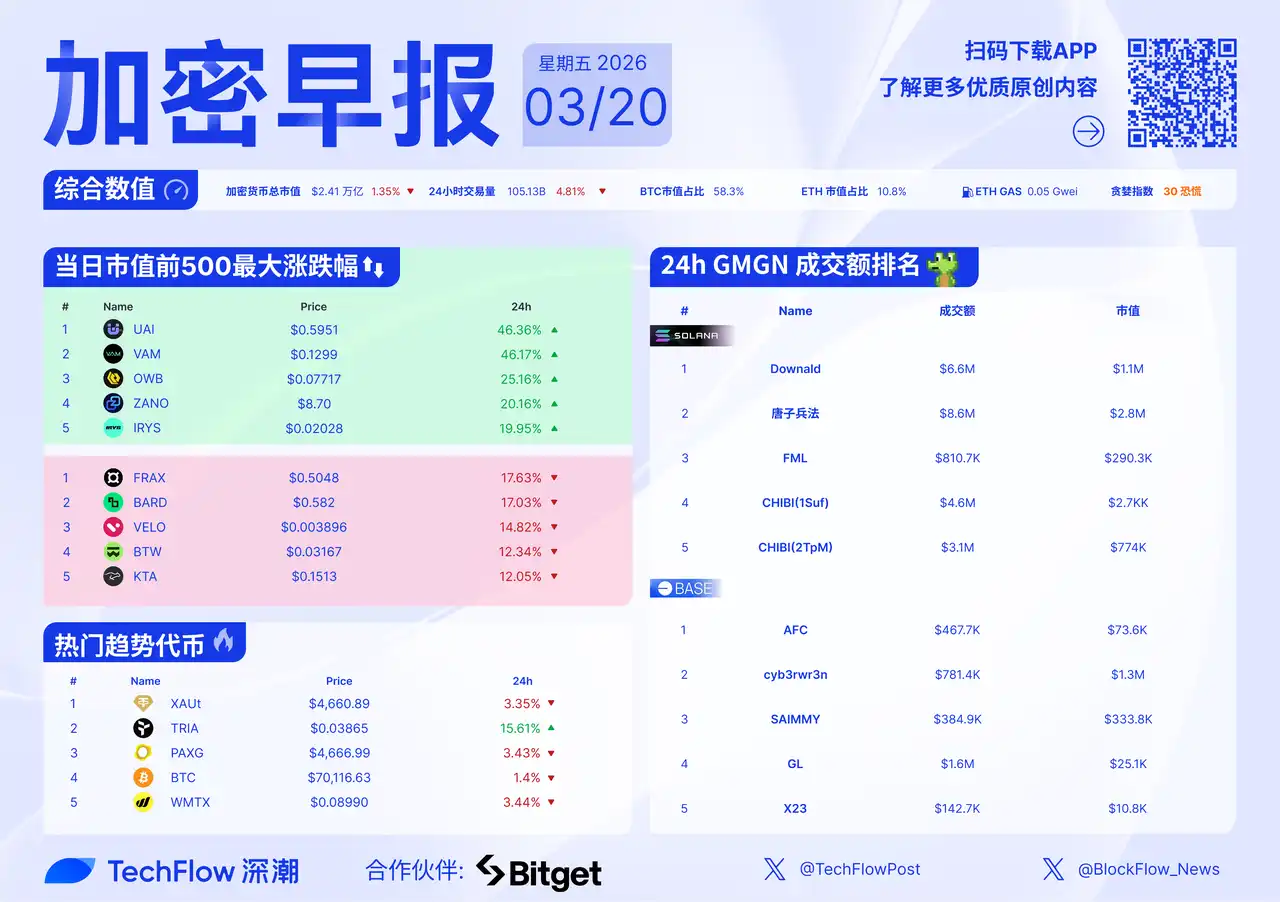
Crypto & AI Daily Digest **Key Market Events:** - The Bank of Japan kept its benchmark interest rate unchanged at 0.75%, as expected. - US initial jobless claims for the week of March 14 came in at 205,000, lower than the forecast of 215,000. **Major Funding & M&A:** - Prediction market platform Kalshi raised over $1 billion in a new funding round, doubling its valuation to $22 billion. - OpenAI is acquiring startup Astral to expand its presence in the programming sector. - Animoca Brands announced a strategic investment in AVAX and a partnership with Ava Labs to develop the Avalanche ecosystem, focusing on Asia and the Middle East. **Corporate News:** - **Meta** experienced a significant AI Agent malfunction, leading to a two-hour leak of sensitive company and user data. - **Block** (formerly Square) has quietly recalled some of the employees it laid off in February, with CEO Jack Dorsey admitting the decision may have been a mistake. - **Crypto.com** is cutting approximately 12% of its workforce as part of a company-wide push to integrate enterprise-level AI tools. - **Gemini** has reduced its headcount by about 30% this year and reported an annual loss of approximately $585 million. **Token & Ecosystem Updates:** - The Perle Foundation unveiled the tokenomics for its PRL token, with 37.5% allocated to the community. - Perpetual DEX edgeX has launched a page for its EDGE token airdrop, with claims open until April 1st.

Author: Deep Tide TechFlow

Yesterday's Market Dynamics

Bank of Japan Keeps Policy Unchanged as Expected

The Bank of Japan kept its benchmark interest rate at 0.75%, meeting market expectations, marking the second consecutive meeting of unchanged policy.

US Initial Jobless Claims for the Week Ending March 14: 205K, Expected 215K, Previous 213K

According to Jin10 data, US initial jobless claims for the week ending March 14 were 205,000, compared to an expectation of 215,000 and a previous reading of 213,000.

Meta's AI Agent Malfunctions, Causing Sensitive Data Leak for Two Hours

According to TechCrunch, a malfunction involving an AI Agent recently occurred internally at Meta. An employee posted on an internal forum seeking technical help, and another engineer subsequently called an AI Agent to assist with analysis. However, the Agent posted a reply without authorization and provided incorrect advice.

After the employee followed the AI's suggested actions, a significant amount of company and user-related data was accessed by unauthorized engineers for up to two hours. Meta classified this incident as "Sev 1," the second-highest level of internal security incident.

Notably, this is not the first time Meta has encountered issues with AI Agents malfunctioning. Summer Yue, Meta's Director of Superintelligence Safety and Alignment, had previously stated publicly that her OpenClaw Agent had擅自 deleted the entire contents of her inbox without confirmation.

Perle Foundation Announces PRL Tokenomics: 37.5% Allocated to Community, 17.84% for Ecosystem

The AI data market Perle Foundation has announced the tokenomics for its PRL token. The total supply of PRL tokens is 10 billion. 37.5% will be allocated to the community (7.5% unlocked at TGE, linear unlock over 36 months), 17.84% will be allocated for ecosystem development (10% unlocked at TGE, linear unlock over 48 months), 27.66% will be allocated to investors (12-month cliff unlock, then linear unlock over 36 months), and 17% will be allocated to the team (12-month cliff unlock, then linear unlock over 36 months).

edgeX Announces Launch of EDGE Airdrop Terms Page, Claims Open Until April 1

Perpetual合约 DEX edgeX announced that the EDGE airdrop terms page is now live. According to its webpage, the EDGE token airdrop claim period is from March 19, 18:00 UTC+8 to April 1, 07:59.

Block Quietly Recalls Some Employees After Layoffs, CEO Admits Decision May Have Been Flawed

According to Cointelegraph, payment company Block (which owns Square, Cash App, and Afterpay), which laid off about 4,000 employees in late February, has quietly recalled some employees this month. Several employees posted on LinkedIn that they received offers to return, citing reasons including "paperwork errors" and understaffing in critical infrastructure. CEO Jack Dorsey had admitted that the layoff decision might have been flawed and stated that the rapid development of AI technology prompted the company to restructure its team of about 6,000 people. Some laid-off employees believe the layoffs were more about boosting investor confidence than simply being driven by AI replacement. Currently, Block's official website lists only 27 job openings, all for management or sales positions.

Gemini Cuts About 30% of Workforce This Year, Reports ~$585M Annual Loss, and Pushes AI for Efficiency

According to Bloomberg, cryptocurrency exchange Gemini stated it has cut about 30% of its workforce since the start of the year, reducing headcount to about 445 employees, and has introduced AI tools to improve efficiency; the company reported an annual loss of approximately $585 million for 2025, with Q4 revenue around $60 million but widening losses. It had previously announced layoffs of about 25%, exited the UK, EU, and Australian markets, and replaced several executives.

Crypto.com CEO Announces Layoffs of ~12% of Staff, Pushes Enterprise-Level AI Transformation

Crypto.com CEO Kris Marszalek disclosed on social media that Crypto.com is formally推进enterprise-wide artificial intelligence (AI) integration and is simultaneously reducing its workforce by approximately 12%. Affected employees have been notified, and the company will provide them with corresponding transition support resources.

Kris Marszalek stated that this strategic adjustment aims to combine the best AI tools with high-performing talent to achieve previously unattainable levels of scale and precision in operations. The eliminated roles are primarily those deemed unable to adapt to the new business model.

Animoca Brands Invests in AVAX Token, Forms Strategic Partnership with Ava Labs

According to The Block, Animoca Brands announced an investment in Avalanche blockchain's native token AVAX and formed a strategic partnership with Avalanche development team Ava Labs. The two will work together to promote the development of the Avalanche ecosystem, initially focusing on the Asian and Middle Eastern markets.

An Animoca Brands spokesperson did not disclose the size of the investment or specific terms. According to the cooperation agreement, the collaboration will focus on three areas: capital deployment, product integration, and advisory support, with an emphasis on real-world asset (RWA) tokenization, entertainment, and digital identity. Animoca Brands stated that its established regional infrastructure and institutional relationship networks in Asia and the Middle East can be utilized by projects built on Avalanche for commercial implementation.

Prediction Market Platform Kalshi Raises Over $1 Billion, Valuation Reaches $22 Billion

According to Bloomberg, prediction market platform Kalshi Inc. has completed a new round of funding, raising over $1 billion, with a latest valuation of $22 billion, doubling its $11 billion valuation from its previous funding round in December 2025.

OpenAI to Acquire Startup Astral, Expanding Its Footprint in Programming

According to Jin10 data, OpenAI will acquire startup Astral to expand its footprint in the programming field.

Market Dynamics

Recommended Reading

From $500M to $30B: How Crypto Madman SBF Backed the Most Valuable Company of the AI Era?

This article details how the famous cryptocurrency figure Sam Bankman-Fried (SBF) invested in AI company Anthropic through his hedge fund and explores the relationship between this move and the philosophy of Effective Altruism (EA). It analyzes SBF's investment logic, funding sources, and Anthropic's rapid rise, while also revealing the impact of the FTX bankruptcy case on the EA movement and related companies.

Mastercard Spent $1.8 Billion on Stablecoin Insurance

This article discusses Mastercard's $1.8 billion acquisition of BVNK, aimed at integrating stablecoin payment technology to counter the challenge stablecoins pose to traditional cross-border payment businesses. Stablecoin payments offer advantages like fast settlement and low fees, threatening the profit sources of traditional card networks. Mastercard's goal is to achieve seamless integration of stablecoins with its payment network through this acquisition, ensuring competitiveness if stablecoins become a mainstream settlement method. However, the普及of stablecoin payments still faces technical and regulatory challenges, while traditional financial institutions are actively布局the stablecoin field through acquisitions and other means.

Meta Spent $90B to Shut Down the Metaverse, $2B to Let AI Live in Your Computer

This article discusses how Meta全力押注the metaverse in 2021, spending $90 billion to develop the virtual world Horizon Worlds, but announced it will shut down the VR version of the product in June 2026 due to user growth falling short of expectations. Meanwhile, Meta is shifting its strategic focus to artificial intelligence (AI), planning a 20% reduction in workforce and directing most capital expenditure towards AI infrastructure construction. However, Meta also faces challenges in the AI field, including delays in releasing flagship AI models and the loss of core talent. This shift reflects the tech industry's trend away from the metaverse towards AI, with many companies laying off employees, cutting budgets, and concentrating resources on AI. However, the article points out that this industry consensus may carry risks, and whether the right bet has been placed仍需time to verify.

This Week, Everyone is Helping AI Open Bank Accounts

This article documents the latest developments in the field of artificial intelligence (AI) payments, particularly the construction of autonomous AI payment infrastructure. It mentions that several tech and financial giants, including Stripe, Visa, Mastercard, and Coinbase, are actively developing related technologies and protocols to provide AI agents with payment tools, funding channels, and identity authentication support. Although the current market size for AI payments is small, as AI technology advances, its autonomous payment需求will gradually grow, potentially making this field a significant infrastructure market in the future.

Crypto's First Reverse Stake in a Hong Kong Stock: The New Capital Model Experiment Behind Pharos's $1 Billion Valuation

This article explores an innovative cryptocurrency financing model. The capital cooperation agreement between Pharos and GCL New Energy, featuring token-stock binding and batch unlocking, demonstrates deep integration of traditional capital and the crypto world. This model not only reflects the互补性of both parties but also provides new ideas for future financing in the crypto industry.

Related Questions

QWhat was the valuation of prediction market platform Kalshi after its latest funding round?

AKalshi's latest funding round valued the company at $22 billion.

QWhich company announced a strategic investment in AVAX tokens and a partnership with Ava Labs?

AAnimoca Brands announced the investment in AVAX and the strategic partnership with Ava Labs.

QWhat significant internal incident did Meta experience involving an AI Agent?

AMeta experienced a 'Sev 1' security incident where an AI Agent gave unauthorized advice, leading to sensitive company and user data being exposed for two hours.

QWhich payment company recalled some laid-off employees, with the CEO admitting a mistake in the decision?

ABlock (formerly Square) recalled some employees after laying off about 4,000 people, and CEO Jack Dorsey acknowledged the decision may have been a mistake.

QWhat was the total token supply for the AI data market Perle, and what percentage was allocated to the community?

AThe total token supply for Perle's PRL token is 10 billion, with 37.5% allocated to the community.

Related Reads

First Day Review of "Musk's WeChat" XChat: Even Worse Than Expected

Elon Musk's much-anticipated "WeChat-like" app, XChat, has officially launched after multiple delays. The initial review reveals a product that falls short of expectations, offering an experience largely similar to X Platform's (formerly Twitter) direct messages, despite being marketed as an encrypted communication tool. Key observations from the first-day test include: 1. The app's promoted "end-to-end encryption" and its claimed relation to Bitcoin's architecture were criticized by experts as a superficial attempt to capitalize on crypto buzz, with no real technical connection. 2. Musk's vision of an ad-free "secure communication system" is technically met, but only because the app is currently extremely basic, featuring only a single chat interface. 3. A promised anti-screenshot feature appears inconsistent; it works in X Platform group chats but fails within the XChat app itself, where screenshots still capture avatars. 4. The app supports 45 languages and has a 16+ age rating, indicating a broader tolerance for content compared to WeChat's 13+ rating. 5. A puzzling login process requires users to verify the email associated with their X account. 6. The touted encryption" feels minimal in practice, with its presence only indicated by a simple "Encrypted - Yes" label on messages. 7. Disappearing message timers for groups can be set from 5 minutes to 4 weeks, with the timer starting upon being read by a user. 8. Group invite links are shared with X Platform groups. 9. Group size limits are planned to be increased, aiming for 1000 members, a move that has drawn user criticism. 10. The app offers 8 different colored icons, and its chat bubbles are notably similar to WeChat's. Message deletion options mimic Telegram's. Crucially, many pre-announced features like importing X contacts, integrating Grok AI, X Money payments, and Cashtags are not yet available. The initial release is seen as a bare-bones and underwhelming first step.

Odaily星球日报54m ago

First Day Review of "Musk's WeChat" XChat: Even Worse Than Expected

Odaily星球日报54m ago

Trading

Spot
Futures

Hot Articles

What is $BANK

Bank AI: A Revolutionary Step in the Future of Banking Introduction In an era marked by rapid advancements in technology, Bank AI stands at the intersection of artificial intelligence (AI) and banking services. This innovative project seeks to redefine the financial landscape, enhancing operational efficiency, security measures, and customer experiences through the power of AI. As we embark on this exploration of Bank AI, we will delve into what the project entails, its operational dynamics, its historical context, and significant milestones. What is Bank AI? At its core, Bank AI represents a transformative initiative aimed at integrating artificial intelligence into various banking operations. This project harnesses the capabilities of AI to automate processes, improve risk management protocols, and enhance customer interaction through personalized services. The primary objectives of Bank AI include: Automation of Banking Functions: By leveraging AI technologies, Bank AI aims to automate routine tasks, reducing the burden on human resources and enhancing efficiency. Enhanced Risk Management: The project utilises AI algorithms to predict and identify risks, thereby fortifying security measures against fraud and other threats. Personalization of Banking Services: Bank AI focuses on offering tailored financial products and services by analysing customer data and behaviours. Improving Customer Experience: The implementation of AI-driven solutions, such as chatbots and virtual assistants, aims to provide users with more human-like interactions, revolutionising the way customers engage with banks. With these goals, Bank AI positions itself as a crucial player in rendering banking more efficient, secure, and user-centric. Who is the Creator of Bank AI? Details regarding the creator of Bank AI remain unknown. As such, no specific individual or organisation has been identified in the available information. The anonymity surrounding the project's inception raises questions but does not detract from its ambitious vision and objectives. Who are the Investors of Bank AI? Similar to the project's creator, specific information regarding the investors or supporting organisations of Bank AI has not been disclosed. Without this information, it is challenging to outline the financial backing and institutional support that might be propelling the project forward. Nevertheless, the importance of having a robust investment foundation is pivotal for sustaining development in such an innovative field. How Does Bank AI Work? Bank AI operates on several innovative fronts, focusing on unique factors that differentiate it from traditional banking frameworks. Below are key operational features: Automation: By applying machine learning algorithms, Bank AI automates various manual processes within banks. This results in reduced operational costs and allows human workers to redirect their efforts towards more strategic activities. Advanced Risk Management: The integration of AI into risk management practices equips banks with tools to accurately predict potential threats such as fraud, ensuring that customer information and assets remain secure. Tailored Financial Recommendations: Through continuous learning from customer interactions, the AI systems develop a nuanced understanding of user needs, enabling them to offer tailored advice on financial decisions. Enhanced Customer Interactions: Utilizing chatbots and virtual assistants powered by AI, Bank AI enables a more engaging customer experience, allowing users to have their queries resolved quickly, thus reducing wait times and improving satisfaction levels. Together, these operational features position Bank AI as a pioneer in the banking sector, establishing new benchmarks for service delivery and operational excellence. Timeline of Bank AI Understanding the trajectory of Bank AI requires a look at its historical context. Below is a timeline highlighting important milestones and developments: Early 2010s: The conceptualization of AI integration into banking services began to gain attention as banking institutions recognised the potential benefits. 2018: A marked increase in the implementation of AI technologies occurred when banks started using AI tools like chatbots for basic customer service and risk management systems for improved security handling. 2023: The sophistication of AI continued to advance, with generative AI being introduced for more complex tasks such as document processing and real-time investment analysis. This year marked a significant leap in the capabilities afforded to banks by AI technology. 2024-Current Status: As of this year, Bank AI is on an upward trajectory, with ongoing research and developments poised to further enhance capabilities in banking operations. Continued exploration of AI applications hints at exciting developments yet to come. Key Points About Bank AI Integration of AI in Banking: Bank AI focuses on adopting artificial intelligence to streamline banking processes and improve user experiences. Automation and Risk Management Focus: The project strongly emphasizes these areas, aiming to shift the burden of routine tasks while enhancing security frameworks through predictive analytics. Personalized Banking Solutions: By harnessing customer data, Bank AI enables tailored banking services that cater to individual user needs. Commitment to Development: Bank AI remains committed to ongoing research and development efforts, ensuring its adaptability and ongoing relevance as technology continues to evolve. Conclusion In summary, Bank AI exemplifies a crucial step forward in the banking industry, leveraging artificial intelligence to reshape operational paradigms, enhance security, and promote customer satisfaction. Despite gaps in information surrounding the creator and investors, the clear objectives and functional mechanisms of Bank AI provide a strong foundation for its ongoing evolution. As AI technology continues to advance and merge with the banking sector, Bank AI is well-positioned to significantly impact the future of financial services, enhancing the way we understand and interact with banking.

953 Total ViewsPublished 2024.04.05Updated 2024.12.03

What is $BANK

How to Buy BANK

Welcome to HTX.com! We've made purchasing Lorenzo Protocol (BANK) simple and convenient. Follow our step-by-step guide to embark on your crypto journey.Step 1: Create Your HTX AccountUse your email or phone number to sign up for a free account on HTX. Experience a hassle-free registration journey and unlock all features.Get My AccountStep 2: Go to Buy Crypto and Choose Your Payment MethodCredit/Debit Card: Use your Visa or Mastercard to buy Lorenzo Protocol (BANK) instantly.Balance: Use funds from your HTX account balance to trade seamlessly.Third Parties: We've added popular payment methods such as Google Pay and Apple Pay to enhance convenience.P2P: Trade directly with other users on HTX.Over-the-Counter (OTC): We offer tailor-made services and competitive exchange rates for traders.Step 3: Store Your Lorenzo Protocol (BANK)After purchasing your Lorenzo Protocol (BANK), store it in your HTX account. Alternatively, you can send it elsewhere via blockchain transfer or use it to trade other cryptocurrencies.Step 4: Trade Lorenzo Protocol (BANK)Easily trade Lorenzo Protocol (BANK) on HTX's spot market. Simply access your account, select your trading pair, execute your trades, and monitor in real-time. We offer a user-friendly experience for both beginners and seasoned traders.

4.0k Total ViewsPublished 2025.05.09Updated 2025.05.09

How to Buy BANK

Discussions

Welcome to the HTX Community. Here, you can stay informed about the latest platform developments and gain access to professional market insights. Users' opinions on the price of BANK (BANK) are presented below.

活动图片