Crypto May No Longer Be Treated Like Penny Stocks Under SEC Plan

bitcoinistPublished on 2026-03-17Last updated on 2026-03-17

Abstract

The US Securities and Exchange Commission (SEC) has proposed amending Exchange Act Rule 15c2-11 to apply only to equity securities, a move that could significantly impact crypto market structure. The rule, historically used to prevent fraud in over-the-counter equity markets, would no longer broadly apply to other asset classes like cryptocurrencies. This change is seen as a meaningful shift away from forcing crypto into existing securities frameworks. By excluding crypto from these rules—originally designed for penny stocks—the SEC signals a more tailored regulatory approach. The proposal is open for public comment, reflecting the agency's growing willingness to treat crypto differently from traditional equities.

The US Securities and Exchange Commission has proposed narrowing Exchange Act Rule 15c2-11 so that it applies only to equity securities, a technical change that could carry outsized significance for crypto market structure. For digital assets, the proposal signals a more tailored regulatory approach after years of trying to force crypto into frameworks built for traditional securities.

In a press release issued March 16, the SEC said Rule 15c2-11 has historically focused on preventing manipulative and fraudulent schemes in over-the-counter equity markets. The proposed amendment would revise the rule so it refers only to equity securities, rather than leaving room for broader application to other asset classes.

Quiet But Meaningful Win For Crypto

That matters because Rule 15c2-11 governs certain information gathering and review requirements for broker-dealers that publish quotations for, or maintain a continuous quoted market in, securities in the OTC market. By explicitly tying the rule to equities, the SEC appears to be drawing a cleaner line around where those obligations begin and end.

SEC Chairman Paul S. Atkins framed the move as a matter of regulatory fit rather than ideology. “Regulations should be appropriately tailored to fit the asset class to which they apply,” Atkins said. “This proposal would clarify regulatory obligations when publishing quotations and affirm what was always understood: Rule 15c2-11 applies to equity securities.”

For crypto market participants, the proposal reads as more than a drafting cleanup. Marty Bent, writing on X (@TFTC), argued that the shift quietly reverses the posture that defined much of the prior SEC era. “The SEC just proposed excluding crypto assets from OTC market rules that govern broker-dealer quotations. These are regulations originally designed for penny stocks and thinly traded equities.”

He went further, casting the amendment as a subtle but meaningful break from the agency’s past playbook. “This is a quiet but meaningful shift. Instead of forcing Bitcoin and crypto into existing securities frameworks, the SEC is explicitly carving it out. The rules being amended (Rule 15c2-11) dictate how broker-dealers can publish quotes for securities. By clarifying that crypto doesn’t fall under these requirements, the SEC is signaling it doesn’t view these assets through the same lens as traditional equities.”

That interpretation is likely to resonate because Rule 15c2-11 was never designed with digital assets in mind. Its original function was tied to OTC equities, particularly the kind of thinly traded names that have historically been vulnerable to quote manipulation and fraud. In that context, the SEC’s proposal does not create a bespoke crypto regime, but it does something nearly as important: it narrows the set of legacy securities rules that might otherwise be stretched to cover crypto by default.

Bent also contrasted the proposal with the enforcement-heavy approach associated with former Chair Gary Gensler. “Under Gensler, the approach was the opposite, force everything into existing rules, then sue when companies couldn’t comply. This is the regulatory posture flipping from ‘prove you’re not a security’ to ‘these rules weren’t built for you.’”

The proposal is now headed to the standard public process. The SEC said the release will be published on SEC.gov and later in the Federal Register, with a 60-day comment period beginning after Federal Register publication. That leaves room for revisions, but the message is already clear enough: the agency is increasingly willing to distinguish crypto from the infrastructure and assumptions of legacy equity markets.

At press time, the total crypto market cap stood at $2.51 trillion.
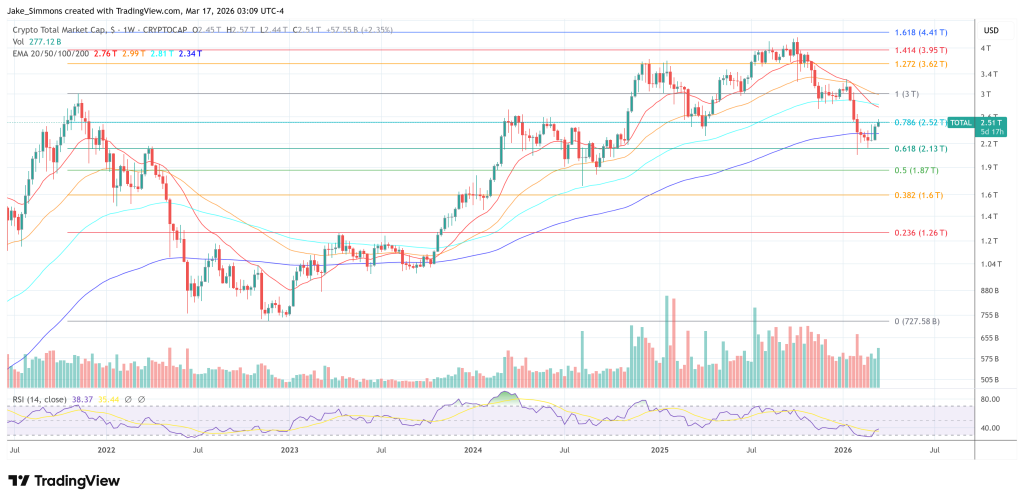
Total crypto market cap must reclaim the 0.786 Fib, 1-week chart | Source: TOTAL on TradingView.com

Related Questions

QWhat is the main change proposed by the SEC regarding Rule 15c2-11?

AThe SEC has proposed narrowing Exchange Act Rule 15c2-11 so that it applies only to equity securities, rather than having broader application to other asset classes like crypto.

QWhy is this proposal considered a significant shift for the crypto market?

AIt signals a more tailored regulatory approach, distinguishing crypto from traditional securities frameworks and reversing the previous posture of forcing crypto into existing rules designed for equities like penny stocks.

QHow did SEC Chairman Paul S. Atkins justify the proposed amendment?

AHe framed it as a matter of regulatory fit, stating that regulations should be appropriately tailored to the asset class they apply to, and that the proposal clarifies Rule 15c2-11 was always understood to apply to equity securities.

QWhat does Marty Bent suggest about the SEC's change in approach compared to the Gary Gensler era?

ABent argues this shifts from an enforcement-heavy approach that forced crypto into existing rules and then sued for non-compliance, to a posture that acknowledges these rules weren't built for crypto assets.

QWhat is the next step for this SEC proposal after its announcement?

AThe proposal will go through a standard public process with a 60-day comment period after being published in the Federal Register, leaving room for potential revisions.

Related Reads

The New Cold War is a Tech Stock War

The New Cold War is a Tech Stock War The article argues that the contemporary geopolitical and economic rivalry between the US and China represents a "New Cold War," but one fundamentally fought through technology and financial markets, not physical barriers or conventional trade. Historically, US dominance was secured through financial systems. The Soviet Union, reliant on the rigid "Transferable Ruble," was ultimately undermined by its dependency on the US dollar for oil trade. Later, Japan's semiconductor challenge was countered not just by tariffs (e.g., Plaza Accord, 301 investigations) but by binding it to US Treasury bonds. China presents a more complex, "embedded" challenger. While it holds vast dollar reserves and US debt like Japan, its industrial base is stronger and more diversified than the Soviet Union's. Surviving the initial 2018 trade war phase, the conflict has evolved into a "tech-financial war." The core battlefield is now the stock market. US tech stocks (AI, semiconductors) are treated as sovereign assets, buoyed by bipartisan national will. China is pushing to strengthen its own financial markets to convert industrial strength into financial power and fund its tech ambitions. Companies like ChangXin (semiconductors), Moonshot AI, and DJI compete not just for market share but as financial proxies for their respective systems. The new paradigm is moving from globally efficient monopolies (Apple, Google) towards companies that achieve monopolistic profits within their respective geopolitical spheres. This competition over "pricing power" and financial valuation in segmented markets defines the current era, making the stock market the primary arena for this tech-centric struggle.

marsbit10m ago

The New Cold War is a Tech Stock War

marsbit10m ago

RWA Weekly: Ten European Financial Institutions Establish Tokenized Asset Cooperative; Ondo Launches New Execution Network Ondo Network

RWA Weekly: European Banks Form Tokenized Asset Cooperative; Ondo Launches New Execution Network Ondo Network Covering July 24-31, 2026, the RWA sector saw a steady on-chain total value locked (TVL) of $36.8 billion, with holder count hitting a record high. However, stablecoin transfer volumes fell sharply (~30%), indicating low on-chain settlement demand. Key regulatory moves include South Korea advancing stablecoin legislation and a push to scrap crypto taxes, Kenya lowering capital requirements for stablecoin issuers, and Zimbabwe approving seven projects for its crypto sandbox. In project developments, BIS-led Project Agorá successfully tested cross-border payments with tokenized funds across six currencies. Ten major European financial institutions formed the RL1 blockchain cooperative to build tokenized asset infrastructure. Other notable updates: Aviva launched a tokenized dollar liquidity fund on XRPL, POSCO International tokenized commercial invoices on Injective, and a Brazilian farmer used tokenized cattle as collateral for a loan. Additional progress includes BNY Mellon migrating its core transfer agent operations to blockchain, Securitize gaining SEC investment advisor registration, and Tether’s compliant stablecoin USA₮ launching on Celo. Ondo Finance introduced Ondo Network, a new execution layer focused on speed and privacy, moving away from its initial chain plans. An analysis highlights that despite the growing scale of on-chain RWAs (~$32B), approximately 90% remain underutilized in DeFi, pointing to a critical challenge in unlocking liquidity and fostering real-world application beyond mere issuance.

marsbit11m ago

RWA Weekly: Ten European Financial Institutions Establish Tokenized Asset Cooperative; Ondo Launches New Execution Network Ondo Network

marsbit11m ago

South Korean Stock Market Sees Sharp Rebound After Forceful De-leveraging, SK Hynix Rises 30%

On July 31, South Korean stocks staged a historic rebound. The benchmark KOSPI index surged 18.27%, with chipmaker SK Hynix hitting a 30% gain limit. This followed a brutal, near-40% decline in the KOSPI over the previous month, driven largely by a deleveraging spiral involving leveraged ETFs. Analysts attributed the sharp sell-off to structural liquidity issues rather than deteriorating corporate fundamentals. The rally was triggered by a confluence of positive catalysts. Firstly, strong earnings from U.S. cloud giants Microsoft and Amazon alleviated fears of an "AI bubble burst," boosting global tech sentiment. Secondly, SK Group Chairman Chey Tae-won made a rare personal purchase of SK Hynix shares, seen as a strong vote of confidence. Thirdly, the South Korean government announced a 20 trillion won ($139 billion) AI investment fund. In response to the market turmoil, South Korean regulators are tightening controls on leveraged ETFs, admitting oversight shortcomings. Measures include raising minimum cash保证金 requirements for散户 investors and suspending new product launches. While the rebound signals eased liquidity pressure, analysts note deep structural issues remain. The market's future stability is seen as dependent on global tech capital expenditure trends and memory chip price cycles, with some viewing the surge as a technical correction rather than a definitive trend reversal.

marsbit31m ago

South Korean Stock Market Sees Sharp Rebound After Forceful De-leveraging, SK Hynix Rises 30%

marsbit31m ago

Cryptocurrency Company Wintermute Makes Pessimistic Statements Regarding Expected Altcoin Growth! Here are the Details

Crypto market maker Wintermute has made a pessimistic assessment regarding the anticipated altcoin season, suggesting that any upcoming rally may benefit only a limited number of projects. The company reports a record 72% of its spot OTC trading volume in H1 2026 came from institutional clients, whose capital is becoming more selective and concentrated. Data shows institutional traders act quickly on price spikes, while retail interest lasts longer. This selective behavior indicates the classic altcoin season, where hundreds of tokens rise simultaneously, may be changing. Wintermute believes only projects with strong use cases, high liquidity, and institutional appeal will stand out. Supporting this view, CryptoQuant data shows altcoin trading volume against Bitcoin is near its lowest since 2021, with the top 10 altcoins (excluding stablecoins) holding about 80.5% of the total altcoin market cap. Similarly, Kaiko reports that the top 10 altcoins now account for 63% of total altcoin trading volume, up from ~50% a few months ago, indicating capital concentration. Analysts suggest that in the current cautious institutional climate, projects with advanced technology, liquidity, and robust ecosystems will attract disproportionate attention. Therefore, any potential new altcoin season may be less broad than past bull markets, with gains concentrated in a narrower set of promising tokens.

cryptonews.ru31m ago

Cryptocurrency Company Wintermute Makes Pessimistic Statements Regarding Expected Altcoin Growth! Here are the Details

cryptonews.ru31m ago

Trading

Spot
活动图片