Crypto market’s weekly winners and losers – KAS, DEXE, UNI, TRUMP

ambcryptoPublished on 2026-03-22Last updated on 2026-03-22

Abstract

Bitcoin (BTC) declined 3.88% over the past week amid geopolitical tensions in West Asia, triggering a broader crypto market downturn. Despite the sell-off, several altcoins showed notable gains. Kaspa (KAS) rose 19.5%, breaking key moving averages, while DeXe (DEXE) climbed 18.62%, highlighting strength in the AI crypto sector. Fetch.ai (FET) and Quant (QNT) also posted gains of 16.55% and 12.6%, respectively. On the losing side, Uniswap (UNI) fell 12.4% due to DeFi sector weakness, and TRUMP token dropped 20.51% following a post-conference decline. OKB slid 12.57%, continuing its bearish trend after a recent rally. Other notable losers included Midnight (NIGHT), Render (RNDR), and Internet Computer (ICP). Bitcoin’s ability to hold above $65.6k support could signal a potential rebound, offering stronger altcoins a chance to recover in the coming week.

Over the past week, Bitcoin [BTC] fell 3.88% in value. The threat of escalation in West Asia and its impact on the global economy led to a swift sell-off over the weekend.

Since Saturday’s high of $71.1k, Bitcoin has fallen 3.5% within 24 hours. The altcoin market capitalization has shrunk 1.94% in the same period. Some enjoyed a notable weekly performance despite the wider crypto market fears, and some altcoins exhibited remarkable weakness.

Time to sort out the biggest weekly winners and losers.

Weekly winners

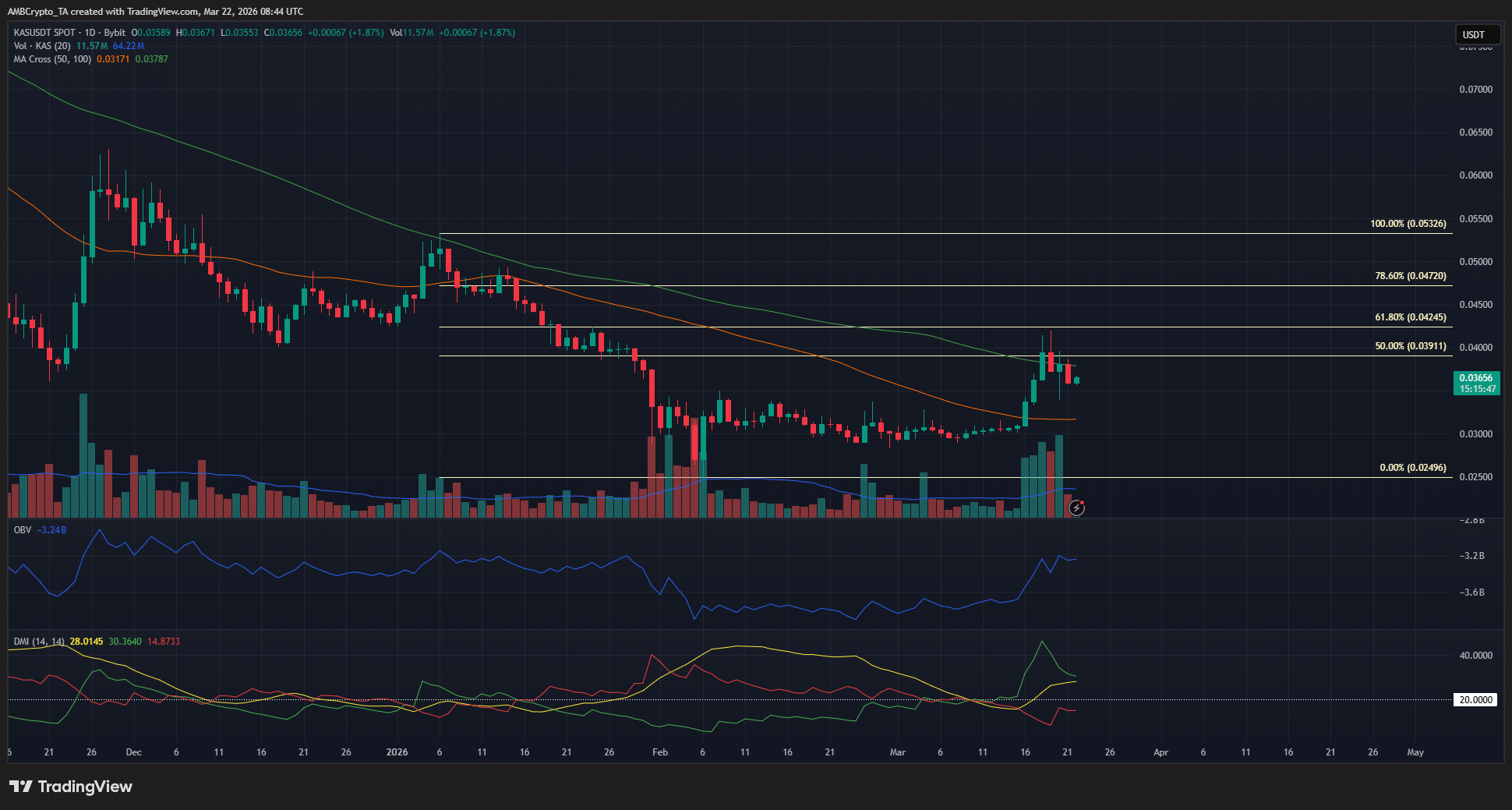
Kaspa seizes altcoin investor attention by breaking its 100-day moving average
Source: KAS/USDT on TradingView

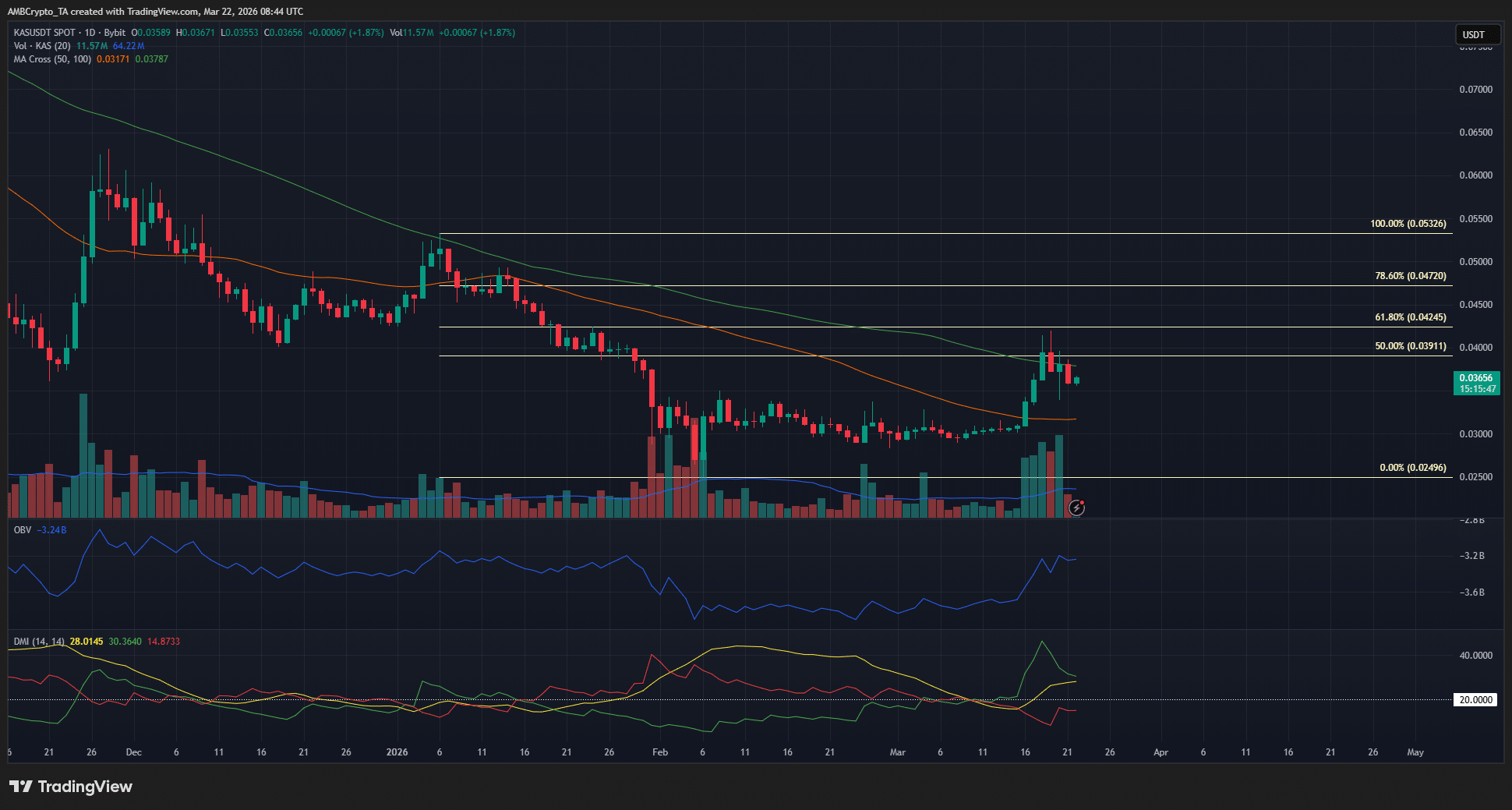
The 1-day timeframe showed that Kaspa has some bullish impetus in recent days. The trading volume soared above the 20-day average on Monday, the 16th of March, and has remained high since then.

The OBV was moving towards new highs, and the DMI showed a strong uptrend in progress as KAS noted a 19.5% rally for the week.

Yet, the price action showed a bearish swing structure. The $0.042-$0.047 was a key resistance zone for the bulls to overcome.

The price has breached the 50- and 100-day moving averages, but these MAs have yet to form a bullish crossover to indicate sustained upward momentum on this timeframe.

DeXe rally reinforces the crypto AI sector’s relative strength

AMBCrypto noted in its previous weekly report that the AI sector market cap growth had been explosive. Popular AI tokens had seen 30% or more gains in a week.

DeXe [DEXE] has continued this trend, with an 18.62% move higher this week.

Some other leading AI sector tokens were unable to maintain their pace, making DeXe’s relative strength even more notable. The $7.4 area was a key supply zone overhead.

River inches closer to breaking past local highs

A recent AMBCrypto report showed that River had established a bullish structure once again. A possible retracement toward $18 in case of a Bitcoin sell-off was expected. The recent selling pressure on BTC did very little to force back the RIVER bulls.

It was likely to break the $28.7 local highs and continue its upward momentum over the coming week.

Other notable winners

Artificial Superintelligence Alliance [FET] was another AI token with a standout weekly performance of 16.55%. FET bulls would continue to be in a strong position so long as prices remain above the $0.2 level.

Quant [QNT] was another winner of the past week, rallying 12.6% this week. It challenged the $80 resistance level but was unable to overcome it on the first try.

Weekly losers

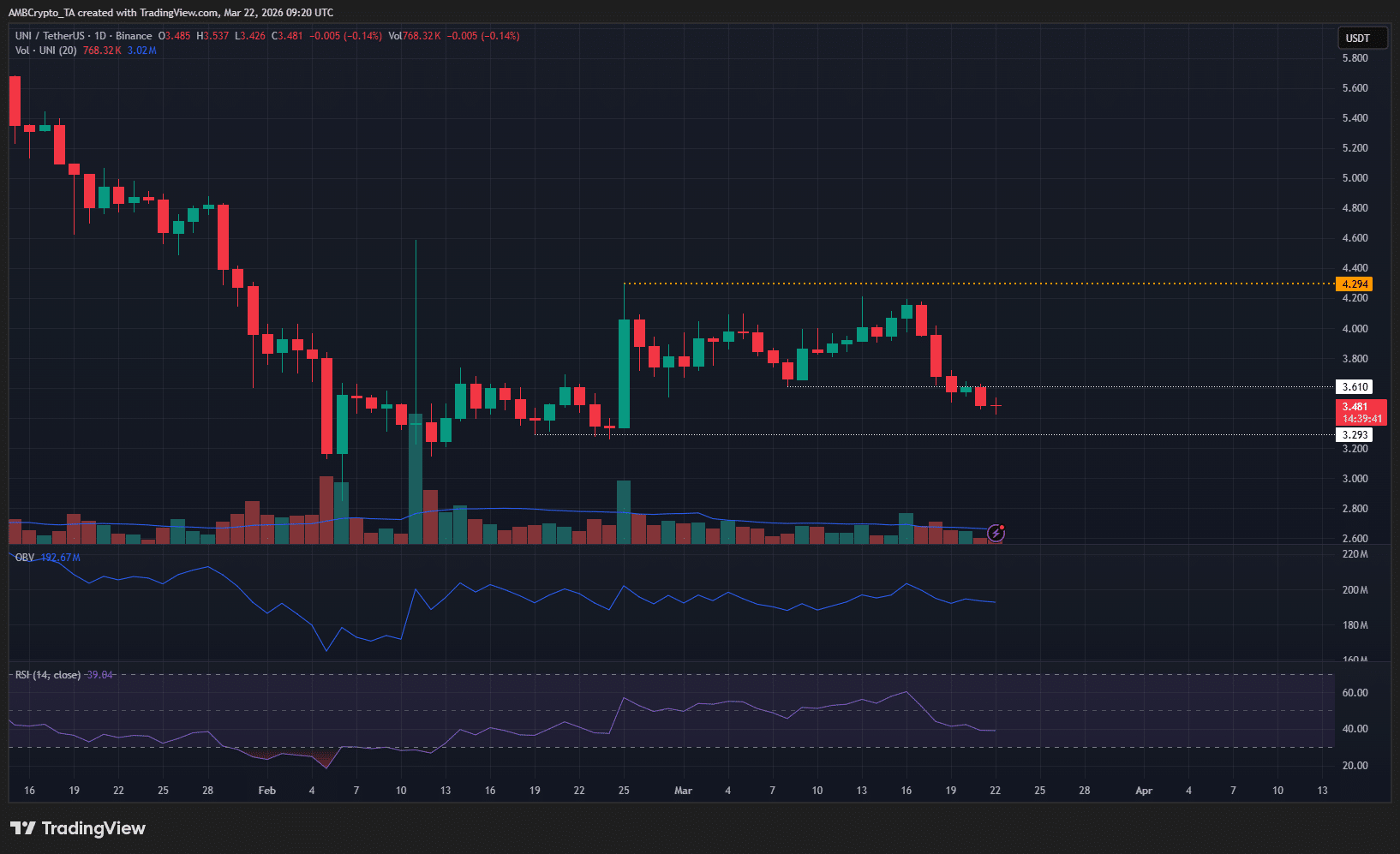
Uniswap is down 12.4% for the week alongside DeFi sector weakness
Source: UNI/USDT on TradingView

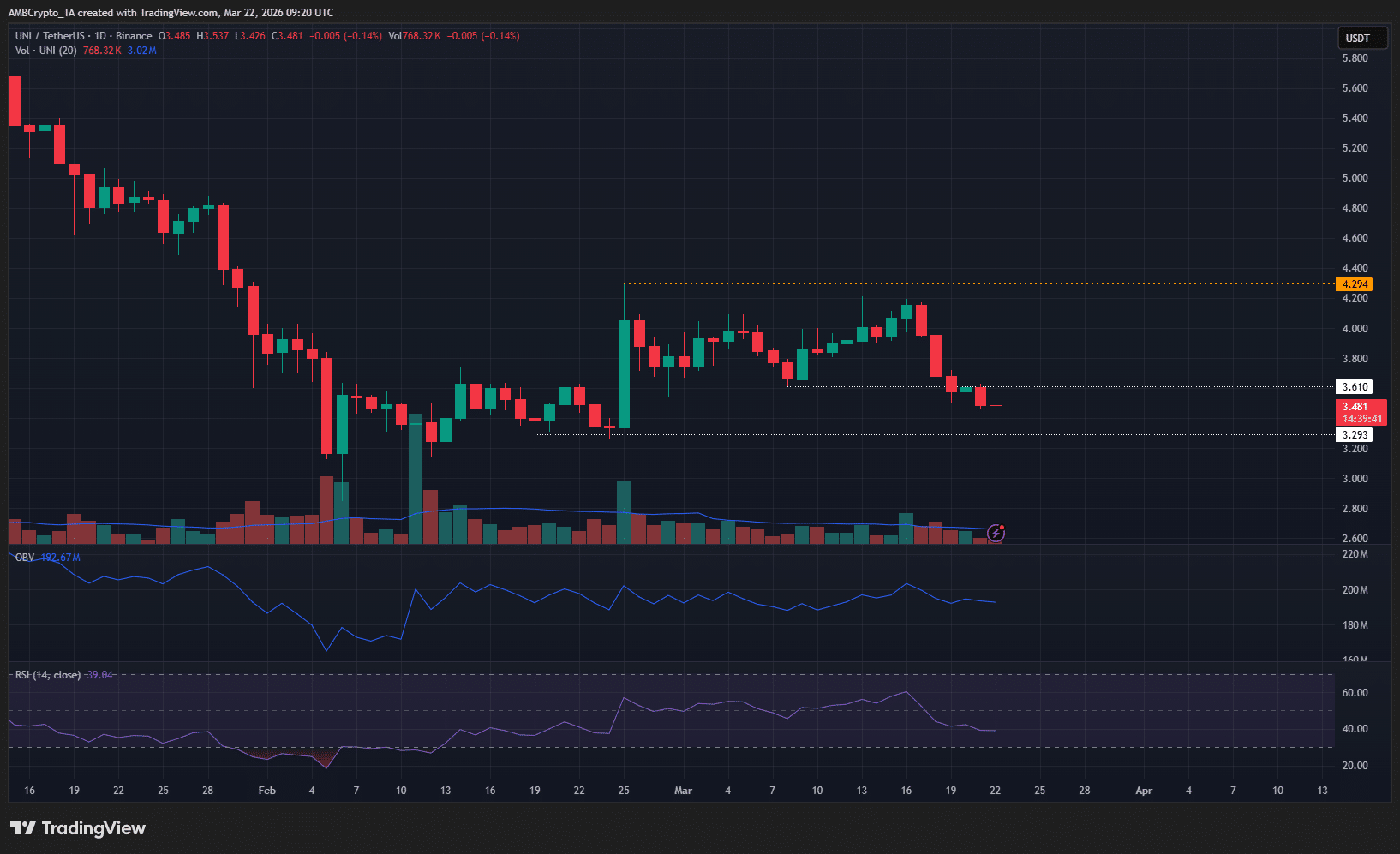
Glassnode data showed that the DeFi sector market capitalization was down 4.5% for the week. Among their leading tokens, UNI was the weakest. A week ago, it was headed toward the $4.29 local high.

The bulls were making steady progress, but this progress was quickly erased. Within a week, the $3.6 support was lost. The RSI has sunk back below the neutral 50 level, and the OBV’s progress has also slowed down.

TRUMP continues to face selling pressure after conference hype

The Official Trump [TRUMP] token was another prominent loser from last week’s trading. It was down nearly 5% in 24 hours and 20.51% for the week. The memecoin’s prices exploded to reach the $4 mark after the Mar-a-Lago crypto conference announcement.

Since then, the longer-term bearish trend has asserted itself once more.

OKB unable to maintain the earlier bullish momentum

OKB, the OKX exchange and gas token, continued to slide down the price charts. Earlier this month, Intercontinental Exchange announced a $25 billion valuation of OKX when unveiling a strategic investment.

This news sent OKB prices soaring past $120, but the move was not sustained. The altcoin was down 31.9% from the $124.2 high. In just the past week, it fell by 12.57%.

Other notable losers

Some of the same suspects made their way into the weekly standout altcoins. Midnight [NIGHT] continued its losing streak with a 16.6% weekly slide.

Render [RENDER] and Internet Computer [ICP] were other popular crypto AI tokens that fell flat over the past week.

The two of them registered a 10.37% and 9.66% weekly loss, respectively.

Geopolitical tensions could make the coming week dreary

Bitcoin was trading in a value area and presented a short-term buying opportunity. If the price can remain above the $65.6k local support, there’s a chance of a recovery beyond $70k.

This could give select altcoins a chance to run higher, especially the ones that have shown relative strength against BTC in recent weeks.


Final Summary

  • The Bitcoin sell-off on Saturday affected some altcoins much worse than others.
  • Kaspa and DeXe were the leading winners this week, while Midnight, TRUMP, and OKB tokens continued their recent slump.


Related Questions

QWhat was the main reason for Bitcoin's price decline over the past week?

AThe threat of escalation in West Asia and its impact on the global economy led to a swift sell-off.

QWhich two altcoins were highlighted as the biggest weekly winners in the article?

AKaspa (KAS) and DeXe (DEXE) were the leading winners.

QWhat key resistance zone did Kaspa (KAS) need to overcome according to the analysis?

AThe $0.042-$0.047 zone was a key resistance area for Kaspa bulls to overcome.

QWhich sector's weakness was specifically mentioned as contributing to Uniswap's (UNI) 12.4% weekly loss?

AThe weakness in the DeFi sector contributed to Uniswap's decline.

QWhat was the primary reason given for the Trump (TRUMP) token's significant price drop?

AThe token faced selling pressure after the initial hype from the Mar-a-Lago crypto conference announcement faded, and the longer-term bearish trend reasserted itself.

Related Reads

WeChat Agent Issues a 'Heroic Summons,' Half of the Internet Responds

WeChat AI Agent is on the horizon. The WeChat Open Platform has issued a guide for developers, offering them ways to integrate into the WeChat AI ecosystem. This will enable mini-programs to be discovered and invoked by the AI. Meituan has already announced its integration, allowing users to access services like food delivery through WeChat AI. Other platforms like Ctrip and Tongcheng have followed suit. Furthermore, WeChat is collaborating with major smartphone manufacturers to enable their native AI assistants to perform actions within WeChat, such as initiating calls or sending messages, through a controlled protocol called Agent-to-Agent (A2A). Reports indicate the WeChat AI Agent will be accessible by swiping right on the main interface. It aims to understand user intent within the rich context of chats, groups, and past interactions, then automatically call upon relevant mini-programs to complete tasks like ordering coffee or booking restaurants. This positions it as a potential "super app" with direct access to WeChat's vast ecosystem of services, social connections, and payment systems. Technically, this is a complex endeavor. It requires advanced natural language understanding, a "world model" to predict interactions within mini-programs (UI-Oceanus), multi-model orchestration for cost efficiency, and careful coordination with millions of third-party service providers. Tencent's development follows a "Co-Design" approach, where product teams and the Hunyuan model team collaborate closely, allowing capabilities honed in other AI products (like Yuanbao for chat, ima for search, WorkBuddy for office tasks) to be transferred to the WeChat Agent. Tencent is strategically opting for the A2A protocol over GUI-based automation (which it has blocked in the past), maintaining control over its ecosystem. To manage the immense scale and cost of serving 1.4 billion monthly active users, Tencent is deepening its ties with DeepSeek, known for its cost-effective training, to secure a low-cost inference backbone. The ultimate goal is to solve practical, everyday problems for users within the WeChat ecosystem, moving beyond technical benchmarks to deliver real utility, which Tencent sees as the key to winning in the long-term AI game.

marsbit4m ago

WeChat Agent Issues a 'Heroic Summons,' Half of the Internet Responds

marsbit4m ago

Humanity Loses $31 Million in Attack, Token Price Plummets 90% Due to a Single Private Key

On June 9th, the digital identity project Humanity Protocol suffered a major security breach resulting in over $31 million in losses. According to on-chain analyst Specter, hundreds of wallets holding the project's H token were drained. The attack was confirmed by founder Terence Kwok to be caused by the compromise of a foundation member's private key. As a precaution, users are advised to avoid interacting with Humanity's cross-chain bridge or liquidity pools. The incident caused the H token price to crash over 90%, from around $0.70 to a low of $0.052, wiping its market cap from $2 billion to approximately $35.7 million. The attacker allegedly minted 100 million new H tokens and is selling them for BNB. This breach adds to existing controversies surrounding Humanity Protocol. Founded in 2024, it aimed to verify human users via palm-print biometrics and zero-knowledge proofs. However, a leaked conversation in 2025 revealed that only about 1 million of its 9 million claimed Human IDs had completed biometric verification, suggesting 88% might be bots. Furthermore, the project has faced allegations of being a repackaged product from a Chinese access control vendor, raising privacy and authenticity concerns. Founder Terence Kwok's previous venture, Tink Labs, a hotel smartphone startup that raised $170 million, failed and entered bankruptcy in 2020 after burning through its funding. The current attack highlights the persistent critical issue of private key management in crypto. Unlike smart contract exploits, a private key compromise bypasses all on-chain security mechanisms. With no user compensation plan announced yet, this $31 million breach may be a final blow to the project's credibility, already weakened by previous controversies and a heavily depreciated token.

marsbit39m ago

Humanity Loses $31 Million in Attack, Token Price Plummets 90% Due to a Single Private Key

marsbit39m ago

MicroStrategy Will Not Die in This Downturn: Reflexivity, STRC Anchoring Back to Par, and the Self-Rescue Logic of "Sell Stock, Not Bitcoin"

This article analyzes the recent sharp decline in Bitcoin and MicroStrategy (MSTR), framing it as a targeted "reflexivity" attack. The trigger was MSTR using its cash reserves to buy back convertible notes, raising market concerns about a liquidity crisis. The playbook follows George Soros's principle: market expectations can shape reality. Fears that MSTR might be forced to sell BTC caused panic selling, lowering BTC's price and worsening MSTR's financial ratios, thus reinforcing the negative narrative. The author argues that MSTR's Structured Convertible (STRC), while falling in price, is a floating-rate security that will eventually return to par value (100). The price drop reflects the market demanding a higher yield due to perceived risk, but as a floating-rate instrument, its coupon can adjust, naturally pulling the price back to par over time. This is crucial for MSTR's continued ability to raise funds. The core thesis is that MSTR's best move to counter the attack is to **issue new equity (sell shares)**, not sell its Bitcoin holdings. While selling BTC would solve the immediate cash crunch, it would destroy the company's core investment thesis and premium. It would dilute the BTC per share, likely erase the market premium over its net asset value (mNAV > 1), and worsen its debt-to-asset ratio. Issuing shares while mNAV is high (e.g., 1.25x) allows MSTR to raise cash for reserves without harming shareholder value or the "perpetual accumulation" narrative. It improves the debt ratio and reassures STRC holders, breaking the negative reflexivity cycle. In conclusion, while MSTR could survive this episode even by selling BTC, doing so would fundamentally alter its investment proposition and weaken it for future cycles. The optimal, value-preserving strategy is to sell equity to rebuild reserves and maintain the long-term growth flywheel.

marsbit39m ago

MicroStrategy Will Not Die in This Downturn: Reflexivity, STRC Anchoring Back to Par, and the Self-Rescue Logic of "Sell Stock, Not Bitcoin"

marsbit39m ago

Humanity Loses $31 Million, a Private Key Causes Token Price to Plunge 90%

On June 9th, the digital identity project Humanity Protocol suffered a major security breach resulting in over $31 million stolen from hundreds of wallets holding its H token. The attack was caused by the compromise of a private key belonging to a foundation member, leading the team to advise users against interacting with its bridge or liquidity pools. Following the incident, the price of the H token plummeted by over 90%, from around $0.70 to a low of $0.052, wiping out a significant portion of its market capitalization. The attacker allegedly minted 100 million new H tokens and began selling them for BNB. Humanity Protocol, founded in 2024, aimed to verify human users through palm-print biometrics and zero-knowledge proofs on Polygon CDK. Despite raising $50 million across two funding rounds and achieving a unicorn valuation, the project faced prior controversies. Shortly after its June 2025 token launch, reports emerged that only about 1 million of its 9 million registered IDs had completed biometric verification, suggesting 88% might be bots. Furthermore, allegations surfaced that the project might be a rebranded "shell" of a Chinese access control company, raising concerns about data privacy and authenticity. The project's founder, Terence Kwok, has a controversial business history. His previous venture, Tink Labs, burned through $170 million in funding before collapsing in 2020. The breach highlights the persistent critical risk of private key management in crypto. With no user compensation plan detailed in the initial response, the incident deals a severe blow to trust in a project already struggling with credibility issues.

Foresight News1h ago

Humanity Loses $31 Million, a Private Key Causes Token Price to Plunge 90%

Foresight News1h ago

Trading

Spot
Futures

Hot Articles

How to Buy DEXE

Welcome to HTX.com! We've made purchasing DeXe (DEXE) simple and convenient. Follow our step-by-step guide to embark on your crypto journey.Step 1: Create Your HTX AccountUse your email or phone number to sign up for a free account on HTX. Experience a hassle-free registration journey and unlock all features.Get My AccountStep 2: Go to Buy Crypto and Choose Your Payment MethodCredit/Debit Card: Use your Visa or Mastercard to buy DeXe (DEXE) instantly.Balance: Use funds from your HTX account balance to trade seamlessly.Third Parties: We've added popular payment methods such as Google Pay and Apple Pay to enhance convenience.P2P: Trade directly with other users on HTX.Over-the-Counter (OTC): We offer tailor-made services and competitive exchange rates for traders.Step 3: Store Your DeXe (DEXE)After purchasing your DeXe (DEXE), store it in your HTX account. Alternatively, you can send it elsewhere via blockchain transfer or use it to trade other cryptocurrencies.Step 4: Trade DeXe (DEXE)Easily trade DeXe (DEXE) on HTX's spot market. Simply access your account, select your trading pair, execute your trades, and monitor in real-time. We offer a user-friendly experience for both beginners and seasoned traders.

3.7k Total ViewsPublished 2024.03.29Updated 2026.06.02

How to Buy DEXE

Discussions

Welcome to the HTX Community. Here, you can stay informed about the latest platform developments and gain access to professional market insights. Users' opinions on the price of DEXE (DEXE) are presented below.

活动图片