Crypto Market Prices the Verdict: $1.8 Billion Bet on Do Kwon's Sentencing Outcome

比推Published on 2025-12-10Last updated on 2025-12-10

Abstract

The cryptocurrency market is witnessing an extraordinary $1.8 billion in futures trading volume for LUNA and LUNA2 tokens, despite their lack of fundamental value. This surge in speculative activity is directly tied to the upcoming sentencing hearing of Terraform Labs co-founder Do Kwon in a New York federal court on December 11th. Prosecutors are seeking a 12-year prison sentence for Kwon’s role in the $40 billion Terra-LUNA collapse, while his defense team is arguing for a 5-year term. This 7-year discrepancy has created a high-stakes betting environment. The market is characterized by extreme divergence, with a high volume of short positions (indicated by negative funding rates) and a powerful counter-force of buyers attempting to squeeze those shorts. The article argues that the current LUNA traders are not the original victims of the crash but are now primarily event-driven speculators, quantitative funds, and opportunistic traders. For them, LUNA has been transformed from a failed project into a pure "legal derivative," a volatile instrument whose price is entirely driven by the legal outcome of Kwon's case, devoid of any fundamental anchor. The author concludes that regardless of the sentencing outcome—whether a harsh or light sentence—the event's conclusion will likely cause LUNA's price to collapse. A harsh sentence would reaffirm its zero fundamental value, while a light sentence would trigger a "sell the news" event. This situation exemplifies the crypto market'...

Author: David, TechFlow

Original Title: On the Eve of Do Kwon's Sentencing, $1.8 Billion Is Betting on His Prison Term


As of the evening of December 10th, you might not have noticed, but the contract data for LUNA tokens is absolutely staggering.

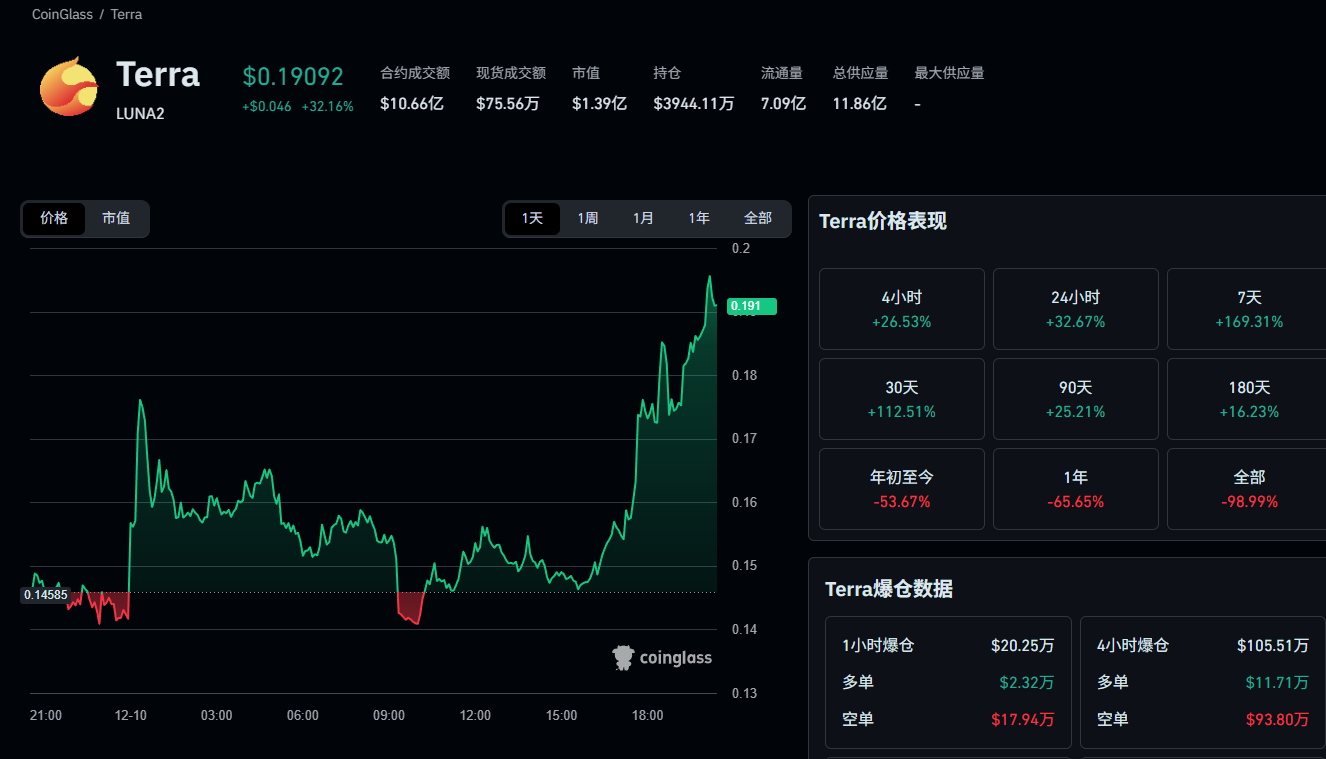
Without any technical upgrades or positive news about its ecosystem, the combined 24-hour trading volume for LUNA series contracts (including LUNA and LUNA2) across the entire market has approached $1.8 billion.

And LUNA itself has surged 150% in the past week.

For comparison, the combined trading volume of LUNA and LUNA2 now ranks within the top ten for contract trading volume across the entire market, just behind HYPE's $1.88 billion.

Their funding rates are -0.0595% and -0.0789%, respectively.

Such high negative funding rates indicate the market is not only crowded but also in a state of extreme divergence: a significant amount of capital is shorting, while an even larger pool of capital is using this crowding to force a short squeeze.

We all know LUNA has little fundamental value left. This $1.8 billion in liquidity is essentially trading a bet on an imminent outcome:

Tomorrow, December 11th at midnight (24:00), the once "Stablecoin King" Do Kwon will face his final sentencing hearing in Courtroom 1305 of the U.S. District Court for the Southern District of New York.

The market is placing real-money bets on the prison sentence of this crypto magnate from the last cycle.

Sentence Could Be Long or Short, Speculation Never Rests

To understand this $1.8 billion in contract volume, one needs to look at the current real progress of this case.

For most people, the name Do Kwon faded from view after the epic collapse in 2022.

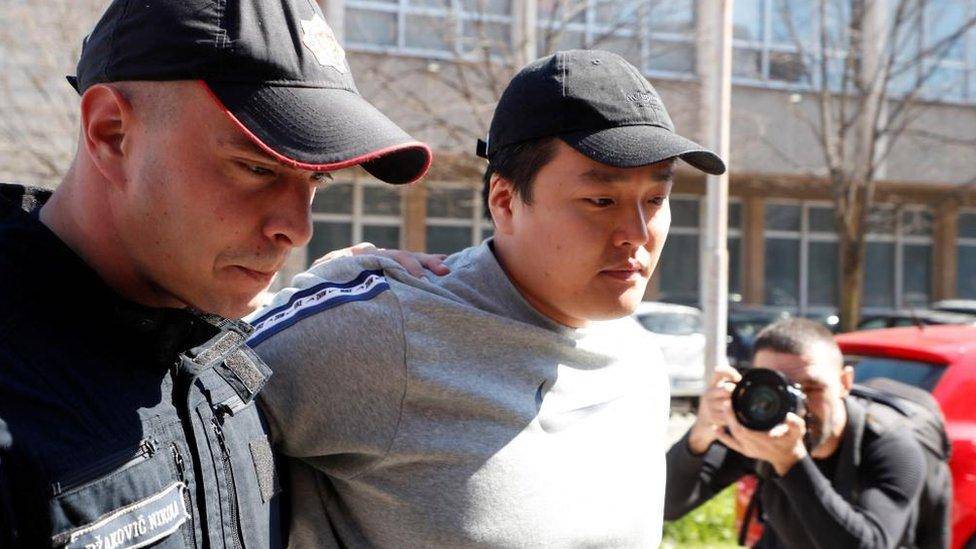
But in fact, this former crypto tycoon was extradited to New York, USA, by the end of 2024. And in August of this year, he formally pleaded guilty in Manhattan federal court to multiple charges, including securities fraud.

Tomorrow's hearing is not a debate about "guilty or not guilty," but the final ruling on the length of the sentence. According to the latest court documents, there is a vast chasm between the sentencing recommendations of the prosecution and defense:

The prosecution is pushing for 12 years in prison.

The U.S. Attorney's Office is taking a hard line, citing the tens of billions in losses from Terra's collapse and Do Kwon's fraudulent behavior regarding the false on-chain' status of the Chai payment application before the crash.

From the market's perspective, 12 years represents a definitive end. At 4-year crypto cycles, that's three full cycles without Do Kwon.

The defense is requesting 5 years in prison.

The defense team is playing the "sympathy card," emphasizing that Do Kwon has already been detained in Montenegro for some time, pleaded guilty in good faith, and cooperated with the SEC's penalty enforcement.
A 7-year gap is more than enough to fuel a day of speculation and capital games around the LUNA token.

The normal logic would be that if the founder gets a heavy sentence, the LUNA token is one step closer to zero. Hence the market is flooded with short positions, reflected in the negative funding rate.

But the main capital, or the whales, don't necessarily need to believe that Do Kwon will actually get a light 5-year sentence. They just need to exploit this sentencing uncertainty, pump the price in the opposite direction, and hunt the overly crowded shorts.

This might also explain why LUNA surged on the eve of Do Kwon's sentencing. The market isn't celebrating justice; it's speculating on the verdict itself.

With the crypto market lacking major catalysts and generally weak, tomorrow's hearing creates one of the few sources of localized volatility.

From Victims to Predators

Wake up, it's 2022 again.

If we had looked at LUNA's holder distribution chart in May 2022, we would have seen a much more tragic picture:

It was crowded with Korean retail investors who lost their life savings, crypto funds that suffered heavy blows, and speculators trying to buy the dip only to be buried. Trading then was filled with anger, despair, and irrational attempts to recoup losses.

Three years later, the market's microstructure has undergone a complete blood transfusion.

The victims from back then have long since sold at a loss. Sitting across the table now are perhaps entirely different participants. Think high-frequency quant teams, event-driven hedge funds, and speculators专门 hunting "junk assets."

For these new players, questions like whether Do Kwon is innocent or if the Terra ecosystem has a future are not only irrelevant but noise. The only metric they care about is Event Beta—the sensitivity of the asset's price to specific legal news.

In this context, LUNA's asset attributes have morphed into a derivative instrument centered around legal proceedings, much like how the fluctuations of certain Meme coins revolve around the actions of a public figure.

This represents an extremely brutal maturation of the crypto market. Death or imprisonment can itself be "monetized."

The current trading in LUNA, and even many other shell tokens, is essentially disaster pricing. The main capital knows full well the fundamentals are zero. But as long as there is divergence, as long as there is room for long-short博弈 (game theory/competition), this "empty shell" is a perfect trading target.

One could even argue that it is precisely the lack of a fundamental anchor that allows the token's price volatility to become unconstrained, dictated solely by sentiment.

It also echoes the saying that most tokens in the crypto market are essentially memes.

Pricing Everything

After the verdict is announced tomorrow, whether Do Kwon hears "5 years" or "12 years," the outcome for LUNA as a trading instrument will likely be the same.

Once the event is over, the token will probably become stagnant again; not only can bad news kill the momentum, but certain good news can too.

If the sentence is heavy, logic returns to fundamentals, and the price goes to zero. If the sentence is light, it's "Sell the News," and profit-takers will exit like a receding tide.
Objectively speaking, LUNA is actually a great lens for observation.

It once reflected a technological narrative of an algorithmic stablecoin, and now it reflects an extremely mature and cold-blooded side of this market.

The current crypto market can efficiently repackage even a dead token and a convicted founder into chips for the gambling table, as long as there's a shred of news value left.

The efficiency of liquidity in the crypto market has evolved to an extreme. It can price anything: sentiment, bugs, memes... and certainly a person's freedom and the delivery of justice.

In the face of such extreme efficiency, moral judgment seems somewhat superfluous.

Do Kwon's future life might be spent sadly in prison, but the crypto market knows no sadness—only volatility yet to be priced.


Twitter:https://twitter.com/BitpushNewsCN

Bitpush TG Discussion Group:https://t.me/BitPushCommunity

Bitpush TG Channel: https://t.me/bitpush

Original link:https://www.bitpush.news/articles/7594619

Related Questions

QWhat is the total 24-hour trading volume of LUNA series contracts (including LUNA and LUNA2) mentioned in the article, and what does this high volume represent?

AThe total 24-hour trading volume for LUNA series contracts is nearly $1.8 billion. This high volume represents a massive speculative bet on the outcome of Do Kwon's sentencing hearing, rather than any fundamental value or positive news about the token.

QWhen is Do Kwon's final sentencing hearing scheduled, and what are the contrasting prison term recommendations from the prosecution and defense?

ADo Kwon's final sentencing hearing is scheduled for December 11th at 24:00. The prosecution is advocating for a 12-year prison sentence, while the defense is requesting a 5-year sentence.

QAccording to the article, what do the highly negative funding rates for LUNA contracts indicate about the market's sentiment?

AThe highly negative funding rates indicate that the market is extremely crowded with short positions and is in a state of extreme divergence, with a large amount of capital shorting the asset while an even larger force of capital is using this crowding to execute a short squeeze.

QHow has the market's composition trading LUNA changed since the 2022 crash, as described in the article?

ASince the 2022 crash, the market's composition has completely changed. The original victims (retail investors, crippled funds) have largely sold their positions and left. The current participants are likely high-frequency quant teams, event-driven hedge funds, and speculators hunting 'junk assets,' who are indifferent to the project's fundamentals and only care about 'Event Beta'.

QWhat is the expected price outcome for LUNA after the sentencing announcement, regardless of whether the sentence is light or heavy?

ARegardless of whether the sentence is light or heavy, the price of LUNA is expected to become stagnant again after the sentencing announcement. If the sentence is heavy, the price will return to its fundamental value of near zero. If the sentence is light, it will be a 'sell the news' event where profit-taking will cause the price to plummet.

Related Reads

The Shutdown of Claude Mythos Revealed the True Cost of Renting AI to Me

The sudden shutdown of Claude Mythos this week starkly highlights a critical, often overlooked risk for founders: when your core capability relies entirely on someone else's platform, your fate is not in your own hands. The key question becomes: who truly owns the intelligence your product depends on? For years, the debate around open-source models focused on cost. Now, the evidence is clear: fine-tuned open-source models can achieve frontier-level quality for specific, mission-critical tasks at a fraction of the cost. However, the deeper issue is control. Relying on a third-party API is like renting; it works until the landlord changes the rules, raises the rent, or asks you to leave—as Mythos experienced. The lesson is not to stop using frontier models—they are incredible infrastructure. The goal is ownership. Ownership means starting with a powerful open-source model and shaping it around what makes your company unique: your data, workflows, domain expertise, and definition of "good." Over time, the model becomes less generic and more reflective of your business, creating durable value. The optimistic conclusion is that AI's future doesn't hinge on one superior model. There is no single frontier. The frontier includes proprietary models, models fine-tuned on company-specific knowledge, specialized models for narrow problems, and intelligent routers orchestrating model ensembles. The most interesting development is not models getting smarter, but intelligence becoming increasingly customizable. The winning companies will be those that transform intelligence into a unique, owned asset. Looking ahead, the vision is not one model dominating all, but many teams owning the part of the frontier that matters most to them.

marsbit4m ago

The Shutdown of Claude Mythos Revealed the True Cost of Renting AI to Me

marsbit4m ago

Tiger Research: U.S. Strategic Bitcoin Reserve - Should the Market Be Happy or Disappointed?

Tiger Research analyzes the evolution of U.S. legislative efforts regarding a strategic Bitcoin reserve, concluding the market impact is limited in the short term but potentially positive long-term. The core event was a March 2025 executive order by former President Trump, which designated confiscated Bitcoin as a strategic reserve and promised not to sell existing holdings (approx. 190k BTC). As it contained no mandate to purchase new Bitcoin, the market reacted negatively, with prices dropping 5.7%. Legislative history shows a significant retreat from initial ambitions. The 2024 "BITCOIN Act" proposed mandatory purchases of 1 million BTC over five years. Reintroduced in 2025, it stalled due to high fiscal costs, concerns over dollar hegemony, and opposition from the Treasury Secretary. The current frontrunner, the 2026 "American Retirement and Monetary Advancement (ARMA) Act," is a compromise. It lacks any purchase requirement, instead focusing on consolidating existing government-held Bitcoin and legally prohibiting its sale for at least 20 years. While ARMA has higher passage odds due to bipartisan support and no purchase mandate, its immediate market effect is neutral. It eliminates potential government selling pressure but creates no new demand. The long-term significance is that formally establishing Bitcoin as a national reserve asset in law could later reignite debates on mandatory purchases. Therefore, the path to a government buyer is longer than initially priced by the market, but the directional narrative remains intact.

marsbit7m ago

Tiger Research: U.S. Strategic Bitcoin Reserve - Should the Market Be Happy or Disappointed?

marsbit7m ago

US Stock Market Trend (June 16): SpaceX Rises 42% in Two Days, New Fed Chairman Takes Office Today

**U.S. Stocks Trend (June 16): SpaceX Soars 42% in Two Days, New Fed Chair Takes Office Today** Markets surged on Monday following former President Trump's social media announcement of a completed U.S.-Iran deal to reopen the Strait of Hormuz, pending a June 19 signing. The news triggered a broad risk-on rally: oil prices crashed, tech stocks soared, bond yields fell, and defensive sectors lagged. **Market Performance:** The Nasdaq jumped 3.07%, led by semiconductor stocks like Micron (+9.2%). The S&P 500 gained 1.65%, and the Dow rose 0.92% to a record high. However, the Russell 2000 small-cap index underperformed (+0.72%). SpaceX continued its hot streak, rising another 5% pre-market after disclosures of large buys by an Australian billionaire and Cathie Wood's ARK. Boeing also rallied on the transportation optimism. Conversely, energy stocks like Chevron fell over 3% on the oil price plunge, with other defensive sectors also selling off. The day's action showed a clear rotation of funds from energy/defensive plays into AI and tech narratives. **Macro & Outlook:** The VIX fear index fell 8.37%. Treasury yields declined, and WTI crude dropped over 5%. Attention now shifts to a packed schedule: the Bank of Japan is widely expected to hike rates to 1.0% on Tuesday. The Fed's June meeting concludes Wednesday, marking new Chair Wash's debut. While rates are expected to hold, his tone on stubborn inflation and the "dot plot" will be crucial for gauging the 2024 rate path. The formal Iran deal signing is set for Friday. **Trend Perspective:** While the peace deal is a genuine positive, Monday's explosive rally may have gotten ahead of itself, pricing in a swift resolution to inflation concerns. The shortened trading week faces a triple test: BoJ tightening, the Fed's policy stance, and deal implementation details. Tech and semiconductors, which led the surge, remain vulnerable to any disappointment from these key events. The real price discovery begins with the central banks' communications this week.

marsbit28m ago

US Stock Market Trend (June 16): SpaceX Rises 42% in Two Days, New Fed Chairman Takes Office Today

marsbit28m ago

Xiaohongshu's Second Great Voyage, This Time Sailing Towards AI

Xiaohongshu's Second Voyage: Navigating Towards AI Since ChatGPT's emergence, Xiaohongshu's founder Mao Wenchao has been acutely aware of AI's potential threat, recognizing that the life advice people seek from chatbots overlaps directly with his platform's core business. Founded in 2013 as a PDF shopping guide for Chinese tourists, Xiaohongshu evolved into a massive community where millions share authentic, personal experiences—from product reviews to travel tips. This vast repository of "I've tried this" human judgment became its most valuable asset. However, the rise of AI, which delivers instant answers, challenges the very need for users to sift through numerous personal notes. Fearing its treasure trove of lived experience could become mere training data for others, Xiaohongshu is proactively adapting. In 2026, it established a dedicated AI division (Dots), launched RED Skill to turn user experiences into usable AI tools, and acquired the AI search product "Diandian." Its investments now extend to AI firms like MiniMax and hardware startups, moving upstream to address needs before they even become search queries. The platform's commercialization strategy is also evolving. With a newly acquired payment license and tools like the AIPS model to track consumer decision journeys, Xiaohongshu aims to seamlessly integrate recommendations with transactions, embedding commerce within AI-generated answers. Yet, a critical tension remains. While building smarter machines to organize and leverage its human experiences, Xiaohongshu must prevent AI from drowning out the authentic, flawed, and trustworthy "I've tried this" voices that built its community. Its core challenge is to harness AI's power without letting the map—the machine's perfect, synthesized answer—replace the territory of genuine human experience. This balance between technological advancement and preserving human trust defines its current journey and its future.

marsbit1h ago

Xiaohongshu's Second Great Voyage, This Time Sailing Towards AI

marsbit1h ago

Trading

Spot
Futures

Hot Articles

Discussions

Welcome to the HTX Community. Here, you can stay informed about the latest platform developments and gain access to professional market insights. Users' opinions on the price of S (S) are presented below.

活动图片















