Crypto market ‘isn’t scared enough’ to call a bottom yet: Santiment

cointelegraphPublished on 2025-12-21Last updated on 2025-12-21

Abstract

According to Santiment founder Maksim Balashevich, the crypto market has not yet shown sufficient fear on social media to confirm a bottom, suggesting Bitcoin could still drop to around $75,000. He noted that widespread optimism about a near-term reversal contradicts typical bottom formation sentiment. Despite this outlook, the Crypto Fear & Greed Index has been in "Extreme Fear" territory since mid-December. Other analysts offer mixed predictions, with Fidelity’s Jurrien Timmer warning of a potential decline to $65,000 in 2026, while Bitwise’s Matt Hougan remains bullish. Market indicators show conflicting signals, including risk-off positioning among traders.

Crypto traders have not yet shown enough fear on social media to confirm a market bottom, according to a crypto analyst who suggested Bitcoin could still slide to around $75,000.

“It looks very tempting to come even closer to it,” crypto market sentiment platform Santiment founder, Maksim Balashevich, said on a video published to YouTube on Friday.

A move to that level would represent an approximate 14.77% drop from Bitcoin’s (BTC) current price of $88,350, according to CoinMarketCap.
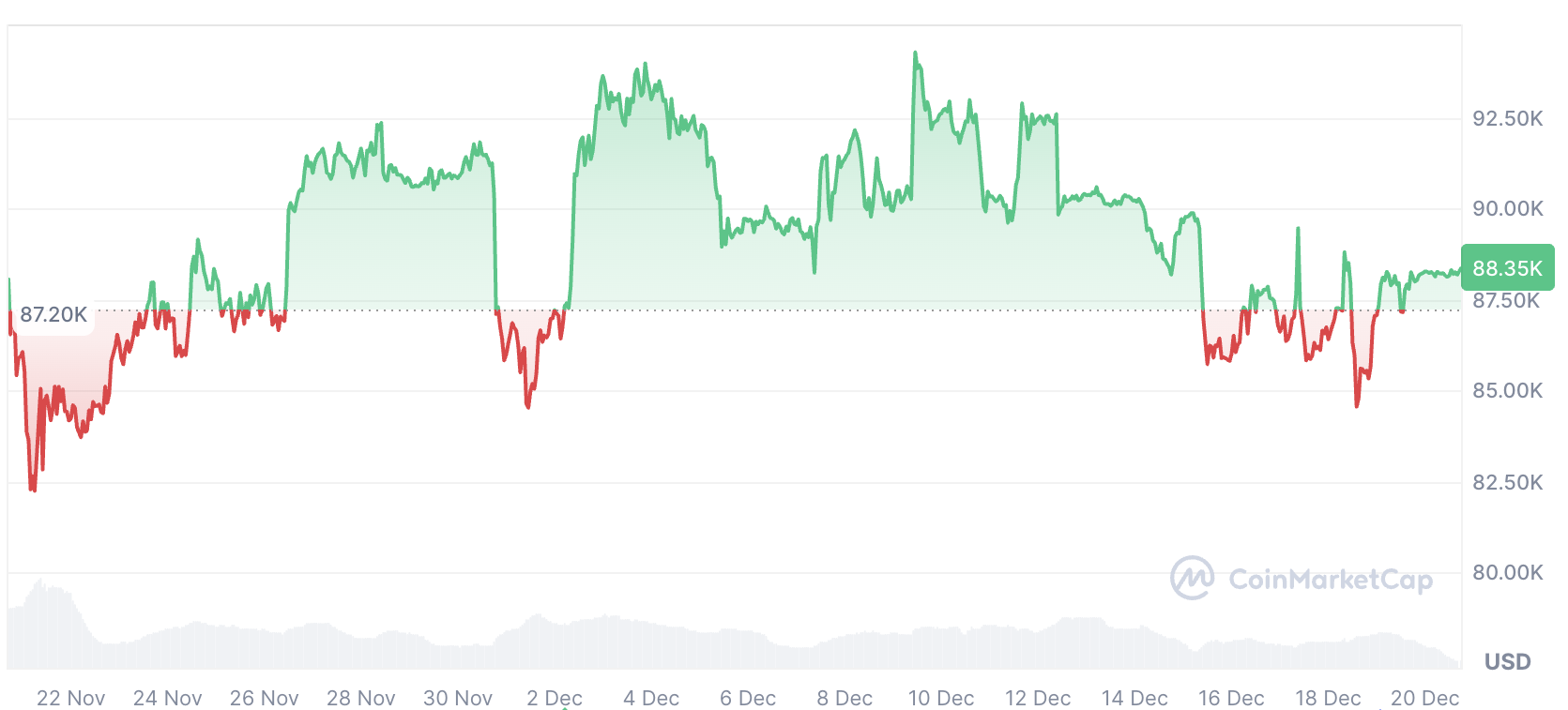
Bitcoin is up 1.81% over the past 30 days. Source: CoinMarketCap

Balashevich explained that his hesitation comes from observing significant optimism online that the downtrend will reverse in the near term, which he said is not usually the case when a true market bottom is forming.

“The crowd isn't scared enough for a bottom,” Santiment said in a report on the same day.

Overly optimistic comments are “not what I want to see,” says Balashevich

“In one particular crowd-dominated or retail-dominated channel, they’re mostly discussing Bank of Japan cut rates, and bears got caught, and now we’ll continue up from here,” he said.

“These kinds of statements are not what I want to see,” he said, adding that if the circumstances were different, he would be “very confident” in calling a market bottom.

Japan’s central bank pushed interest rates to a 30-year high of 0.75% on Friday, a move that has previously been associated with roughly 20% corrections in Bitcoin.

However, Balashevich said a move down to this price level would potentially provide a “very good setup” for traders.

On Thursday, Jurrien Timmer, Fidelity’s director of global macro research, said that Bitcoin could take a “year off” in 2026, with the price potentially falling to around $65,000.

Other analysts, such as Bitwise chief investment officer Matt Hougan, are forecasting 2026 to be an “up year” for Bitcoin.

Crypto market indicators conflict with Balashevich’s outlook

While Balashevich is not convinced that the market has yet reached its bottom, crypto market indicators suggest otherwise.

The Crypto Fear & Greed Index, which measures overall crypto market sentiment, has been lingering in “Extreme Fear” territory since Dec. 14. On Sunday, the Index posted an “Extreme Fear” score of 20.

Related: Bitcoin institutional buys flip new supply for the first time in 6 weeks

Other indicators are suggesting risk-off positioning among crypto traders.

The Altcoin Season Index, which measures the performance of the top 100 altcoins relative to Bitcoin over the past 90 days, posted a “Bitcoin Season” reading of 17 out of 100 on Saturday.

Magazine: Big questions: Would Bitcoin survive a 10-year power outage?

Trending Cryptos

Related Questions

QAccording to Santiment, why hasn't the crypto market bottomed out yet?

ABecause crypto traders have not shown enough fear on social media, and there is significant optimism that the downtrend will reverse, which is not typical when a true market bottom is forming.

QWhat price level does Santiment's founder suggest Bitcoin could potentially drop to?

ABitcoin could still slide to around $75,000, which would represent an approximate 14.77% drop from its current price of $88,350.

QWhat event does Balashevich mention as being discussed optimistically by retail traders, and why is he concerned?

ARetail traders are optimistically discussing the Bank of Japan's rate cut, believing the market will continue upward. Balashevich is concerned because such optimism is not what he wants to see for a market bottom confirmation.

QWhat does the Crypto Fear & Greed Index indicate about current market sentiment?

AThe Crypto Fear & Greed Index has been in 'Extreme Fear' territory since December 14, with a score of 20 on Sunday, indicating high fear among traders.

QWhat conflicting indicator is mentioned regarding Balashevich's outlook on the market bottom?

AThe Crypto Fear & Greed Index shows 'Extreme Fear,' which conflicts with Balashevich's view that there isn't enough fear to call a bottom, as extreme fear typically aligns with potential market bottoms.

Related Reads

From Transaction Fees to Stablecoins: The Revenue Drivers and Economic Moats Behind Web3 Business Models

"From Transaction Fees to Stablecoins: Revenue Drivers and Moats in Verified Web3 Business Models" This analysis explores five established Web3 revenue models, examining their drivers and long-term sustainability. 1. **Transaction Fees**: This model is highly cyclical, with income tied to market activity and user risk appetite (formula: volume × fee rate). Growth depends on expanding the market, gaining market share, and maintaining stable fees amid intense competition. 2. **Stablecoin Reserve Yield**: Revenue stems from the scale of issued stablecoins and the interest earned on their underlying reserves (like US Treasuries). While predictable with strong moats (high user migration costs), growth is tied to adoption as on-chain dollar infrastructure and is sensitive to interest rate cycles. 3. **Funding Rate Arbitrage & Lending Spreads**: Protocols like Aave and Ethena profit from capital supply-demand imbalances. Similar to transaction fees, this model is cyclical and driven by user leverage demand during bullish market phases. 4. **Block Space Sales**: Chains sell computational resources (formula: demand × gas price). A key challenge is the ongoing decline in gas fees due to technological advances and competition among L1s and L2s. Future viability hinges on whether demand growth can offset falling unit prices. 5. **Protocol-Level Service Fees**: Similar to SaaS, this model involves charging other protocols for essential services (e.g., oracles like Chainlink). Revenue scales with ecosystem adoption. The primary moat is high switching costs once integrated, making market leadership crucial. In summary: Transaction fees and funding spreads are highly cyclical. Stablecoin yields and protocol services build strong, durable moats. Block space sales face the structural challenge of perpetually declining unit revenue despite growing demand.

marsbit1h ago

From Transaction Fees to Stablecoins: The Revenue Drivers and Economic Moats Behind Web3 Business Models

marsbit1h ago

Trading

Spot

Hot Articles

How to Buy CAP

Welcome to HTX.com! We've made purchasing Cap (CAP) simple and convenient. Follow our step-by-step guide to embark on your crypto journey.Step 1: Create Your HTX AccountUse your email or phone number to sign up for a free account on HTX. Experience a hassle-free registration journey and unlock all features.Get My AccountStep 2: Go to Buy Crypto and Choose Your Payment MethodCredit/Debit Card: Use your Visa or Mastercard to buy Cap (CAP) instantly.Balance: Use funds from your HTX account balance to trade seamlessly.Third Parties: We've added popular payment methods such as Google Pay and Apple Pay to enhance convenience.P2P: Trade directly with other users on HTX.Over-the-Counter (OTC): We offer tailor-made services and competitive exchange rates for traders.Step 3: Store Your Cap (CAP)After purchasing your Cap (CAP), store it in your HTX account. Alternatively, you can send it elsewhere via blockchain transfer or use it to trade other cryptocurrencies.Step 4: Trade Cap (CAP)Easily trade Cap (CAP) on HTX's spot market. Simply access your account, select your trading pair, execute your trades, and monitor in real-time. We offer a user-friendly experience for both beginners and seasoned traders.

345 Total ViewsPublished 2026.06.26Updated 2026.06.26

How to Buy CAP

What Is TradFi

TradFi (Traditional Finance) refers to a centralized financial system dominated by banks, securities exchanges, asset management firms, and regulatory institutions.

28.3k Total ViewsPublished 2026.07.01Updated 2026.07.01

What Is TradFi

Discussions

Welcome to the HTX Community. Here, you can stay informed about the latest platform developments and gain access to professional market insights. Users' opinions on the price of A (A) are presented below.

活动图片