Aave launches Stable Vaults—but can AAVE extend its rally?

ambcryptoPublished on 2026-07-11Last updated on 2026-07-11

Abstract

DeFi protocol Aave introduced Stable Vaults, allowing fintechs and payment providers to embed fixed-rate stablecoin yields. The announcement, alongside record deposit numbers from the Aave V4 upgrade, boosted the AAVE token, with its price and trading volume rising. Technical analysis, however, suggests caution. While a short-term rally towards the $100-$106 resistance zone is possible, the higher-timeframe trend remains bearish. A move above the key $118.87 level would signal a bullish shift; until then, the current upward momentum might be a trap for buyers.

In a blog post on Thursday, July 9, DeFi giant Aave [AAVE] introduced Stable Vaults. This infrastructure allows fintechs, wallets, exchanges, and payment providers to embed fixed-rate stablecoin yield into their products.

Possible use cases include neobank embedded savings powered by Aave market, and a payments company letting merchants earn on idle settlement balances, among others, according to the announcement.

The Aave V4 upgrade also drew record deposit numbers, AMBCrypto reported. This has given the AAVE token a positive jolt. The daily trading volume of the token was up 14.5%, and the price was up by just under 3.5% in the past 24 hours.

Here’s why this momentum might be able to push prices another 12% higher.

Should investors buy the Aave move beyond $100?

In short, buyers might be on the wrong side in this battle. Here’s why.

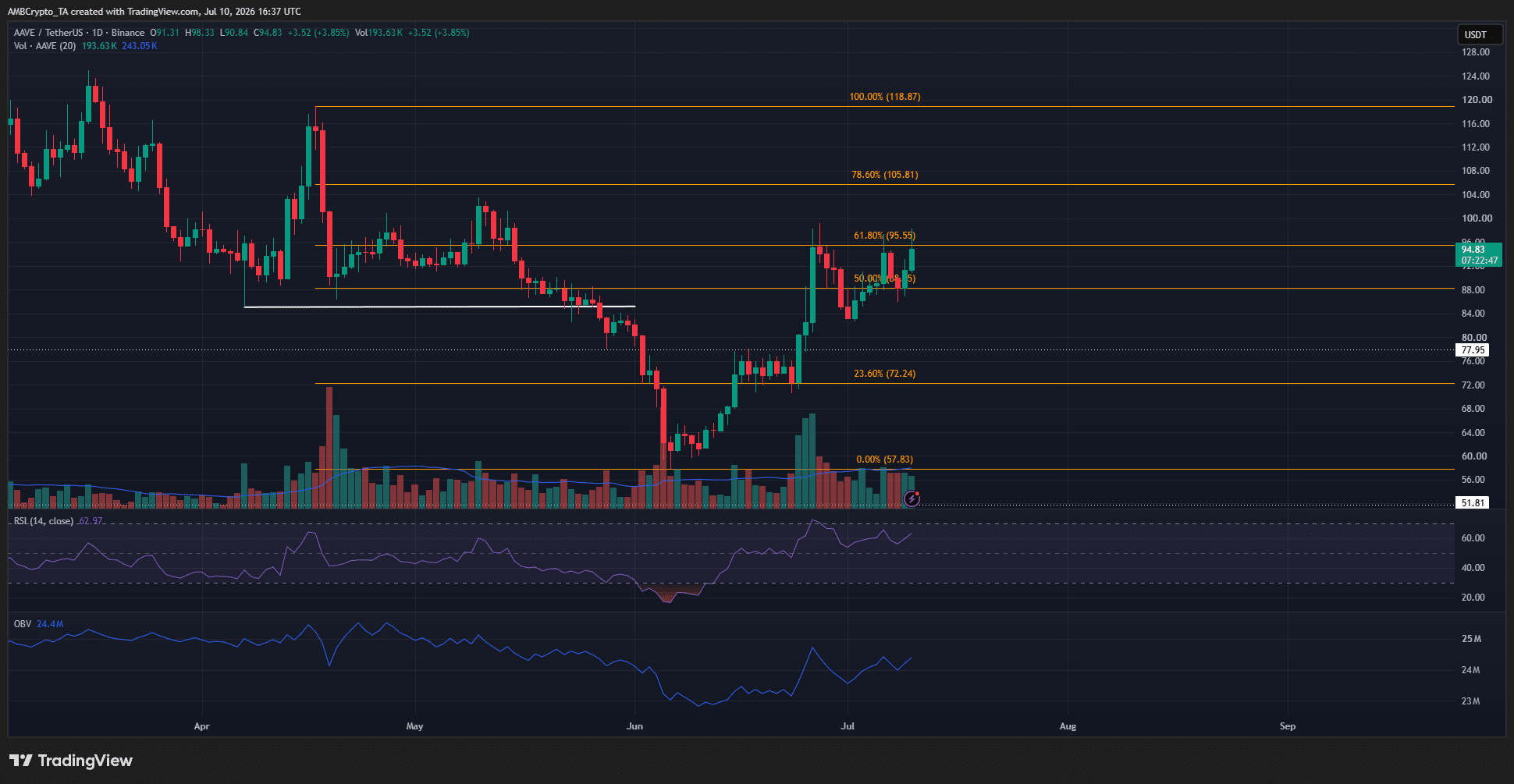
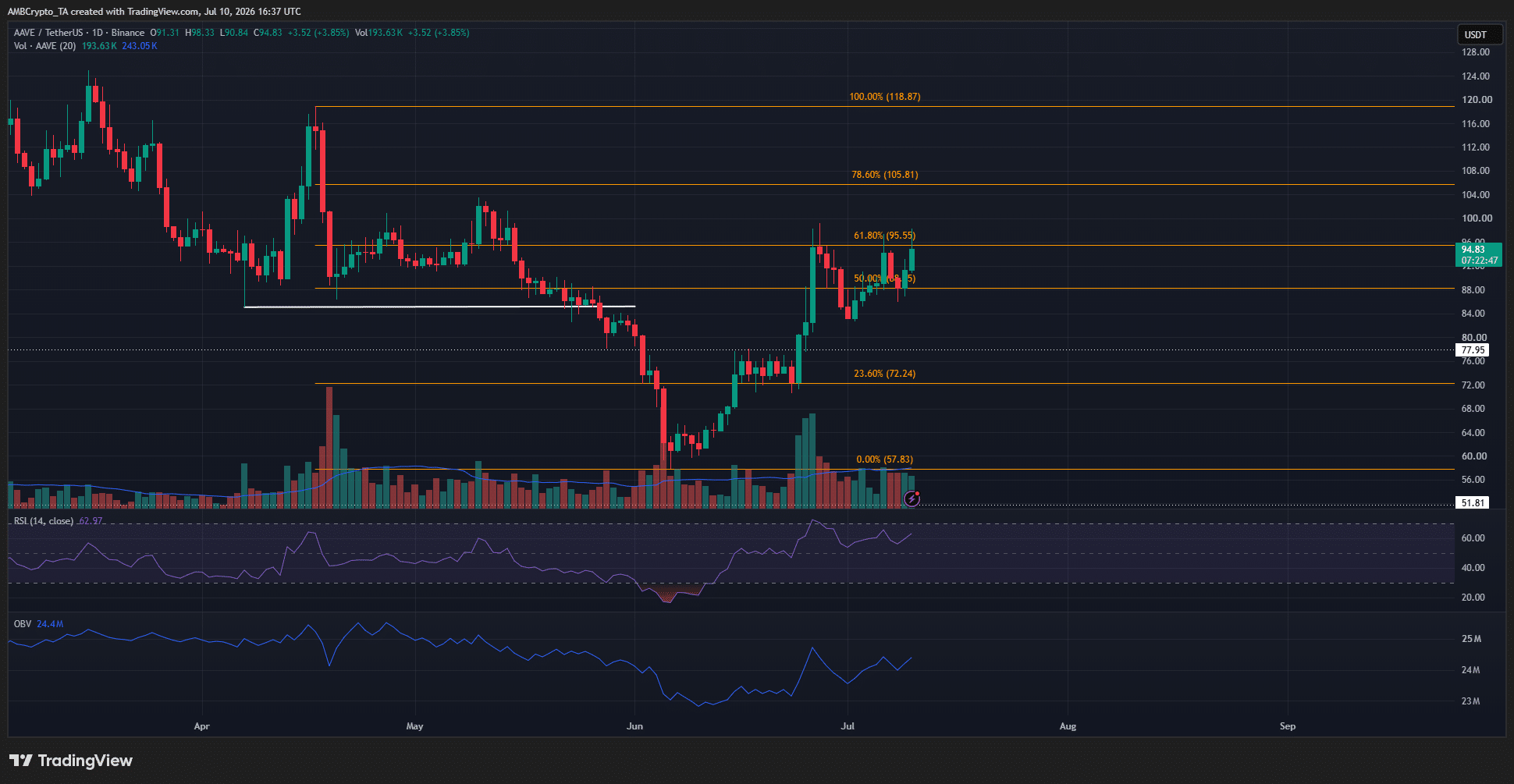
Source: AAVE/USDT on TradingView

The 1-day chart showed a bearish swing structure in place. A bearish continuation was established in May, when Aave prices slid below the swing low at $85.05 to reach a new low of $57.83.

This downward impulse move was used to plot a set of Fibonacci retracement levels [orange]. At the time of writing, AAVE bulls were battling against the 61.8% retracement level at $95.55.

This resistance was also just below the $100 round-number resistance. On one hand, it appeared that a breach of this level would be bullish confirmation.

Traders’ call to action- Watch out for a trap

Such a rally could prove to be a bullish trap if AAVE fails to reclaim the higher-timeframe resistance levels. The trend on the higher timeframes, such as daily and weekly, were firmly bearish. A continued move up to $105.81, the 78.6% retracement level, is possible.

This is the trap traders and investors should watch out for. Short-term holders might want to use this bounce to exit at a profit.

If the rally continues and breaks the $118.87 swing high, a bullish structural shift would have occurred. Until then, caution would be the safer approach.


Final Summary

  • Aave’s Stable Vaults launch adds another fundamental catalyst to the protocol’s growing ecosystem, helping lift short-term sentiment around AAVE.
  • However, the higher-timeframe trend remains bearish, meaning any rally toward $100–$106 could face heavy selling unless buyers reclaim $118.87.

Related Questions

QWhat new product did Aave launch on July 9th, and what is its purpose?

AAave launched Stable Vaults. Its purpose is to allow fintechs, wallets, exchanges, and payment providers to embed fixed-rate stablecoin yield into their products.

QAccording to the article, what was the immediate impact of the Aave V4 upgrade and the new launch on the AAVE token?

AThe Aave V4 upgrade drew record deposit numbers. This gave the AAVE token a positive jolt, with its daily trading volume up 14.5% and its price up by just under 3.5% in the past 24 hours.

QWhat key resistance level are AAVE bulls battling against according to the 1-day chart analysis?

AAccording to the 1-day chart, AAVE bulls are battling against the 61.8% Fibonacci retracement level at $95.55, which is also just below the $100 round-number resistance.

QWhy does the article warn that a rally towards $100-$106 could be a 'bullish trap'?

AThe article warns it could be a bullish trap because the higher-timeframe (daily and weekly) trends are still firmly bearish. A rally without reclaiming the key higher-timeframe resistance level of $118.87 could lead to heavy selling.

QAccording to the final summary, what condition must be met for a bullish structural shift to occur for AAVE?

AAccording to the final summary, for a bullish structural shift to occur, the rally must continue and break the $118.87 swing high.

Related Reads

U.S. Aims at Iran's Crypto Sector Due to Oil Payments Exceeding $100 Billion

The U.S. Treasury Department has expanded sanctions on Iran to target its digital asset sector, citing over $100 million in cryptocurrency payments allegedly used to facilitate Iranian oil sales. The Treasury’s Office of Foreign Assets Control (OFAC) announced new sectoral sanctions covering digital assets, technology, gold, aviation, and shipping, alongside sanctions against nearly 60 entities, individuals, and vessels linked to nuclear, missile, cyber, and oil networks. The move allows OFAC to sanction foreign persons and firms operating in or supporting Iran’s crypto sector, which the Treasury stated is increasingly used as a "tool of choice" to circumvent sanctions, including by the Islamic Revolutionary Guard Corps (IRGC). Specific targets include Ukrainian broker Ivan Obukhov and his UAE-registered firm Foscom FZE, accused of processing over $100 million in crypto payments to facilitate oil sales for the IRGC’s Quds Force. This follows recent U.S. actions against Iran-linked crypto exchanges, including sanctions against UK-based Zedcex and Zedxion in January, four Iranian exchanges including Nobitex in June, and exchanges Shelbit and Aban Tether in August. Unlike previous targeted sanctions, the new measures establish a framework to penalize broader involvement in Iran’s crypto sector, significantly expanding OFAC’s authority under Executive Order 13902. Designated persons’ U.S.-linked property will be blocked, and foreign banks facilitating significant transactions for them may face U.S. account restrictions.

cryptonews.ru50m ago

U.S. Aims at Iran's Crypto Sector Due to Oil Payments Exceeding $100 Billion

cryptonews.ru50m ago

Conversation with Charles Zhang: Amidst the AI Frenzy, Why Pursue 'Anti-Efficiency' Content?

Dialogue with Charles Zhang: In the Era of AI's Sprint, Why Create "Anti-Efficiency" Content Standing out among China's early internet pioneers, Charles Zhang, founder and CEO of Sohu, maintains a distinct personal identity. He keeps a consistent public presence and embodies traits of high-energy individuals: sleeping only 4-5 hours daily, running 5km or marathons, and hosting frequent offline tech forums and dialogues with Nobel laureates. He has shifted focus from external business expansion to internal self-reconstruction, adhering to his own pace. "People aren't afraid of being busy; the busier you are, the better your health. Having nothing to do can lead to emotional issues and poor health." Marking the 10th anniversary of his live-streamed "Charles Zhang's English Class," he recently took it offline for a real-world classroom session. Following this, he discussed the course's decade-long journey, Sohu Video's content ecosystem, and the value of content in the AI era. **Pen and Mouth Diligence: A Class Against Instant Mastery** His English class began in August 2016 on "Qianfan Live." He spends about 40 minutes daily preparing, reviewing dozens of news headlines, reading five in detail, and selecting three for the lesson. Over ten years, he has completed over 2000 live sessions totaling more than 110,000 minutes, with over 52 million views. Initially, the stream was a way to "talk more" and combat emotional struggles. He started by repeating after TV news anchors, then moved to live-streaming with the launch of Qianfan Live. It was 40% for personal emotional regulation ("like a monk chanting sutras"), 30% to deliver authentic news, and 30% to promote the new platform. This daily "ritual" helped him overcome depression, leading to what he calls his "peak life state." From a product perspective, it was counter-intuitive—launched without prior market research or growth strategies, based on the founder's personal need that resonated with users. Yet, his content creation follows a strict routine. The decade of covering geopolitics, economics, tech, health, and society has built a vast "knowledge compound interest" system. In an age of AI summaries and algorithmic content, Zhang insists on "hard work": meticulous reading, handwritten notes, and manually created teaching materials, refusing AI-generated content. The English class is now a fixed daily rhythm; preparing for his weekly physics class requires a full day of solitary deduction on a blackboard. In his live streams, Zhang positions himself as a "content creator," not a CEO or teacher. He sees physics as extreme brain training and English as a "sensor" to understand the world. This explains why a top entrepreneur persists for a decade in seemingly "unprofessional" pursuits—it's the information input and psychological healing method he found during a low point. It's fundamentally an "anti-efficiency" commitment. He believes the meaning of reading lies in finding community and spiritual support, not just fleeting conversation points. For today's media, he states: "Reading news isn't the goal. As humans with many confusions, we need reference points, to find a group, find kindred spirits, or seek support and spiritual nourishment. Large language models can't satisfy these starting points; they only give you information." This offers solace and a value defense for media professionals impacted by AI summaries. **"Don't Think Earth Stops Turning Because AI Arrived"** A content creator expressed anxiety: after feeding their article to AI, it produced a more comprehensive, profound version, making their work feel valueless. Zhang responded with an analogy: "Carrots from the market, with a bit of soil, not glossy, taste delicious and flavorful. Tomatoes forced by chemical fertilizer have no taste at all." He sees AI giving world content a "plastic feel," but acknowledges its significant role in improving information access efficiency, especially in physics and social science research where he often queries AI for quick professional answers. The key, Zhang stresses, is that the outside world still needs to guide our perspective. LLMs provide "information," while the outside world offers "viewpoints." He cares deeply about *what* that external viewpoint is and *how* someone thinks about an issue. "Don't think the Earth stops turning because AI arrived," he analyzes. AI currently replaces rule-based work, noting significant impact on the software industry with many programmers laid off as even less experienced people can now write decent code. However, AI cannot yet replace arts, social sciences, emotions, and creative content. "Hollywood remains thriving, producing great works. Oscars will continue, Nobel Literature Prizes will still be awarded—all by real people, with works conceived by real people." While wary of AI, Zhang isn't anti-technology and is open to its applications. Sohu itself has launched AI assistants. In Sohu's AI practice, Zhang defines his role as a "large language model corpus provider." He believes LLM training is inseparable from human-original content as its data foundation, so original content retains irreplaceable value. "The era of self-media indeed offers everyone new ways to discover their strengths and achieve growth." He suggests every young person should consider self-media. Most importantly, the bottom line of content creation should be "authenticity." If using AI avatars, they must be clearly labeled; not doing so and misleading viewers wastes their time, especially when people still prefer real human content. Behind AI's sprint lie unavoidable realities. As AI quickly provides seemingly perfect answers, people grow accustomed to accepting "summarized" results, omitting processes of questioning, deduction, and trial-and-error, leading to a decline in deep thinking. Zhang's "anti-efficiency" practice with his two live-streamed classes is his answer to AI's狂奔: In an algorithm-driven era chasing ultimate efficiency, don't expect AI to fill inner voids. Read books, speak in front of a camera, sweat on a running track, and build connections with real people.

marsbit1h ago
Conversation with Charles Zhang: Amidst the AI Frenzy, Why Pursue 'Anti-Efficiency' Content?

marsbit1h ago

Trading

Spot
活动图片