Crypto Funds See Record Exodus: $1.7 Billion Leaves Market

bitcoinistPublished on 2026-01-27Last updated on 2026-01-27

Abstract

Crypto investment products experienced a record weekly outflow of $1.73 billion, the largest since November 2025. The outflows were driven by fading hopes for interest rate cuts, weak price momentum, and crypto's failure to act as a reliable inflation hedge. Major issuers like BlackRock and Fidelity saw significant withdrawals, with the U.S. market accounting for nearly $2 billion of the movement. Bitcoin and Ether funds led the outflows, losing $630 million and $1.10 billion respectively, while some altcoins like Solana saw modest inflows. Despite the sell-off, market confidence appears unsettled rather than broken, with investors shifting strategies rather than fully exiting the market.

Crypto investment vehicles dumped cash last week in a move that startled many market watchers. According to CoinShares, crypto exchange-traded products saw about $1.73 billion of outflows — the largest weekly withdrawal since mid-November 2025.

The pullback came after a recent stretch of inflows, which left some investors caught between hope and caution. Reports say fading hopes for quick interest rate cuts, weak price momentum, and a sense that crypto has not yet played the inflation hedge role many expected helped drive the exit.

Flows Reverse Sharply

Big names felt the hit. BlackRock’s iShares led issuers with roughly $950 million leaving its coffers. Fidelity lost close to $470 million, and Grayscale saw withdrawals near $270 million.

In the regional front, the US accounted for the bulk of the movement, with nearly $2 billion exiting from that market alone.
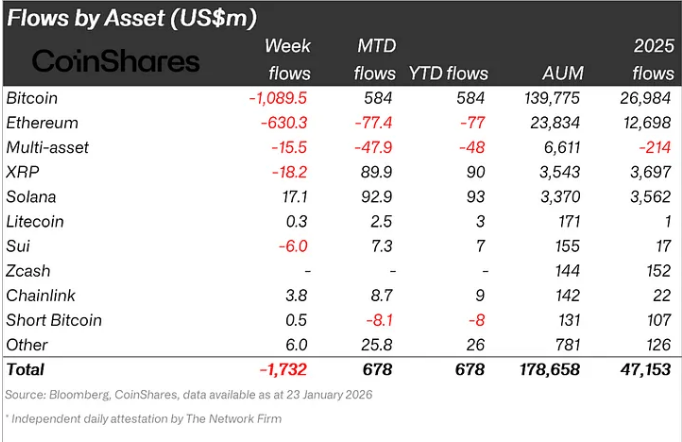
Weekly crypto ETP flows by asset in millions of USD. Source: CoinShares

Some managers did attract fresh capital — groups focused on volatility or niche strategies posted modest gains — showing that investors are shifting tactics rather than abandoning the sector entirely.

Who Pulled Money Out

Bitcoin and Ether were the largest contributors to the outflows. Combined, they comprise most of the $1.73 billion. Based on reports, Ether funds lost roughly $1.10 billion while Bitcoin-focused products shed about $630 million.

Total crypto market cap currently at $2,95 trillion. Chart: TradingView

That split shows a renewed skepticism about large-cap tokens even as traders weigh macro signals. Smaller tokens told a mixed story: Solana drew about $17 million in inflows, while XRP and SUI saw withdrawals of a little over $18 million and $6 million, respectively.

Bitcoin Price Action

Meanwhile, price moves matched the money flow. Bitcoin traded in a choppy range and slipped below $90,000 at one point as risk appetite evaporated. But it did not cave in.

Periodic buying returned, and shorts were put under stress when prices bounced back. Traders are watching macro cues; weakness in sentiment has been paired with bouts of institutional interest, creating a seesaw battle that keeps volatility up.

What This Means For Traders

Market behavior suggests that confidence is unsettled, not totally evaporated. Reports note that investors are recalibrating timeframes and tools. Some are rotating into altcoins that look cheap to them, while others beef up hedges or step back from leveraged positions.

Featured image from Unsplash, chart from TradingView

Related Questions

QWhat was the total amount of outflows from crypto exchange-traded products last week, and why was it significant?

AThe total outflows were approximately $1.73 billion. This was significant because it marked the largest weekly withdrawal since mid-November 2025.

QWhich three major issuers saw the largest outflows, and how much did each lose?

ABlackRock’s iShares led with about $950 million in outflows, Fidelity lost close to $470 million, and Grayscale saw withdrawals of nearly $270 million.

QAccording to the article, what were the three main factors that helped drive the massive exit from crypto funds?

AThe three main factors were fading hopes for quick interest rate cuts, weak price momentum, and a sense that crypto has not yet played the inflation hedge role many expected.

QWhich two cryptocurrencies were the largest contributors to the outflows, and what were the respective amounts?

ABitcoin and Ether were the largest contributors. Ether funds lost roughly $1.10 billion, while Bitcoin-focused products shed about $630 million.

QDespite the record outflows, what does the market behavior suggest about overall investor confidence?

AThe market behavior suggests that confidence is unsettled but not totally evaporated, as investors are shifting tactics and some are rotating into altcoins or adjusting their strategies rather than abandoning the sector entirely.

Related Reads

Yao Shunyu's 88 Days

Yao Shunyu, a 27-year-old AI expert with a background from Princeton and OpenAI, joined Tencent in September 2025. Within 88 days, he led a major overhaul of Tencent’s AI strategy and organization, resulting in the release of Hunyuan Hy3 preview—a MoE model with 295B total parameters and 21B active parameters, supporting up to 256K context length. The launch came after Tencent leadership, including CEO Ma Huateng and President Martin Lau, openly criticized Hunyuan's earlier underperformance—citing slow development, over-reliance on superficial benchmark optimization, and poor generalization in real-world applications. Internal adoption was low, with key business units like WeChat and gaming seeking external AI solutions. Yao reshaped Tencent’s AI approach by integrating previously siloed teams, dissolving the ten-year-old Tencent AI Lab, and establishing new units focused on AI infrastructure and data. Hy3 preview was developed using co-design principles, closely aligned with product teams to ensure practical usability from the start. It has already been integrated into core products like Yuanbao, QQ, and enterprise tools. The release signals a shift from chasing rankings to building usable, scalable AI grounded in Tencent’s ecosystem. While external partnerships (like with DeepSeek and OpenClaw) helped retain users temporarily, the focus is now on making Hunyuan a reliable internal foundation. The real test lies in sustaining this new organizational momentum amid fierce competition from Alibaba, DeepSeek, and others.

marsbit1h ago

Yao Shunyu's 88 Days

marsbit1h ago

Trading

Spot
Futures

Hot Articles

How to Buy MOVE

Welcome to HTX.com! We've made purchasing Movement (MOVE) simple and convenient. Follow our step-by-step guide to embark on your crypto journey.Step 1: Create Your HTX AccountUse your email or phone number to sign up for a free account on HTX. Experience a hassle-free registration journey and unlock all features.Get My AccountStep 2: Go to Buy Crypto and Choose Your Payment MethodCredit/Debit Card: Use your Visa or Mastercard to buy Movement (MOVE) instantly.Balance: Use funds from your HTX account balance to trade seamlessly.Third Parties: We've added popular payment methods such as Google Pay and Apple Pay to enhance convenience.P2P: Trade directly with other users on HTX.Over-the-Counter (OTC): We offer tailor-made services and competitive exchange rates for traders.Step 3: Store Your Movement (MOVE)After purchasing your Movement (MOVE), store it in your HTX account. Alternatively, you can send it elsewhere via blockchain transfer or use it to trade other cryptocurrencies.Step 4: Trade Movement (MOVE)Easily trade Movement (MOVE) on HTX's spot market. Simply access your account, select your trading pair, execute your trades, and monitor in real-time. We offer a user-friendly experience for both beginners and seasoned traders.

3.8k Total ViewsPublished 2024.12.10Updated 2025.03.21

How to Buy MOVE

Discussions

Welcome to the HTX Community. Here, you can stay informed about the latest platform developments and gain access to professional market insights. Users' opinions on the price of MOVE (MOVE) are presented below.

活动图片