Crypto Biz: Bitcoin’s $116M self-custody wake-up call

cointelegraphPublished on 2026-08-14Last updated on 2026-08-14

Abstract

A $116 million Bitcoin hardware wallet exploit has reignited debate over the risks of self-custody versus institutional products. This coincides with U.S. spot Bitcoin ETFs seeing their strongest weekly inflows since April, leading analysts to speculate security fears may drive investors toward ETFs. MicroStrategy CEO Phong Le announced the company will resume its Bitcoin accumulation strategy later this year, despite recent sales to meet shareholder obligations. The firm remains the largest institutional Bitcoin holder. Bitcoin miner Riot Platforms is reportedly transforming part of its infrastructure into a $9 billion, 20-year power supply deal with AI company Anthropic, highlighting a growing trend of miners pivoting to AI. Finally, Trump Media plans to revamp its crypto treasury strategy after reporting a $238 million Q2 loss, partly due to unrealized losses on its Bitcoin holdings. The company has increased its Bitcoin position but warned of counterparty risks in its earning activities.

A $116 million hardware wallet exploit has reopened one of Bitcoin’s oldest debates: Is holding your own keys worth the risk? Days later, US spot Bitcoin ETFs recorded their strongest inflows since April, prompting Bloomberg analyst Eric Balchunas to wonder whether security scares could eventually push more investors away from self-custody and toward ETFs.

Elsewhere, Strategy is preparing to resume Bitcoin purchases after a rare bout of selling, Riot Platforms is reportedly turning its mining infrastructure into a $9 billion AI deal, and Trump Media is rethinking its crypto treasury strategy after a $238 million quarterly loss.

Strategy CEO says company will resume Bitcoin accumulation this year

Strategy CEO Phong Le said the company plans to resume Bitcoin accumulation later this year, seeking to reinforce its long-term strategy after a series of relatively small sales drew scrutiny over its once-firm “never sell” stance.

Le told FOX Business that Strategy bought roughly 175,000 BTC and sold about 7,000 BTC this year — about 25 times more buying than selling. The company now holds more than 840,000 BTC, making it the largest institutional holder, but has sold Bitcoin on four occasions since May, most recently unloading 1,690 BTC to support preferred dividends, buybacks and its dollar reserve.

Those sales have highlighted the competing demands facing Strategy as it balances its Bitcoin accumulation strategy with obligations to common and preferred shareholders. The treasury model has also come under pressure. According to Novaque Research, when companies trade below Bitcoin net asset value, raising capital becomes increasingly dilutive and the financing cycle harder to sustain.
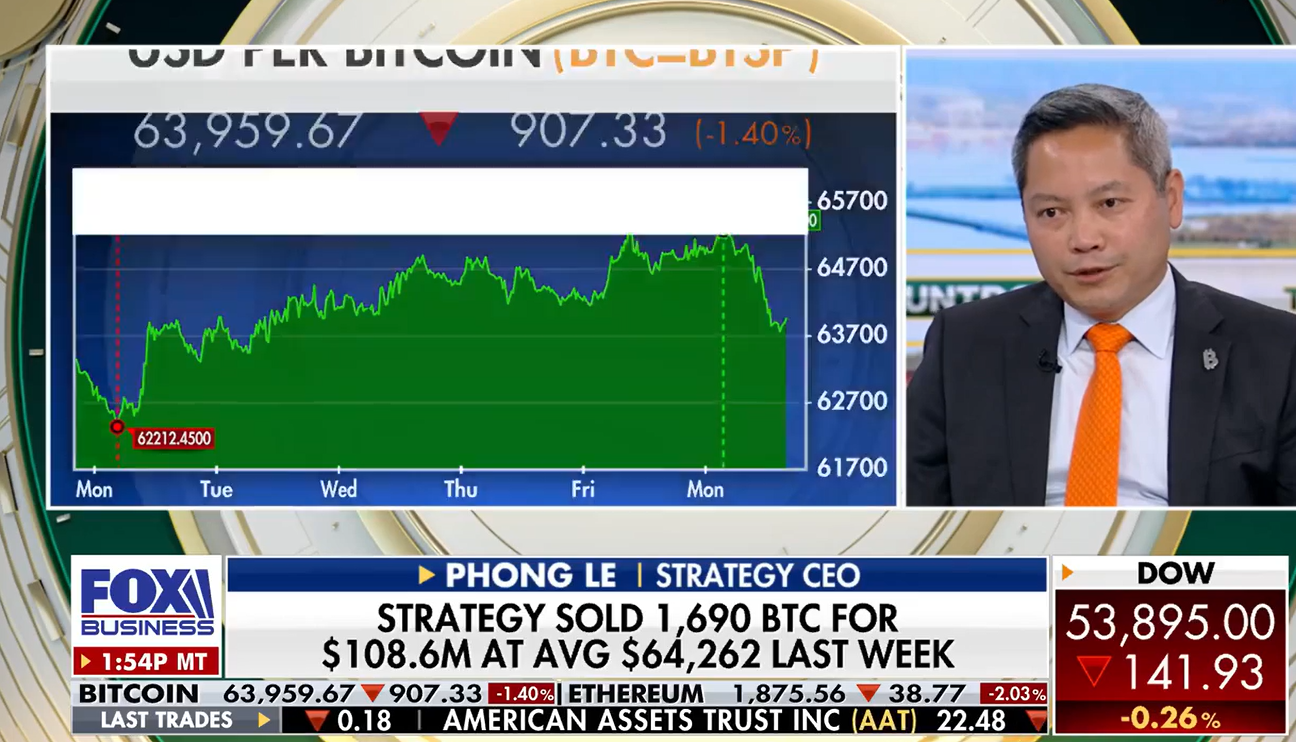
Phong Le appearing on FOX Business. Source: FOX

Bitcoin ETF demand rebounds as self-custody risks come into focus

US spot Bitcoin ETFs attracted roughly $1 billion in net inflows for the week, signaling renewed institutional demand even as Bitcoin’s price remains subdued and a major hardware wallet exploit puts fresh attention on the risks of self-custody.

Bloomberg ETF analyst Eric Balchunas said it was the third-best week since October, a period he described as Bitcoin’s “silent IPO,” a term popularized by investor Jordi Visser. The theory holds that early investors have been selling into growing ETF and institutional demand, creating enough supply to keep Bitcoin subdued despite fresh capital entering the market.

The rebound also followed a Coldcard hardware wallet exploit linked to faulty key generation that drained about $116 million in Bitcoin. Balchunas said the incident could ultimately bolster ETFs’ appeal among investors concerned about self-custody risks, pointing to post-hack inflows as a possible, though unproven, connection.

He cautioned that correlation does not imply causation, but added that “long-term I can’t imagine there aren’t some who migrate over.”
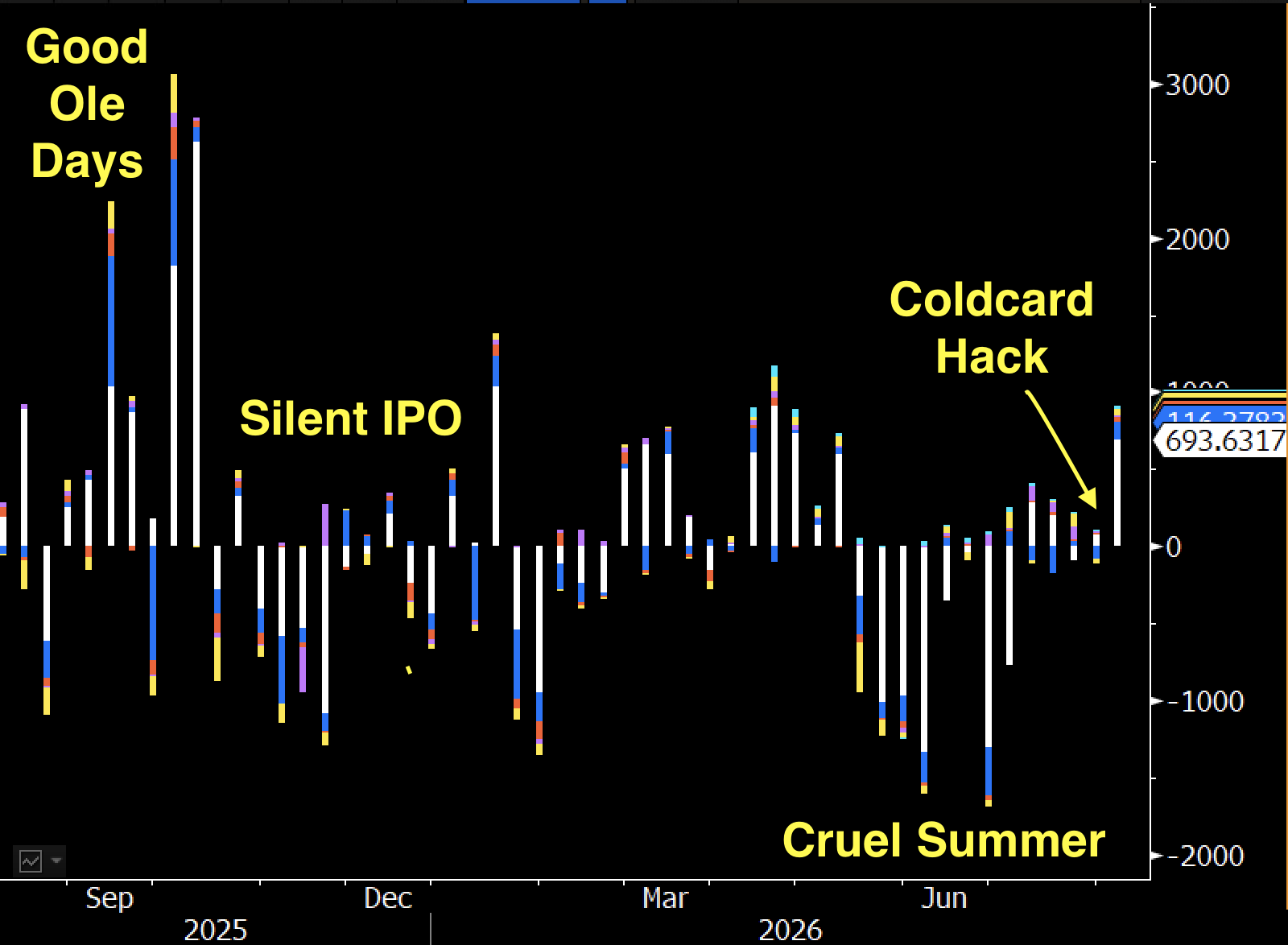
Source: Eric Balchunas

Anthropic reportedly struck a $9 billion compute deal with Bitcoin miner Riot

Anthropic reportedly struck a $9 billion deal with Riot Platforms for 191 megawatts of capacity from the Bitcoin miner’s Texas campus, highlighting how access to power is becoming increasingly valuable as AI data centers face capacity constraints.

Riot said it secured a 20-year agreement to supply 191 megawatts from its Rockdale campus to a “leading frontier AI” company, which Bloomberg identified as Anthropic. The deal follows Anthropic’s $19 billion TeraWulf data center lease and adds Riot to a growing list of Bitcoin miners expanding into AI, including Bitdeer, CleanSpark, MARA Holdings, Core Scientific, Hut 8 and IREN.

Riot shares fell 5.4% Monday before rising 21% overnight and are up roughly 50% year-to-date. The fourth-largest Bitcoin miner has a $7.33 billion market capitalization, while Bernstein said partnerships between AI companies and miners could help address the power crunch constraining data center expansion.

Trump Media to revamp crypto treasury strategy after $238 million Q2 loss

Trump Media said it will revamp its digital asset treasury strategy after unrealized losses on crypto and securities helped push the company to a $238 million second-quarter net loss, highlighting the balance-sheet risks of corporate crypto holdings.

The company reported $190.4 million in unrealized losses across its digital assets, and pledged digital assets and equity securities in the second quarter. It held 9,477.16 Bitcoin as of June 30, down from 9,542.16 the prior quarter. In July, it sold $159.6 million in Bitcoin-related securities and used the proceeds to buy more Bitcoin, bringing its holdings to about 14,139 BTC worth $890.5 million by July 31.

Trump Media warned that generating additional income from its Bitcoin holdings could expose it to counterparty risk, particularly if a partner should default or become insolvent. In some cases, the company could be unable to recover Bitcoin committed under unsecured arrangements. It also plans to direct more resources to Truth Social, Truth+ and other media operations as part of a broader shift in capital allocation.

Crypto Biz is your weekly pulse on the business behind blockchain and crypto, delivered directly to your inbox every Thursday.


Trending Cryptos

Related Questions

QWhat event has reopened the debate about self-custody vs. third-party custody of Bitcoin?

AA $116 million hardware wallet exploit involving a Coldcard wallet has reopened the debate about the risks of self-custody versus using third-party services like ETFs.

QWhat is MicroStrategy's CEO's stated plan regarding Bitcoin, and how does the company's recent activity contrast with its previous stance?

AMicroStrategy CEO Phong Le stated the company plans to resume Bitcoin accumulation later this year. This comes after the company sold Bitcoin on four occasions since May, which contrasts with its once-firm 'never sell' stance, drawing scrutiny.

QAccording to Bloomberg analyst Eric Balchunas, what could be a potential long-term effect of security scares like the hardware wallet exploit on investor behavior?

ABloomberg analyst Eric Balchunas suggested that security scares like the hardware wallet exploit could, in the long term, push some investors concerned about self-custody risks away from holding their own keys and towards Bitcoin ETFs.

QWhat major deal did Riot Platforms reportedly strike with Anthropic, and what trend does this highlight?

ARiot Platforms reportedly struck a $9 billion deal to supply 191 megawatts of power capacity from its Texas campus to Anthropic. This highlights the trend of Bitcoin miners expanding into providing infrastructure and power for AI data centers, which face capacity constraints.

QWhy is Trump Media revamping its crypto treasury strategy, and what specific risk did it warn about concerning its Bitcoin holdings?

ATrump Media is revamping its crypto treasury strategy after unrealized losses on crypto and securities contributed to a $238 million Q2 net loss. The company warned that generating additional income from its Bitcoin holdings could expose it to counterparty risk, particularly if a partner defaults or becomes insolvent, potentially leaving it unable to recover Bitcoin under unsecured arrangements.

Related Reads

5 Lessons from 'The Odyssey' for Traders: Strategy, Discipline, and How to Survive in the Market

"The Odyssey" offers timeless lessons for traders on strategy, discipline, and market survival. This article draws parallels between the epic's themes and the core principles of trading. First, **strategy over brute force** is key. Odysseus’s cunning escapes, like from the Cyclops, highlight that a market view must translate into a concrete plan with entry, exit, position sizing, and failure conditions. Over-trading often harms performance more than it helps. Second, facing **temptation and self-control**, Odysseus had himself tied to the mast *before* hearing the Sirens. Similarly, pre-set trading rules (like stop-losses) are more reliable than willpower in the heat of the moment, preventing emotionally-driven decisions. Third, managing **risk and trade-offs** is crucial. Odysseus chose a limited loss (losing six men to Scylla) to avoid total disaster (Charybdis). In trading, position sizing ensures a loss doesn't prevent future trades, as recovering from large drawdowns becomes exponentially harder. Fourth, the ability to **adapt to change** is vital. Odysseus faced unique challenges requiring different tactics. Markets also change; a strategy effective in one environment (e.g., a trend) may fail in another (e.g., a range). The key is distinguishing when a strategy needs adjustment from normal short-term variance. Finally, success is measured by the **entire journey**, not single events. A decade-long voyage or a series of trades defines performance, not one win or loss. Consistency and long-term metrics matter more than any single trade. Ultimately, a reliable trading system isn't about always being right, but about containing mistakes within manageable limits, ensuring survival and the chance to succeed over the long term—much like Odysseus's arduous but ultimately successful return home.

marsbit36m ago

5 Lessons from 'The Odyssey' for Traders: Strategy, Discipline, and How to Survive in the Market

marsbit36m ago

Current State of Web3 Projects: 200 Projects Cease Updates Monthly, Only 70 New Ones Emerge

The article discusses a significant decline in active Web3 projects, based on data from RootData's "2026 Crypto Industry Dead Project Collection." It highlights that approximately 200 projects cease social media updates monthly, while only 70-100 new ones emerge, indicating a net loss in the active project count since mid-2025. RootData's methodology for identifying "dead" projects relies on three objective criteria: official announcements of shutdown, over six months of inactivity across key platforms (like X and Discord), or the inability to access official websites/social accounts. Over 70% of identified dead projects fall into the long-term inactivity category. Currently, RootData tracks over 20,000 crypto projects, with only about 2,200 considered active based on August social media updates. The analysis suggests the crypto industry is undergoing a deep consolidation phase. While infrastructure projects are declining among new entries (now under 10%), new projects are increasingly focused on application and distribution layers, with over 65% in categories like prediction markets, RWA cards, tokenized stocks, perpetual contracts, AI agents, and memecoins. The article concludes that this shakeout, driven by reduced VC funding, may force greater focus on sustainable business models and real user demand, potentially strengthening the ecosystem's long-term health.

marsbit2h ago

Current State of Web3 Projects: 200 Projects Cease Updates Monthly, Only 70 New Ones Emerge

marsbit2h ago

Unexpectedly Negative! US July Retail Sales Drop 0.6% Month-over-Month, Marking the Largest Decline in Over a Year

U.S. Retail Sales Unexpectedly Fall Sharply in July U.S. retail sales in July declined by 0.6% month-on-month, marking the largest drop since May 2025 and falling significantly short of the market expectation for a 0.1% gain. The cooling demand, driven by decreases in auto purchases and online sales, has prompted a more cautious outlook on consumer spending resilience for the second half of the year. The closely watched "control group" sales, which exclude autos, gasoline, building materials, and food services and directly feed into GDP calculations, fell 0.4%, missing expectations of a 0.3% increase. Core retail sales (excluding autos and gasoline) also fell 0.2%, against an anticipated 0.3% rise. Economists attribute the weakness to several factors: the fading boost from excess tax refunds earlier in the year, a decline in personal savings rates, and temporary disruptions. These include the shift of major promotional events like Amazon's Prime Day to June, hot weather around the July 4 holiday, and the post-World Cup spending lull. Specific categories like clothing, gasoline, and furniture saw declines. Notably, the consumption slowdown is accompanied by a shift in spending patterns across income groups. Recent data shows spending growth among low-income households has outpaced that of high-income households in recent weeks, even for discretionary goods, suggesting a potential convergence from the previous "K-shaped" economic recovery into a more uniform "C-shaped" pattern. Year-on-year, retail sales still grew 5.0%, indicating an overall robust level, but the sharp monthly miss is expected to increase pressure for downward revisions to Q3 GDP growth forecasts.

marsbit2h ago

Unexpectedly Negative! US July Retail Sales Drop 0.6% Month-over-Month, Marking the Largest Decline in Over a Year

marsbit2h ago

Trading

Spot

Hot Articles

What is $BITCOIN

DIGITAL GOLD ($BITCOIN): A Comprehensive Analysis Introduction to DIGITAL GOLD ($BITCOIN) DIGITAL GOLD ($BITCOIN) is a blockchain-based project operating on the Solana network, which aims to combine the characteristics of traditional precious metals with the innovation of decentralized technologies. While it shares a name with Bitcoin, often referred to as “digital gold” due to its perception as a store of value, DIGITAL GOLD is a separate token designed to create a unique ecosystem within the Web3 landscape. Its goal is to position itself as a viable alternative digital asset, although specifics regarding its applications and functionalities are still developing. What is DIGITAL GOLD ($BITCOIN)? DIGITAL GOLD ($BITCOIN) is a cryptocurrency token explicitly designed for use on the Solana blockchain. In contrast to Bitcoin, which provides a widely recognized value storage role, this token appears to focus on broader applications and characteristics. Notable aspects include: Blockchain Infrastructure: The token is built on the Solana blockchain, known for its capacity to handle high-speed and low-cost transactions. Supply Dynamics: DIGITAL GOLD has a maximum supply capped at 100 quadrillion tokens (100P $BITCOIN), although details regarding its circulating supply are currently undisclosed. Utility: While precise functionalities are not explicitly outlined, there are indications that the token could be utilized for various applications, potentially involving decentralized applications (dApps) or asset tokenization strategies. Who is the Creator of DIGITAL GOLD ($BITCOIN)? At present, the identity of the creators and development team behind DIGITAL GOLD ($BITCOIN) remains unknown. This situation is typical among many innovative projects within the blockchain space, particularly those aligning with decentralized finance and meme coin phenomena. While such anonymity may foster a community-driven culture, it intensifies concerns about governance and accountability. Who are the Investors of DIGITAL GOLD ($BITCOIN)? The available information indicates that DIGITAL GOLD ($BITCOIN) does not have any known institutional backers or prominent venture capital investments. The project seems to operate on a peer-to-peer model focused on community support and adoption rather than traditional funding routes. Its activity and liquidity are primarily situated on decentralized exchanges (DEXs), such as PumpSwap, rather than established centralized trading platforms, further highlighting its grassroots approach. How DIGITAL GOLD ($BITCOIN) Works The operational mechanics of DIGITAL GOLD ($BITCOIN) can be elaborated on based on its blockchain design and network attributes: Consensus Mechanism: By leveraging Solana’s unique proof-of-history (PoH) combined with a proof-of-stake (PoS) model, the project ensures efficient transaction validation contributing to the network's high performance. Tokenomics: While specific deflationary mechanisms have not been extensively detailed, the vast maximum token supply implies that it may cater to microtransactions or niche use cases that are still to be defined. Interoperability: There exists the potential for integration with Solana’s broader ecosystem, including various decentralized finance (DeFi) platforms. However, the details regarding specific integrations remain unspecified. Timeline of Key Events Here is a timeline that highlights significant milestones concerning DIGITAL GOLD ($BITCOIN): 2023: The initial deployment of the token occurs on the Solana blockchain, marked by its contract address. 2024: DIGITAL GOLD gains visibility as it becomes available for trading on decentralized exchanges like PumpSwap, allowing users to trade it against SOL. 2025: The project witnesses sporadic trading activity and potential interest in community-led engagements, although no noteworthy partnerships or technical advancements have been documented as of yet. Critical Analysis Strengths Scalability: The underlying Solana infrastructure supports high transaction volumes, which could enhance the utility of $BITCOIN in various transaction scenarios. Accessibility: The potential low trading price per token could attract retail investors, facilitating wider participation due to fractional ownership opportunities. Risks Lack of Transparency: The absence of publicly known backers, developers, or an audit process may yield skepticism regarding the project's sustainability and trustworthiness. Market Volatility: The trading activity is heavily reliant on speculative behavior, which can result in significant price volatility and uncertainty for investors. Conclusion DIGITAL GOLD ($BITCOIN) emerges as an intriguing yet ambiguous project within the rapidly evolving Solana ecosystem. While it attempts to leverage the “digital gold” narrative, its departure from Bitcoin's established role as a store of value underscores the need for a clearer differentiation of its intended utility and governance structure. Future acceptance and adoption will likely depend on addressing the current opacity and defining its operational and economic strategies more explicitly. Note: This report encompasses synthesised information available as of October 2023, and developments may have transpired beyond the research period.

1.9k Total ViewsPublished 2025.05.13Updated 2025.05.13

What is $BITCOIN

Discussions

Welcome to the HTX Community. Here, you can stay informed about the latest platform developments and gain access to professional market insights. Users' opinions on the price of BTC (BTC) are presented below.

活动图片