Contrary To Popular Belief, This Is Not The Worst Bitcoin Crash In History – Here’s The List

bitcoinistPublished on 2026-02-09Last updated on 2026-02-09

Abstract

Contrary to popular belief, the recent Bitcoin crash is not the worst in its history. According to Swan CEO Cory Klippsten, the decline from the all-time high of $126,000 to $60,000 (a 52% drop) ranks only as the 9th-largest Bitcoin drawdown. The most significant crash occurred in 2011, when BTC fell 94% from $32 to $2. Other major crashes include an 87% drop from $1,160 to $152 (2013-2015) and an 84% crash from $19,600 to $3,100 (2017-2018). Analyst Michaël van de Poppe noted the appearance of a capitulation candle on the weekly chart, suggesting that the range of $65,000–$70,000 may form a bottom area. While some experts, like Peter Brandt, warn that Bitcoin could still drop to around $42,000, van de Poppe is optimistic, predicting a potential rally toward $85,000. At the time of writing, Bitcoin price is around $71,000, up over 2% in 24 hours.

Swan’s CEO Cory Klippsten has highlighted past Bitcoin crashes, proving that this latest crash isn’t the worst in BTC’s history. This comes as the leading crypto looks to recover, although experts warn that the crash may not be over yet.

Crypto CEO Shares List Of Worst Bitcoin Crashes Ever

In an X post, the Swan CEO described the Bitcoin crash from its current all-time high (ATH) of $126,000 to $60,000 as the 9th-largest in its history. He shared a list of all the major crashes that the leading crypto has suffered since its inception. The largest crash was in 2011, when BTC dropped from a peak of $32 to $2, representing a 94% drawdown.

The second-largest Bitcoin crash occurred between 2013 and 2015, when BTC fell 87% from a peak of $1,160 to a low of $152. The leading crypto suffered its third-largest crash between 2017 and 2018 when it dropped from $19,600 to $3,100, representing an 84% crash. The crash from $260 to $45 in 2013 and from $69,000 to $15,500 complete the top five largest crashes in Bitcoin’s history.
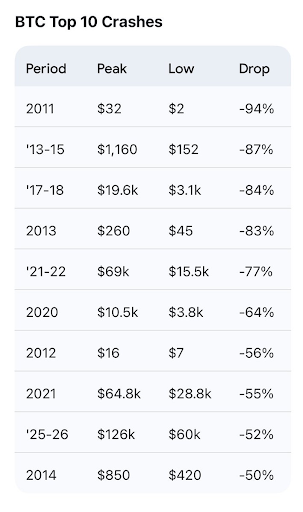
Source: Chart from Cory Klippsten on X

The Bitcoin crash from a peak of $126,000 to a low of $60,000 represents a 52% drawdown, which is why it ranks as the 9th-largest crash, just below the crash from $64,800 to $28,800 and above the crash from $850 to $420. However, based on predictions from experts such as veteran trader Peter Brandt, this recent sell-off may not yet be over. Brandt predicted that BTC could still drop to as low as $42,000, which could mark the bottom based on past bear cycles.

Analyst Highlights Capitulation Candle on Bitcoin

Crypto analyst Michaël van de Poppe stated in an X post that the weekly BTC chart shows that the market has just witnessed the capitulation candle following the latest Bitcoin crash. He warned that this doesn’t mean that BTC can’t consolidate here and then test some lower levels. The analyst added that holding above the 2021 ATH of $69,000 is key, and that the capitulation candle indicates buying pressure that likely contributed to the rebound above $70,000.

Michaël Van De Poppe also mentioned that the reversal for Bitcoin might not be quick, but given the sudden upside bounce, he believes the range between $65,000 and $70,000 is the bottom area for the coming weeks. As such, the analyst is confident that a BTC rally to as high as $85,000 is definitely on the cards. He also remarked that the leading crypto is closer to the bottom than the top.

At the time of writing, the Bitcoin price is trading at around $71,000, up over 2% in the last 24 hours, according to data from CoinMarketCap.

BTC trading at $70,202 on the 1D chart | Source: BTCUSDT on Tradingview.com

Related Questions

QAccording to Swan's CEO Cory Klippsten, what is the ranking of the current Bitcoin crash from $126,000 to $60,000 among the worst crashes in BTC's history?

AThe current Bitcoin crash from $126,000 to $60,000, a 52% drawdown, is ranked as the 9th-largest crash in Bitcoin's history.

QWhich Bitcoin crash is considered the largest in history, and what was the percentage decline?

AThe largest Bitcoin crash was in 2011, when BTC dropped from a peak of $32 to $2, representing a 94% drawdown.

QWhat did veteran trader Peter Brandt predict could be the potential bottom for Bitcoin's price in this recent sell-off?

AVeteran trader Peter Brandt predicted that BTC could still drop to as low as $42,000, which could mark the bottom based on past bear cycles.

QWhat key level does analyst Michaël van de Poppe state is crucial for Bitcoin to hold above?

AAnalyst Michaël van de Poppe stated that holding above the 2021 all-time high (ATH) of $69,000 is key.

QWhat price range does Michaël van de Poppe believe is the bottom area for Bitcoin in the coming weeks, and what is his high-end price target?

AMichaël van de Poppe believes the range between $65,000 and $70,000 is the bottom area for the coming weeks and is confident that a BTC rally to as high as $85,000 is on the cards.

Related Reads

Three Frameworks for Ordinary People to Achieve AI Capability Leap: Say Goodbye to the Dilemma of 'Repeating Inputs Every Day'

Summary: This article outlines three frameworks for maximizing AI efficiency, moving beyond basic prompt usage. 1. **Three-Layer Evolution**: Users progress from (1) **Prompt** (one-off instructions, reset each session), to (2) **Project** (context-aware within a specific project), to (3) **Skill** (permanent, auto-applied knowledge). Most users stagnate at the first layer, repeating the same instructions daily with no cumulative improvement. Skills transform the AI from a chat tool into a personalized work system. 2. **Transaction vs. Compound Interest Mindset**: Using prompts is a linear transaction—effort and output are 1:1, and stopping resets progress. Investing time in building Skills is compound interest; a small initial time investment pays continuous dividends, as each Skill permanently elevates the AI's baseline performance. 3. **Thin Harness, Fat Skills**: The system architecture should prioritize thick, well-defined Skills (90% of the value—containing processes, standards, and domain knowledge) and a thin "harness" (the minimal technical environment). Avoid over-engineering the toolchain while neglecting the AI's actual knowledge. Skills are permanent assets that automatically improve with model updates. The key takeaway: Identify tasks you repeat, encode them into Skills (using tools like Claude's Skill Creator), and shift focus from daily prompting to building a compounding, self-improving AI system.

marsbit8m ago

Three Frameworks for Ordinary People to Achieve AI Capability Leap: Say Goodbye to the Dilemma of 'Repeating Inputs Every Day'

marsbit8m ago

Trading

Spot
Futures

Hot Articles

What is $BITCOIN

DIGITAL GOLD ($BITCOIN): A Comprehensive Analysis Introduction to DIGITAL GOLD ($BITCOIN) DIGITAL GOLD ($BITCOIN) is a blockchain-based project operating on the Solana network, which aims to combine the characteristics of traditional precious metals with the innovation of decentralized technologies. While it shares a name with Bitcoin, often referred to as “digital gold” due to its perception as a store of value, DIGITAL GOLD is a separate token designed to create a unique ecosystem within the Web3 landscape. Its goal is to position itself as a viable alternative digital asset, although specifics regarding its applications and functionalities are still developing. What is DIGITAL GOLD ($BITCOIN)? DIGITAL GOLD ($BITCOIN) is a cryptocurrency token explicitly designed for use on the Solana blockchain. In contrast to Bitcoin, which provides a widely recognized value storage role, this token appears to focus on broader applications and characteristics. Notable aspects include: Blockchain Infrastructure: The token is built on the Solana blockchain, known for its capacity to handle high-speed and low-cost transactions. Supply Dynamics: DIGITAL GOLD has a maximum supply capped at 100 quadrillion tokens (100P $BITCOIN), although details regarding its circulating supply are currently undisclosed. Utility: While precise functionalities are not explicitly outlined, there are indications that the token could be utilized for various applications, potentially involving decentralized applications (dApps) or asset tokenization strategies. Who is the Creator of DIGITAL GOLD ($BITCOIN)? At present, the identity of the creators and development team behind DIGITAL GOLD ($BITCOIN) remains unknown. This situation is typical among many innovative projects within the blockchain space, particularly those aligning with decentralized finance and meme coin phenomena. While such anonymity may foster a community-driven culture, it intensifies concerns about governance and accountability. Who are the Investors of DIGITAL GOLD ($BITCOIN)? The available information indicates that DIGITAL GOLD ($BITCOIN) does not have any known institutional backers or prominent venture capital investments. The project seems to operate on a peer-to-peer model focused on community support and adoption rather than traditional funding routes. Its activity and liquidity are primarily situated on decentralized exchanges (DEXs), such as PumpSwap, rather than established centralized trading platforms, further highlighting its grassroots approach. How DIGITAL GOLD ($BITCOIN) Works The operational mechanics of DIGITAL GOLD ($BITCOIN) can be elaborated on based on its blockchain design and network attributes: Consensus Mechanism: By leveraging Solana’s unique proof-of-history (PoH) combined with a proof-of-stake (PoS) model, the project ensures efficient transaction validation contributing to the network's high performance. Tokenomics: While specific deflationary mechanisms have not been extensively detailed, the vast maximum token supply implies that it may cater to microtransactions or niche use cases that are still to be defined. Interoperability: There exists the potential for integration with Solana’s broader ecosystem, including various decentralized finance (DeFi) platforms. However, the details regarding specific integrations remain unspecified. Timeline of Key Events Here is a timeline that highlights significant milestones concerning DIGITAL GOLD ($BITCOIN): 2023: The initial deployment of the token occurs on the Solana blockchain, marked by its contract address. 2024: DIGITAL GOLD gains visibility as it becomes available for trading on decentralized exchanges like PumpSwap, allowing users to trade it against SOL. 2025: The project witnesses sporadic trading activity and potential interest in community-led engagements, although no noteworthy partnerships or technical advancements have been documented as of yet. Critical Analysis Strengths Scalability: The underlying Solana infrastructure supports high transaction volumes, which could enhance the utility of $BITCOIN in various transaction scenarios. Accessibility: The potential low trading price per token could attract retail investors, facilitating wider participation due to fractional ownership opportunities. Risks Lack of Transparency: The absence of publicly known backers, developers, or an audit process may yield skepticism regarding the project's sustainability and trustworthiness. Market Volatility: The trading activity is heavily reliant on speculative behavior, which can result in significant price volatility and uncertainty for investors. Conclusion DIGITAL GOLD ($BITCOIN) emerges as an intriguing yet ambiguous project within the rapidly evolving Solana ecosystem. While it attempts to leverage the “digital gold” narrative, its departure from Bitcoin's established role as a store of value underscores the need for a clearer differentiation of its intended utility and governance structure. Future acceptance and adoption will likely depend on addressing the current opacity and defining its operational and economic strategies more explicitly. Note: This report encompasses synthesised information available as of October 2023, and developments may have transpired beyond the research period.

363 Total ViewsPublished 2025.05.13Updated 2025.05.13

What is $BITCOIN

Discussions

Welcome to the HTX Community. Here, you can stay informed about the latest platform developments and gain access to professional market insights. Users' opinions on the price of BTC (BTC) are presented below.

活动图片