Computing Power Subprime Crisis: The AI Infrastructure Debt Wave, Miner Leverage, and the Vanishing 'Liquidation Liquidity'

marsbitPublished on 2025-12-18Last updated on 2025-12-18

Abstract

AI Infrastructure Debt Crisis: A Looming "Compute Subprime" Scenario Beneath the surface of booming AI investment and data center expansion, a severe financial mismatch is brewing. Credit investors are growing alarmed as the industry uses long-term, real-estate-like debt models to finance rapidly depreciating tech assets with an effective shelf life of just 18 months. The core issue is a fundamental asset-liability mismatch. AI compute is inherently deflationary; inference costs are falling 20-40% annually due to technological advances, eroding the future cash flows used to service debt taken out at peak 2024 prices. This risk is amplified by a shift in financing. High-risk, venture-grade tech assets are being packaged into low-risk, utility-grade project finance and asset-backed loans (ABL), transforming potential equity losses into systemic defaults. Crypto miners, often portrayed as successfully "pivoting" to AI, are particularly vulnerable. Many have not deleveraged but have instead taken on double leverage—using volatile crypto holdings as collateral to borrow more dollars to buy GPUs. This creates a dangerous correlation risk where a crypto crash and a drop in AI rental prices could occur simultaneously. The final, critical flaw is the illusion of collateral. Unlike real estate, a defaulting borrower's GPUs are nearly impossible to liquidate. They are physically dependent on specialized infrastructure, face rapid obsolescence, and lack a deep secondary market, mean...

Author: Anita @anitahityou

If you only read tech news in 2025, the world seems rosy: AI investment continues, North American data center construction accelerates, and crypto miners have finally "exited the cycle," successfully transforming their highly volatile mining operations into stable AI computing power services.

But in the credit departments of Wall Street, the atmosphere is completely different.

Credit investors aren't discussing model performance or which generation of GPU is stronger. They stare at the core assumptions in their Excel spreadsheets and begin to feel a chill: we seem to be using a 10-year real estate financing model to purchase a perishable product with a shelf life of only 18 months.

Back-to-back reports from Reuters and Bloomberg in December revealed the tip of the iceberg: AI infrastructure is rapidly becoming a "debt-intensive industry." But this is just the surface; the real crisis lies in a deep financial structure mismatch—when high-depreciation computing assets, highly volatile miner collateral, and rigid infrastructure debt are forcibly bundled together, a hidden chain of default transmission has already formed.

I. Deflation on the Asset Side: The Brutal Revenge of "Moore's Law"

The core logic of credit is Debt Service Coverage Ratio (DSCR). Over the past 18 months, the market assumed AI compute租金 (rent) would be as stable as real estate rent, or even as inflation-resistant as oil.

Data is mercilessly shattering this assumption.

According to Q4 2025 tracking data from SemiAnalysis and Epoch AI, the unit cost of AI inference has decreased by 20–40% year-over-year in the past year.

  • The adoption of model quantization, distillation techniques, and efficiency improvements in dedicated inference chips (ASICs) have led to an exponential increase in the efficiency of computing power supply.
  • This means so-called "compute租金" has a natural deflationary attribute.
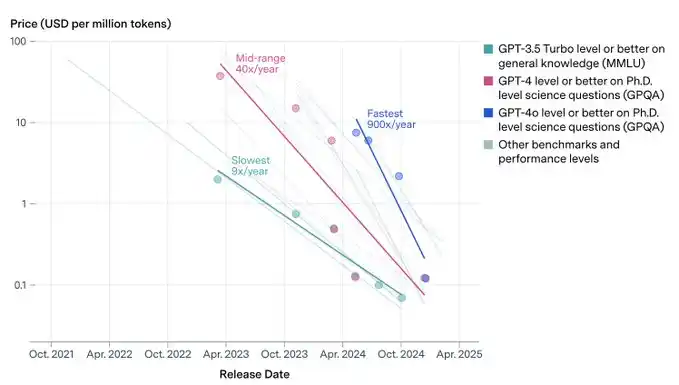
This creates the first duration mismatch: the issuing entities purchased GPUs at 2024 peak prices (CapEx), locking in a rental income curve destined to plummet post-2025.

If you are an equity investor, this is called technological progress; if you are a creditor, this is called collateral depreciation.

II. The Distortion on the Financing Side: Packaging Venture Risk as Infrastructure Returns

If returns on the asset side are thinning, the liability side should rationally become more conservative.

But reality is恰恰相反 (precisely the opposite).

According to the latest statistics from The Economic Times and Reuters, the total debt financing for AI data centers and related infrastructure surged 112% in 2025, reaching a scale of $25 billion. The main drivers of this surge are "Neo-Cloud" vendors like CoreWeave and Crusoe, as well as transitioning mining companies, which are大规模采用 (large-scale adoption of) Asset-Backed Lending (ABL) and Project Finance.
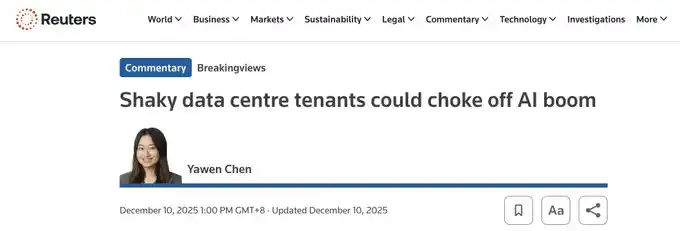
The本质变化 (essential change) in this financing structure is extremely dangerous:

  • Past: AI was a game for tech VCs; failure meant equity goes to zero.
  • Present: AI has become an infrastructure game; failure means debt default.

The market is mistakenly placing high-risk, high-depreciation tech assets (Venture-grade Assets) into a low-risk financing model (Utility-grade Leverage) meant for highways and hydropower plants.

III. Miners' "Fake Transformation" and "Real Leverage"

The most fragile link appears among crypto miners. The media loves to praise miner转型 (transformation) to AI as "de-risking," but from a balance sheet perspective, this is risk叠加 (stacking).

Consulting data from VanEck and TheMinerMag reveals a counterintuitive fact: the net debt ratios of leading listed mining companies in 2025 have not substantially decreased compared to the 2021 peak.甚至 (Even), the debt scale of some aggressive mining firms has surged by 500%.
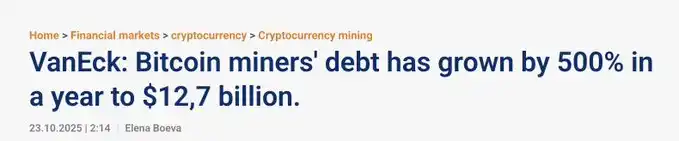
How did they achieve this?

  • Left hand (Asset side): Still holds highly volatile BTC/ETH, or uses future computing income as implicit collateral.
  • Right hand (Liability side): Issues convertible notes or high-yield bonds, borrows USD to purchase H100s/H200s.

This is not deleveraging; this is a Rollover (debt extension).

This means miners are playing a "double leverage" game: using Crypto's volatility as collateral to bet on GPU cash flow. During顺风期 (favorable periods) this means double profits, but once the macro environment tightens, "coin price decline" and "compute租金 decline" will occur simultaneously**. In credit models, this is called correlation convergence, the nightmare of all structured products.

IV. The Non-Existent "Repo Market" (The Missing Repo Market)

What keeps credit managers awake at night is not the default itself, but the清算 (liquidation) after default.

In the real estate subprime crisis, banks could at least foreclose and auction houses. But in AI compute financing, if a miner defaults, who can the creditor sell those ten thousand H100 GPUs to?

This is a secondary market whose liquidity is严重高估 (severely overestimated):

  1. Physical Dependence: High-end GPUs aren't something you can just plug into a home computer; they heavily depend on specific liquid-cooled racks and power density (30-50kW/rack).
  2. Technical Obsolescence (Hardware Obsolescence): With the release of NVIDIA's Blackwell and even Rubin architectures, older cards face non-linear depreciation.
  3. Buy-Side Vacuum: When systemic selling occurs, there is no "lender of last resort" willing to take on obsolete electronic waste.

We must be wary of this "collateral illusion"—the LTV on the books looks safe, but that secondary repo market capable of absorbing tens of billions of dollars in selling pressure simply doesn't exist in reality.

This Isn't Just an AI Bubble; It's a Failure of Credit

It needs to be clarified that this article does not否定 (deny) AI's technological prospects, nor does it deny the real demand for computing power. What we question is the wrong financial structure.

When deflationary assets (GPUs) driven by Moore's Law are priced like inflation-resistant real estate; when miners who haven't truly deleveraged are financed like premium infrastructure operators—the market is actually conducting a credit experiment that has not been sufficiently priced in.

Historical experience repeatedly proves: credit cycles often peak earlier than technology cycles. For macro strategists and credit traders, the primary task before 2026 might not be predicting which large model will win, but重新审视 (re-examining) the true credit spreads of those "AI Infra + Crypto Miners" combinations.

https://epoch.ai/data-insights/llm-inference-price-trends

https://epochai.substack.com/p/the-epoch-ai-brief-april-2025

https://semianalysis.com/2025/

https://www.reuters.com/commentary/breakingviews/shaky-data-centre-tenants-could-choke-off-ai-boom-2025-12-10/

https://longbridge.com/en/news/269179463

https://economictimes.indiatimes.com/topic/data-center-capacity

https://www.webpronews.com/ais-debt-fueled-data-center-frenzy-risks-mounting-in-2025-boom/

https://www.alpha-matica.com/post/assessing-risks-in-ai-infrastructure-finance

https://www.blackstone.com/news/press/coreweave-secures-7-5-billion-debt-financing-facility-led-by-blackstone-and-magnetar/

https://www.prnewswire.com/news-releases/coreweave-secures-7-5-billion-debt-financing-facility-led-by-blackstone-and-magnetar-301848093.html

https://www.cnbc.com/2024/05/17/ai-startup-coreweave-raises-7point5-billion-in-debt-blackstone-leads.html

https://happycoin.club/en/vaneck-za-god-dolgi-bitkoin-majnerov-vyrosli-na-500-do-127-mlrd/

https://www.binance.bh/en-BH/square/post/10-23-2025-crypto-news-bitcoin-miner-debt-surges-500-as-industry-gears-up-for-hashrate-

https://www.aicerts.ai/wp-content/uploads/2025/02/Publications-Certification-Impact-Report-1.pdf

https://www.webpronews.com/ais-debt-fueled-data-center-frenzy-risks-mounting-in-2025-boom/

https://www.alpha-matica.com/post/assessing-risks-in-ai-infrastructure-finance

Trending Cryptos

Related Questions

QWhat is the core financial mismatch that the article identifies as the root of the potential 'Compute Subprime Crisis'?

AThe core financial mismatch is using long-term, real estate-style infrastructure financing models (e.g., 10-year debt) to purchase rapidly depreciating and deflationary tech assets (e.g., GPUs with an 18-month effective lifespan). This creates a duration mismatch where the cost of capital is locked in at a high price point, but the revenue from the asset is on a steeply declining curve due to technological progress.

QAccording to the article, why is the 'AI compute rental' income stream inherently deflationary?

AAI compute rental income is deflationary due to rapid technological advancements, specifically model quantization, distillation techniques, and the efficiency gains from specialized inference chips (ASICs). These factors cause the cost of performing a unit of AI inference to decrease by 20-40% year-over-year, crushing the assumption of stable, inflation-resistant rental income.

QHow does the article characterize the risk transformation from the 'past' state of AI to the 'now' state?

AThe article states that in the past, AI was a venture capital (VC) game where the risk was borne by equity investors, and failure meant equity going to zero. Now, AI has become an infrastructure game where the risk is shifted to debt markets, and failure means a debt default, posing a systemic risk to the credit system.

QWhat 'double leverage' game are crypto miners playing according to the analysis?

ACrypto miners are playing a 'double leverage' game by using their highly volatile crypto assets (BTC/ETH) or future compute revenue as collateral to take on more dollar-denominated debt (e.g., via convertible notes) to purchase more GPUs. This creates a dangerous correlation convergence where a downturn could simultaneously crash both crypto prices and AI compute rental rates, triggering a crisis.

QWhy does the article argue that the secondary market for GPUs (the 'repo market') is an illusion and a critical vulnerability?

AThe article argues the secondary market is an illusion because high-end GPUs lack true liquidity for large-scale liquidation events. They are physically dependent on specialized infrastructure like liquid-cooled racks, become obsolete quickly due to new architectures, and there is no 'lender of last resort' to absorb billions of dollars worth of outdated hardware during a systemic sell-off, making the collateral's stated loan-to-value (LTV) ratio dangerously misleading.

Related Reads

Doubao and Qwen Will Discontinue Agent Functionality on July 15

On July 4th, Doubao and Tongyi Qianwen announced the impending shutdown of their user-created "AI Agent" features. Doubao confirmed its agent feature will be taken offline on July 15, directing users to ByteDance's CatBox app for similar needs. On the same day, Tongyi Qianwen notified users, specifying that personalized interactive agents and user-built agent functions will cease on July 10, with all agent features and services completely deactivated by July 15. After this date, access to agent configurations and historical chat records will be lost. This adjustment impacts core user scenarios like role-playing, personal assistants, and vertical tool agents. The shutdown date coincides with the official implementation of China's "Interim Measures for the Administration of Artificial Intelligence Human-like Interactive Services" on July 15. The new regulations impose strict rules on "human-like emotional interaction services," requiring platforms to implement measures like anti-addiction systems, minor verification, and content moderation. This move is widely seen as a proactive step by the platforms to align with regulatory timelines and mitigate compliance risks. Additionally, commercial challenges are a key driver. Analysis suggests that casual, human-like chat agents generate high-frequency, low-value interactions, leading to high computational costs with poor monetization. As the AI application market shifts from user growth to proving value, sustaining such "high-cost, low-efficiency" user-generated content becomes difficult. Both platforms have outlined transition plans. Doubao will allow data viewing and self-backup for a period after shutdown, with data scheduled for permanent deletion by October 15. Tongyi Qianwen similarly advised users to save important content via copying or screenshots before the deadline. This strategic retreat from C-end agent features signals a broader market shift. Compliance capability and sustainable business models are replacing user scale and feature richness as the new core competitive dimensions. Tongyi Qianwen's recent move to fully open its Agent and Skill platforms to third-party enterprises and developers further underscores a strategic pivot from low-value C-end services to high-value B-end enterprise scenarios.

marsbit50m ago

Doubao and Qwen Will Discontinue Agent Functionality on July 15

marsbit50m ago

Why Did Codex and ChatGPT Merge? What's Next for Codex? OpenAI Core Leader Answers Everything

In 2026, OpenAI's Codex saw explosive growth, with weekly active users surging over 5x to 5 million since January, driven largely by the February launch of its desktop app. Codex desktop lead Andrew Ambrosino explains key shifts behind its evolution. A core change is the inversion of development costs: implementation is now cheap, while curation and taste—judging which of many AI-generated prototypes is valuable—have become the new scarcities. Ambrosino defines taste as a blend of aesthetics, systems thinking, direction, and semantic coherence in interaction. He notes AI still struggles with design because evaluating it requires human cultural context and abstract reasoning about how components relate—capabilities beyond current models. Timing is critical: the same Codex app would have failed months earlier; success hinges on the model's capabilities at launch. Roles are blurring within his team, with engineers, designers, and PMs overlapping significantly. However, Ambrosino cautions against eliminating specialized roles entirely, as each field retains deep expertise. On AI-assisted development, the focus has shifted from measuring code written by AI to distinguishing between supervised and unsupervised generation. A current challenge is teaching models to simplify code, not just add complexity. The merger of Codex and ChatGPT stems from observed user behavior: non-developers adopted Codex for general knowledge work despite its developer-centric interface. This revealed a collapsing boundary between specialized tools and universal assistants. The vision is a "home base" that orchestrates tasks across external professional tools (like Excel or Premiere Pro) via connectors, rather than rebuilding everything internally. An internal example showed Codex helping edit video by interacting with Premiere Pro's files and even writing a plugin for it. The future direction is a unified, extensible platform that serves as a central hub for automating and managing work across any specialized tool the user employs.

marsbit1h ago

Why Did Codex and ChatGPT Merge? What's Next for Codex? OpenAI Core Leader Answers Everything

marsbit1h ago

Trading

Spot

Hot Articles

Discussions

Welcome to the HTX Community. Here, you can stay informed about the latest platform developments and gain access to professional market insights. Users' opinions on the price of AI (AI) are presented below.

活动图片