Coinbase Launches Prediction Market Across US as SUBBD Explodes

bitcoinistPublished on 2026-02-04Last updated on 2026-02-04

Abstract

Coinbase has launched a U.S.-regulated prediction market platform, entering a space dominated by players like Polymarket and Kalshi. This move signals growing regulatory acceptance for event-based trading contracts. Meanwhile, attention is shifting toward utility-driven crypto projects like SUBBD Token ($SUBBD), which aims to decentralize the $85 billion content creator economy. SUBBD uses AI tools and Web3 payments to help creators monetize content more efficiently, bypassing high fees and restrictions from centralized platforms. Its ongoing presale has raised over $1.4 million, offering staking rewards and exclusive content access to token holders.

Coinbase just walked into the prediction market arena. By launching a U.S.-regulated platform for trading event contracts, the American crypto giant is taking a swing at emerging heavyweights like Polymarket and Kalshi.

This isn’t just about competition; it’s a signal. By running these contracts through its CFTC-regulated arm, Coinbase is essentially legitimizing a sector that’s spent years operating in DeFi’s gray zones.

It’s a bold move. Prediction markets used to be a niche curiosity, but recent volume on decentralized platforms proves there’s a massive appetite for betting on real-world outcomes, everything from Fed rates to election results.

Coinbase’s entry suggests infrastructure providers are finally comfortable with the regulatory landscape surrounding these ‘binary options.’ We aren’t just looking at asset speculation anymore; we’re moving toward functional markets where information, probability, and capital actually intersect.

But the democratization of markets isn’t stopping at financial derivatives. While Coinbase tackles the prediction vertical, a different shift is hitting the creator economy. Smart money is rotating into utility-driven protocols that solve actual headaches for non-financial users.

As the hype around prediction markets builds, liquidity is quietly flowing into projects that redefine content monetization. That’s where SUBBD Token ($SUBBD) steps in, a protocol aiming to dismantle the centralized monopolies choking the $85 billion content industry.

Check out the $SUBBD presale here.

SUBBD Token ($SUBBD) Redefining the $85 Billion Creator Economy

The digital content sector is facing a serious centralization problem. Platforms like OnlyFans and Patreon often take a 30% cut of earnings and hold the power to deplatform users on a whim. SUBBD Token ($SUBBD) uses a decentralized architecture to fix these inefficiencies, but it’s not just about lower fees.

By merging Web3 payments with advanced AI tools, the project offers a technological leap rather than just a financial band-aid.

The real differentiator here is the AI integration. According to the project’s whitepaper, SUBBD equips creators with an AI Personal Assistant for automated interactions and proprietary AI Voice Cloning tech.
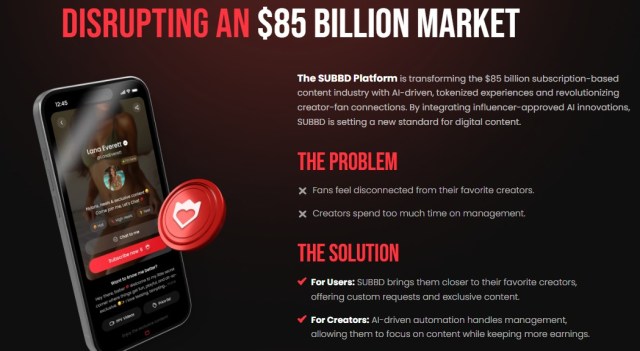
This allows for ‘AI Influencers’, autonomous personas that generate revenue 24/7. That matters. It shifts the creator economy from a labor-intensive grind to a scalable, asset-based model. Plus, by tokenizing access via Ethereum smart contracts, SUBBD ensures creators keep their data and revenue, not the platform.

The logic is simple: legacy platforms are struggling with payment restrictions and bloated fees, while decentralized alternatives offer better margins. SUBBD supports subscriptions, pay-per-view (PPV), and NFT sales, all governed by the token.

It’s a circular setup where the asset is needed for governance, staking, and premium features, theoretically driving demand as the user base grows.

Visit the $SUBBD presale.

Presale Surges Past $1.4M As Investors Seek Yield

You can see this rotation into utility tokens in the fundraising data. $SUBBD has raised over $1.4M in its ongoing presale, a figure that suggests serious conviction from early backers. With tokens currently priced at $0.05749, the entry point is still accessible relative to the roadmap.
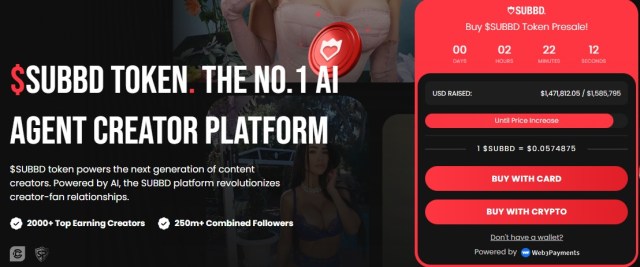
This steady inflow during a choppy market suggests investors are hedging against pure speculation by backing infrastructure plays with clear revenue models.

Staking incentives are also driving retention. SUBBD offers a fixed 20% APY for the first year to users who lock their tokens. That high-yield strategy does two things: rewards early adopters and takes supply off the table during the launch phase.

After that initial period, the model shifts to ‘platform benefit staking.’ Holding tokens then grants access to exclusive livestreams, ‘behind-the-scenes’ drops, and XP multipliers.

This structure makes the ecosystem sticky for active users. Unlike governance tokens that often lack immediate utility, $SUBBD functions as a license to operate within this new creator economy. As Coinbase validates decentralized prediction markets, projects like SUBBD are doing the same for content.

It points to a broader trend: blockchain tech finally replacing middleman-heavy industries.

Buy $SUBBD here.

Disclaimer: The content of this article is for informational purposes only and does not constitute financial advice. Cryptocurrency investments carry inherent risks, and you should perform your own due diligence before making any investment decisions.


Related Questions

QWhat is the significance of Coinbase launching a U.S.-regulated prediction market platform?

ACoinbase's launch of a U.S.-regulated prediction market platform legitimizes a sector that has operated in DeFi's gray zones and signals that infrastructure providers are becoming comfortable with the regulatory landscape for binary options.

QHow does SUBBD Token ($SUBBD) aim to address problems in the content creator economy?

ASUBBD Token uses a decentralized architecture to reduce platform fees, prevent deplatforming risks, and integrates AI tools like an AI Personal Assistant and Voice Cloning to enable scalable, asset-based revenue models for creators.

QWhat fundraising milestone has the $SUBBD presale achieved, and what does it indicate?

AThe $SUBBD presale has raised over $1.4 million, indicating strong investor conviction in utility-driven protocols with clear revenue models during a volatile market.

QWhat staking incentives does SUBBD offer to its early adopters?

ASUBBD offers a fixed 20% APY for the first year to users who lock their tokens, rewarding early adopters and reducing supply during launch, followed by platform benefit staking for exclusive content access.

QHow does the integration of AI technology differentiate SUBBD from traditional content platforms?

ASUBBD's AI integration enables features like AI Influencers and automated interactions, shifting the creator economy from a labor-intensive model to a scalable, autonomous revenue-generating system.

Related Reads

You Bet on the News, the Pros Read the Rules: The True Cognitive Gap in Losing Money on Polymarket

The article explains that the key to profiting on Polymarket, a prediction market platform, lies not just predicting real-world events correctly, but in meticulously understanding the specific rules that govern how each market will be resolved. It illustrates this with examples, such as a market on Venezuela's 2026 leader, where the official rules defining "officially holds" the office overruled the intuitive answer of who was in practical control. Other examples include debates over the definition of a "token" or what constitutes an "agreement." The core argument is that a "reality vs. rules" gap creates pricing discrepancies that savvy traders ("车头" or "whales") exploit. The platform has a formal dispute resolution process managed by UMA token holders to settle ambiguous outcomes. This process involves proposal submission, a challenge window, a discussion period, and a final vote. However, the article highlights a critical flaw in this system compared to a traditional court: the lack of separation between the arbiters (UMA voters) and the interested parties (traders with financial stakes in the outcome). This conflict of interest undermines the discussion phase, leads to herd mentality, and results in opaque final decisions without explanatory rulings. Consequently, the system lacks a body of precedent, making it difficult for users to learn from past disputes. The ultimate takeaway is that success on Polymarket requires a lawyer-like scrutiny of the rules to identify and capitalize on the cognitive gap between how events appear and how they are contractually defined for settlement.

marsbit13m ago

You Bet on the News, the Pros Read the Rules: The True Cognitive Gap in Losing Money on Polymarket

marsbit13m ago

Will the Fed Still Cut Interest Rates? Tonight's Data Is Crucial

The core debate surrounding the Federal Reserve's potential interest rate cuts is intensifying amid geopolitical conflict and rebounding inflation. The key question is whether high energy prices will cause persistent inflation or weaken consumer demand enough to force the Fed to cut rates. Citigroup presents a bullish case for cuts, arguing that oil supply disruptions from the Strait of Hormuz are temporary and will not lead to lasting inflationary pressure. They point to receding bond yields and oil prices as evidence the market is pricing in a short-lived shock. Citi's data also shows tightening financial conditions, a stabilizing labor market, and healthy tax returns, supporting their view that the path to lower rates remains open. Conversely, Deutsche Bank offers a starkly contrasting, more hawkish outlook. They argue the Fed's current policy is already neutral and expect rates to remain unchanged indefinitely. Their view is based on stalled disinflation progress and a shift toward more hawkish rhetoric from key Fed officials like Waller, who cited risks from prolonged Middle East conflict and tariffs. Other officials, including Williams and Hammack, signaled rates would likely stay on hold for a "considerable time." The market pricing has shifted dramatically, now forecasting zero cuts in 2026. The imminent release of the March retail sales "control group" data is highlighted as a critical test. This metric, which excludes gas station sales, will reveal if high gasoline prices are eroding consumer spending in other areas. A weak reading could support the case for imminent rate cuts, while a strong one would bolster the argument for the Fed to hold steady. This data is pivotal for determining the near-term policy path.

marsbit33m ago

Will the Fed Still Cut Interest Rates? Tonight's Data Is Crucial

marsbit33m ago

The Second Half of Macro Influencer Fu Peng's Career

Fu Peng, a prominent Chinese macroeconomist and former chief economist of Northeast Securities, has joined Hong Kong-based digital asset management firm Bitfire Group (formerly New Huo Group) as its chief economist. This move, announced in April 2026, triggered an 11% surge in Bitfire's stock price. Fu, known for his accessible macroeconomic commentary and large social media following, will focus on integrating digital assets into global asset allocation frameworks, particularly combining FICC (fixed income, currencies, and commodities) with cryptocurrencies for institutional clients. His career includes roles at Lehman Brothers and Solomon International, with significant influence gained through public communication. However, in late 2024, Fu faced temporary social media bans after a controversial private speech at HSBC on China's economic challenges, though he denied regulatory sanctions. He later left Northeast Securities citing health reasons. Bitfire, a licensed virtual asset manager serving high-net-worth clients, seeks to build trust and attract traditional capital through Fu’s expertise and credibility. The partnership represents a strategic shift for both: Fu enters the crypto sector after a traditional finance peak, while Bitfire aims to leverage his macro framework for institutional adoption. Outcomes remain uncertain regarding capital inflows and compatibility within corporate structure.

marsbit1h ago

The Second Half of Macro Influencer Fu Peng's Career

marsbit1h ago

Trading

Spot
Futures
活动图片