Coinbase borrows Kalshi’s playbook, sues three states over prediction markets

cointelegraphPublished on 2025-12-19Last updated on 2025-12-19

Abstract

Coinbase has filed lawsuits against regulators in Connecticut, Illinois, and Michigan, seeking federal court rulings that prediction markets operated under CFTC oversight fall under the Commodity Exchange Act and are not subject to individual state gambling laws. The exchange argues that allowing states to independently classify these markets as illegal gambling would undermine federal regulatory authority and create inconsistent national standards. Coinbase’s chief legal officer, Paul Grewal, emphasized that prediction markets function as neutral trading platforms—unlike traditional sportsbooks—and should be treated as regulated financial instruments. The legal move mirrors strategies used by prediction market operator Kalshi, which has faced mixed outcomes in similar state-level challenges. The cases may ultimately determine whether prediction markets are considered CFTC-regulated derivatives or gambling products subject to state prohibitions.

Coinbase is taking three US states to court in a bid to lock in federal protection for its planned prediction markets, opening a new front in the battle over whether event contracts are finance or gambling.​

The exchange has sued regulators in Connecticut, Illinois, and Michigan, asking federal judges to declare that prediction markets listed on a US Commodity Futures Trading Commission (CFTC)-regulated platform fall under the Commodity Exchange Act (CEA) and the CFTC’s exclusive jurisdiction, not 50 separate state gambling codes.

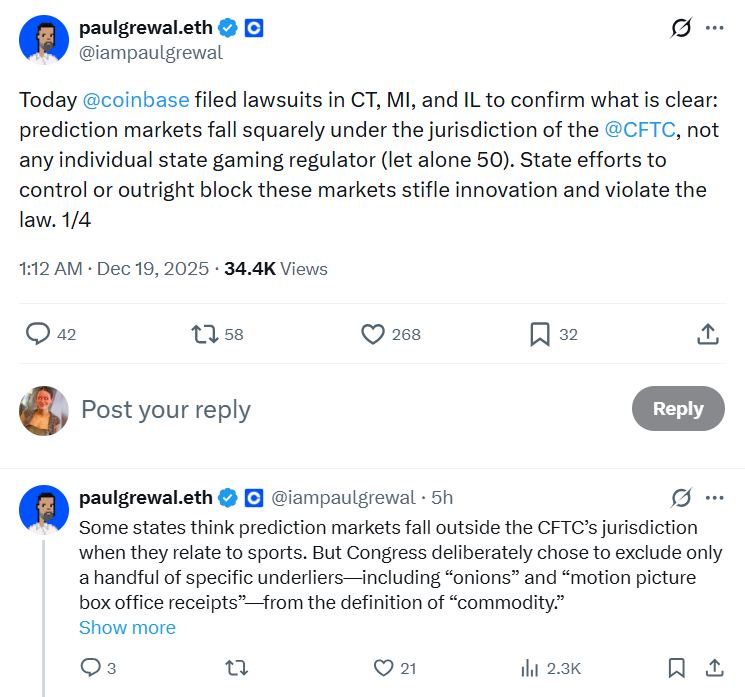
In a Friday X post, chief legal officer Paul Grewal said Coinbase filed the cases “to confirm what is clear: prediction markets fall squarely under the jurisdiction of the @CFTC, not any individual state gaming regulator (let alone 50).”​

Source: Paul Grewal

Related: Coinbase appoints former UK minister George Osborne to chair advisory council

Coinbase’s federalism challenge to state gambling laws

Coinbase frames the dispute as both a legal and structural question. Court filings argue that if each state can independently decide whether federally supervised prediction markets are illegal gambling, the most restrictive regime would effectively become the national standard, “turning our system of federalism upside down.”

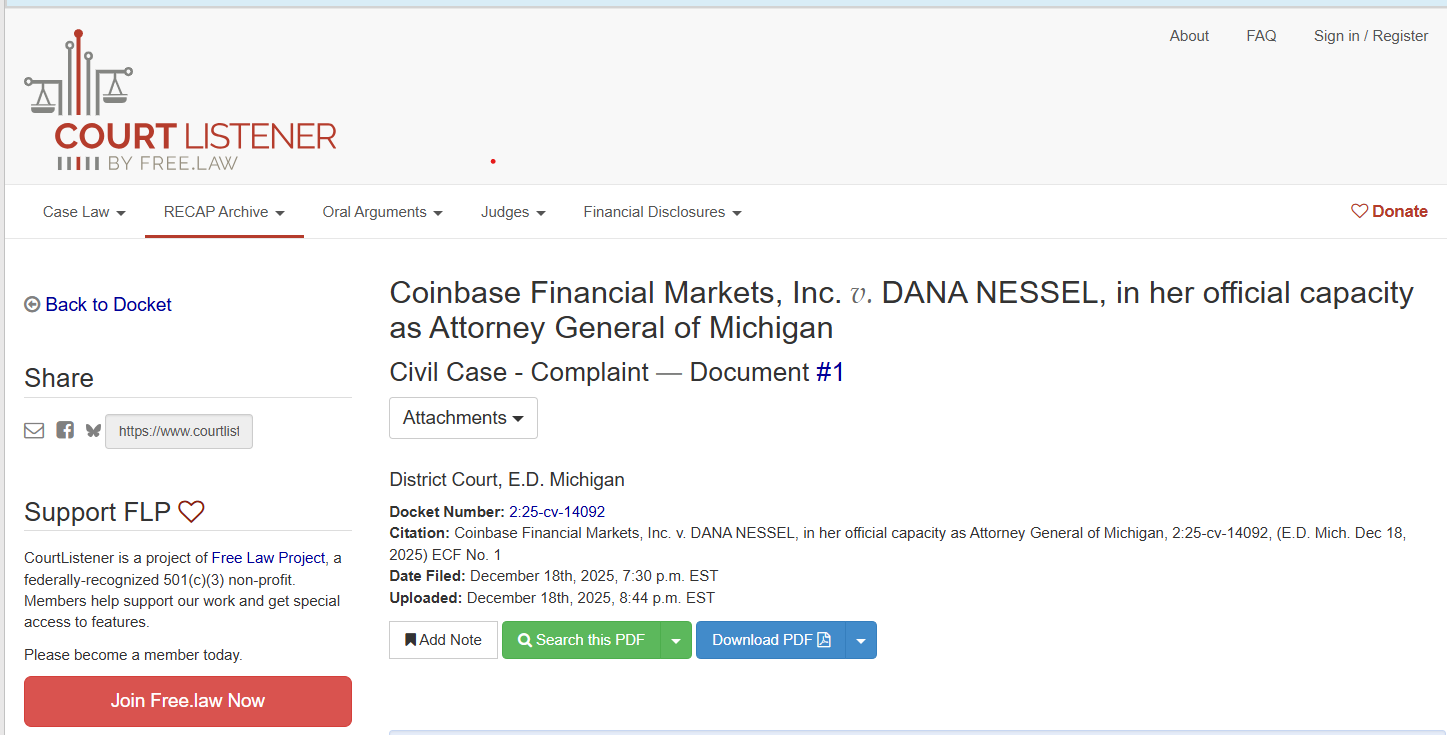
The company also leans hard on the way Congress defined “commodity” in the CEA, noting that lawmakers chose to carve out only a handful of specific underliers, notably onions and “motion‐picture box‐office receipts,” rather than sports or politics.​

Coinbase filing against Michigan. Source: Court Listener

Grewal draws a clear line between Coinbase’s planned markets and traditional sportsbooks. Casinos and bookmakers, he argues, profit from customer losses and set odds to maximize their winnings. Prediction markets, on the other hand, are neutral matching engines that pair buyers and sellers and are indifferent to price.

Treating both as the same thing, Coinbase says, would not only misread the statute but also smother a federally regulated product that is supposed to live inside the derivatives framework, with CFTC surveillance and position limits.​

Related: Coinbase adds stock trading, prediction markets in ‘everything app’ push

Kalshi’s mixed record shows what’s at stake for prediction markets

Kalshi, which already operates as a CFTC‐designated contract market for event contracts, has been testing that theory in court for almost a year. It has sued or been sued in at least six states over whether its sports and event markets are CFTC‐regulated derivatives or unlicensed gambling.

Outcomes so far are mixed. In Nevada and Maryland, judges have held that Kalshi is subject to state gaming oversight despite its CFTC status, while in New Jersey and, more recently, Connecticut, federal courts have granted the company temporary protection from enforcement while they weigh broader injunctions. Massachusetts, meanwhile, has sued to block Kalshi’s sports products, with an injunction decision not expected until early 2026.​

With Coinbase now effectively adopting Kalshi’s pre‐emption playbook, the combined docket could force federal courts to answer the core question both firms have been circling. Are US prediction markets going to be treated as regulated financial instruments under the CEA, or as gambling products that live or die under state law?


Trending Cryptos

Related Questions

QWhat is the main legal action Coinbase is taking and against which states?

ACoinbase is suing regulators in Connecticut, Illinois, and Michigan to seek federal declaration that its prediction markets are under CFTC jurisdiction, not state gambling laws.

QHow does Coinbase differentiate its prediction markets from traditional sports betting?

ACoinbase argues that prediction markets are neutral matching engines for buyers and sellers, indifferent to price, unlike sportsbooks which profit from customer losses and set odds to maximize their own winnings.

QWhat precedent has been set by Kalshi's legal battles in various states?

AKalshi has had mixed outcomes: courts in Nevada and Maryland ruled it is subject to state gaming oversight, while courts in New Jersey and Connecticut granted temporary protection from enforcement. Massachusetts is suing to block its sports products.

QWhat is the core legal question that Coinbase's lawsuit aims to resolve?

AThe core question is whether US prediction markets should be treated as regulated financial instruments under the Commodity Exchange Act (CEA) and CFTC jurisdiction, or as gambling products subject to individual state laws.

QWhat structural argument does Coinbase make regarding state vs. federal regulation?

ACoinbase argues that allowing each state to independently decide the legality of federally supervised prediction markets would let the most restrictive state regime become the de facto national standard, undermining the principle of federalism.

Related Reads

BitMart Research Institute Weekly Highlights: Rising Rate Hike Expectations, Crypto Market Stabilizes Amid Fluctuations

BitMart Research Weekly Market Review: Rate Hike Expectations Rise, Crypto Market Stabilizes Macro & Traditional Markets: U.S. stocks weakened with tech and semiconductors leading losses (Nasdaq down 1.55%, Philly Semi Index down 4.78%), while Apple bucked the trend. Brent oil surged 9.3% after Middle East ceasefire破裂, but gold fell 1% as美元 strengthened. The Fed's June FOMC纪要 was hawkish, shifting market expectations toward potential rate hikes, pushing the 10-year Treasury yield to 4.56%. Crypto Market Overview: BTC saw a slight 0.2% weekly gain, trading between ~$61.3K and $64.7K and settling near $64K. ETH outperformed, rising 1.2%. Market fear eased slightly but remained in "Fear" territory. Altcoin performance was mixed, with gains concentrated in large-cap assets. Key Developments: U.S. spot Bitcoin ETFs ended an 8-week outflow streak with a $197.4M net inflow, aiding price stabilization. On-chain, stablecoin growth was minimal. Robinhood Chain's TVL surpassed $132M within two weeks, largely driven by institutional stablecoin deposits. MicroStrategy executed its first major BTC sale (3,588 BTC for $216M) to fund dividends, while maintaining a large BTC reserve. Institutional infrastructure advanced with Swift's blockchain pilot for tokenized deposits and growing Asia-Pacific stablecoin initiatives. *This is market analysis, not investment advice. Cryptocurrency investment is high-risk; assess your risk tolerance and implement strict risk management.*

marsbit19m ago

BitMart Research Institute Weekly Highlights: Rising Rate Hike Expectations, Crypto Market Stabilizes Amid Fluctuations

marsbit19m ago

Trading

Spot

Hot Articles

Discussions

Welcome to the HTX Community. Here, you can stay informed about the latest platform developments and gain access to professional market insights. Users' opinions on the price of S (S) are presented below.

活动图片