Coinbase-Backed Stand With Crypto Discloses Political Plan For 2026 Midterm Elections

bitcoinistPublished on 2026-03-27Last updated on 2026-03-27

Abstract

Coinbase-backed advocacy group Stand With Crypto has announced its first endorsements for the 2026 U.S. midterm elections and launched an online voter hub to mobilize pro-crypto voters. The group endorsed six incumbent lawmakers from both major parties and will focus on competitive House races where crypto issues may be decisive. The voter hub provides information on candidates' positions, including scorecards based on public statements and legislative records. With over 2.7 million advocates, the group aims to turn crypto supporters into a influential voting bloc. A survey revealed that 59% of crypto owners are swing voters, and 80% are highly motivated to vote. Nearly two-thirds would support candidates backing the crypto industry, and 74% favor those supporting clearer regulations.

Stand With Crypto, an advocacy group backed by crypto exchange Coinbase (COIN), has unveiled its first endorsements for the upcoming midterm elections in the United States and unveiled a new online voter hub aimed at mobilizing pro-crypto voters.

Stand With Crypto Builds Voter Tools

In a Thursday press release, the organization said it will back six incumbent lawmakers from both major parties and focus resources on a set of competitive House contests where it believes crypto issues could be decisive.

The voter hub, the group said, will compile up-to-date information on congressional candidates’ positions on digital assets, including scorecards that rate candidates’ favorability based on public statements, legislative records, and responses to a Stand With Crypto questionnaire.

The group described the hub as a tool to equip its network — more than 2.7 million advocates nationwide — with the information needed to cast informed ballots in November.
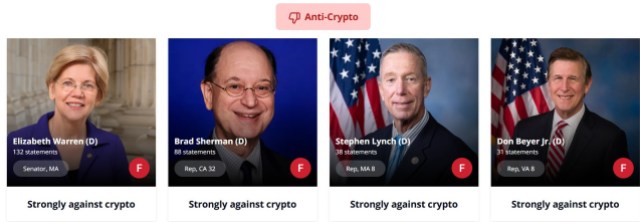
Stand With Crypto’s scorecard for each candidate

Mason Lynaugh, executive director of the Coinbase-backed group, framed the initiative as an effort to convert crypto supporters into an influential voting bloc, stating:

This year, crypto voters are poised to play a powerful and decisive role at the ballot box — our goal is to equip our more than 2.7 million advocates across the country with the tools they need to make informed choices this November.

Lynaugh added that the organization’s priority races are intended to help ensure that the 120th Congress is “the most pro-crypto session in America’s history,” and that the initial slate of endorsed candidates already has a record of supporting clear, pragmatic policies that foster innovation.

Stand With Crypto named six members of Congress in its first endorsement round: Representative Zach Nunn (R-Iowa), Rep. Susie Lee (D-Nevada), Rep. Mike Lawler (R-New York), Rep. Don Davis (D-North Carolina), Rep. Greg Landsman (D-Ohio), and Rep. Rob Borsellino Bresnahan (R-Pennsylvania).

Majority Of Crypto Owners Want Clearer Rules

The group also reported that among 1,000 crypto owners and advocates polled, 59% of crypto owners and 77% of Stand With Crypto advocates are heterogeneous voters who do not reliably vote for a single party.

The group noted that nearly a third of these voters are persuadable in their respective US Senate contests, suggesting that candidates’ positions on cryptocurrencies could sway outcomes.

Survey results also suggest crypto owners are highly motivated to vote: nearly 80% described themselves as “almost certain” to vote in 2026, and more than 75% said they were enthusiastic about participating in the general election — figures Stand With Crypto said outpace the broader adult population.

A majority (64%) of crypto owners said they would be enthusiastic about supporting candidates who back the cryptocurrency industry, and about 47% said they could back a candidate who agreed with them on crypto even if they disagreed on other policy areas.

Importantly for ongoing congressional negotiations on the anticipated CLARITY Act, 74% of crypto owners said they would be more likely to support candidates who favor clearer regulatory frameworks for the sector, with 31% saying they would be much more likely to do so.

The daily chart shows Coinbase’s stock dropping near $170 on Thursday trading session. Source: COIN on TradingView.com

Featured image from OpenArt, chart from TradingView.com

Related Questions

QWhat is the main goal of Stand With Crypto's new political initiative for the 2026 midterm elections?

AThe main goal is to mobilize pro-crypto voters by providing them with information and tools, and to help ensure that the 120th Congress becomes 'the most pro-crypto session in America's history'.

QHow many advocates does Stand With Crypto claim to have in its nationwide network?

AStand With Crypto claims to have more than 2.7 million advocates in its nationwide network.

QWhich six incumbent lawmakers did Stand With Crypto endorse in its first round?

AThe endorsed lawmakers are Rep. Zach Nunn (R-Iowa), Rep. Susie Lee (D-Nevada), Rep. Mike Lawler (R-New York), Rep. Don Davis (D-North Carolina), Rep. Greg Landsman (D-Ohio), and Rep. Rob Borsellino Bresnahan (R-Pennsylvania).

QAccording to the group's survey, what percentage of crypto owners are 'almost certain' to vote in the 2026 election?

ANearly 80% of the crypto owners surveyed described themselves as 'almost certain' to vote in the 2026 election.

QWhat key piece of legislation is mentioned in relation to the survey results on regulatory frameworks?

AThe anticipated CLARITY Act is mentioned, with 74% of crypto owners saying they would be more likely to support candidates who favor clearer regulatory frameworks for the sector.

Related Reads

Has Bitcoin Bottomed, or Is a 'Shakeout' Approaching? What's the Situation with XRP?

Cryptocurrency analytics platform Santiment shared key insights on Bitcoin and altcoin markets, highlighting significant signals from on-chain data. Analysis shows Bitcoin's 365-day MVRV ratio has fallen to -26%, indicating substantial losses for long-term holders, a level historically associated with market bottom formations and long-term buying opportunities. While short-term MVRV is near breakeven, suggesting no clear directional signal, the annual perspective points to a bottom before bullish cycles. On-chain data reveals divergent behavior: large wallets (10-10,000 BTC) have been accumulating, adding ~18,500 BTC in 10 days, while smaller retail investors continue buying dips. Analysts caution that high retail demand can sometimes create a risk of a final market shakeout or correction. The altcoin market shows a mixed picture. Ethereum's 365-day MVRV is around -33%, but recent monthly gains combined with overly optimistic social sentiment pose a short-term correction risk. XRP is in oversold territory with 30-day and 365-day MVRVs at -57.5% and -45.5% respectively, signaling potential for a strong mid-to-long term rebound. Social activity and optimism are rising for Solana, while investor sentiment remains calmer towards Cardano. Future direction for Bitcoin and altcoins depends not only on on-chain metrics but also on macroeconomic and regulatory developments. The Federal Reserve's interest rate decision and upcoming policy rulings are increasing market volatility expectations, while uncertainty around the U.S. Congressional clarity process continues to pressure pricing. *This is not investment advice.

cryptonews.ru32m ago

Has Bitcoin Bottomed, or Is a 'Shakeout' Approaching? What's the Situation with XRP?

cryptonews.ru32m ago

Bank of Korea Reveals Results of Tokenized Deposit Testing

The Bank of Korea has announced the results of its pilot test for tokenized deposits. Involving 28 central banks and international financial organizations, the project saw participation from major South Korean banks including KB Kookmin Bank, NH NongHyup Bank, Shinhan Bank, Woori Bank, and Hana Bank. Transactions, from payment orders to final settlement, were completed in real time, averaging just 80 seconds. The test involved 30 transactions across 17 different scenarios—such as corporate and interbank transfers—and was conducted in six currencies, including the Korean won, US dollar, and euro, with a total transaction value reaching approximately $995,000. The central bank reported that the platform operated stably throughout, despite being only partially connected to the existing banking infrastructure. Settlements using tokenized deposits were executed seamlessly, quickly, and transparently. An internal transfer of 20 million won (about $13,890) between NH NongHyup Bank and Shinhan Bank was also successfully processed via the Project Agora platform, which involved connecting to the Bank of Korea's CBDC test platform, Project Hangang. Additionally, KB Kookmin Bank and Japan's MUFG Bank tested cross-border payments using these deposit tokens—digital certificates issued by commercial banks within the pilot, not directly by the central bank. The Bank of Korea plans to continue testing payments with tokenized deposits. This follows last year's pledge by South Korean authorities to tighten regulations for won-based stablecoins, which will require approval from both the central bank and the Financial Services Commission.

cryptonews.ru2h ago

Bank of Korea Reveals Results of Tokenized Deposit Testing

cryptonews.ru2h ago

Trading

Spot
活动图片