Anthropic has separated Agent SDK usage from subscriptions, offering a fixed credit based on API retail prices instead. Heavy users have seen their usable volume shrink by nearly tenfold. In the same week, OpenAI offered enterprise users two months of free migration to Codex. The first pricing battle in the final round of the ASI race has begun.
Anthropic has changed programmatic calls from an "all-you-can-eat buffet" to "rationed portions."
Effective June 15, calls from claude -p, Agent SDK, GitHub Actions, and third-party tools like OpenClaw and Hermes are all being separated from subscription quotas.
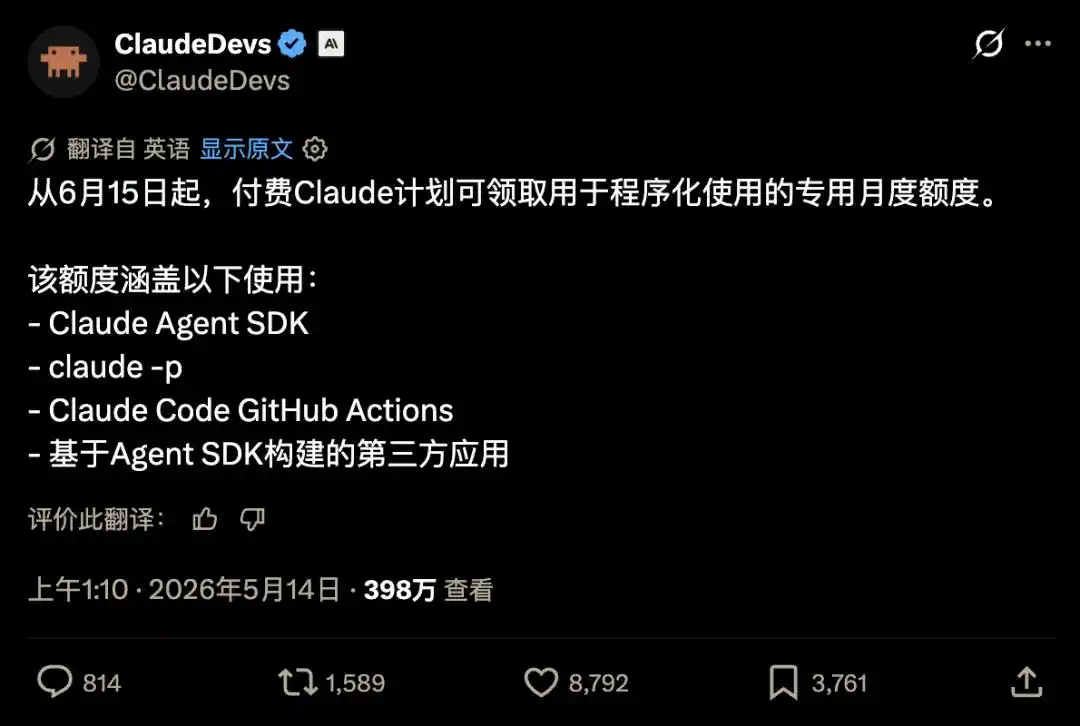
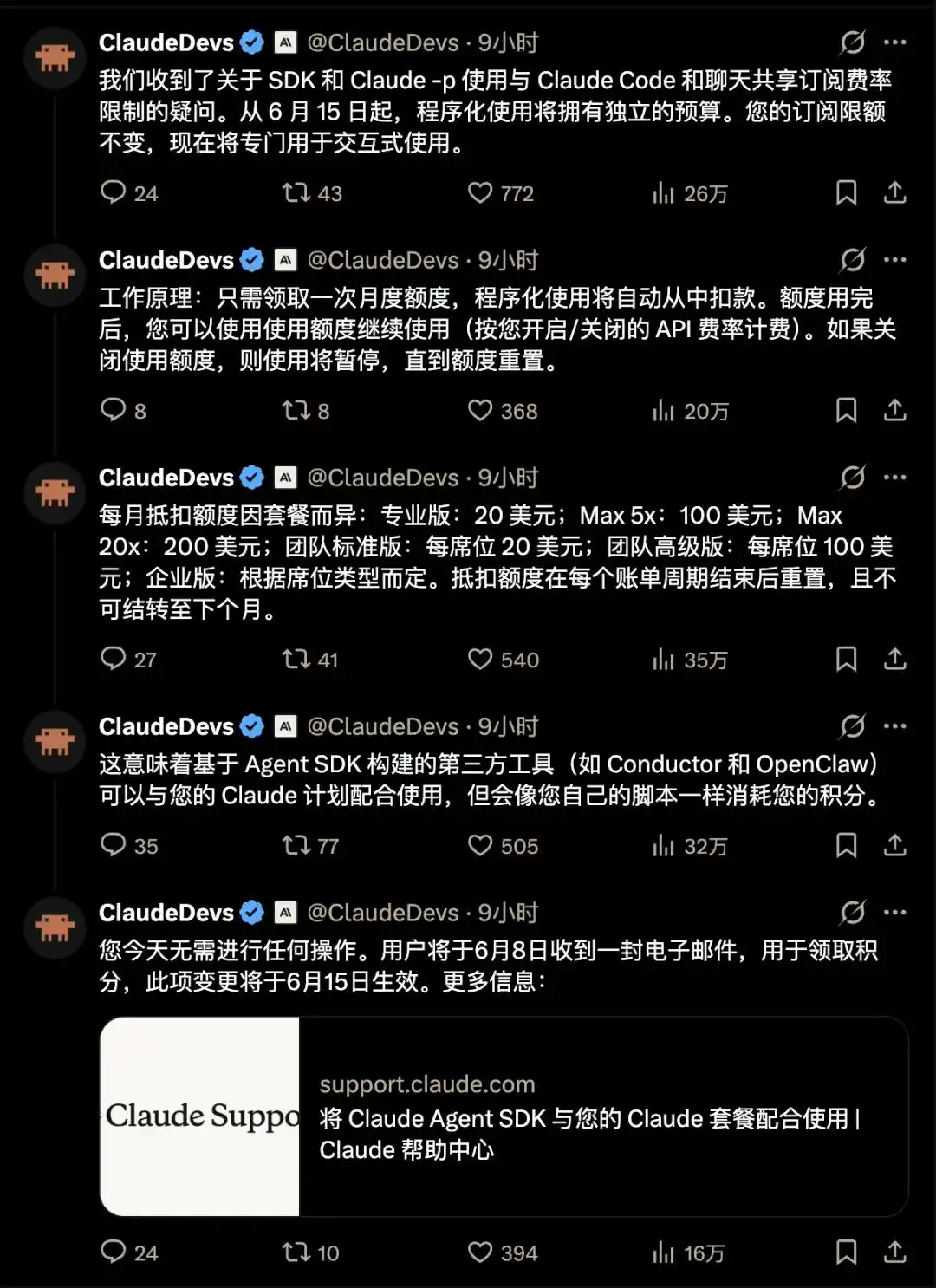
https://x.com/ClaudeDevs/status/2054610152817619388
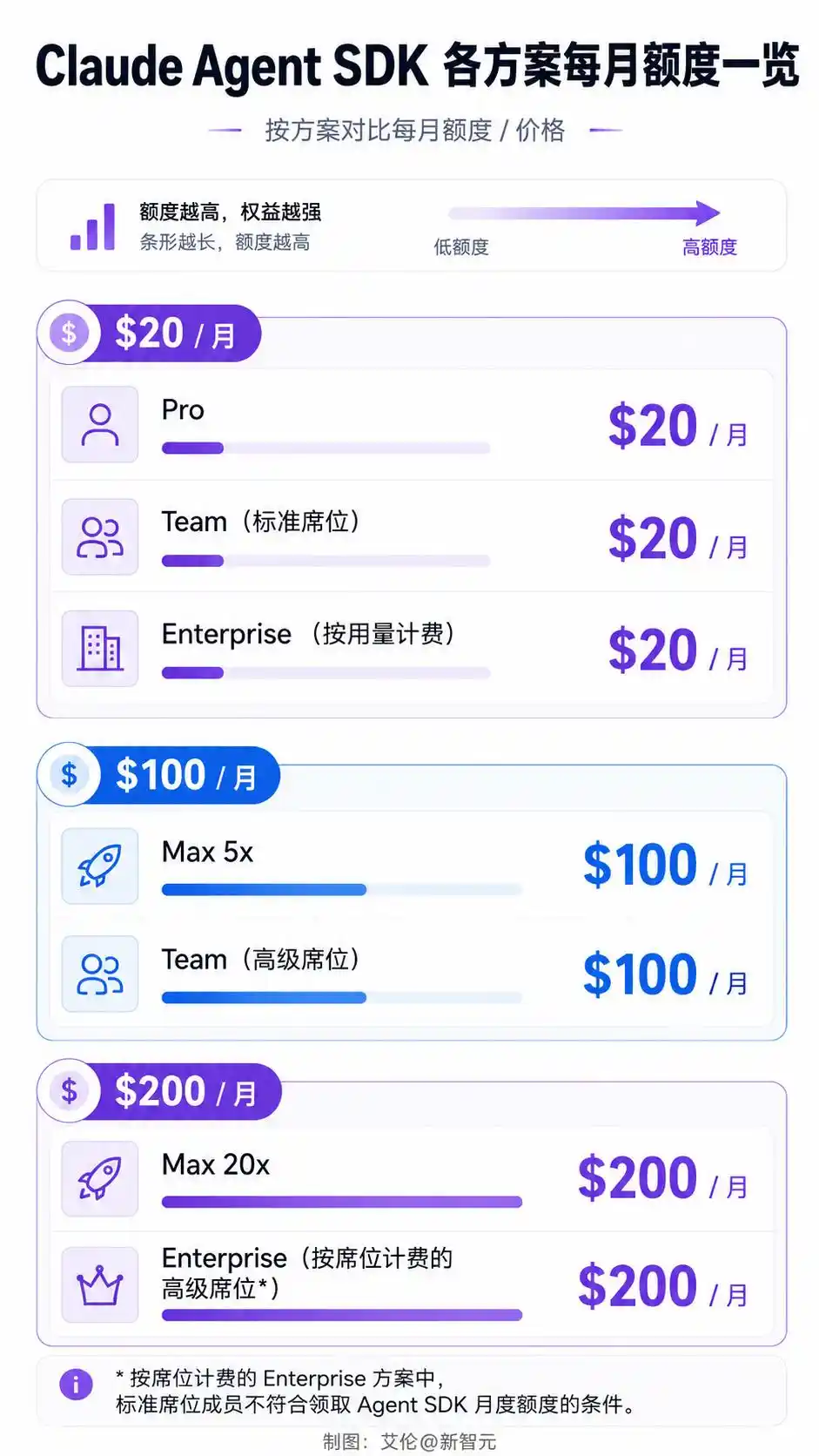
This is being replaced by a monthly Credit calculated based on API retail prices: $20 for Pro, $100 for Max 5x, and $200 for Max 20x.
The original subscription quota remains unchanged, dedicated exclusively to Claude Code interactive use and claude.ai chat. The two pools do not interfere with each other.
Credits must be manually claimed. Notification emails were sent on June 8, effective from June 15, resetting monthly without rollover.
Anticipating user frustration, Claude Code quotas were raised twice in a row to appease users.
Last week, the 5-hour rolling window doubled, and this week the weekly total increased by another 50%. These are cumulative and effective until July 14.

https://x.com/ClaudeDevs/status/2054639777685934564
All paying users are automatically adjusted; no action is required.
Anthropic's biggest competitor, OpenAI, quickly seized this opportunity, immediately launching a free Codex migration for enterprises.
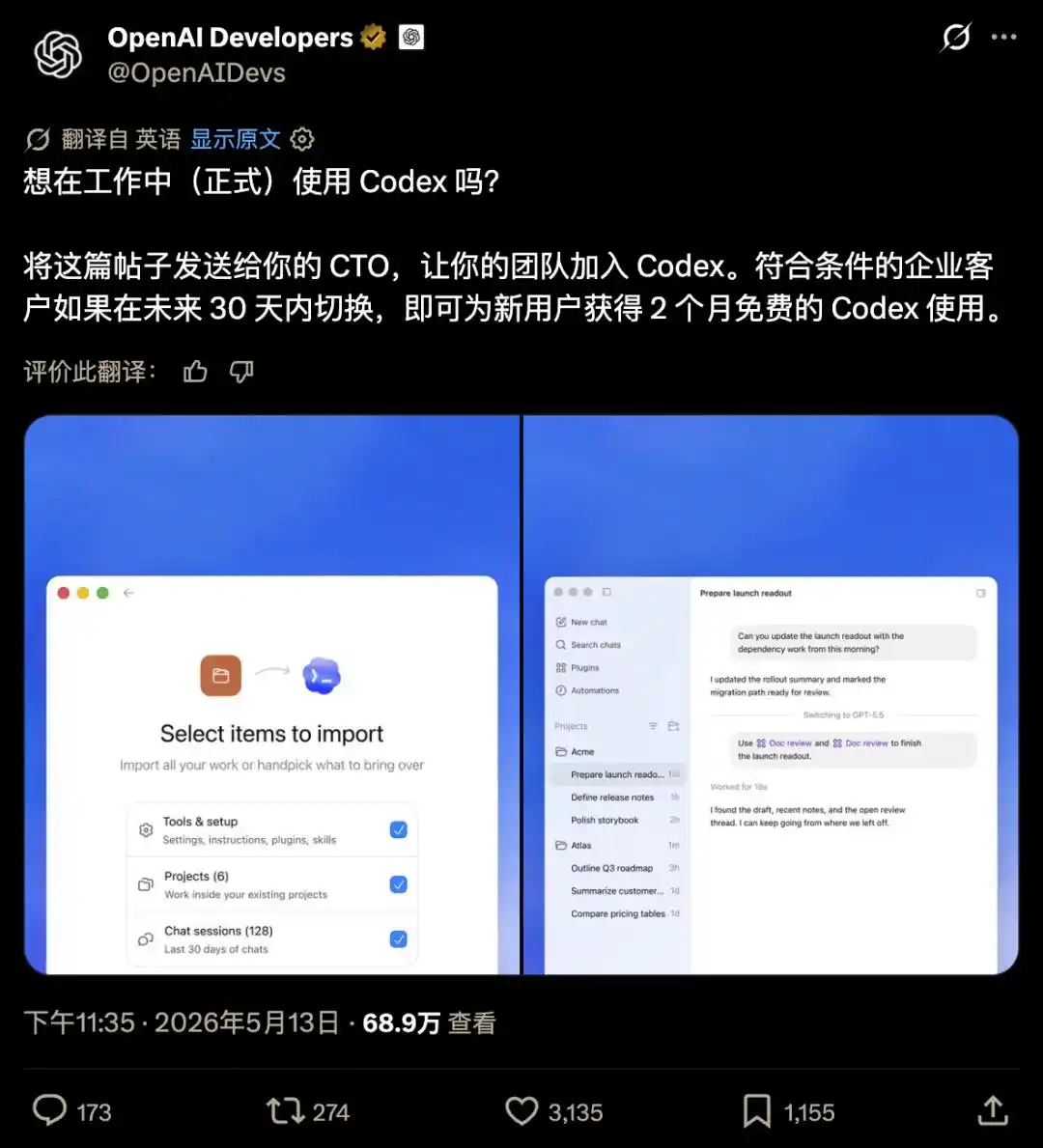
https://x.com/OpenAIDevs/status/2054586214112780518
Apply within 30 days for 2 months free, with a built-in one-click migration tool that can directly transfer Claude Code's system prompts, Skills, and MCP configurations.
Codex does not differentiate between interactive and programmatic calls; subscription users can use it however they want.
These three events happening simultaneously are not a coincidence.
Why Split?
There is a structural flaw in Anthropic's subscription model. On the eve of its impending IPO and the ASI sprint, Anthropic can no longer tolerate this flaw.
The economic model of subscriptions is based on the premise that human typing speed is limited.
The Token volume a $200/month Max 20x user can consume through manual interaction translates to an API retail price between $2000 and $5000.
Anthropic was willing to subsidize this difference because interactive data is valuable for model training.
Agent SDK and claude -p broke this premise.
Machines calling 24/7, a for loop could consume a month's quota in just a few hours. Moreover, programmatic calls have almost no training value from user behavior data.
It was tolerable when the user base was small.
But SpaceX just leased 220,000 GPUs to Anthropic, Google added up to $40 billion in investment, and Amazon signed a $25 billion capacity agreement.
For further reading: Breaking News, Musk's xAI Disbands! 220,000 GPUs Reluctantly Given Entirely to Claude
With compute power secured and user numbers poised to explode, the subsidy bleeding would amplify exponentially.
Anthropic's help documentation also explicitly states its position: teams running production-grade automation should switch to the developer platform and use API keys for pay-as-you-go billing.
This is a pricing flaw patch, timed by the rhythm of the ASI competition.
How Big is the Cost?
Same face value, but actual shrinkage is nearly tenfold.
A Max 20x user pays $200 monthly and receives a Credit of $200.
But before, they shared the subscription quota, which, converted to API retail price, was worth approximately $2000-$5000.
Now it's replaced by a fixed $200 credit calculated at API retail price.

https://x.com/anakin/status/2054643675590807884
Pro users are in an even more awkward position. $20 for Sonnet only allows about six to seven million input Tokens or a little over a million output Tokens. A few rounds of intensive Agent loops will deplete it.
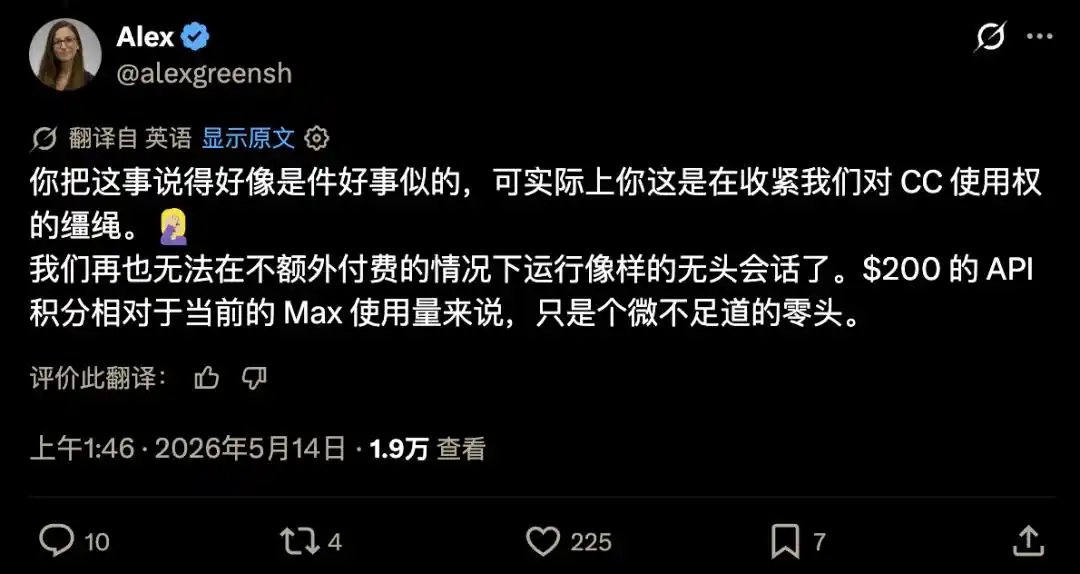
https://x.com/alexgreensh/status/2054619241811169402
Third-party tool users are hit the hardest.
Previously, using Agent tools like OpenClaw and Hermes was equivalent to running high-frequency automation at subscription prices.
Under the new policy, this path is left with only that small amount of credit. Once burned, users either enable Extra Usage to continue at API prices or stop until next month.
The only good news is that third-party tools finally received their "official ID."
Two months ago, Anthropic still viewed OpenClaw as a means of exploiting loopholes. Now, the announcement directly names and acknowledges their legitimacy.
Mismatch Between Compute Power and Developers
At the moment of greatest compute power, Anthropic uses pricing policy to push heavy developers toward competitors.
SpaceX's 220,000 GPUs are currently the only compute power cooperation that can be immediately deployed; other partners' capacity all needs to wait until late 2026 or even 2027.
With this batch of spot compute power backing it up, Claude Code quotas can be successively raised.
But the Claude Code quota increase and the SDK Credit cap target two different groups.
The overlap between interactive users and programmatic call users is limited. The improved experience for the former does not offset the losses for the latter.
OpenAI precisely stepped into this crack.
Codex does not separate usage by method, does not differentiate between call types, has zero seat fee, charges by Token, and includes a tool for one-click migration from Claude Code.
The pain point just created by Anthropic is immediately used as a selling point by OpenAI.
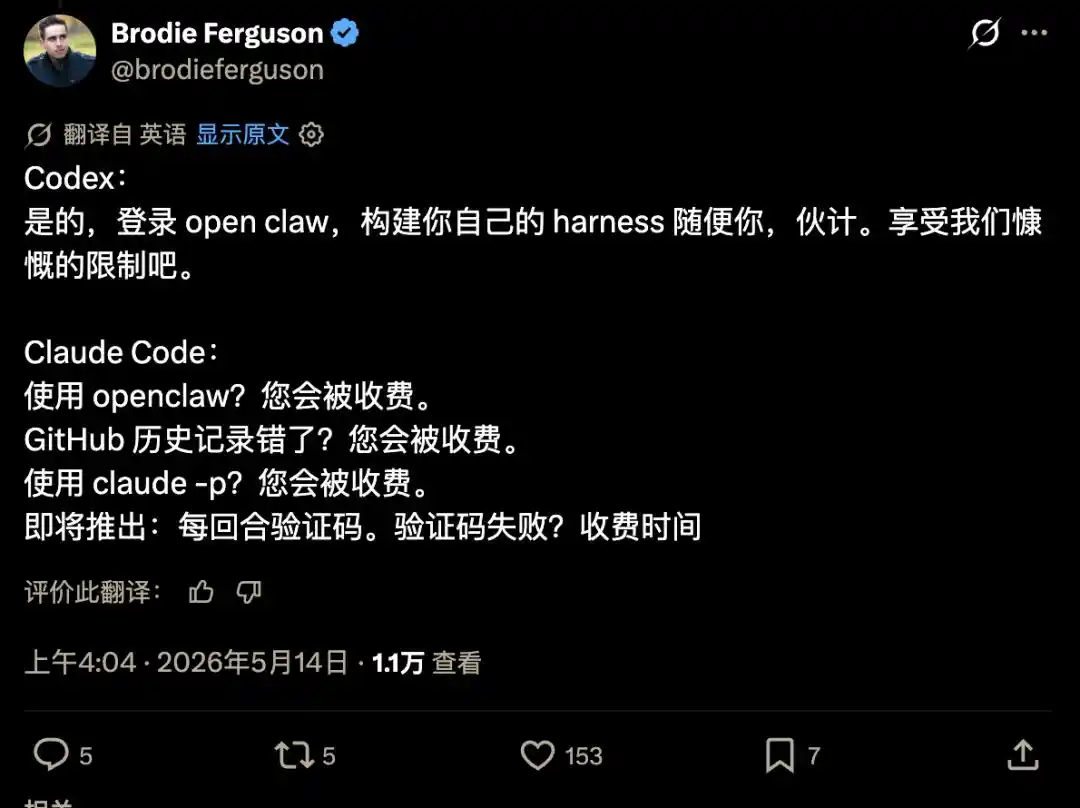
https://x.com/brodieferguson/status/2054653995864707344
The two-month free period is just enough for enterprises to get their automated pipelines running and form muscle memory.
After the free period ends, the migration cost is already too high to move back.
Why This Matters to Everyone
The era of "unlimited all-you-can-eat buffets" for AI subscriptions is ending.
Anthropic's patching of this loophole is just the beginning.
As Agent capabilities grow stronger and automated calls become more frequent, all AI companies will face similar economic pressure.
AI payment models will gradually shift from monthly flat rates to pay-as-you-go based on actual consumption, much like the path cloud computing took.
The ownership of the developer ecosystem determines what AI ordinary users will use in the future.
Whoever wins over developers will have a richer tool ecosystem.
Today's battle between Claude Code and Codex will directly reflect the quality of AI applications available on everyone's phones in three to five years.
The endgame of the ASI competition is not just about model capabilities, but also about ecosystems.
The final round of the ASI competition, the contenders are basically locked in: on one side, OpenAI + Microsoft + Stargate (Oracle + SoftBank); on the other, Anthropic + Google + Amazon + SpaceX.
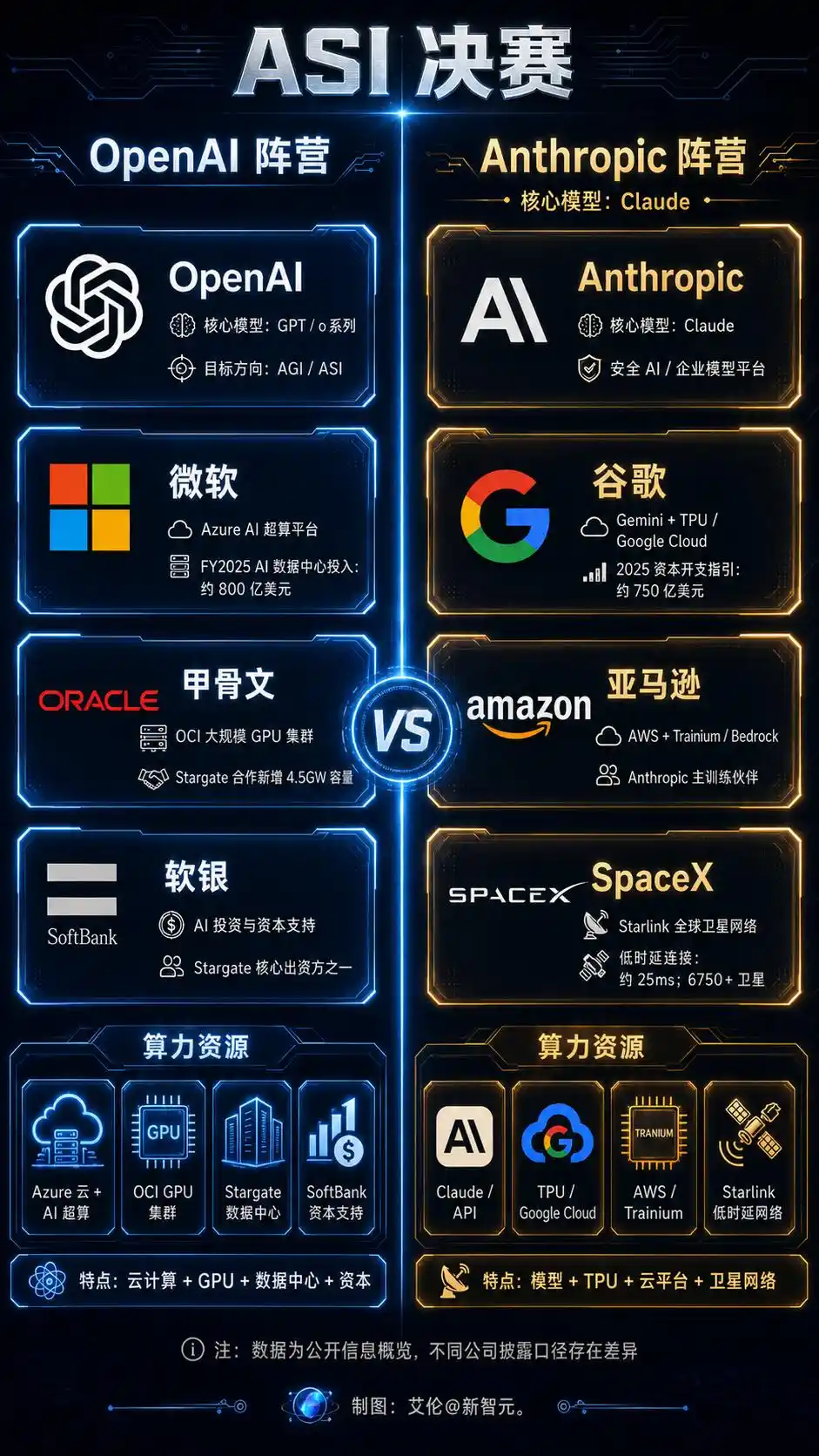
Model capabilities are converging. The real moat lies in who has the strongest infrastructure, the most developers, and the most entrenched enterprise customers.
This week's covert pricing war is the first shot in the final round.
Three things to watch next: the verdict in the Musk vs. Altman case in mid-May, Anthropic's IPO pricing in June, and whether the temporary Claude Code quota increase becomes permanent after its expiration on July 14.
The direction of these three events will directly determine which side the developer ecosystem scale tips towards in the ASI race.
Remember to claim your Credit on June 8. If you don't claim, it's $0; claiming gives you at least $200.
Appendix: Full Announcement
Using Claude Agent SDK in Your Claude Plan
Updated today
Claude subscription plans are now eligible for monthly Agent SDK credits. These credits cover Claude Agent SDK usage, the claude -p command, and third-party applications built on the Agent SDK. This article explains what is covered by the credit, how it works, and how to claim it.
Available in Pro, Max, Team, and Enterprise plans from June 15, 2026. Claude developer platform accounts using API keys will not receive credits. Pay-as-you-go billing remains unchanged.
What's Changing
From June 15, 2026, Claude Agent SDK and claude -p usage will no longer count against your Claude plan's usage limits. Your subscription usage limits remain unchanged and are reserved for interactive use of Claude Code, Claude Cowork, and Claude.
To support Agent SDK usage, eligible Pro, Max, Team, and Enterprise plan users can claim a separate monthly credit. This credit applies only to Agent SDK usage and refreshes with your billing cycle.
Monthly Credit by Plan
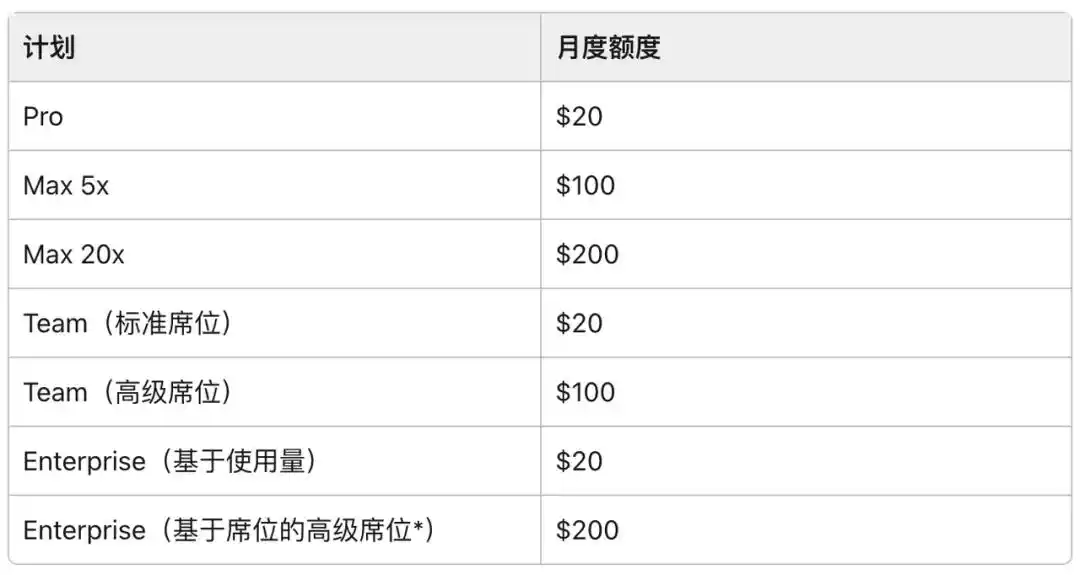
*Members using standard seats in seat-based Enterprise plans are not eligible to claim the Agent SDK monthly credit.
What the Credit Covers
The Agent SDK monthly credit applies to:
Claude Agent SDK usage (Python or TypeScript) in your own projects
The claude -p command (non-interactive mode) in Claude Code
Claude Code GitHub Actions integration
Third-party applications using your Claude subscription for authentication via Agent SDK
The Credit Does Not Apply to:
Interactive Claude Code in terminals or IDEs
Claude conversations on web, desktop, or mobile apps
Claude Cowork
Other features deducted from extra usage
How the Credit Works
Per user, not shared. Credits belong to individual accounts. They cannot be shared or pooled among team members.
Refreshes monthly. Your credit resets at the start of each billing cycle. Unused credits do not carry over to the next cycle.
One-time opt-in. You claim the credit once through your Claude account. Afterwards, it refreshes automatically each cycle.
Priority deduction. Agent SDK usage is deducted first from your monthly credit, then from other sources.
Usage transfers to extra usage after credit is exhausted. When your monthly credit is used up, additional Agent SDK usage flows to extra usage at standard API rates—but only if you have extra usage enabled. If extra usage is not enabled, Agent SDK requests will stop until your credit refreshes.
What Remains Unchanged
This change does not affect:
Subscription usage limits. Your plan's usage limits have not changed as part of this update.
Interactive Claude Code. Using Claude Code in terminals or IDEs continues to use your subscription usage limits exactly as before.
Claude conversations. Web, desktop, and mobile chat continue to use subscription usage limits.
API key users. If you use Agent SDK with an API key from the Claude developer platform, nothing changes. Pay-as-you-go billing continues, and you will not receive an Agent SDK monthly credit.
For Team and Enterprise Administrators
If you manage a Team or Enterprise account, here's what you need to know:
Credit is per user. Each eligible user in your team claims their own credit. Credits cannot be pooled, transferred, or shared across the organization.
Large-scale production automation. The Agent SDK monthly credit is sized for personal experimentation and automation. Teams running shared production automation should use the Claude developer platform and API keys for predictable pay-as-you-go billing.
What you need to do. No action is required now. Eligible users in your team will receive an email with details and instructions for claiming the credit before June 15, 2026.
References:
https://support.claude.com/zh-CN/articles/15036540-%E5%9C%A8%E6%82%A8%E7%9A%84-claude-%E8%AE%A1%E5%88%92%E4%B8%AD%E4%BD%BF%E7%94%A8-claude-agent-sdk
https://x.com/ClaudeDevs/status/2054610152817619388
https://x.com/ClaudeDevs/status/2054639777685934564
This article is from the WeChat public account "Xinzhiyuan," author: Xinzhiyuan, editor: Ellen