Jito jumps 12% after JIP-38 buyback proposal – Can JTO reach $0.80?

ambcryptoPublished on 2026-07-21Last updated on 2026-07-21

Abstract

Jito (JTO) surged 12% following the introduction of JIP-38, a proposal to use Jito DAO's revenue from JTX Trade for programmatic JTO buybacks and burns for at least one year. The token's price rose to $0.6087 with market cap reaching $304.67 million, supported by increased trading volume and positive sentiment around Solana's ecosystem. Derivatives activity grew as Open Interest increased, indicating fresh capital entering the market. Spot market data also showed sustained buyer dominance. Technically, JTO rebounded from the $0.5332 support level, with the next key resistance at $0.65. A break above this level could pave the way for a move toward $0.80, while failure to hold support may lead to a retest of lower levels. The rally is viewed as driven by improving fundamentals and broader participation rather than mere speculation.

Jito [JTO] climbed 11.59% over the previous 24 hours to $0.6087 as of writing, while its market capitalization reached $304.67 million as investor interest strengthened. Trading activity also accelerated, with daily volume surging 142.17%, indicating that buyers returned aggressively after recent weakness.

The rally followed growing optimism surrounding JIP-38, a proposal that established Jito as a token-centric network by directing 100% of the Jito DAO’s revenue share from JTX Trade toward programmatic JTO buybacks and burns for at least one year.

Positive sentiment surrounding Solana’s [SOL] institutional adoption and capital rotation into Solana ecosystem tokens further supported the move. As a result, market participants increasingly viewed the proposal as a long-term value driver rather than a short-lived catalyst.

JTO’s leveraged traders return

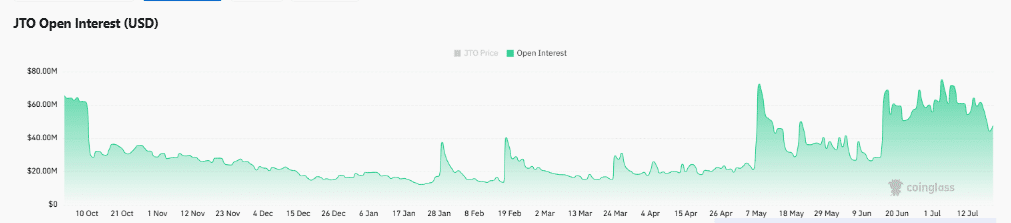
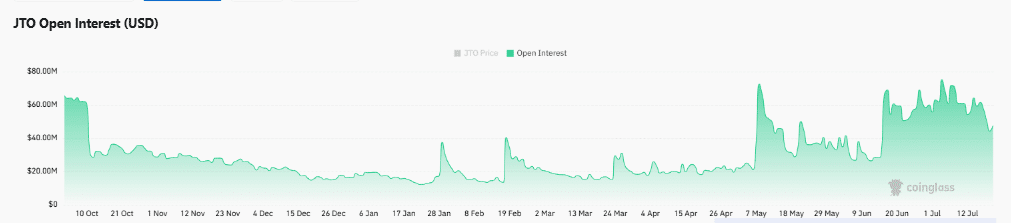
Derivatives traders also increased their exposure as Open Interest (OI) rose 14.53% to $52.05 million at press time, during the rally. The increase suggested that fresh positions entered the market instead of existing contracts simply closing.

Rising OI alongside double-digit price gains often reflected stronger market conviction because both spot and futures participants committed additional capital.

Unlike rallies driven by declining derivatives exposure, JTO‘s advance attracted broader participation across multiple trading segments. The combination suggested traders expected the bullish narrative surrounding JIP-38 to continue influencing price action.

However, expanding leveraged exposure also increased the probability of sharper volatility should sentiment reverse or profit-taking accelerate after the recent advance.
Source: CoinGlass

Buyers maintained control across spot markets

Spot market activity also favored buyers throughout the latest recovery.

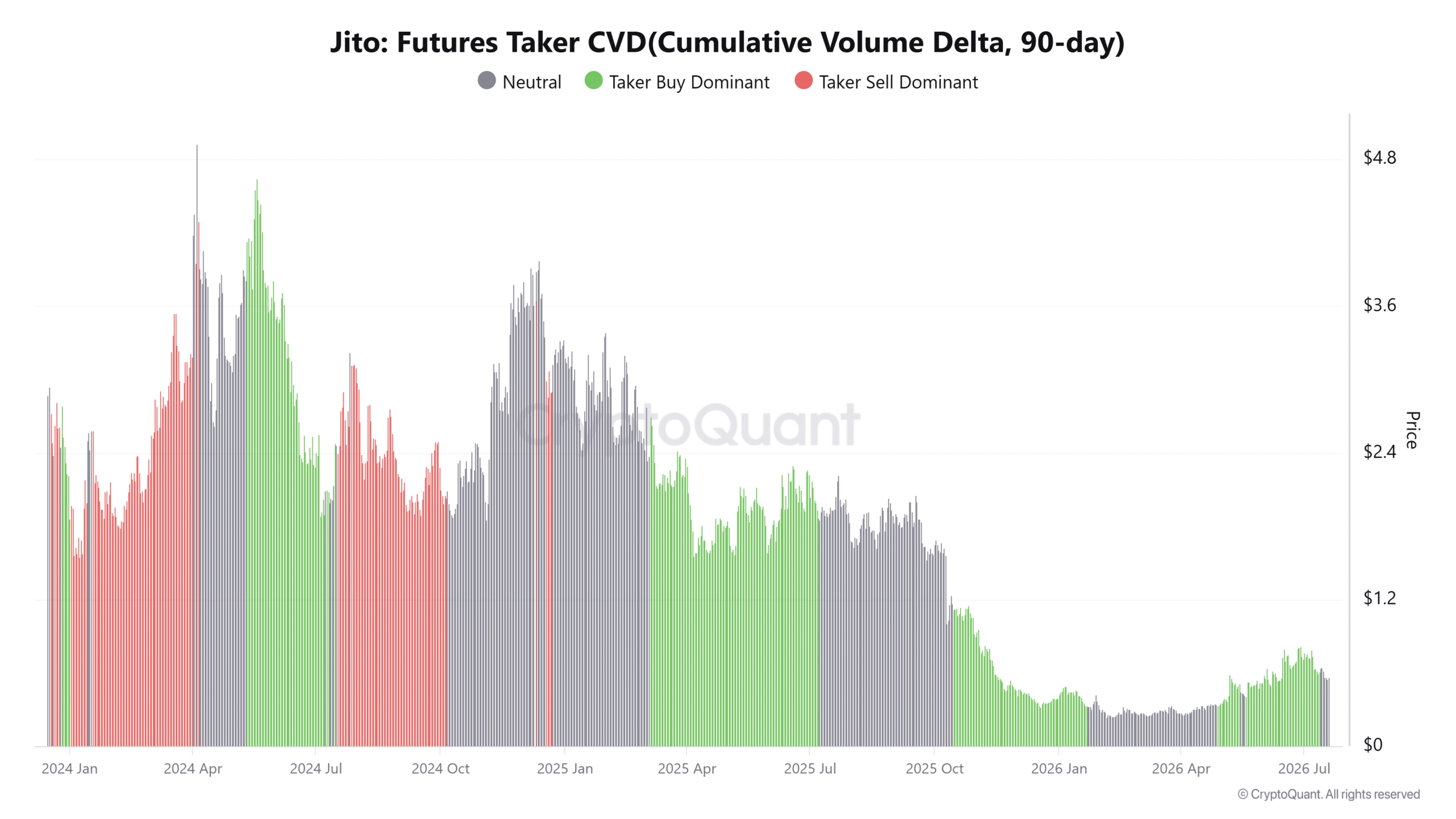
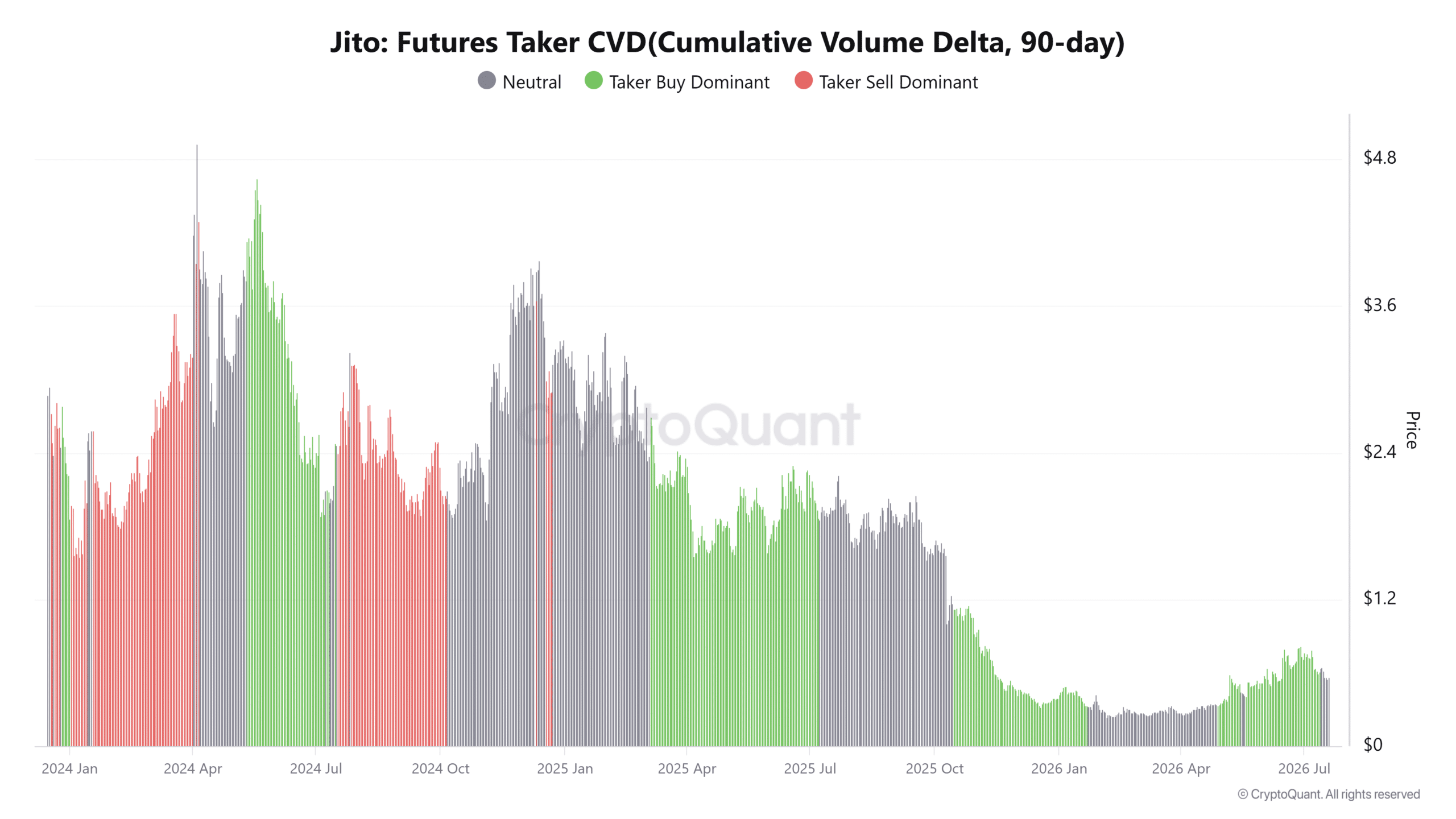
At the time of writing, the 90-day Futures Taker CVD remained buy dominant, showing that aggressive market buyers consistently absorbed available sell orders. The behavior aligned with the sharp increase in trading volume, which expanded 142.17% over the previous day.

Stronger buying pressure supported the price recovery instead of allowing sellers to regain control after recent weakness.

In addition, the sustained demand complemented improving sentiment surrounding Jito’s revised tokenomics and the broader Solana ecosystem. Although buyers held the advantage, continued demand would remain necessary to absorb future profit-taking as speculative participation increased across both spot and derivatives markets.
Source: CryptoQuant

Can JTO reclaim $0.80 next?

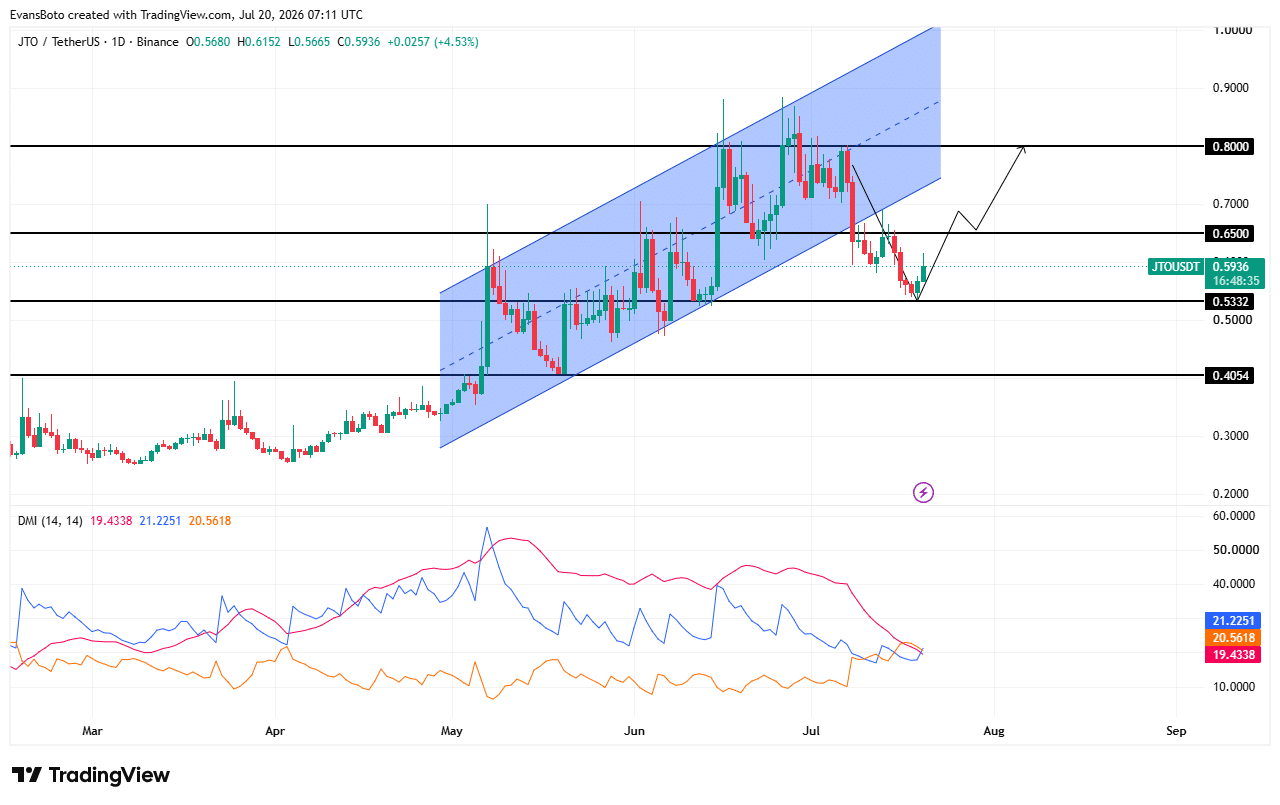
JTO rebounded from the $0.5332 support area after breaking below its broader ascending channel earlier.

Buyers pushed the token back toward $0.6500, which now represented the nearest resistance before a possible move toward $0.8000. The Directional Movement Index (DMI) also reflected improving conditions.

At press time, the +DI stood at 21.23, remaining above the -DI at 20.56, while the ADX measured 19.43, suggesting bullish strength had started improving but remained below the threshold associated with a strong trend.

If buyers reclaimed $0.6500, the chart suggested a retest of $0.8000 could follow. However, failure to hold above $0.5332 would likely expose JTO to another test of the $0.4054 support level.
Source: TradingView

Conclusively, JTO’s rally reflected improving fundamentals, stronger buying pressure, and increasing trader participation rather than a purely speculative bounce.

If buyers continue defending support and overcome the $0.6500 barrier, the token could challenge $0.8000 in the sessions ahead. However, weakening demand would likely delay that recovery and shift attention back toward the $0.5332 support zone.


Final Summary

  • JTO’s rally gained support from stronger buying activity and growing confidence after the JIP-38 proposal.
  • Rising Open Interest and steady spot demand kept bullish pressure intact, though $0.6500 remains the next key hurdle.


Trending Cryptos

Related Questions

QWhat is the JIP-38 proposal and how did it affect Jito (JTO)?

AThe JIP-38 proposal established Jito as a token-centric network by directing 100% of the Jito DAO's revenue share from JTX Trade toward programmatic JTO buybacks and burns for at least one year. This proposal sparked investor optimism, leading to a significant price rally for JTO, with the token climbing 11.59% in 24 hours as the market viewed it as a long-term value driver.

QWhat were the key indicators of increased trading activity and market conviction for JTO during the rally?

AThe key indicators were a surge in daily trading volume by 142.17% and a rise in Open Interest (OI) by 14.53% to $52.05 million. The increase in OI indicated the entry of fresh long positions rather than just the closing of old contracts, showing broader market participation and stronger conviction among both spot and derivatives traders.

QWhat does the 90-day Futures Taker CVD data indicate about the market sentiment for JTO?

AThe 90-day Futures Taker CVD data showed a buy-dominant trend, indicating that aggressive market buyers were consistently absorbing available sell orders. This behavior aligned with the sharp increase in trading volume and demonstrated sustained buying pressure, supporting the price recovery and indicating positive sentiment.

QAccording to the article, what are the key price levels JTO needs to overcome for a potential move towards $0.80?

AAccording to the article, the key resistance level JTO needs to overcome is $0.6500. If buyers successfully reclaim this level, a retest of the $0.8000 target could follow. However, failure to hold above the $0.5332 support level could lead to a test of the lower $0.4054 support.

QHow did the Directional Movement Index (DMI) reflect the market conditions for JTO at the time of writing?

AAt the time of writing, the DMI showed the +DI at 21.23, remaining above the -DI at 20.56, indicating bullish strength was improving. However, the ADX (Average Directional Index) measured 19.43, which is below the threshold commonly associated with a strong, established trend, suggesting the bullish momentum was present but not yet extremely strong.

Related Reads

Starknet Launches Privacy-First Bitcoin strkBTC, Targeting Institutional On-Chain Finance

Starknet introduces strkBTC, a privacy-focused version of Bitcoin designed for institutional on-chain finance. As digital assets face increased scrutiny, two major challenges emerge: the public visibility of all transactions and the looming threat of quantum computing to current cryptographic signatures. Bitcoin, representing over 56% of the crypto market, highlights these issues most clearly. strkBTC, built on Starknet’s STRK20 privacy framework, allows Bitcoin to be used privately on-chain while maintaining compliance. It operates in two modes: a public mode like standard ERC-20 tokens, and a shielded mode that hides balances and transactions from public view. This addresses the need for confidentiality in institutional finance, similar to traditional markets’ private trading venues. A third-party auditor, Financial Privacy Inc, holds view keys for regulatory access when necessary. Additionally, Starknet is positioned ahead in quantum resistance. Its STARK-based proof system relies on hash functions rather than elliptic-curve cryptography, making it less vulnerable to quantum attacks. Starknet’s native account abstraction also allows easier migration to quantum-resistant signatures without protocol-level forks. The team has outlined a roadmap to achieve end-to-end quantum security before “Q-day,” though dependencies on Ethereum’s own migration remain. While strkBTC currently uses a trusted bridge consortium, Starknet plans to transition toward more trustless, Bitcoin-native verification over time. The initiative underscores a shift in on-chain finance beyond yield—prioritizing privacy, compliance, and long-term security for institutional adoption.

marsbit5m ago

Starknet Launches Privacy-First Bitcoin strkBTC, Targeting Institutional On-Chain Finance

marsbit5m ago

Bank of America Quietly Positions: Could $6 Trillion in Bank Deposits Flow into Stablecoins?

Bank of America has quietly made leadership appointments to accelerate its digital asset strategy, sparking discussion about a potential large-scale migration of bank deposits to stablecoins. Reports highlighted the bank naming Sonali Theisen, Kevin Milsom, and Adam Dixon to lead its global digital asset and AI platform, focusing on stablecoins, tokenized deposits, custody, and crypto settlement. This move revived a claim that $6 trillion in bank deposits could flow into stablecoins, a figure originally cited by Bank of America's CEO Brian Moynihan in January. However, he conditioned this shift on stablecoins being allowed to pay interest—a feature not permitted under the current GENIUS Act. The legislation's final rules are delayed, pushing its effective date to January 2027. Major banks are not waiting. JPMorgan and Citigroup are already piloting tokenized deposit services, and a consortium including Bank of America is building a shared tokenized deposit network targeting a 2027 launch. While some, like Pacemakers.io's Alessandro Hatami, remain skeptical of rapid bank collaboration, data shows significant institutional adoption. Stablecoin settlement volume hit $33 trillion in 2025, and analysts project the market could surpass $1 trillion by 2026. Despite a recent dip in crypto prices and stablecoin supply, the institutional push for real-world use cases continues. The race is on for January 2027, when the GENIUS Act takes effect, potentially reshaping the competition between traditional finance and digital assets.

Foresight News23m ago

Bank of America Quietly Positions: Could $6 Trillion in Bank Deposits Flow into Stablecoins?

Foresight News23m ago

US Treasury Secretary Bement Claims: The US Will Soon Control 80% of Global Computing Power

U.S. Treasury Secretary Ben Sent proclaimed that America is poised to control 80% of the world's computing power, positioning compute dominance as a core pillar of U.S. economic strategy. Speaking on the Mike Rowe show, he stated the U.S. currently holds 50-60% of global compute share, with expectations to reach 80% soon. He framed this as a strategic competition the U.S. "cannot afford to lose," warning that a rival's lead would grant "unacceptable" strategic leverage, while asserting a current one-year AI lead. This high-level policy endorsement is seen as a direct boost for AI infrastructure investment, benefiting chipmakers like NVIDIA and cloud providers' capex cycles. Sent positioned AI compute, semiconductors, and quantum computing as three pillars of national economic strength and security. He defended AI's societal impact, citing historical tech shifts, and argued AI empowers small businesses without causing net job loss so far. He highlighted government efforts to deepen public-private AI cybersecurity cooperation. For investors, the statement signals sustained U.S. policy support for AI infrastructure. However, analysts urge caution, noting "compute share" lacks a standard public metric; the 80% figure is a forecast, not audited data. They recommend focusing on tangible indicators like physical capacity expansion and power infrastructure, with future semiconductor and cloud reports providing key verification data.

marsbit34m ago

US Treasury Secretary Bement Claims: The US Will Soon Control 80% of Global Computing Power

marsbit34m ago

Trading

Spot

Hot Articles

How to Buy JTO

Welcome to HTX.com! We've made purchasing Jito (JTO) simple and convenient. Follow our step-by-step guide to embark on your crypto journey.Step 1: Create Your HTX AccountUse your email or phone number to sign up for a free account on HTX. Experience a hassle-free registration journey and unlock all features.Get My AccountStep 2: Go to Buy Crypto and Choose Your Payment MethodCredit/Debit Card: Use your Visa or Mastercard to buy Jito (JTO) instantly.Balance: Use funds from your HTX account balance to trade seamlessly.Third Parties: We've added popular payment methods such as Google Pay and Apple Pay to enhance convenience.P2P: Trade directly with other users on HTX.Over-the-Counter (OTC): We offer tailor-made services and competitive exchange rates for traders.Step 3: Store Your Jito (JTO)After purchasing your Jito (JTO), store it in your HTX account. Alternatively, you can send it elsewhere via blockchain transfer or use it to trade other cryptocurrencies.Step 4: Trade Jito (JTO)Easily trade Jito (JTO) on HTX's spot market. Simply access your account, select your trading pair, execute your trades, and monitor in real-time. We offer a user-friendly experience for both beginners and seasoned traders.

3.4k Total ViewsPublished 2024.03.29Updated 2026.06.02

How to Buy JTO

Discussions

Welcome to the HTX Community. Here, you can stay informed about the latest platform developments and gain access to professional market insights. Users' opinions on the price of JTO (JTO) are presented below.

活动图片