Cipher enters US wholesale power market with Ohio data center acquisition

cointelegraphPublished on 2025-12-23Last updated on 2025-12-23

Abstract

Cipher Mining has acquired a 200-megawatt power site in Ohio, marking its first expansion outside Texas and entry into the PJM wholesale electricity market. The site, expected to be operational by Q4 2027, is suitable for Bitcoin mining, high-performance computing, and data center use. This move addresses growing demand from hyperscalers like Amazon Web Services and Google Cloud. The acquisition reflects a broader trend of Bitcoin miners diversifying into power, data center, and infrastructure ventures amid ongoing pressure on mining profitability. Despite low hash prices, mining stocks have surged in 2025, with investors focusing on long-term strategic positioning rather than short-term Bitcoin production.

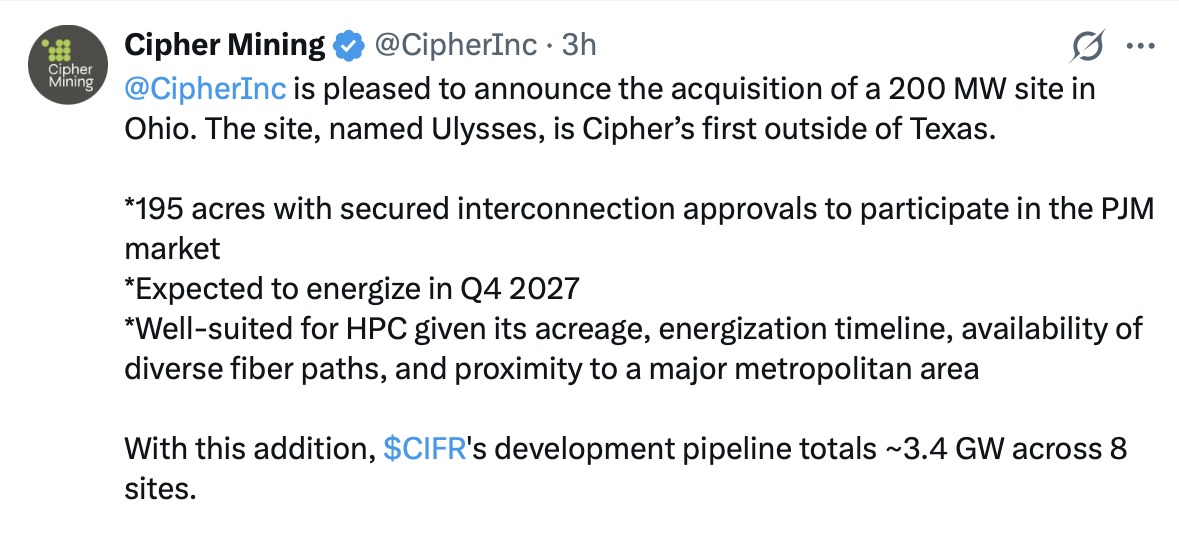
Cipher Mining has acquired a 200-megawatt power site in Ohio called “Ulysses,” marking its first expansion outside of Texas and entry into the PJM wholesale electricity market, the largest power market in the United States.

According to Tuesday’s announcement, the 195-acre site has secured power capacity from AEP Ohio, with all required utility agreements in place, and is expected to be energized in the fourth quarter of 2027.

Cipher said the facility is suitable for high-performance computing and data center use in addition to Bitcoin (BTC) mining. Financial terms of the transaction were not disclosed.

The move aims to meet growing demand from hyperscalers, large cloud computing companies such as Amazon Web Services and Google Cloud, for data centers. “Hyperscalers are driving unprecedented demand for large-scale sites,” said Cipher CEO Tyler Page, adding that the company's new site will give it additional capacity to expand its high-performance computing (HPC) hosting business.
Source: Cipher Mining

The deal follows a broader push by publicly listed Bitcoin miners into power, data center and manufacturing infrastructure beyond traditional mining.

Hut 8, for instance, recently signed a 15-year lease worth about $7 billion to supply 245 megawatts of AI data center capacity at its River Bend campus in Louisiana, with infrastructure provider Fluidstack as the tenant and Google backing lease payments.

A few days later, Bitdeer leased about 188,000 square feet at a logistics facility in Sparks, Nevada, to expand its US manufacturing footprint, according to The Miner Mag.

Related: How Bhutan is building a green Bitcoin economy from the ground up

Bitcoin mining hashprice puts pressure on miners

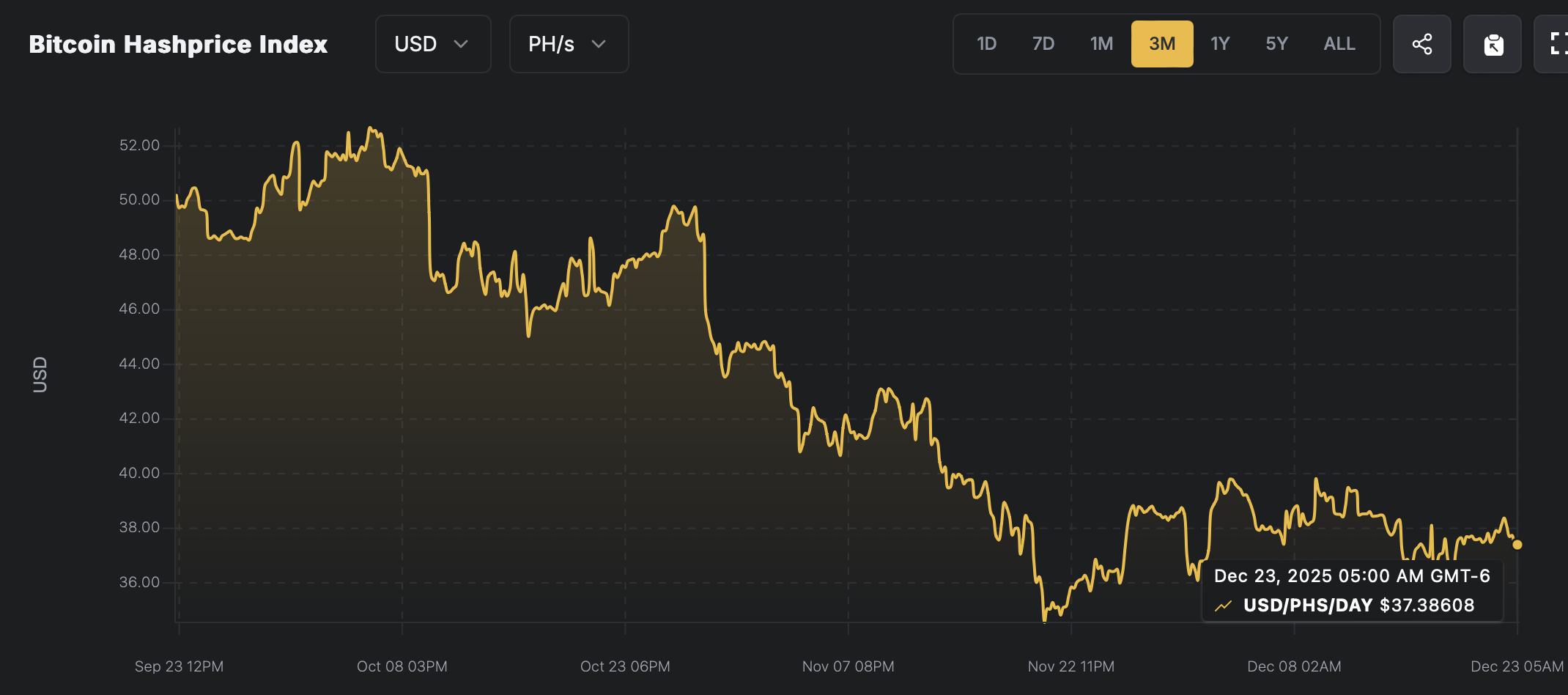
The Bitcoin mining hash price, a key measure of miner revenue per unit of computing power, has been below $40 since mid-November, a level many operators view as breakeven. The slump has forced mining companies to reassess their operating models as margins across the sector remain under pressure.
Bitcoin hash price over the past three months. Source: Hashrate Index

While many miners have sought diversification through AI and HPC demand, some are also turning to renewable energy as a way to lower costs and stabilize profitability.

Sangha Renewables recently brought a 20-megawatt solar-powered mining facility online in Ector County, Texas, while Phoenix Group launched a 30-megawatt hydro-powered operation in Ethiopia in November.

Separately, Canaan partnered with Soluna in September to deploy mining capacity at a wind-powered site in Texas and is developing adaptive mining rigs that use AI to optimize energy efficiency.

Despite the mounting pressure on mining economics, Bitcoin mining stocks have rallied sharply in 2025, signaling that public markets are increasingly focused on miners’ long-term strategic positioning rather than near-term Bitcoin production alone.

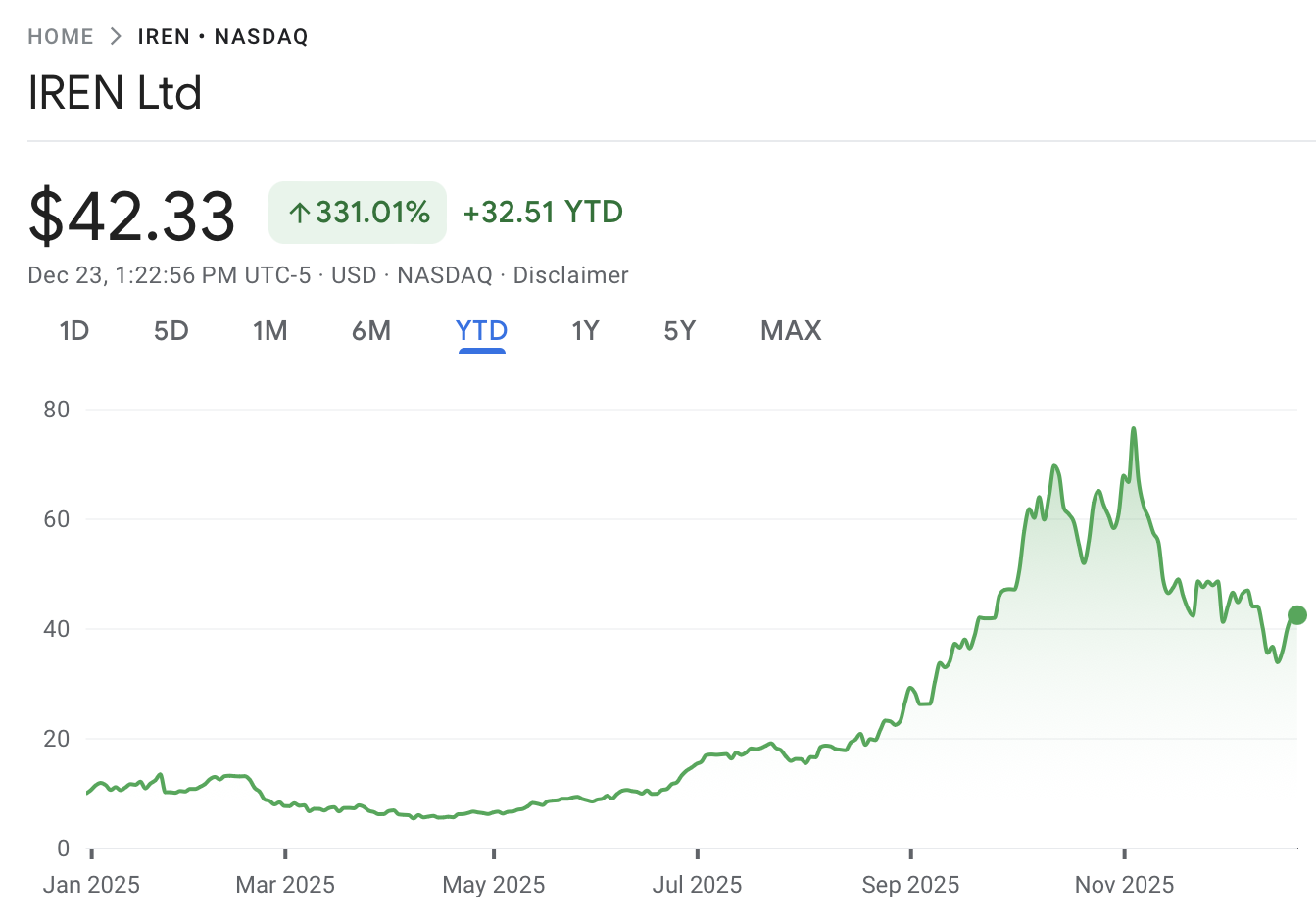
Among the top five publicly traded miners, IREN Limited is up roughly 331% year-to-date, followed by Applied Digital (246%), Cipher Mining (250%), Hut 8 (160%), and Riot Platforms (36%), according to data from Google Finance.
Iren Limited YTD stock price. Source: Google Finance

Magazine: Big questions: Would Bitcoin survive a 10-year power outage?

Trending Cryptos

Related Questions

QWhat is the significance of Cipher Mining's acquisition of the Ulysses site in Ohio?

AThe acquisition marks Cipher Mining's first expansion outside of Texas and its entry into the PJM wholesale electricity market, the largest power market in the United States. It is a 200-megawatt power site suitable for Bitcoin mining, high-performance computing, and data center use.

QWhat is the expected timeline for the Ulysses site to become operational, and what key utility agreement is in place?

AThe Ulysses site is expected to be energized in the fourth quarter of 2027. It has secured power capacity from AEP Ohio, with all required utility agreements in place.

QAccording to Cipher's CEO, what is driving unprecedented demand for large-scale sites like Ulysses?

ACipher CEO Tyler Page stated that hyperscalers, which are large cloud computing companies such as Amazon Web Services and Google Cloud, are driving unprecedented demand for large-scale data center sites.

QHow has the low Bitcoin mining hashprice since mid-November affected mining companies?

AThe Bitcoin mining hashprice has been below $40, a level many operators view as breakeven. This slump has forced mining companies to reassess their operating models as margins across the sector remain under pressure.

QWhat are some strategies Bitcoin miners are using to diversify and stabilize profitability amid economic pressures?

AMiners are diversifying through AI and high-performance computing (HPC) demand. They are also turning to renewable energy to lower costs, with examples including solar-powered facilities in Texas, hydro-powered operations in Ethiopia, and wind-powered sites.

Related Reads

Examining the Open USD Partner Lineup: Follow Who's Joining to See Where the Money Flows

**Title: Deciphering the Open USD Partner Roster: Following the Money** The launch of Open USD is notable less for the stablecoin itself and more for its expansive list of over 140 founding partners, which reads like a "who's who" of global finance and tech. This coalition, including asset managers like BlackRock, card networks Visa and Mastercard, banks (BNY Mellon, Standard Chartered, etc.), tech giants (Google, IBM), merchants (Shopify), and crypto firms (Coinbase, Ripple, Aave, MetaMask), signals a strategic shift. The diverse membership reveals that stablecoins are increasingly viewed not as products to compete over, but as shared infrastructure too critical to be left to any single entity. Each partner category has distinct motives. Asset managers like BlackRock seek to manage the large, sticky cash reserves, a lucrative fee-generating opportunity. Merchants like Shopify aim for lower-cost settlement and potential yield on balances. Banks join defensively to retain custody and settlement roles, fearing deposit outflows to stablecoins. Tech companies bet on programmable money for future machine-to-machine commerce. Crypto firms gain mainstream legitimacy and distribution channels. Remarkably, the consortium includes direct competitors (Visa vs. Mastercard, Coinbase vs. Ripple), indicating that the fear of exclusion from this emerging financial layer outweighs competitive rivalries. However, this shared governance could also lead to slow decision-making. The roster's composition is the real message: it represents a collective bet that a widely accepted, consortium-owned stablecoin is preferable to proprietary versions or having none at all. For incumbents like Circle and Tether, this alliance poses a significant threat, as potential clients have collectively chosen to build their own alternative. The absence of major U.S. retail banks (busy with their own tokenized deposit networks) is equally telling. In essence, the partner list maps where the industry believes value and risk will flow in a tokenized dollar future, marking stablecoin's evolution from a product to a utility.

Foresight News14m ago

Examining the Open USD Partner Lineup: Follow Who's Joining to See Where the Money Flows

Foresight News14m ago

IOSG: Q-Day Countdown, Will Quantum Computing End Cryptocurrency?

IOSG: The Q-Day Countdown – Will Quantum Computing End Cryptocurrency? This analysis explores the looming threat quantum computing poses to blockchain technology. Quantum computers, leveraging Shor's algorithm, could theoretically break the elliptic curve cryptography (ECC) underpinning cryptocurrencies like Bitcoin and Ethereum. The article outlines a hypothetical "Q-Day" scenario where exposed public keys from dormant assets are compromised, leading to fund theft and a deep governance crisis. The core risk is not the complete erasure of blockchains but a systemic reset of public-key cryptography. Bitcoin faces significant challenges due to its "code-is-law" ethos and the immense social consensus required for migration. Its primary vulnerability lies in legacy UTXOs with publicly exposed keys. Ethereum's path involves a more complex, full-stack cryptographic agility upgrade across execution, consensus, and data layers. The industry has a limited "engineering comfort window" of 5-8 years to coordinate a migration to post-quantum cryptography (PQC), such as lattice-based or hash-based signatures. While the existential threat is often overstated, the real bottleneck is the immense coordination required across protocol developers, node operators, wallet providers, exchanges, and custodians. Market repricing of crypto assets may occur well before an actual Q-Day if quantum hardware roadmaps accelerate or regulatory pressure mounts. The article concludes that quantum computing is not a doomsday weapon but a severe stress test for blockchain's foundational security model and governance structures.

marsbit43m ago

IOSG: Q-Day Countdown, Will Quantum Computing End Cryptocurrency?

marsbit43m ago

Why 2026 could redefine Ethereum, Solana, Base and Avalanche

Blockchain infrastructure is undergoing a major coordinated transformation, driven by institutional demand for reliability, compliance, and predictable settlement. Over $30 billion in Real-World Assets (RWA) on-chain has exposed network weaknesses. Major blockchains are responding with foundational upgrades, moving beyond incremental speed improvements. Ethereum's "Glamsterdam" upgrade, planned for H1 2026, will significantly increase gas limits and introduce features like PBS (pre-blocked state) for enhanced settlement and parallel execution. Solana's "Alpenglow," targeting a mainnet launch in H2 2026, focuses on reducing finality time dramatically and freeing network resources to improve reliability. Beyond speed, compliance is critical. Base's "Beryl" upgrade in Q3 2026 will introduce a standardized, regulatory-compliant token framework (B20). Avalanche's "Octane" upgrade aims to boost transaction processing and reduce costs for enterprise applications. Even Bitcoin is evolving with the potential activation of OP_CAT by late 2026/early 2027. The competition is shifting. While technical upgrades are widespread, institutions will ultimately allocate capital based on proven execution, operational resilience, and regulatory compatibility during market stress. Ethereum currently leads in tokenized assets, while networks like Base and Solana are strengthening their institutional offerings. The blockchain that best delivers reliable, compliant, and uninterrupted service is poised to attract the greatest share of future institutional capital.

ambcrypto1h ago

Why 2026 could redefine Ethereum, Solana, Base and Avalanche

ambcrypto1h ago

Trading

Spot

Hot Articles

How to Buy US

Welcome to HTX.com! We've made purchasing Talus Network (US) simple and convenient. Follow our step-by-step guide to embark on your crypto journey.Step 1: Create Your HTX AccountUse your email or phone number to sign up for a free account on HTX. Experience a hassle-free registration journey and unlock all features.Get My AccountStep 2: Go to Buy Crypto and Choose Your Payment MethodCredit/Debit Card: Use your Visa or Mastercard to buy Talus Network (US) instantly.Balance: Use funds from your HTX account balance to trade seamlessly.Third Parties: We've added popular payment methods such as Google Pay and Apple Pay to enhance convenience.P2P: Trade directly with other users on HTX.Over-the-Counter (OTC): We offer tailor-made services and competitive exchange rates for traders.Step 3: Store Your Talus Network (US)After purchasing your Talus Network (US), store it in your HTX account. Alternatively, you can send it elsewhere via blockchain transfer or use it to trade other cryptocurrencies.Step 4: Trade Talus Network (US)Easily trade Talus Network (US) on HTX's spot market. Simply access your account, select your trading pair, execute your trades, and monitor in real-time. We offer a user-friendly experience for both beginners and seasoned traders.

5.1k Total ViewsPublished 2025.12.11Updated 2026.06.02

How to Buy US

Discussions

Welcome to the HTX Community. Here, you can stay informed about the latest platform developments and gain access to professional market insights. Users' opinions on the price of US (US) are presented below.

活动图片