Chainlink demand surges as withdrawals reach 2 mln LINK: Will this boost price?

ambcryptoPublished on 2026-03-25Last updated on 2026-03-25

Abstract

Chainlink (LINK) is experiencing a surge in investor demand, with over 2.046 million tokens withdrawn from exchange reserves in the past month, signaling potential accumulation and a bullish sentiment. Despite a modest monthly gain of 3.75%, LINK saw a 7.15% price increase in 24 hours, trading at $9.20, accompanied by a 65% surge in trading volume to $952.83 million. Analytics data indicates long-term holder interest, with exchange reserves dropping significantly. Derivatives data shows traders favoring long positions, with bulls dominating. Technically, LINK is moving within an ascending channel pattern. After a recent dip to the lower boundary, a bullish engulfing candle suggests a potential reversal. If LINK holds above $8.576, a 10% rise to $10.08 is possible, with further upside toward $11.20 if key resistance is broken. The RSI at 52.03 indicates growing buying interest and a shift toward bullish territory.

Demand for Chainlink [LINK] among investors is rising significantly, even though its price remains stagnant.

Crypto tracker CoinMarketCap showed that LINK gained a modest 3.75% over the past month, with the asset fluctuating within a range, reaching a high of $10 and a low of $8.17 during this period.

As the broader market exhibited signs of recovery, LINK jumped 7.15% over the past 24 hours, trading at the $9.20 level at press time.

Along with the price increase, market participation has also risen, as reflected in trading volume, which has surged by over 65% to $952.83 million.

This rise in trading volume not only indicates higher market activity but also suggests that investors and traders are showing strong interest in the current trend.

Analytics and derivatives data signal bullish sentiment

Analytics tool CryptoQuant shows that long-term investors are highly interested in LINK.

According to the latest data, over 2.046 million LINK tokens have been withdrawn from exchange reserves over the past month, as reflected in a significant decline from 129.427 million on the 24th of February to 127.381 million on the 24th of March 2026.

Whereas, in the past week, a massive drop of 951,000 LINK has been recorded in exchange reserves, indicating that LINK is in high demand among holders.
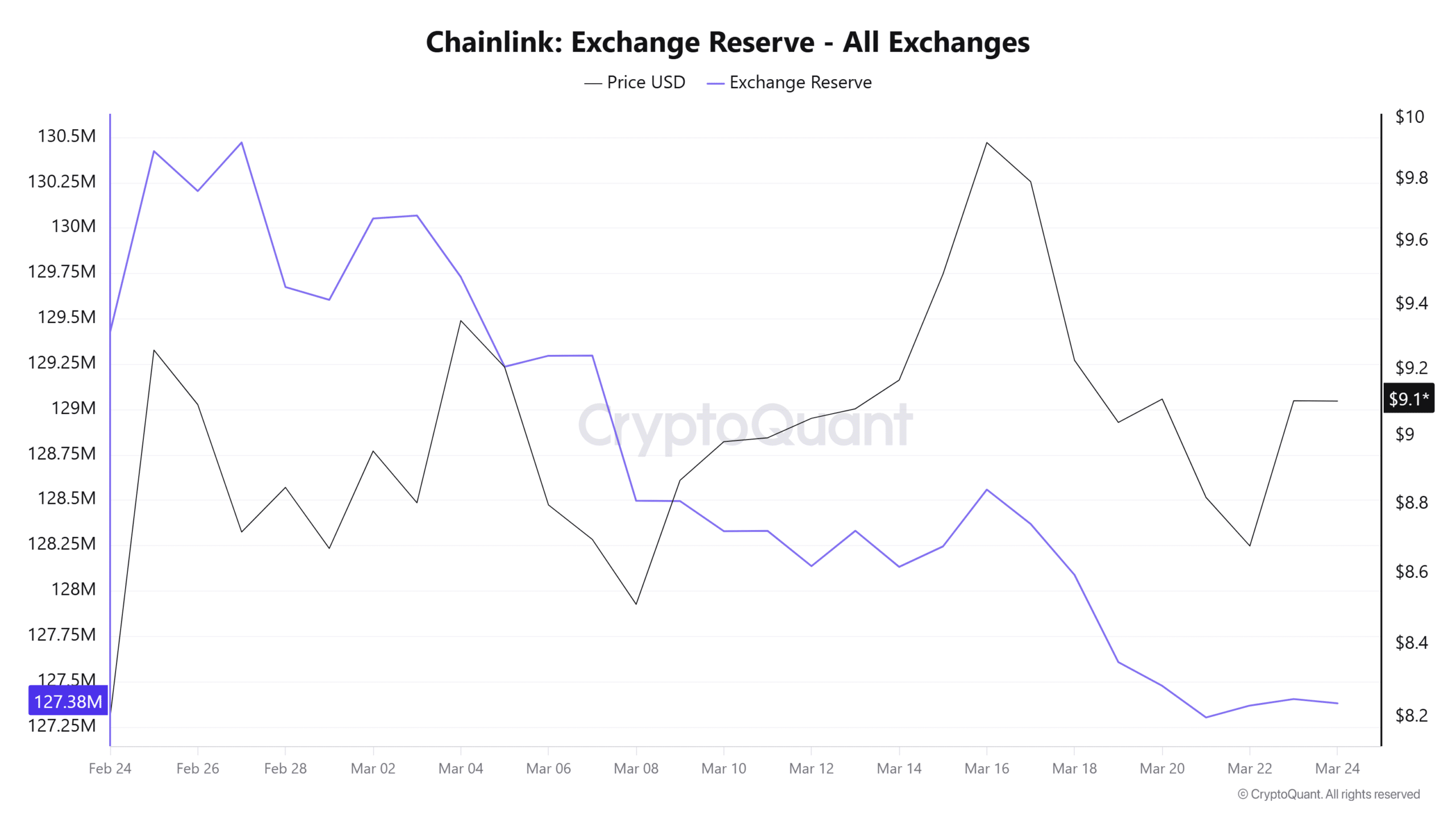
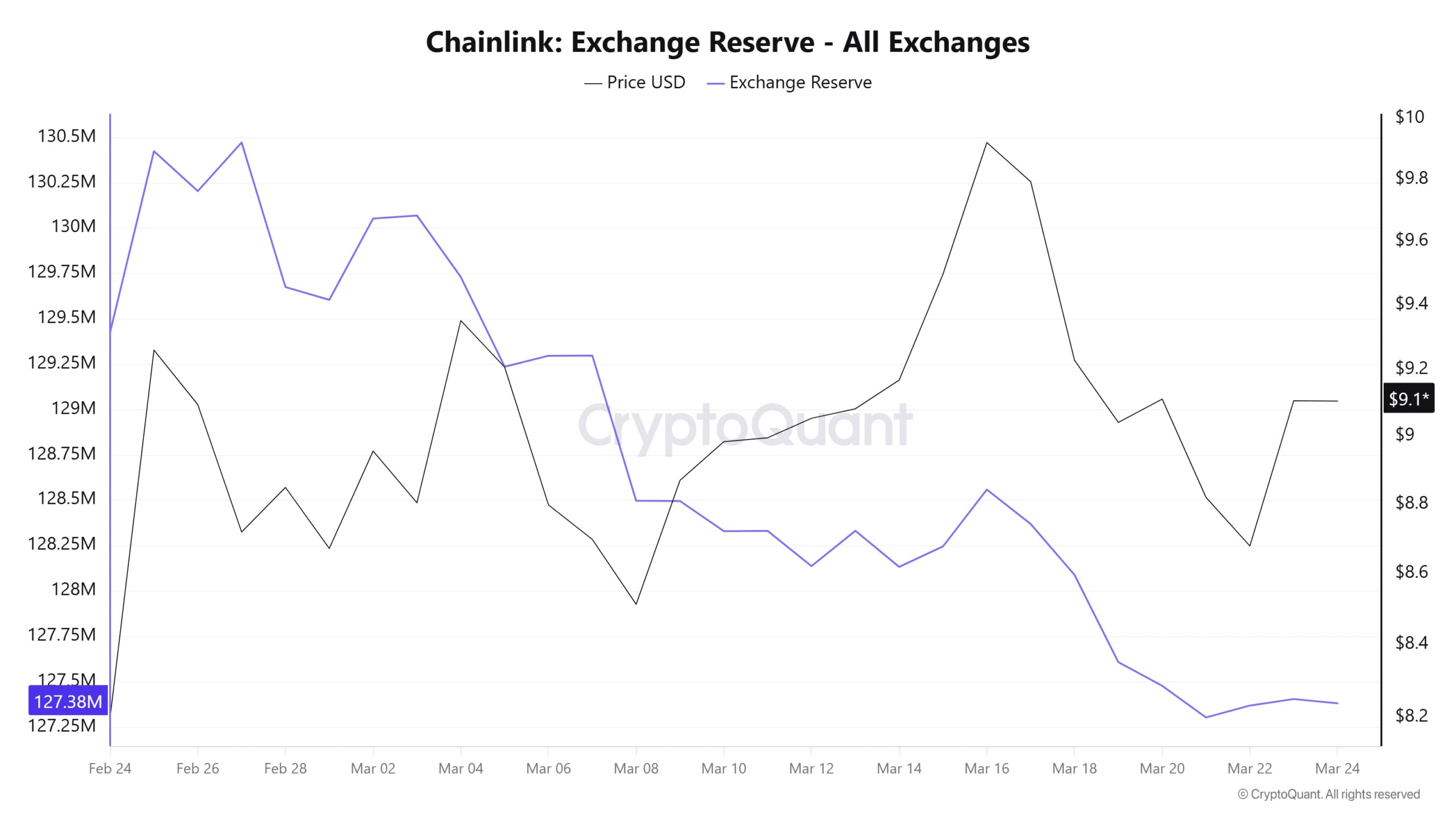
Source: CryptoQuant

Falling exchange reserves of any asset typically suggest potential accumulation, as holders tend to move assets from exchanges to their wallets, which is generally considered a bullish signal.

However, this potential accumulation over the past month and in recent weeks also raises questions about whether the current level is an ideal buying zone or not.

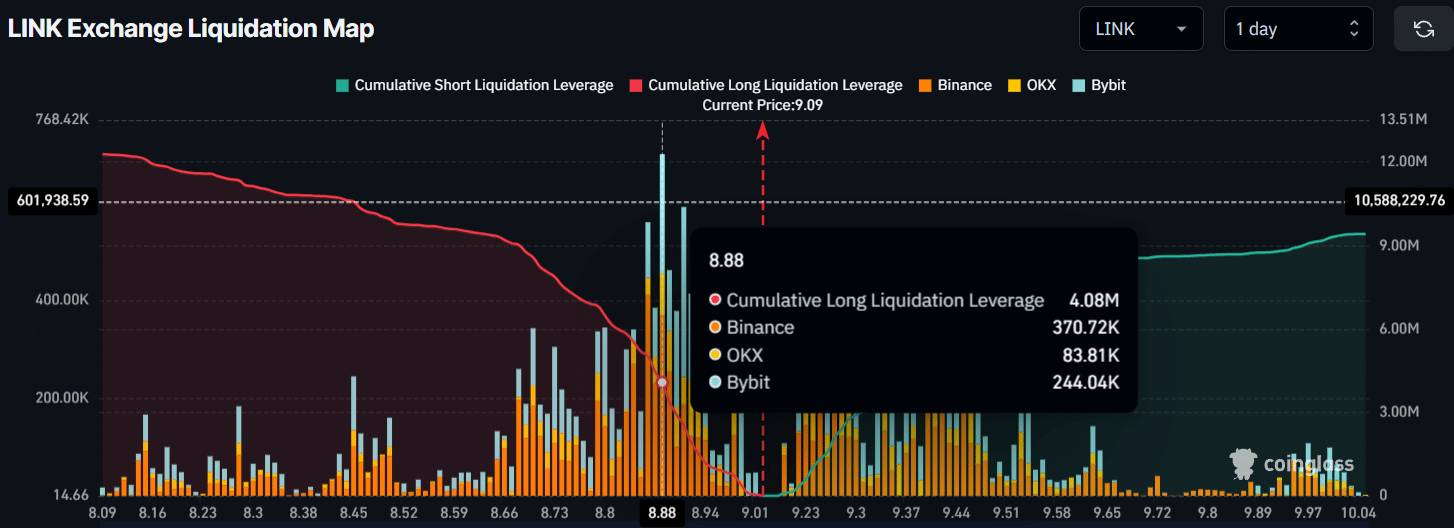
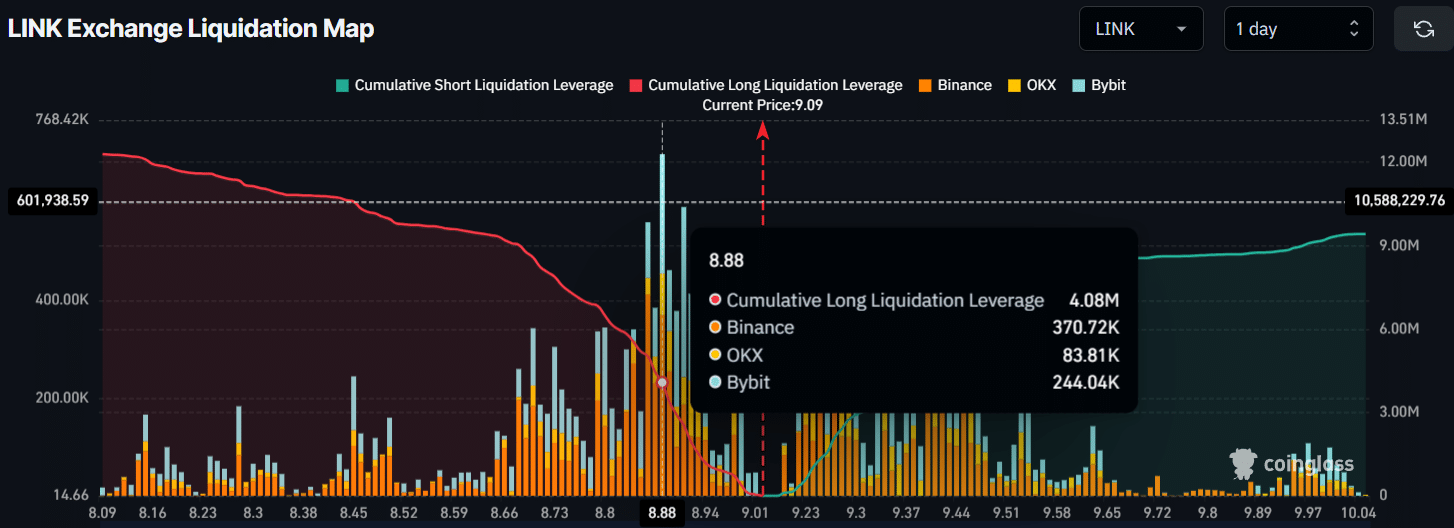
According to the derivatives analytics tool CoinGlass, intraday traders are currently following the trend, as they are eyeing long-leveraged positions. As per the data, $8.88 on the lower side and $9.27 on the upper side are the major liquidation levels from the current price.

Traders at these levels have built $4.08 million worth of long-leveraged positions and $2.10 million in short-leveraged positions, indicating that bulls are dominating the asset, while short sellers appear to be losing interest.
Source: CoinGlass

LINK: Price action eyes 10% jump

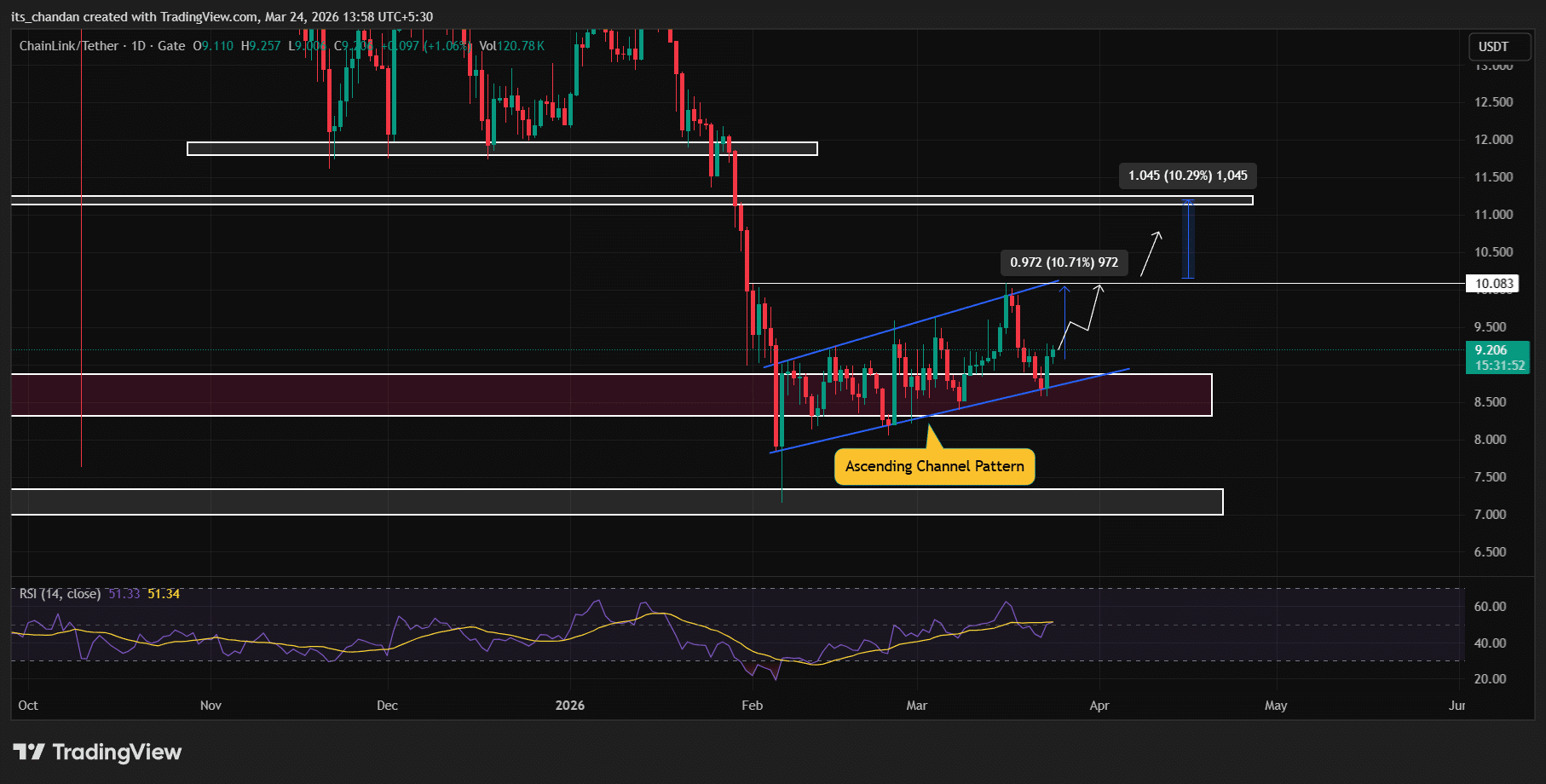
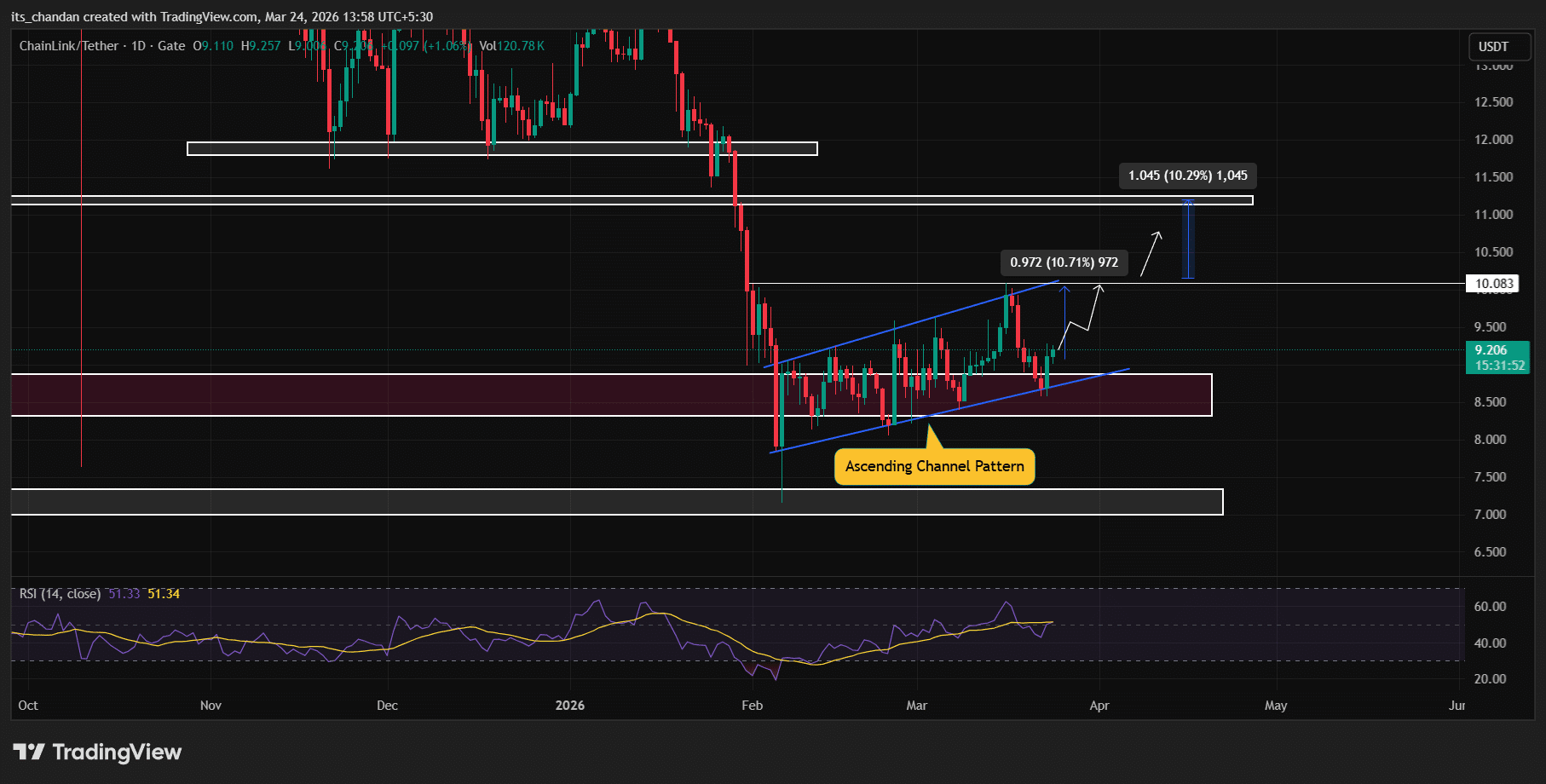
On the daily chart, LINK appeared to be moving within an ascending channel pattern between the upper and lower boundaries.

Following a recent dip of 14.65% between the 16th and the 23rd of March, the price declined to the lower boundary, where it formed a bullish engulfing candle, suggesting that LINK may be on the verge of a reversal in the coming days.
Source: TradingView

Based on the current price action, if LINK remains above the upper boundary and the $8.576 level (the low of the engulfing candle), it could see a price jump of 10% and potentially reach the $10.08 level.

Further upside is also possible; however, $10.08 has been a key resistance level since the 1st of February. If LINK clears this level, another 10% rally could occur, potentially pushing the price toward $11.20.

As of now, Chainlink appears to be recovering as the Relative Strength Index (RSI) on the daily chart reaches 52.03, indicating a shift toward bullish territory and growing buying interest, with the asset gaining strength above the neutral 50 level.


Final Summary

  • Exchange reserves have declined by 2.046 million tokens over the past 30 days, indicating strong demand.
  • The daily chart shows that LINK is moving in an ascending channel pattern. After testing the lower boundary, it may see another 10% price jump in the coming days.


Related Questions

QWhat is the main reason for the surge in Chainlink (LINK) demand according to the article?

AThe main reason for the surge in Chainlink (LINK) demand is the significant withdrawal of tokens from exchange reserves, with over 2.046 million LINK tokens being removed over the past month, indicating strong accumulation by long-term investors.

QHow much did LINK's trading volume increase by, and what does this suggest?

ALINK's trading volume surged by over 65% to $952.83 million. This increase suggests higher market activity and indicates that investors and traders are showing strong interest in the current trend.

QWhat does the formation of a bullish engulfing candle on the daily chart indicate for LINK's price?

AThe formation of a bullish engulfing candle on the daily chart, after the price declined to the lower boundary of its ascending channel, suggests that LINK may be on the verge of a reversal and a potential price jump in the coming days.

QWhat are the key price levels that traders are watching for potential liquidation, according to CoinGlass data?

AAccording to CoinGlass data, the key liquidation levels from the current price are $8.88 on the lower side and $9.27 on the upper side.

QWhat is the potential price target for LINK if it breaks above the key resistance level of $10.08?

AIf LINK breaks above the key resistance level of $10.08, it could see another 10% rally, potentially pushing the price toward $11.20.

Related Reads

Microsoft Announces Commercial-Grade Quantum Computer to be Completed in Three Years: Will the Boots Land?

Microsoft announces plans to build a commercially viable quantum computer by 2029, a significant acceleration from the previous industry consensus of a decade. The breakthrough is fueled by their new Majorana 2 quantum chip, which boasts a record-breaking average qubit lifetime of 20 seconds—a 1,000-fold reliability improvement over its predecessor. This leap was achieved by leveraging topological qubits, a theoretically more stable technology using Majorana zero modes, and switching the core superconducting material from aluminum to lead. Crucially, Microsoft's "Discovery" agentic AI platform accelerated the R&D process. AI agents autonomously analyzed vast experimental data, optimized manufacturing parameters (like the lead alloy composition), and solved issues like "ghost noise," dramatically speeding up experimentation. While the 20-second coherence time is a landmark, challenges remain: scaling from 12 qubits to the millions needed for practical applications, managing compilation costs, and verifying quantum results. Skeptics call for peer-reviewed data, and questions persist about whether even 20 seconds is sufficient for complex algorithms like breaking RSA encryption. The race is on with other approaches (superconducting, trapped ions), but Microsoft's confidence in its topological roadmap signals a potential shortcut to a scalable quantum future.

marsbit19m ago

Microsoft Announces Commercial-Grade Quantum Computer to be Completed in Three Years: Will the Boots Land?

marsbit19m ago

Is There Really a "World Cup Curse" in the Market?

Is there really a "World Cup Curse" affecting markets? Historical data shows global equity markets often underperform during the tournament. The S&P 500 has averaged negative returns of -1.5% to -2.11% across 19 World Cups since 1950, with declines in 58% of events. China's Shanghai Composite fell in 71% of tournaments since 1994. Studies confirm reduced trading activity during matches, with volumes dropping significantly, especially when a home nation plays. A team's loss can also lead to negative sentiment and selling pressure in its domestic market the next day. However, the "curse" may be partly attributed to seasonal weakness. Many tournaments are held in June-July, a historically weaker period for stocks ("Sell in May and go away"). The 2022 Qatar World Cup, held in November-December, saw a smaller drop in trading volume compared to summer events, suggesting timing plays a role. The cryptocurrency market's performance during World Cups has been mixed and largely driven by its own major catalysts (e.g., Mt. Gox hack, FTX collapse, halving cycles) rather than the tournament. Investment opportunities have shifted over time. Traditional beneficiaries like TV manufacturers have seen fading returns as streaming platforms become the core viewing channel. Classic consumer plays like beer and sportswear face challenges from changing consumption trends. Newer digital assets, like fractionalized collectible player cards on blockchain, have seen explosive growth. While gambling is a traditional sector, prediction markets are emerging. In conclusion, while a statistical correlation exists, the World Cup's direct impact on markets is likely limited and intertwined with seasonal patterns. With lower liquidity during the event, the simplest strategy for many might be to step back from trading and enjoy the games.

marsbit26m ago

Is There Really a "World Cup Curse" in the Market?

marsbit26m ago

Why 'AI Service Subscription' Is Destined to Die Out?

"Why 'AI Service Subscription Models' Are Doomed to Disappear" The article argues that the flat-rate subscription model for AI services is fundamentally unsustainable. It points to recent industry shifts, such as Anthropic limiting access to its flagship Claude Fable 5 model for subscribers after just 14 days, and GitHub and OpenAI moving towards credit-based or usage-based billing. The core problem is that subscription models rely on a capped human consumption limit—like watching videos or listening to music—which keeps costs predictable. However, the rise of autonomous AI agents shatters this premise. Agents can consume 5 to 30 times more computing resources (tokens) than a human chatting, and they operate continuously without user presence. This removes the natural usage cap, making fixed-price plans financially unviable as heavy users incur massive costs. Attempts to patch the model with higher tiers or usage caps have failed, often leading to "adverse selection" where only the heaviest users subscribe. The industry's solution is to hollow out subscriptions, replacing "unlimited" access with prepaid credits charged per token, akin to a utility meter. While chat-based subscriptions may linger, the real value and revenue are shifting to pay-as-you-go models. The current period represents a final, heavily subsidized phase for users. The conclusion is that the soul of subscription—a fixed price for worry-free use—is dying, soon to be replaced by pure usage-based pricing where everyone pays for their own "electricity meter."

marsbit27m ago

Why 'AI Service Subscription' Is Destined to Die Out?

marsbit27m ago

Trading

Spot
Futures

Hot Articles

How to Buy LINK

Welcome to HTX.com! We've made purchasing ChainLink (LINK) simple and convenient. Follow our step-by-step guide to embark on your crypto journey.Step 1: Create Your HTX AccountUse your email or phone number to sign up for a free account on HTX. Experience a hassle-free registration journey and unlock all features.Get My AccountStep 2: Go to Buy Crypto and Choose Your Payment MethodCredit/Debit Card: Use your Visa or Mastercard to buy ChainLink (LINK) instantly.Balance: Use funds from your HTX account balance to trade seamlessly.Third Parties: We've added popular payment methods such as Google Pay and Apple Pay to enhance convenience.P2P: Trade directly with other users on HTX.Over-the-Counter (OTC): We offer tailor-made services and competitive exchange rates for traders.Step 3: Store Your ChainLink (LINK)After purchasing your ChainLink (LINK), store it in your HTX account. Alternatively, you can send it elsewhere via blockchain transfer or use it to trade other cryptocurrencies.Step 4: Trade ChainLink (LINK)Easily trade ChainLink (LINK) on HTX's spot market. Simply access your account, select your trading pair, execute your trades, and monitor in real-time. We offer a user-friendly experience for both beginners and seasoned traders.

9.1k Total ViewsPublished 2024.03.29Updated 2026.06.02

How to Buy LINK

Discussions

Welcome to the HTX Community. Here, you can stay informed about the latest platform developments and gain access to professional market insights. Users' opinions on the price of LINK (LINK) are presented below.

活动图片