On March 18, S&P Dow Jones Indices announced the licensing of the S&P 500 index to Trade.xyz for the issuance of perpetual contracts on the Hyperliquid blockchain. This marks the first time in S&P's history that it has granted a brand license for its flagship index to an on-chain protocol.
The difference is, this time S&P took the initiative, handing its brand license to a decentralized protocol. The contracts use USDC as margin, target non-U.S. investors, and trade 24/7 with no expiration date. According to an S&P Global press release, over $1 trillion in S&P 500-linked exposure is traded daily through traditional markets. Now, a small portion of that access has moved on-chain.
But the key point of this event isn't compliance. Traditional finance is beginning to actively seek out on-chain infrastructure to reach users and time periods it cannot cover. The reason S&P chose Hyperliquid is hidden in the data from the past six months.
HIP-3 is a permissionless perpetual contract deployment protocol launched by Hyperliquid in 2025, allowing anyone to create new trading markets on it. Trade.xyz operates on Hyperliquid's HIP-3 protocol and is the largest market creator on HIP-3, accounting for 90% of its total open interest, according to The Block.
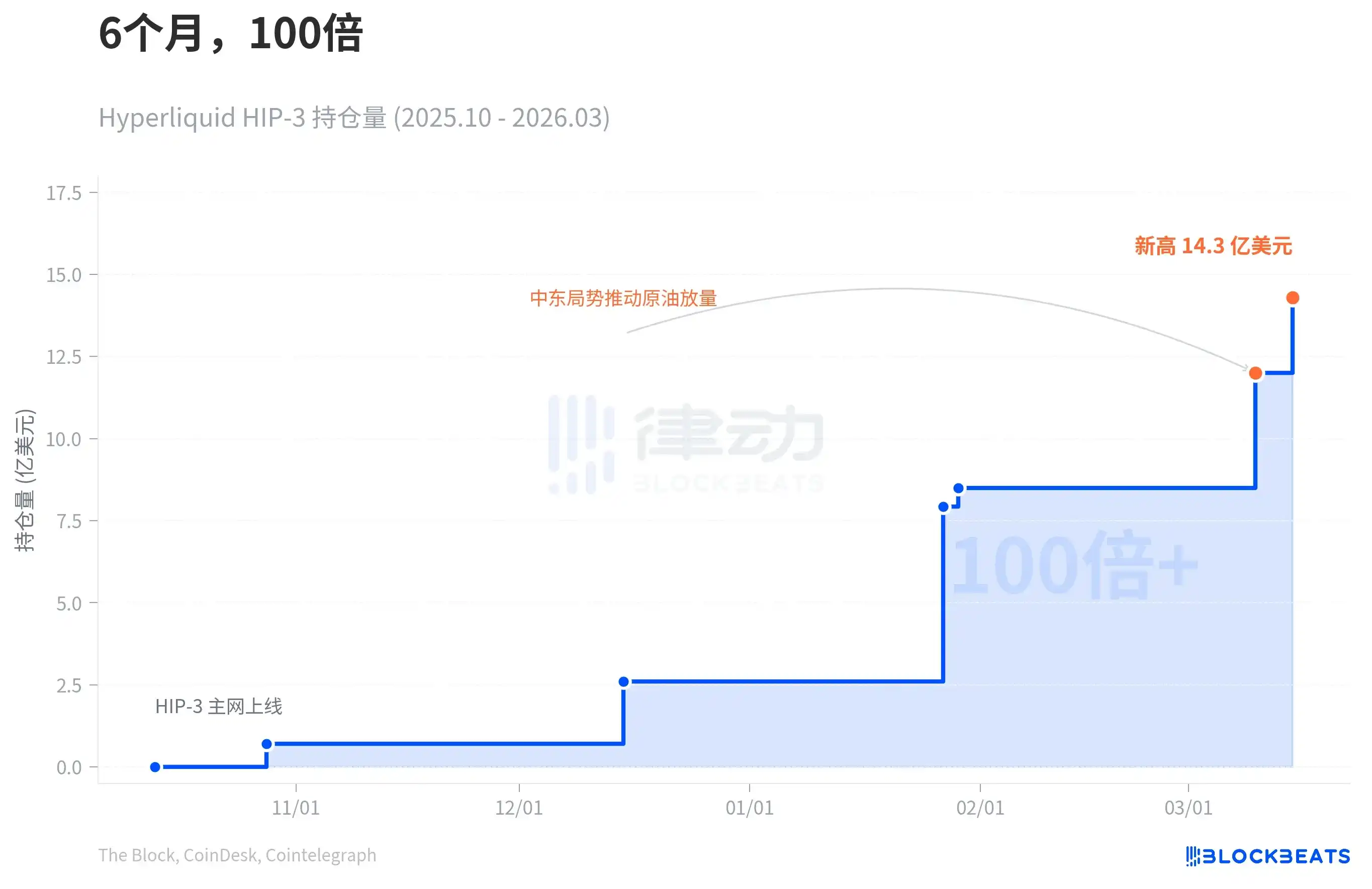
When the HIP-3 mainnet launched on October 13, 2025, its open interest was near zero. Two weeks later, it grew to $70 million. By January 27, 2026, this number reached $793 million, with a month-over-month growth exceeding 200%. According to a March 15 report by The Block, HIP-3 open interest hit a new all-time high of $1.43 billion. From the mainnet launch, this represents over 100x growth in 6 months.
The interesting part is that this growth curve is driven by traditional asset traders.
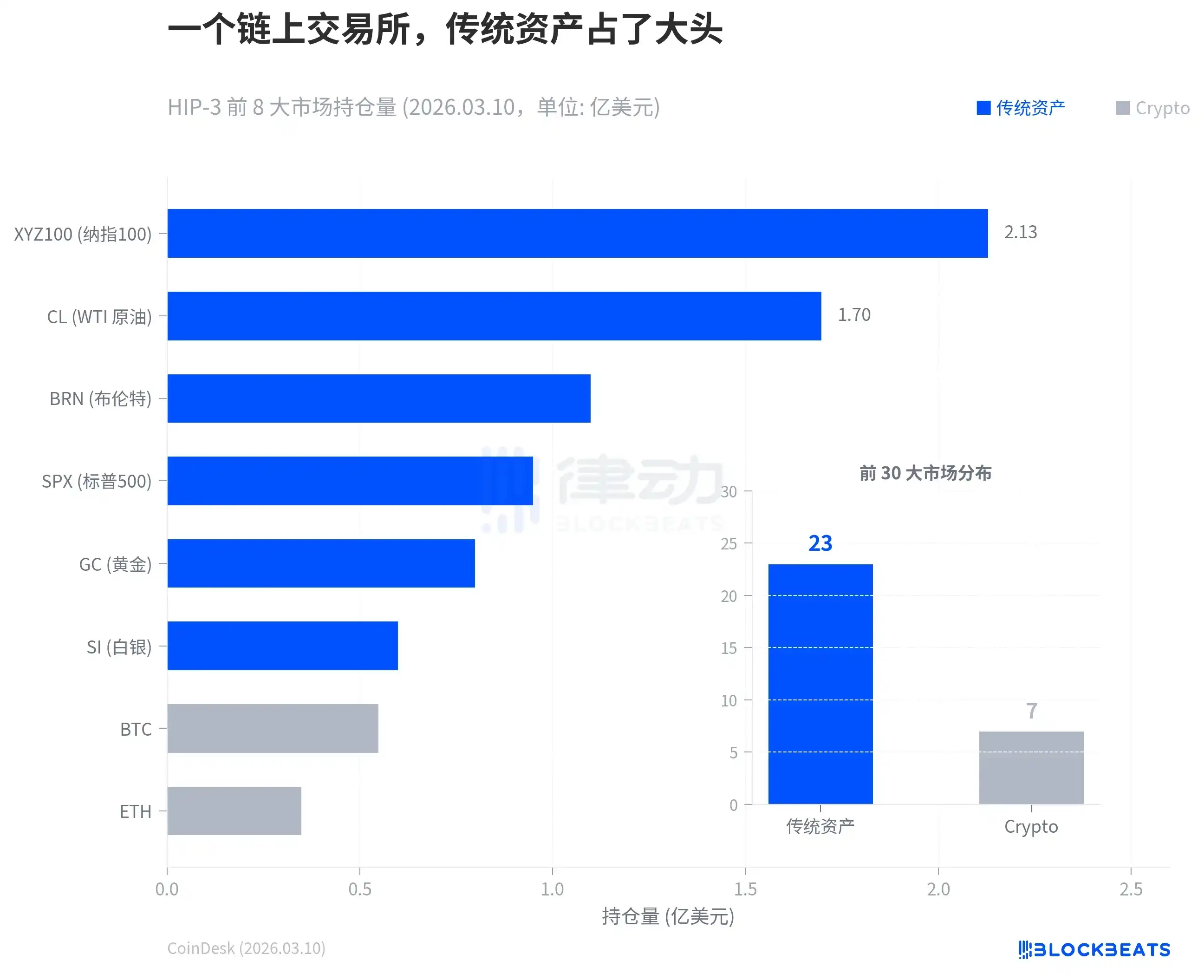
Among the top 30 markets on HIP-3, only 7 are crypto trading pairs. The other 23 are all traditional assets. Ranking first is XYZ100, a contract tracking the Nasdaq 100, with $213 million in open interest. Second is CL, tracking WTI crude oil, with $170 million. Following are Brent crude oil, S&P 500, gold, silver. BTC and ETH rank seventh and eighth.
The top six markets on an on-chain exchange are not a single crypto asset.
The formation of this structure had a specific catalyst. On March 9, the escalation of the Iran situation occurred while traditional futures markets were closed for the weekend. According to AMBCrypto, the trading volume for the crude oil contract CL-USDC surged from approximately $21 million to over $1.2 billion in a single day. According to DL News, Hyperliquid's crude oil contract trading volume on that day briefly surpassed BTC, becoming the second-largest market after perpetual BTC. The same CoinDesk report pointed out that HIP-3 markets accounted for nearly 80% of Hyperliquid's total platform volume that day.
The logic here is straightforward: geopolitical events don't wait for Monday's open. When traditional futures exchanges are closed, Hyperliquid is the only venue to trade crude oil and stock indices. Traders voted with their feet, and capital flowed to the one that never closes.
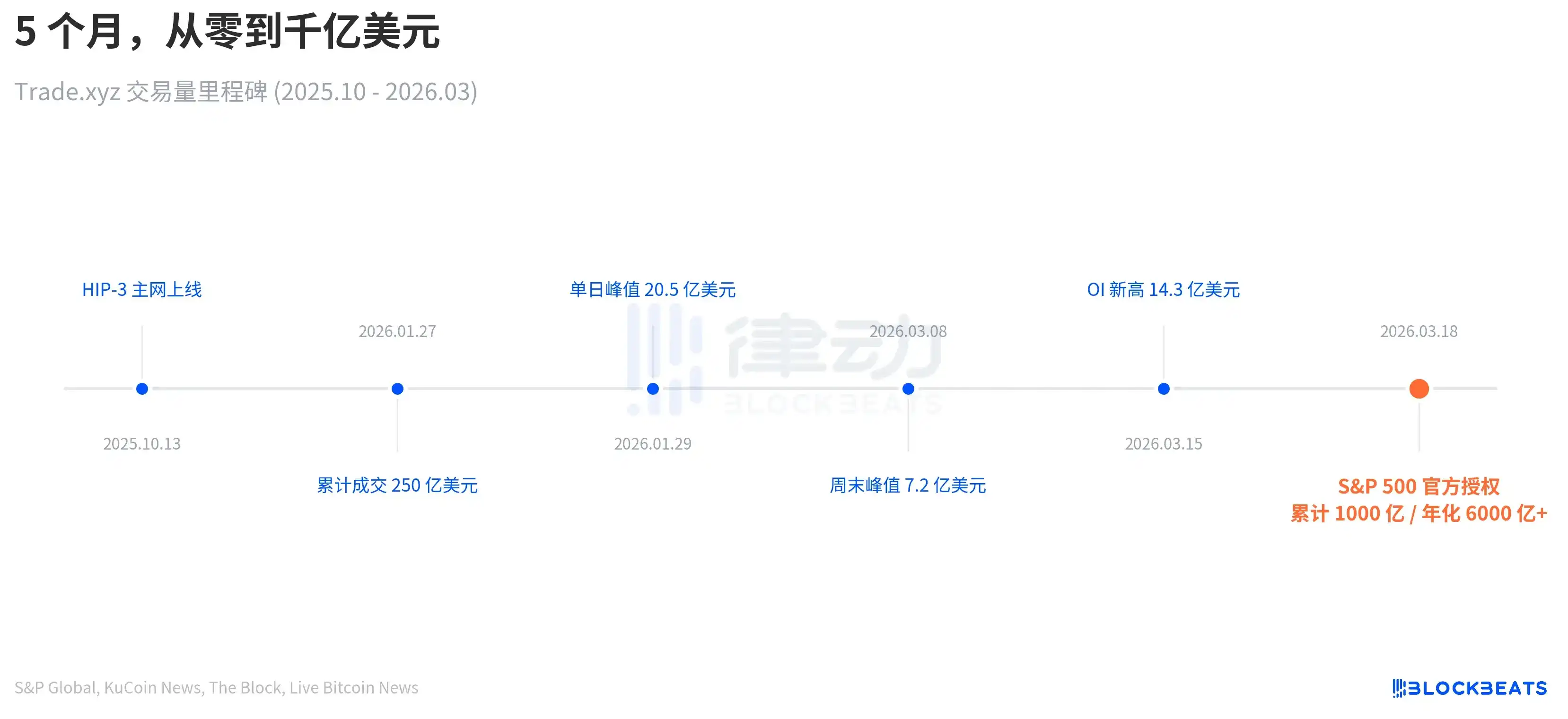
Trade.xyz's cumulative trading volume has exceeded $100 billion since its launch in October 2025, with a current annualized run rate exceeding $600 billion. At the end of January 2026, Trade.xyz's single-day trading volume peaked at $2.05 billion. According to Live Bitcoin News, the weekend trading volume on March 8 reached $720 million, setting a new weekend record for HIP-3. From zero to one hundred billion in cumulative trading volume in five months.
This growth curve leads directly to S&P's official authorization. The wording of S&P DJI's Chief Product and Operations Officer, Cameron Drinkwater, in the press release is worth reading carefully. He skipped the usual 'we are exploring blockchain' tentative language and directly stated that 'digital-native investors deserve the same institutional-grade standards as traditional investors.' The implication is that on-chain traders are now a mature investor group in S&P's eyes.
Hyperliquid's own structure is also an integral part of this story. Substack blogger Lex pointed out that Hyperliquid's annualized revenue is approximately $550 million, with a fully diluted valuation of about $40 billion, holding about a 60% share in the decentralized derivatives market. Unlike the vast majority of crypto projects, Hyperliquid has no VC funding.
Zero institutional investors, zero private rounds. The HYPE token, launched in November 2024, had 31% airdropped to approximately 94,000 early users, worth about $1.2 billion at the time. According to Tokenomics.com data, HYPE holders receive approximately $65 million in monthly revenue from trading fees and profit sharing from the HLP market-making pool. All growth comes from the product itself and the alignment of interests with community holders.
Putting CME and Trade.xyz side by side makes the contrast clearer. CME's S&P 500 E-mini futures require an initial margin of about $5,060, a futures brokerage account, and a full KYC process, with hours from Sunday to Friday, 23 hours a day. Trade.xyz's S&P perpetual contract uses USDC as margin, connects directly via an on-chain wallet, and is open 24/7/365. Both products track the same index using the same set of official S&P licensed data. But CME's entry point is in New York, while Trade.xyz's entry point is anywhere with an internet connection.
According to CoinGecko data, on the same day the S&P 500 perpetual contract launched, the HYPE token rose 14.7%, with a market cap of about $10 billion, ranking 14th in the crypto market. An on-chain exchange that never took a penny of VC money received the official license for the world's most widely tracked stock index. Trade.xyz COO and General Counsel Collins Belton said in the press release that the S&P 500 is the 'natural starting point'. He didn't say where the finish line is.