Century-Old S&P Goes On-Chain for the First Time: Who's Taking CME's Weekend Business?

marsbitPublished on 2026-03-19Last updated on 2026-03-19

Abstract

On March 18, S&P Dow Jones Indices authorized the S&P 500 index to Trade.xyz for perpetual contracts on the Hyperliquid blockchain—the first time the flagship index has been licensed to an on-chain protocol. The move targets non-U.S. investors with 24/7 trading, USDC margin, and no expiration. The shift reflects traditional finance actively adopting on-chain infrastructure to reach underserved users and time windows. Hyperliquid’s HIP-3 protocol, launched in October 2025, saw open interest surge from near zero to $1.43 billion in six months, driven largely by traditional assets like Nasdaq 100, WTI crude oil, and gold—not crypto. A key catalyst was the March 9 Iran crisis, which occurred during traditional market closures. Hyperliquid’s oil contracts saw daily volume spike to $1.2 billion as traders sought 24/7 access. Trade.xyz, HIP-3’s largest market maker, has reached over $100 billion in cumulative volume in five months. Hyperliquid, with no VC funding, airdropped tokens to users and now holds a $40 billion fully diluted valuation. Its S&P 500 perpetual contract offers lower barriers and global access compared to CME’s traditional futures. S&P DJI’s endorsement signals that on-chain traders are now viewed as a mature investor class.

On March 18, S&P Dow Jones Indices announced the licensing of the S&P 500 index to Trade.xyz for the issuance of perpetual contracts on the Hyperliquid blockchain. This marks the first time in S&P's history that it has granted a brand license for its flagship index to an on-chain protocol.

The difference is, this time S&P took the initiative, handing its brand license to a decentralized protocol. The contracts use USDC as margin, target non-U.S. investors, and trade 24/7 with no expiration date. According to an S&P Global press release, over $1 trillion in S&P 500-linked exposure is traded daily through traditional markets. Now, a small portion of that access has moved on-chain.

But the key point of this event isn't compliance. Traditional finance is beginning to actively seek out on-chain infrastructure to reach users and time periods it cannot cover. The reason S&P chose Hyperliquid is hidden in the data from the past six months.

HIP-3 is a permissionless perpetual contract deployment protocol launched by Hyperliquid in 2025, allowing anyone to create new trading markets on it. Trade.xyz operates on Hyperliquid's HIP-3 protocol and is the largest market creator on HIP-3, accounting for 90% of its total open interest, according to The Block.
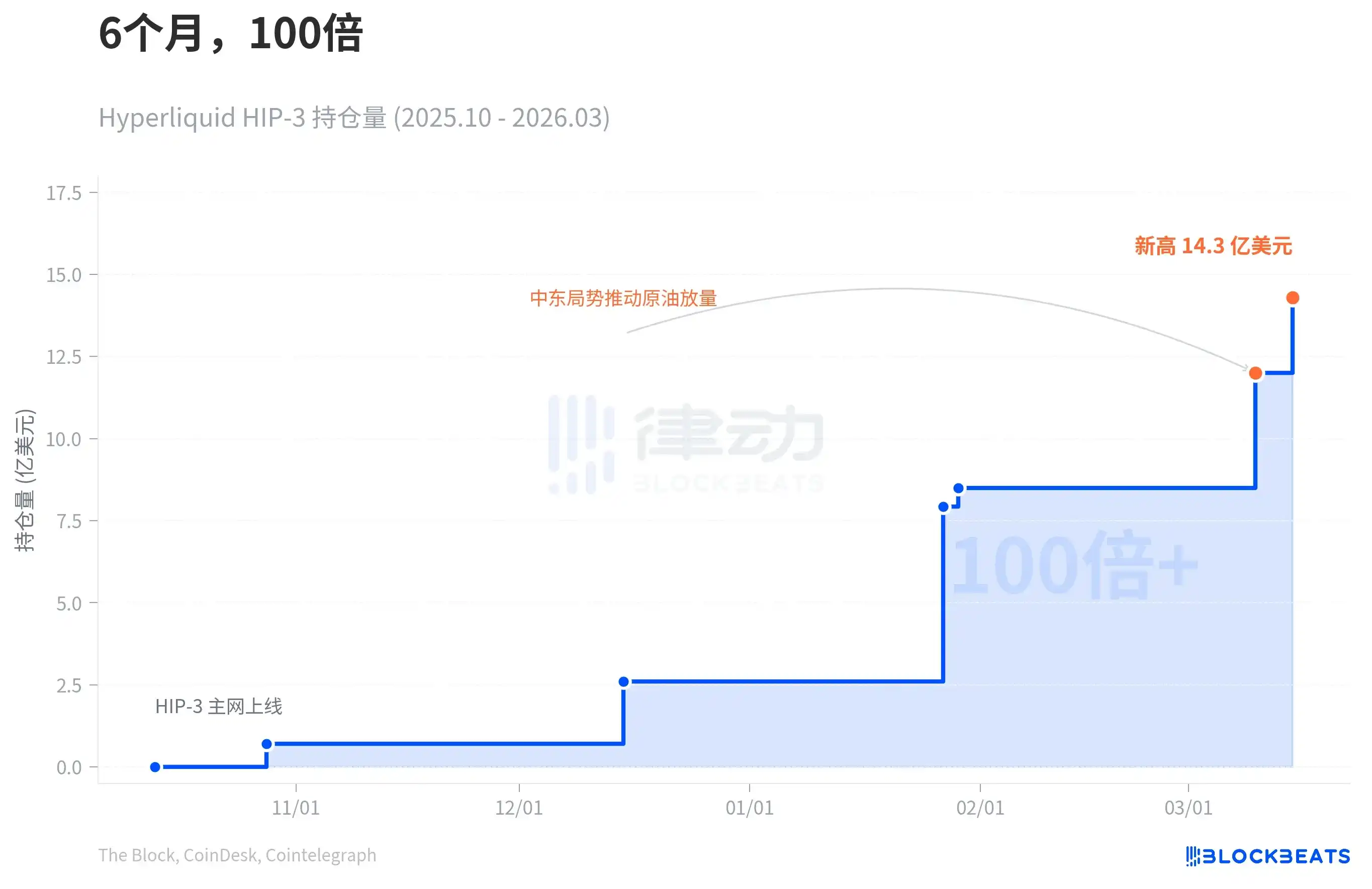
When the HIP-3 mainnet launched on October 13, 2025, its open interest was near zero. Two weeks later, it grew to $70 million. By January 27, 2026, this number reached $793 million, with a month-over-month growth exceeding 200%. According to a March 15 report by The Block, HIP-3 open interest hit a new all-time high of $1.43 billion. From the mainnet launch, this represents over 100x growth in 6 months.

The interesting part is that this growth curve is driven by traditional asset traders.

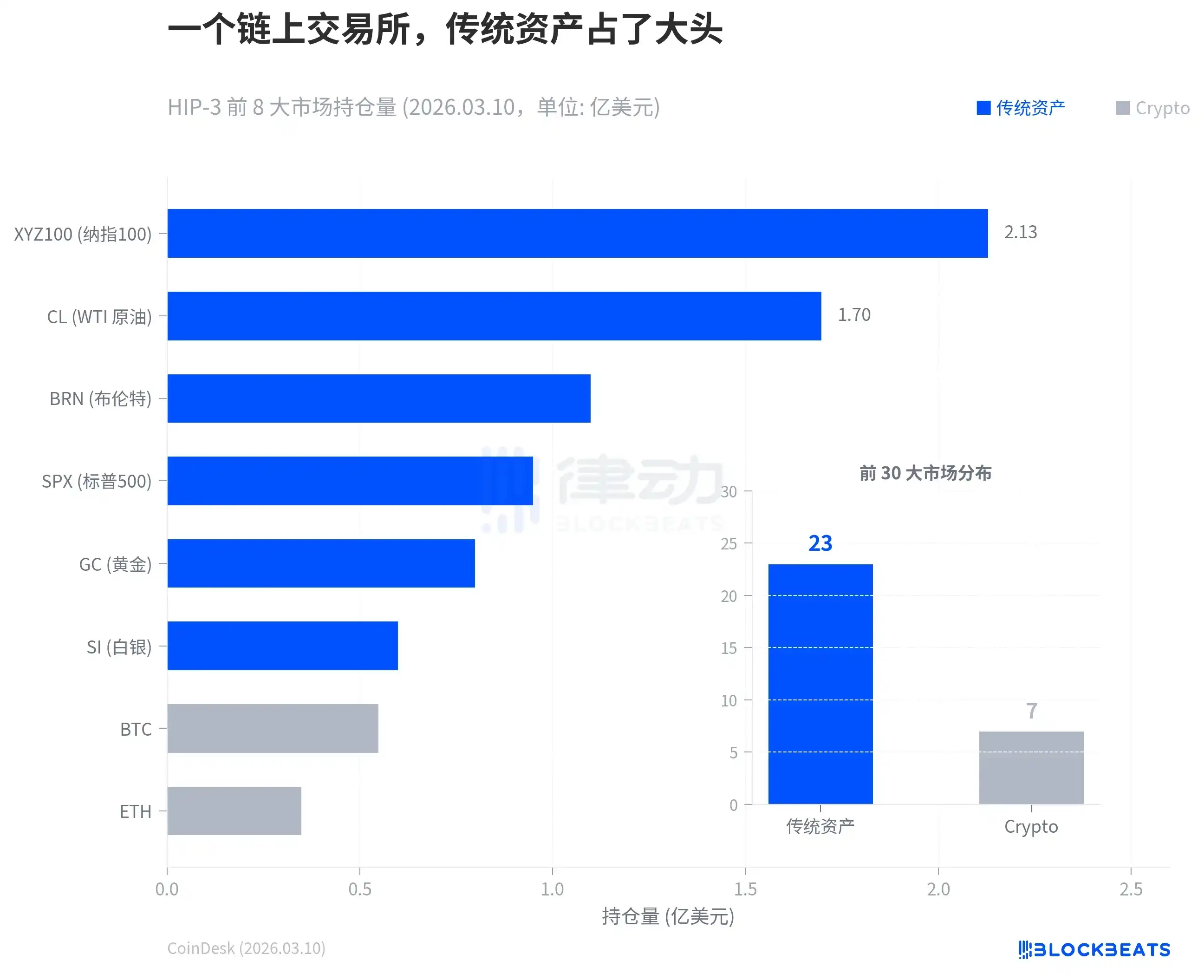
Among the top 30 markets on HIP-3, only 7 are crypto trading pairs. The other 23 are all traditional assets. Ranking first is XYZ100, a contract tracking the Nasdaq 100, with $213 million in open interest. Second is CL, tracking WTI crude oil, with $170 million. Following are Brent crude oil, S&P 500, gold, silver. BTC and ETH rank seventh and eighth.

The top six markets on an on-chain exchange are not a single crypto asset.
The formation of this structure had a specific catalyst. On March 9, the escalation of the Iran situation occurred while traditional futures markets were closed for the weekend. According to AMBCrypto, the trading volume for the crude oil contract CL-USDC surged from approximately $21 million to over $1.2 billion in a single day. According to DL News, Hyperliquid's crude oil contract trading volume on that day briefly surpassed BTC, becoming the second-largest market after perpetual BTC. The same CoinDesk report pointed out that HIP-3 markets accounted for nearly 80% of Hyperliquid's total platform volume that day.

The logic here is straightforward: geopolitical events don't wait for Monday's open. When traditional futures exchanges are closed, Hyperliquid is the only venue to trade crude oil and stock indices. Traders voted with their feet, and capital flowed to the one that never closes.

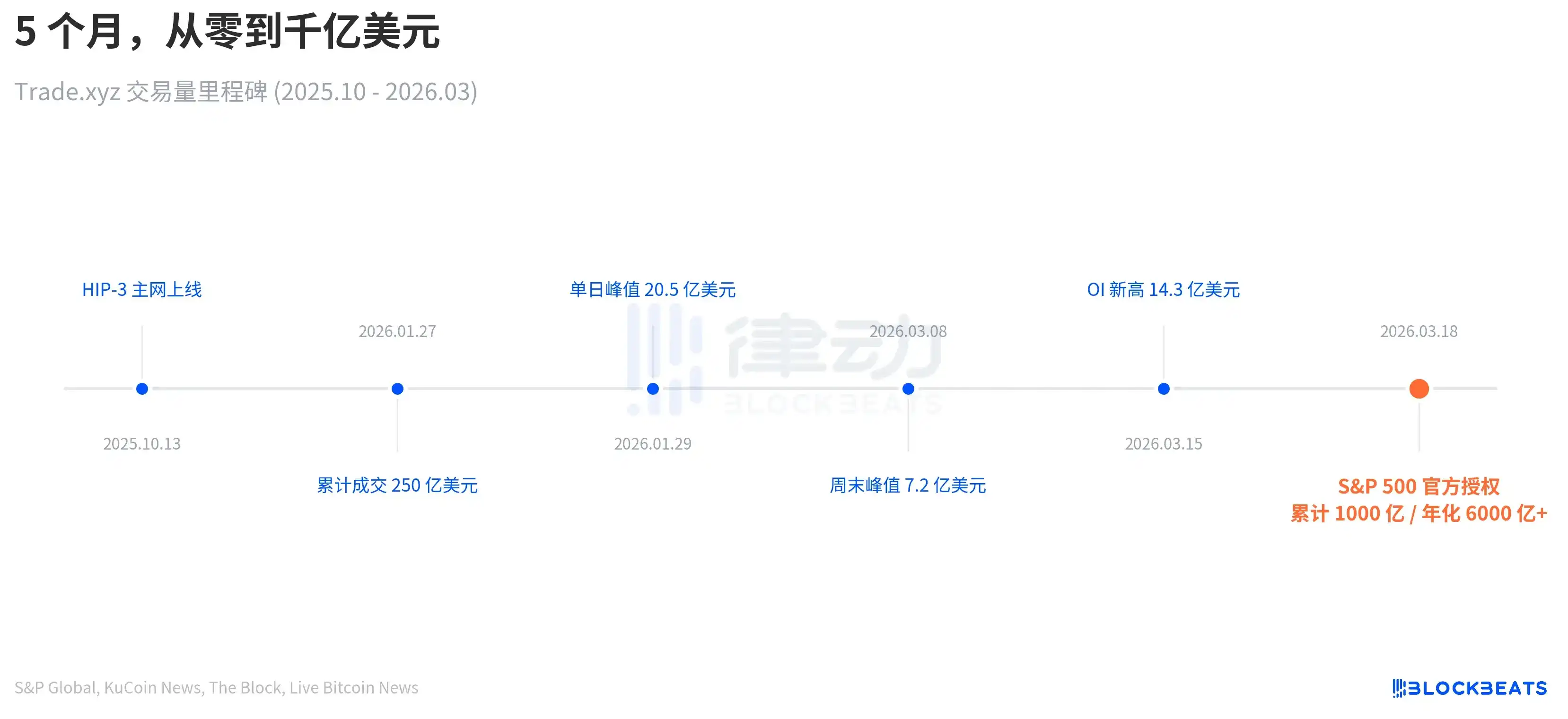
Trade.xyz's cumulative trading volume has exceeded $100 billion since its launch in October 2025, with a current annualized run rate exceeding $600 billion. At the end of January 2026, Trade.xyz's single-day trading volume peaked at $2.05 billion. According to Live Bitcoin News, the weekend trading volume on March 8 reached $720 million, setting a new weekend record for HIP-3. From zero to one hundred billion in cumulative trading volume in five months.

This growth curve leads directly to S&P's official authorization. The wording of S&P DJI's Chief Product and Operations Officer, Cameron Drinkwater, in the press release is worth reading carefully. He skipped the usual 'we are exploring blockchain' tentative language and directly stated that 'digital-native investors deserve the same institutional-grade standards as traditional investors.' The implication is that on-chain traders are now a mature investor group in S&P's eyes.
Hyperliquid's own structure is also an integral part of this story. Substack blogger Lex pointed out that Hyperliquid's annualized revenue is approximately $550 million, with a fully diluted valuation of about $40 billion, holding about a 60% share in the decentralized derivatives market. Unlike the vast majority of crypto projects, Hyperliquid has no VC funding.

Zero institutional investors, zero private rounds. The HYPE token, launched in November 2024, had 31% airdropped to approximately 94,000 early users, worth about $1.2 billion at the time. According to Tokenomics.com data, HYPE holders receive approximately $65 million in monthly revenue from trading fees and profit sharing from the HLP market-making pool. All growth comes from the product itself and the alignment of interests with community holders.

Putting CME and Trade.xyz side by side makes the contrast clearer. CME's S&P 500 E-mini futures require an initial margin of about $5,060, a futures brokerage account, and a full KYC process, with hours from Sunday to Friday, 23 hours a day. Trade.xyz's S&P perpetual contract uses USDC as margin, connects directly via an on-chain wallet, and is open 24/7/365. Both products track the same index using the same set of official S&P licensed data. But CME's entry point is in New York, while Trade.xyz's entry point is anywhere with an internet connection.

According to CoinGecko data, on the same day the S&P 500 perpetual contract launched, the HYPE token rose 14.7%, with a market cap of about $10 billion, ranking 14th in the crypto market. An on-chain exchange that never took a penny of VC money received the official license for the world's most widely tracked stock index. Trade.xyz COO and General Counsel Collins Belton said in the press release that the S&P 500 is the 'natural starting point'. He didn't say where the finish line is.


Trending Cryptos

Related Questions

QWhat is the significance of S&P Dow Jones Indices licensing the S&P 500 to Trade.xyz on the Hyperliquid blockchain?

AIt marks the first time in S&P's history that it has licensed its flagship index brand to an on-chain protocol, representing a major shift where traditional finance is actively seeking on-chain infrastructure to reach users and time periods it previously could not access.

QWhat specific event catalyzed the massive surge in trading volume for traditional assets like oil on Hyperliquid's HIP-3 protocol?

AThe escalation of the Iran situation on March 9th, which occurred while traditional futures markets were closed for the weekend. This led to a single-day trading volume for the crude oil contract (CL-USDC) skyrocketing from around $21 million to over $1.2 billion.

QHow does the structure and funding of Hyperliquid differ from most other crypto projects?

AHyperliquid has no venture capital (VC) funding. It had zero institutional investors and zero private rounds. Its HYPE token was largely airdropped to early users, and all of its growth has come from the product itself and the alignment of interests with its community token holders.

QWhat are the key operational differences between trading the S&P 500 on CME versus on Trade.xyz?

ACME's S&P 500 E-mini futures require an initial margin of ~$5,060, a futures broker account, full KYC, and trade 23 hours a day from Sunday to Friday. Trade.xyz's perpetual contract uses USDC as margin, connects directly via an on-chain wallet, and is available 24/7/365 from anywhere with an internet connection.

QWhat does the composition of the top markets on the HIP-3 protocol indicate about its user base?

AThe top markets are dominated by traditional assets, not cryptocurrencies. Of the top 30 markets, 23 are traditional assets (like the Nasdaq 100 index, WTI crude oil, and gold), indicating that the platform's growth is being driven primarily by traditional asset traders.

Related Reads

As Consensus Accelerates, What Are Young Investors Betting On?

Title: As Consensus Forms Faster, What Are Young Investors Betting On? In the rapid evolution of tech investment, a new generation of young investors is navigating a landscape where AI, robotics, commercial aerospace, and quantum computing are advancing simultaneously. Traditional investment logic based on financial models is giving way to a need for deep technical understanding and the ability to act before industry consensus forms. An analysis of trends from the "WAIC FUTURE TECH" list of young investment leaders reveals key shifts in focus. The first major trend is the movement of AI from the digital screen into the physical world. Investment is shifting from large language models and chatbots towards embodied AI, robotics, AI hardware, and edge computing. While demonstrations generate excitement, the real challenge lies in achieving scalable, reliable, and cost-effective delivery in complex real-world environments like factories and logistics. Success depends not just on algorithms but on the integration of sensors, actuators, and control systems. Second, the competitive focus for large models is moving beyond raw capability toward building an "intelligence flywheel." The goal is to create self-reinforcing systems where user interaction generates data, improving the model, which in turn enhances the user experience and attracts more engagement. Companies that successfully embed AI into workflows to create these closed-loop systems can build lasting value that isn't easily erased by the next model upgrade. Third, facing a potential bottleneck in high-quality human-generated data, investors are looking at new underlying technologies. Reinforcement learning and self-play, as demonstrated by AlphaGo Zero, offer paths for AI to generate its own experience. Scientific foundation models, which aim to build general AI capabilities for fields like life sciences and materials discovery, represent a non-consensus direction that could unlock new frontiers of knowledge and data. Finally, in deep-tech areas like quantum computing, commercial aerospace, and space-based infrastructure, patient capital is essential. These fields have long, uncertain development and validation cycles involving complex engineering, supply chains, and regulations. Investment here requires a long-term view, focusing on foundational team capabilities and the eventual emergence of market demand, even if commercial returns are distant. Collectively, these trends illustrate how young investors are adapting to a new era. They are learning to make earlier, technically-informed judgments, balance hype with real-world viability, and provide the patient capital needed to build the deep-tech foundations of the future.

marsbit10m ago

As Consensus Accelerates, What Are Young Investors Betting On?

marsbit10m ago

Can Japan Buy Growth with AI? Will the Bond Market Believe It?

Japan's cabinet has introduced the 2026 Basic Policy on Economic and Fiscal Management and Reform, shifting its primary fiscal target. The new framework moves away from the traditional annual primary balance goal and instead prioritizes a stable reduction of the debt-to-GDP ratio. This change is tied to a strategy of increased "responsible proactive fiscal" spending, aiming to boost long-term growth through investments in strategic sectors like AI, semiconductors, energy, and robotics. The government estimates total public and private investment in 62 key technologies could exceed 370 trillion yen by 2040. The market reaction has been mixed and cautious. While equity markets may respond to policy signals, bond markets are focused on fiscal credibility. Concerns center on whether the weakening of the clear primary balance anchor could lead to looser fiscal discipline. If investors doubt that these strategic investments will generate sufficient productivity gains, tax revenue, and nominal growth to outpace rising interest costs, they may demand higher yields on Japanese Government Bonds (JGBs). Recent volatility in the yen and JGB yields, with the 10-year yield briefly reaching 2.9%, reflects this skepticism. The success of this new framework hinges on two factors: whether Japan can achieve a nominal growth rate consistently higher than its long-term interest rates, and whether future budgets demonstrate disciplined control over bond issuance. The government's narrative is that strategic investment is essential to break Japan's cycle of low growth, aging, and labor shortages. However, the bond market will continuously assess the credibility of this plan, pricing the risk that it may represent fiscal expansion rather than a viable growth strategy.

marsbit47m ago

Can Japan Buy Growth with AI? Will the Bond Market Believe It?

marsbit47m ago

Misjudged A-Shares: Resilience, Expectations, and Confidence

China's A-share market recently faced selling pressure, especially in tech sectors, initially triggered by a global tech sell-off that began in South Korea. However, the article argues this is a case of "mistaken injury" and highlights the market's underlying resilience. This resilience stems from three main pillars: **1) Tech Sector Fundamentals:** Unlike Korea's market dominated by a few memory chip stocks, China's tech sector is diversified across computing, communications, electronics, and semiconductors, supported by dual narratives of global AI supply chains and domestic substitution. Core areas like optical modules and fiber optics continue to show strong earnings growth. **2) "National Team" Support:** State-backed institutions and large corporations have made significant market purchases and announced buybacks, providing liquidity and signaling confidence. This is seen as a stabilizing policy signal, often associated with market bottoms. **3) Broader Market Pillars:** Other major sectors are showing endogenous recovery momentum. Consumer stocks benefit from stabilizing CPI and signs of sector recovery (e.g., liquor price hikes). Cyclical sectors like aluminum have high earnings, potential price increases due to tight supply, and low valuations. The financial sector offers stable dividends and low valuations. The conclusion is that the sell-off was driven by external contagion, not a collapse in fundamentals. With strong policy support and recovering momentum across key sectors, the A-share market possesses the toughness to regain stability.

marsbit1h ago

Misjudged A-Shares: Resilience, Expectations, and Confidence

marsbit1h ago

Trading

Spot

Hot Articles

Discussions

Welcome to the HTX Community. Here, you can stay informed about the latest platform developments and gain access to professional market insights. Users' opinions on the price of S (S) are presented below.

活动图片














