Cardano Whales Return To The Table As Historical Data Says A Price Rally Could Be Coming

bitcoinistPublished on 2026-04-10Last updated on 2026-04-10

Abstract

Cardano (ADA) is showing signs of a potential price rally as on-chain data indicates a return of large investors, known as whales. After a prolonged period of muted performance and investor sell-offs, the network has experienced a surge in activity. According to Santiment, the number of wallets holding at least 10 million ADA has increased by 5.92% to 424, marking the first rise in this metric in over a month. This suggests renewed accumulation by whales despite ADA's ongoing price struggles. Additionally, sentiment among ADA investors remains overwhelmingly bullish, with approximately 79% expecting price increase. Historical data from CryptoRank also supports a positive outlook, showing that April has historically been a bullish month for ADA with average returns of 14.1%. The increased buying pressure from whales could reduce market supply, potentially driving prices up, though overall market trends will still play a crucial role.

Cardano has been one of the worst-hit altcoins in the crypto market, barely getting a rally in the last run and dropping fast once momentum shifted. Over the last year, the cryptocurrency’s performance remained muted as it seemed like investors were focused on offloading their coins in order to avoid more losses. But with the new year, this trend seems to be changing, especially as investors seem to be coming back to the table.

Cardano Sees Renewed Activity

According to the on-chain tracking platform, Santiment, the Cardano network is beginning to see some much-needed change when it comes to participation. The network saw a major surge in activity as reported earlier in the week, suggesting that sentiment toward the altcoin is beginning to move again.

Santiment’s data focused on Cardano wallets holding at least 10 million ADA, meaning these are the whale wallets. This large investor cohort had begun to make more moves, rapidly adding to their already massive holdings as the ADA price continued to struggle.

As the tracker reports, the number of wallets holding at least 10 million ADA has now moved up to 424. This means that it is the first time in more than one month that this metric is moving, and it translates to a 5.92% increase in whale wallets.
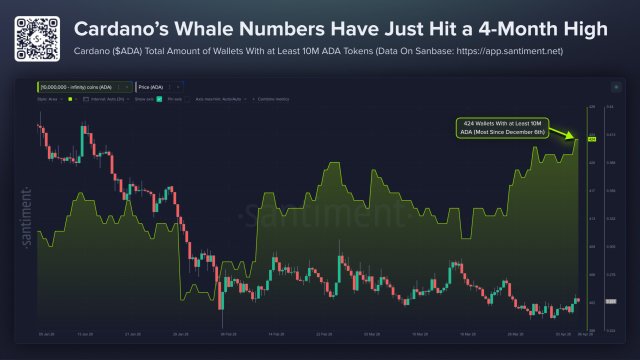
Source: Santiment

ADA Investors Are Very Bullish

While the Cardano whales are coming back to the table, the sentiment is beginning to turn toward the positive again. An earlier report from Santiment shows that ADA investors are still heavily bullish despite most being underwater. The data comes out to around 79% of all investors still bullish and expecting the cryptocurrency’s price to actually move upward.

In addition to this, the month of April has usually been rather bullish for the Cardano price, with more green closes than red for this month throughout history. CryptoRank’s data puts the average ADA price returns for April at 14.1%, suggesting that there could be some positive movement for the cryptocurrency.
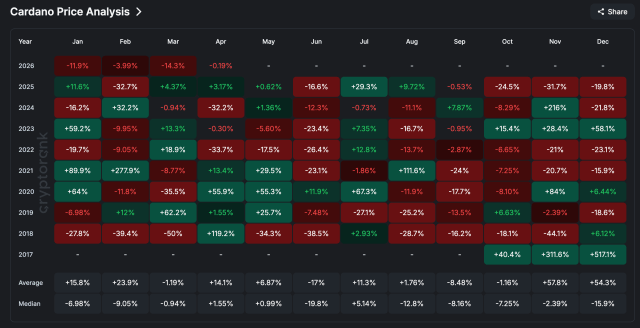
Source: CryptoRank

The rise in whale volume is also a net positive as these large buys go toward reducing the available supply on the market. Thereby, introducing scarcity and pushing the price upwards. However, the direction of the general crypto market still comes into play, meaning that if the market does go bullish, the likelihood of the ADA price going up becomes higher.

ADA price movements remain muted | Source: ADAUSDT on Tradingview.com

Related Questions

QWhat does the on-chain tracking platform Santiment report about Cardano whale wallets?

ASantiment reports that the number of Cardano wallets holding at least 10 million ADA has increased to 424, marking a 5.92% rise in whale wallets for the first time in over a month.

QAccording to the article, what is the sentiment of the majority of ADA investors despite price struggles?

AApproximately 79% of ADA investors remain bullish and expect the cryptocurrency's price to move upward, despite most being underwater on their investments.

QWhat is the historical average price return for Cardano (ADA) in the month of April, as cited in the article?

AAccording to data from CryptoRank, the average ADA price return for the month of April is 14.1%.

QHow does the activity of Cardano whales potentially affect the price of ADA?

AThe large buys from whales reduce the available supply of ADA on the market, which introduces scarcity and can help push the price upwards.

QWhat was the general performance of Cardano compared to other altcoins in the recent market, as described in the article?

ACardano has been one of the worst-hit altcoins, barely getting a rally in the last run and dropping fast once market momentum shifted.

Related Reads

When Doing Cryptocurrency Payment, the First Thing is Licenses, What is the Second?

When launching a crypto payment business, obtaining the necessary licenses is the crucial first step. However, the second, and arguably more critical, step is designing a comprehensive operational framework that forms a coherent business loop. This loop must be clearly understood and executable by all stakeholders: banks, payment partners, exchanges, on-chain analytics providers, regulators, and your internal team. Many projects mistakenly believe a single license permits all operations. Licenses merely grant entry; they don't define how the specific business functions. The real challenge lies in detailing every aspect of the workflow. This involves clarifying the customer base, the flow of fiat and crypto assets, the settlement process, and establishing clear lines of responsibility for risks like AML compliance, sanctions screening, chargebacks, and regulatory inquiries. A robust framework must answer seven core questions: Who are the clients and merchants? Who collects fiat and crypto? Who handles conversion and custody? And who is ultimately accountable for compliance and risk management? Projects often fail not from a lack of licensing, but during due diligence when they cannot convincingly explain these operational details. Therefore, beyond securing licenses, the priority must be constructing a closed-loop system. This system ensures the business model is transparent, risks are managed, responsibilities are delineated, contracts are aligned, and the entire process is comprehensible to partners and regulators. The true competitive edge in crypto payments lies not in acquiring a license quickly, but in integrating licensing, banking, compliance, and operations into a sustainable and executable whole.

marsbit22m ago

When Doing Cryptocurrency Payment, the First Thing is Licenses, What is the Second?

marsbit22m ago

Arthur Hayes Analysis: AI Bubble Nears Burst, Crypto Market Faces Short-Term Pressure

Arthur Hayes argues that the current AI market is a bubble poised to burst, which will exert downward pressure on the crypto market in the near term. The core trigger is rising oil prices due to the US-Iran conflict and a blockade of the Strait of Hormuz. Higher energy costs directly increase the operational expenses of AI data centers, squeezing profit margins for companies like Google, Anthropic, and OpenAI. Hayes predicts that persistent inflation from high oil prices will force Trump, in a bid to win the November election, to turn public sentiment against the AI industry. He may propose regulations and taxes on data centers and AI companies to appeal to voters concerned about costs and job displacement. Such political rhetoric could shatter market confidence. Furthermore, the market is unlikely to healthily absorb the massive concurrent IPOs of SpaceX, Anthropic, and OpenAI, which together seek valuations in the trillions. The combination of soaring energy costs, overwhelming equity supply, and negative political pressure will puncture the AI bubble. Hayes notes that nearly all new USD liquidity since 2022 has flowed into AI, leaving crypto like Bitcoin behind. When the AI bubble bursts, liquidity will contract sharply, pulling down all risk assets, including cryptocurrencies. In response, Hayes's fund, Maelstrom, has sold all AI-related stocks and non-core cryptocurrencies. It maintains core positions in Bitcoin and Ethereum while increasing exposure to energy sector equities, betting on rising oil and gas prices. He expects Bitcoin to bottom after the AI-led market decline, before rallying again with future monetary easing.

Foresight News36m ago

Arthur Hayes Analysis: AI Bubble Nears Burst, Crypto Market Faces Short-Term Pressure

Foresight News36m ago

To C, To B, and the Next Big Thing Called To A

After To C and To B, the Next Wave is To A: Serving AI Agents In a recent quarterly earnings call, Meituan's Wang Xing introduced a new concept: To A (To Agent), signifying that future business services will increasingly target AI Agents as primary clients, not just consumers or merchants. This shift implies that internet giants must now consider how to make their services more appealing for AI Agents to recommend, fundamentally altering traditional distribution logic. This "To A era" is prompting an unusual trend of alliances among major tech companies. Unlike previous competitive battles, firms like Meituan, Tencent, JD.com, Huawei, OPPO, and OpenAI are rapidly forming partnerships. The reason is strategic: as AI Agents become the primary user interface, handling tasks from a single command (e.g., "Book a Japanese restaurant for tomorrow"), the risk for platforms is being bypassed entirely. Companies are positioning themselves within this new value chain. Three primary strategies are emerging: 1. **Super-Entry Points + Service Providers:** Platforms like Tencent's Yuanbao, WeChat, and ChatGPT aim to be the first-stop Agent, integrating various services (food delivery, shopping, travel) from partners like Meituan and JD.com. 2. **Apps as Callable Services:** Companies like Meituan, JD.com, and Uber are ensuring their core services remain accessible and callable by external Agents, shifting from front-end apps to back-end capabilities. 3. **System-Level Agent Entry Points:** Smartphone makers (Huawei, Honor, OPPO) are leveraging their OS-level AI assistants to control the initial user command, redistributing it to relevant service apps. While alliances offer mutual benefit—entry points gain service capabilities, and service providers gain traffic—inherent conflicts of interest exist. A dominant Agent platform could eventually attempt to connect directly with suppliers (restaurants, hotels), bypassing current aggregators like Meituan or Ctrip. Other unresolved challenges include the potential for Agent recommendations to become a new form of paid ranking and unclear accountability for faulty recommendations. The current rush to form alliances is a defensive move by service providers to secure their position before the landscape solidifies. In this To A-driven restructuring, the greatest risk is not losing the race but failing to hear the starting gun.

marsbit45m ago

To C, To B, and the Next Big Thing Called To A

marsbit45m ago

The More Lifelike the Robot, the More Terrifying? Unveiling the 'Uncanny Valley Effect' in the Era of Humanoid Robots

As humanoid robots become increasingly lifelike, they confront a significant psychological barrier known as the "Uncanny Valley Effect," a concept proposed by Japanese roboticist Masahiro Mori in 1970. This phenomenon describes a dip in human comfort and acceptance when robots appear almost, but not perfectly, human. Minor imperfections in facial expressions, eye movements, or skin texture trigger a subconscious sense of unease, as the brain detects something trying, yet failing, to mimic a person. Examples range from the controversial human-like robot Sophia to animated characters in films like *The Polar Express*. The effect poses a key design challenge for robotics companies. Some, like Boston Dynamics, avoid it entirely by creating highly capable but visibly mechanical robots. Others, like Hanson Robotics, push for greater human likeness despite the risk. For consumer robots, especially in homes, most manufacturers opt for stylized or clearly mechanical designs to ensure broader acceptance. While the Uncanny Valley remains a powerful force, its impact may diminish over time through technological advancements that achieve near-perfect realism or through generational familiarity as people grow accustomed to interacting with humanoid machines. Ultimately, navigating this psychological frontier requires as much understanding of human perception as of robotics technology itself.

marsbit45m ago

The More Lifelike the Robot, the More Terrifying? Unveiling the 'Uncanny Valley Effect' in the Era of Humanoid Robots

marsbit45m ago

Trading

Spot
Futures

Hot Articles

Discussions

Welcome to the HTX Community. Here, you can stay informed about the latest platform developments and gain access to professional market insights. Users' opinions on the price of ADA (ADA) are presented below.

活动图片