Cardano stuck in 2-month range: Is a long-term bottom in sight for ADA?

ambcryptoPublished on 2026-03-24Last updated on 2026-03-24

Abstract

Cardano (ADA) has been trading within a narrow range for nearly two months, failing to capitalize on the bullish momentum seen in Bitcoin and other altcoins in March. A decisive breakout above $0.30 or below $0.245 is needed to determine its next price trend. Despite underperforming, ADA shows potential long-term bottom signals. Santiment data indicates a -43% 365-day MVRV, reflecting significant losses for holders and placing the asset in a historical buy zone. Additionally, Binance funding rates are at their most negative since mid-2023, suggesting extreme shorting pressure. These conditions have historically preceded market bottoms and could fuel a short squeeze, attracting capital inflows. However, investors should remain cautious. Any significant rally may face selling pressure from profit-taking and investors exiting at breakeven. Key resistance levels to watch are $0.30, $0.315, $0.365, and $0.43, where taking partial profits is advised. A drop below the $0.235–$0.24 range could invalidate the bullish outlook and signal continued seller dominance.

Cardano [ADA] continued to trade within a range. The range was nearly two months old now, and the altcoin does not show any signs of a breakout yet. Even though Bitcoin [BTC] and some altcoins saw a bullish March, Cardano was unable to replicate their gains.
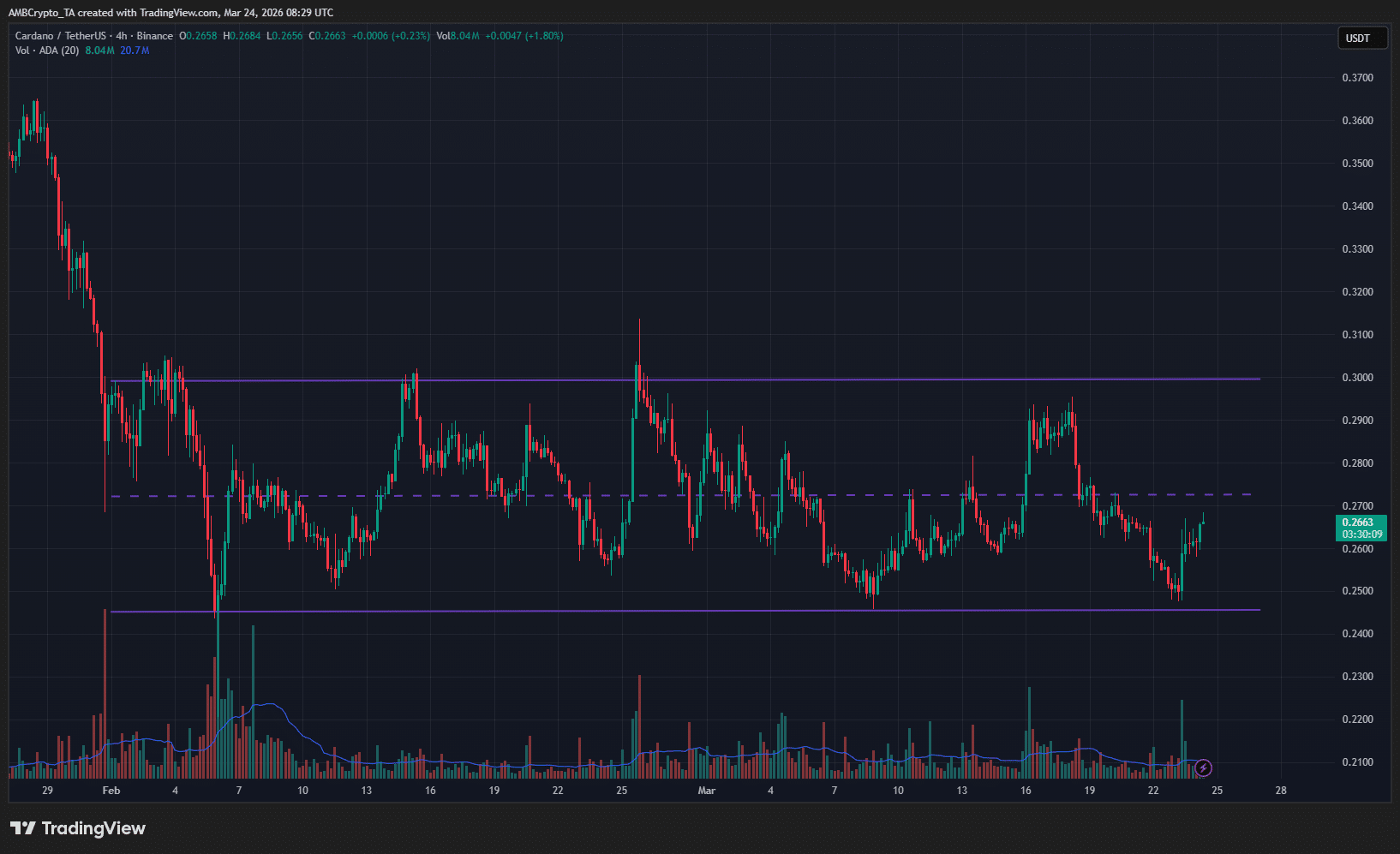
Source: ADA/USDT on TradingView

A move beyond $0.245 or $0.30 is needed for Cardano to establish its next price trend.

Since the 6th of February, the altcoin market (excluding Ethereum [ETH]) has gained 7.91% in cumulative market capitalization. ADA has kept pace with an 8.47% move. Should long-term investors buy the relatively weak Cardano token near its range lows and wait for it to catch up to Bitcoin?

The Cardano opportunity explained
Source: Santiment

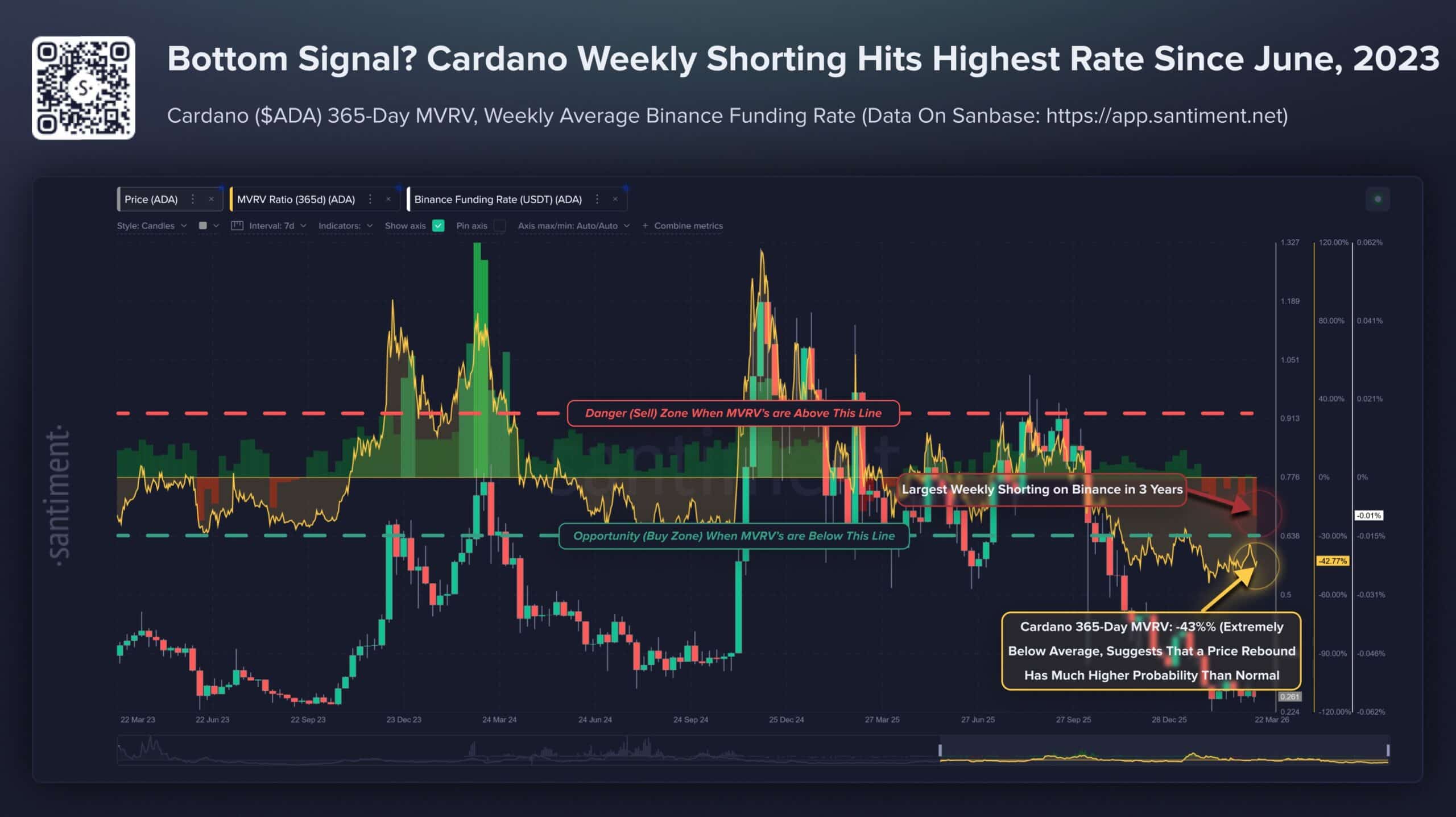
In a post on X, Santiment explained why Cardano was flashing bottom signals. The 365-day MVRV was at -43% and deep within a buy zone. Cardano has shed 71% in value since September 2025.

The MVRV tracks the average profit/loss that holders are at. The metric showed that the past year’s holders were facing a 43% drawdown.

The Binance funding rate was the most negative it has been since June, 2023. This high shorting level meant traders anticipated more losses. Santiment noted that this signal has been a bottom signal historically.

These short positions would provide the fuel for a short squeeze, and the subsequent price gain can capture investor attention and draw capital flows inward.

The combination of a market consensus of further losses and severe yearly holder drawdown could be the long-term bottom signal that Cardano investors are waiting for.

Profit-taking would be important during the next rally

The MVRV was at extremely low levels, but investors should remember the wider crypto bear market. A sizeable rally would likely face selling pressure as holders indulge in profit-taking and underwater investors exit at breakeven.

Investors should keep a close eye on the MVRV values across different timeframes to understand what short and long-term holders are doing.
Source: CoinGlass

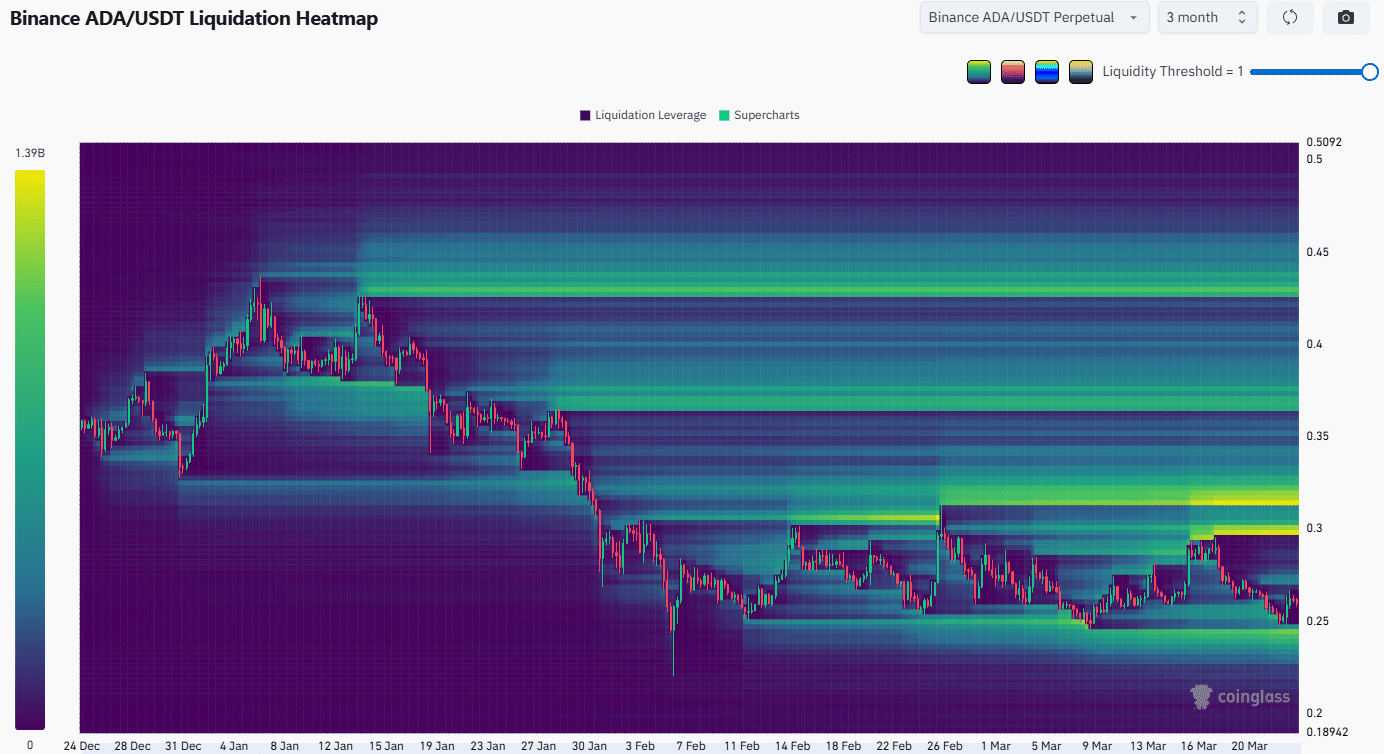
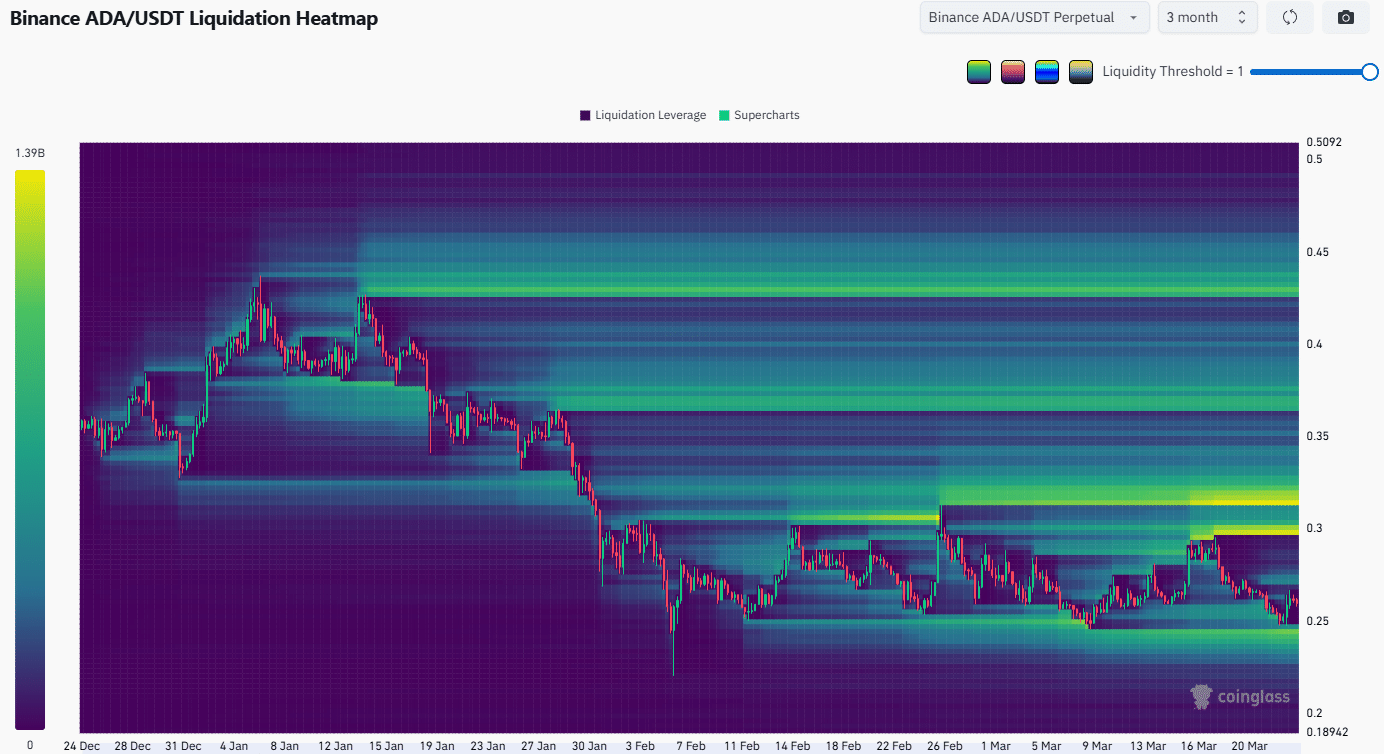
The 3-month liquidation heatmap showed that $0.300, $0.315, $0.365, and $0.430 were the key magnetic zones that the price could be attracted to. Taking partial profits at these levels was a viable option.

To the south, another liquidity cluster lay at $0.240, just below the current range lows. A price drop below $0.235-$0.240 could invalidate the buying opportunity and assert seller dominance.


Final Summary

  • The combination of heavy shorting pressure and deep drawdown for 1-year holders has historically been a market bottom signal.
  • A breakout beyond $0.30, the local range highs, would confirm bullish strength.

Related Questions

QWhat are the key price levels that Cardano (ADA) needs to break to establish its next trend?

AA move beyond $0.245 or $0.30 is needed to establish the next price trend.

QAccording to Santiment, what two key metrics are flashing bottom signals for Cardano?

AThe 365-day MVRV at -43% (indicating deep holder losses) and the most negative Binance funding rate since June 2023 (indicating heavy shorting) are the bottom signals.

QWhy could the high level of short positions potentially lead to a price increase for ADA?

AThe high level of short positions could provide the fuel for a short squeeze, where a price gain forces short sellers to buy back, which can capture investor attention and draw capital inflows.

QWhat is the significance of the $0.235-$0.240 price level mentioned in the article?

AA price drop below the $0.235-$0.240 level could invalidate the current buying opportunity and assert seller dominance, as it is a key liquidity cluster just below the current range lows.

QWhat does the 365-day MVRV (Market Value to Realized Value) ratio of -43% indicate about ADA holders?

AIt indicates that holders who bought ADA in the past year are facing an average unrealized loss of 43%, placing the metric deep within a historical 'buy zone'.

Related Reads

Dialogue with a Macro Analyst: AI Drains All Liquidity from U.S. Stocks, $40K Bitcoin is the True Bottom

In a recent discussion, macro strategist Luke Groman, founder of FFT LC, presented a sobering analysis of current markets. He argues that while the S&P 500 hits new highs, this is largely driven by just seven AI stocks, which are "sucking all the oxygen and liquidity out of the room." Bitcoin, which he calls the "last working smoke alarm for liquidity," is signaling trouble, having entered a difficult period. Groman explains that the AI boom is fueled by accounting practices that front-load revenue, creating an illusion of high profits while cash is being depleted. He warns this cycle could reverse sharply when construction slows. His base case is that stocks will rise in dollar terms but fall significantly when measured in gold or Bitcoin, highlighting that long-term US Treasury futures have already lost 90% of their value against gold over the past decade. He points to major structural risks, including China's dominance in rare earths—a small commodity market underpinning trillions in tech stock value—and the prolonged closure of the Strait of Hormuz, which he calls a "Suez Moment" for the US. This, combined with a shift towards a "no ticky, no washy" proof-of-work system for settling trade (using gold, not trust), signals deeper systemic distrust. Regarding US debt, Groman notes that historically, all 58 countries that reached a 130% debt-to-GDP ratio defaulted, primarily through inflation. The US crossed this threshold in 2020. He also highlights a contradiction in the AI narrative: if it's as transformative as claimed, it must destroy white-collar jobs, threatening half of US tax revenue—a reality at odds with the "no job loss" messaging from tech leaders. On Bitcoin, Groman sold most of his position near the top and hasn't fully re-entered. Citing technical analysis from Northstar Bad Charts, he suggests a potential bottom around $40,000 could materialize in Q3 or Q4. He concludes that while he may be labeled a doomsayer, his view is simply realistic, grounded in historical precedents and current macro pressures.

marsbit54m ago

Dialogue with a Macro Analyst: AI Drains All Liquidity from U.S. Stocks, $40K Bitcoin is the True Bottom

marsbit54m ago

Apple's Desired On-Device AI Sees a Dark Horse Emerge: The First Cognitive Model is Born, 4B Matches GPT-5.4

A Chinese company, Tomorrow's Journey (Nextie), has introduced what it is calling the industry's first "cognitive model" for edge devices. Named New Journey Alpha, this 4-billion-parameter model reportedly matches the performance of trillion-parameter giants like GPT-5.4 in group intelligence tasks such as debate and collective decision-making. The development follows Andrej Karpathy's vision of stripping vast factual knowledge from large language models to retain only a smaller "cognitive core" capable of reasoning, planning, and knowing its own limits. This approach directly addresses the soaring computational costs and token expenses hindering AI's widespread deployment, as highlighted by incidents like Amazon shutting down an internal AI tool due to prohibitive costs. Trained via reinforcement learning on a corpus of academic papers from 1800-2020 to enhance generalization, the model enables three key advancements: 1) Improved decision quality in multi-agent systems, 2) Drastically reduced compute costs, allowing for cost-effective cloud or on-device (e.g., MacBook) deployment, and 3) The feasibility of "proactive" AI agents that act autonomously without user prompts, unlocking new commercial possibilities beyond today's reactive models. Built by the former Microsoft Xiaoice team—known for creating a 3.6B model that outperformed a 65B Llama model—the company is now focusing on the multi-agent systems sector, a field gaining significant investor interest. The model's economic impact is profound; by achieving high-level performance with minimal parameters, it fundamentally alters the cost structure of AI services, challenging the prevailing model of ever-larger parameter counts.

marsbit3h ago

Apple's Desired On-Device AI Sees a Dark Horse Emerge: The First Cognitive Model is Born, 4B Matches GPT-5.4

marsbit3h ago

Trading

Spot
Futures

Hot Articles

Discussions

Welcome to the HTX Community. Here, you can stay informed about the latest platform developments and gain access to professional market insights. Users' opinions on the price of ADA (ADA) are presented below.

活动图片