Cardano Is Already Running Behind 200 German Companies, Foundation CEO Says

bitcoinistPublished on 2026-04-17Last updated on 2026-04-17

Abstract

Cardano Foundation CEO Frederik Gregaard revealed that approximately 200 large German companies are already using Cardano’s blockchain infrastructure—without being aware of it—through agentic AI deployments. These firms leverage Cardano as a security, digital identity, and accountability layer, particularly for verifying AI agents and ensuring data privacy without disclosure. Gregaard emphasized blockchain’s evolving role as a foundational trust layer for AI systems rather than just a payment rail. He noted that regulated stablecoins like USDM are used for microtransactions between AI agents, aligning incentives and enhancing security. He also highlighted Cardano’s regulatory positioning as a commodity, its quantum security features, and potential growth under emerging US and EU legislation. At the time of reporting, ADA was trading at $0.2566.

Cardano is already being used by roughly 200 large companies in Germany through agentic AI deployments, even if those firms do not realize the blockchain is sitting underneath their stack, according to Cardano Foundation CEO Frederik Gregaard. The claim, made during an interview with Jane King on GBBC’s Markets on Chain series from the New York Stock Exchange published April 16, points to a version of blockchain adoption that is less visible to end users but potentially more embedded in enterprise infrastructure.

200 German Companies Use Cardano Without Even Knowing It

Gregaard framed the Cardano Foundation’s role as pushing blockchain into systems people use without necessarily recognizing it. “We have about 200 companies in Germany who live on agentic AI, fairly large companies, and they don’t even know they’re using Cardano as a security layer, as a digital identity layer and as an accountability layer,” he said. “Part of when you have, for instance, agentic AI who’s using data from two different databases, [is] ensuring that the agentic AI is who they say they are, that they have the data they claim without disclosing it, because we want privacy.”

That argument was central to Gregaard’s broader pitch: blockchain, in his view, is becoming an underlying trust and coordination layer for AI-driven systems rather than simply a rails story for tokens or payments. He described a model where users could interact with seamless consumer applications while Cardano handles provenance, identity and compliance in the background. The point was less about visible crypto branding than about infrastructure-level deployment.

Payments still featured prominently. Gregaard said AI agents in some of these systems are already transacting using a regulated stablecoin called USDM, with microtransactions used to meter prompt activity and align incentives between participants. “The AIs are actually paying themselves using regulatory compliant stablecoins,” he said. “There’s a microtransaction happening just to do the prompts. And that’s also part of the security layer, which ensures that one database who has more computing power than the other doesn’t do unlimited prompts and can circumvent the security.”

Why Cardano Could Strive In The EU And US

The interview also tied that enterprise and AI narrative to policy. Gregaard said the US stablecoin framework under the GENIUS Act had moved the market closer to Europe’s MiCA regime, but argued the more consequential shift could come from the Clarity Act. He said he expects that legislation, if passed, to unlock materially broader blockchain usage beyond financial applications, adding that “hundreds of companies” are already waiting on that kind of legal certainty. He further claimed that recent regulatory language had made clear that “Cardano is a commodity,” and suggested the US could move faster than Europe on this front.

Alongside adoption, Gregaard leaned heavily on security. He said Cardano’s on-chain governance model and distributed validator base make it harder to compromise through a single point of failure, a contrast with networks he described as effectively controlled by a small number of insiders. He also argued that Cardano is emerging as a “first level quantum secure environment” through its interoperability with legal entity identity standards, which he said is drawing interest from banks, brokers, exchanges and central securities depositories.

At press time, Cardano traded at $0.2566.
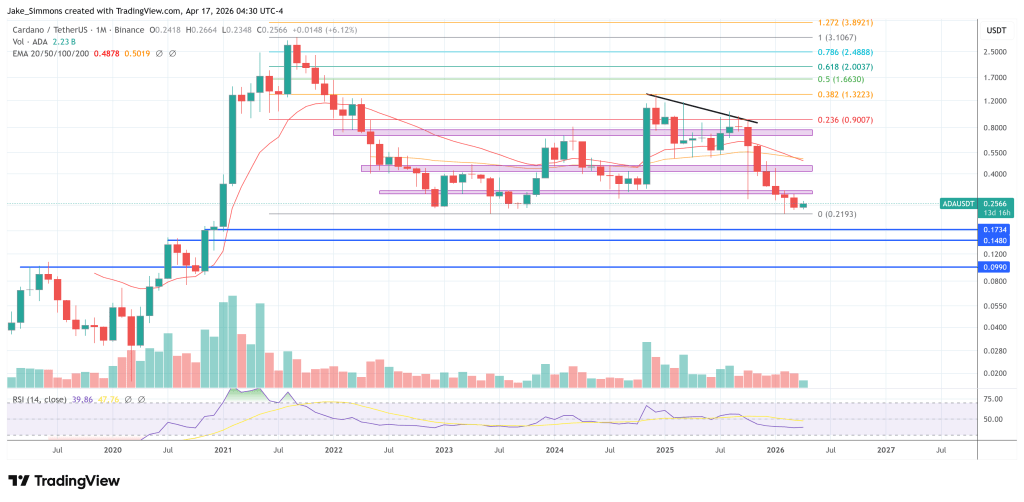
ADA hovers below key resistance, 1-monthly chart | Source: ADAUSDT on TradingView.com

Related Questions

QAccording to the Cardano Foundation CEO, how many large companies in Germany are using Cardano without realizing it, and for what purposes?

AAccording to Cardano Foundation CEO Frederik Gregaard, roughly 200 large companies in Germany are using Cardano as a security layer, a digital identity layer, and an accountability layer in their agentic AI deployments, without even knowing the blockchain is underneath their stack.

QWhat specific type of digital currency are the AI agents using for microtransactions in these systems, and what is its purpose?

AThe AI agents are using a regulated stablecoin called USDM for microtransactions. These microtransactions are used to meter prompt activity and align incentives between participants, and they form part of the security layer to prevent abuse.

QWhat US legislation does Gregaard suggest could unlock significantly broader blockchain usage beyond financial applications?

AGregaard suggests that the Clarity Act, if passed, could unlock materially broader blockchain usage beyond financial applications. He claims that 'hundreds of companies' are waiting for this kind of legal certainty.

QHow does Gregaard contrast Cardano's security model with that of other networks?

AGregaard contrasts Cardano's security by highlighting its on-chain governance model and distributed validator base, which make it harder to compromise through a single point of failure. He contrasts this with networks he describes as effectively controlled by a small number of insiders.

QWhat two key regulatory frameworks does the article mention in the context of stablecoins, and which region does Gregaard suggest might move faster on classifying assets like Cardano?

AThe article mentions the US stablecoin framework under the GENIUS Act and Europe's MiCA regime. Gregaard suggests that the US could move faster than Europe on providing regulatory clarity, recently stating that regulatory language has made clear that 'Cardano is a commodity.'

Related Reads

Warsh Hearing Concludes: What Are the Notable Signals for the Crypto Industry?

The Senate Banking Committee held a confirmation hearing for Judy Shelton, a Federal Reserve nominee, who faced intense questioning regarding her ability to maintain the central bank's independence amid pressure from President Trump to lower interest rates. Shelton denied any pre-arranged commitments on rate cuts and emphasized her independence, though Democrats remained skeptical, citing contradictions with Trump's public statements. Shelton characterized post-pandemic inflation as a major policy failure and called for a "regime change" in the Fed’s approach, including reforms to inflation measurement and communication strategies. She criticized the current practice of Fed officials frequently signaling future rate moves and did not commit to maintaining post-meeting press conferences, suggesting potential reductions in transparency. Regarding crypto markets, Shelton’s extensive investments in digital asset companies—including Solana, DeFi, and blockchain infrastructure—were noted, though she has pledged to divest these holdings due to ethics rules. Her familiarity with the crypto industry and deregulatory leanings may signal a more open, though cautious, stance toward digital assets. However, concerns were raised about potential conflicts of interest, especially given Trump family involvement in crypto-financial ventures. The timing of her confirmation remains uncertain, pending a Justice Department investigation into current Chair Powell. Shelton’s potential leadership could lead to a more hawkish, productivity-focused Fed with tighter policy communication—factors that may significantly influence liquidity conditions and macro narratives for crypto markets.

marsbit6h ago

Warsh Hearing Concludes: What Are the Notable Signals for the Crypto Industry?

marsbit6h ago

Trading

Spot
Futures

Hot Articles

Discussions

Welcome to the HTX Community. Here, you can stay informed about the latest platform developments and gain access to professional market insights. Users' opinions on the price of ADA (ADA) are presented below.

活动图片













