Charles Hoskinson has escalated a public dispute with Iagon’s leadership, saying the Cardano project crossed what he described as personal and professional “red lines” by targeting Midnight community members and ambassadors during an ongoing funding fight.
In a video published on April 27, 2026, the Cardano founder framed the clash as broader than a disagreement over governance or treasury funding. Hoskinson said criticism of him or Input Output was fair game, but accused Iagon’s leadership of moving the dispute into harassment of volunteers and community participants connected to Midnight, the privacy-focused project associated with the Cardano ecosystem.
Hoskinson Says Iagon Leadership Crossed A Line In Cardano Dispute
“I have red lines. There’s not many of them, but if you cross them, I will always behave the same way,” Hoskinson said. “If you accuse me of criminal conduct, illegal activity, and you’re more than just an anonymous internet troll, you actually have a following and so forth, we of course will respond to that up to and including litigation.”
Hoskinson tied that first red line to the earlier ADA voucher controversy, saying Input Output had been accused of criminal conduct before being “exonerated with an audit.” He described that period as “a very dark time in the history of Cardano.”
The second line, he said, involves attacks on people affiliated with projects Input Output is building or supporting. According to Hoskinson, disagreements with him or his company should not be extended to volunteers, ambassadors or community members who are participating in those projects.
“Do not attack our ambassadors. Not once, not ever. Do not bully them. Do not harass them,” he said. “Do not harass them on Twitter and bring them into the court of public opinion for a Twitter mob to tear them apart and claim that they’re bought and sold and owned by me. It’s disgusting.”
The dispute appears to center on Iagon’s opposition to Input Output-related funding proposals and its conduct around Midnight. Hoskinson said Iagon’s CEO first voted to defund Input Output and then, in his view, pressured Midnight ambassadors or sought to discourage them from participating. He also criticized Iagon’s CTO, saying the executive had supported defunding Input Output while claiming the company was “evil” because of Hoskinson.
Hoskinson stressed that voting against a funding proposal was not itself the issue. He noted that other Cardano entities, including the Cardano Foundation and Emurgo, have abstained or voted against proposals in the past. The line, he argued, was crossed when the dispute became personal toward community members.
He also suggested that Iagon’s leadership may be preparing to move away from Cardano, pointing to prior “multi-chain” messaging and the intensity of the current conflict. Hoskinson said he had no animus toward Iagon token holders, but said he had lost confidence in the project’s current leadership.
“I do not have any faith in the leadership, ethics or integrity of the Iagon principles at the moment based upon their statements and conduct,” he said. “It seems to be deeply unstable and bizarre. Thus, it doesn’t give me high confidence they’re going to be able to deliver on their mission.”
Hoskinson said Input Output would respond by supporting more decentralized infrastructure options for Cardano. He named Filecoin and Walrus as projects with which he intends to build relationships, and said he would like to see Blockfrost contribute additional capabilities as well.
That infrastructure push comes as Cardano’s governance and funding process remains under pressure. Hoskinson said the total fiat value of the current coalition’s proposals, including Input Output and vendors working with it, is now below $50 million, compared with $97.5 million for Input Output’s proposals last year. He framed that as a major efficiency improvement, while acknowledging that lower ADA prices forced cuts and difficult decisions.
Despite the dispute, Hoskinson said he remains encouraged by Cardano’s direction, citing Bitcoin DeFi, Midnight, new venture capital involvement, dedicated marketing discussions, open-source infrastructure plans and ecosystem KPIs from the Intersect KPI committee.
He closed by saying the Iagon matter was now finished from his side. Further engagement, he said, would be met with blocks rather than debate.
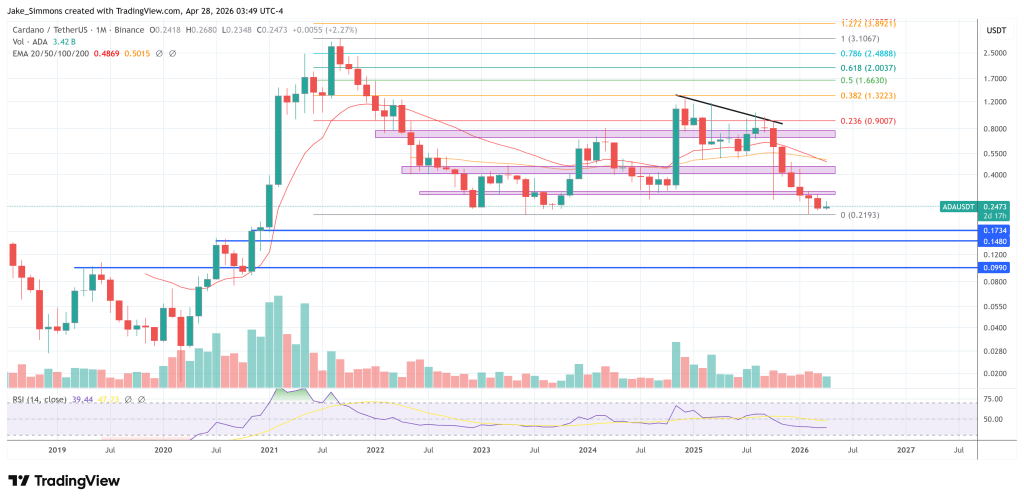
At press time, ADA traded at $0.2473.