Can Solana reclaim $80? SOL’s next move depends on THIS level

ambcryptoPublished on 2026-07-17Last updated on 2026-07-17

Abstract

Solana (SOL) pulled back to $74.8, retesting the key 50-day Moving Average support after Bitcoin's decline. Holding this $74 level could lead to a recovery targeting $80-$88. A breakdown below it risks a drop under $70. Potential catalysts include Morgan Stanley's new spot SOL trading on E*TRADE, positive U.S. ETF inflows, and strong recent accumulation, though macro risks remain.

Solana [SOL] has given back its gains made earlier in the week as Bitcoin slipped below $63K on Friday, the 17th of July.

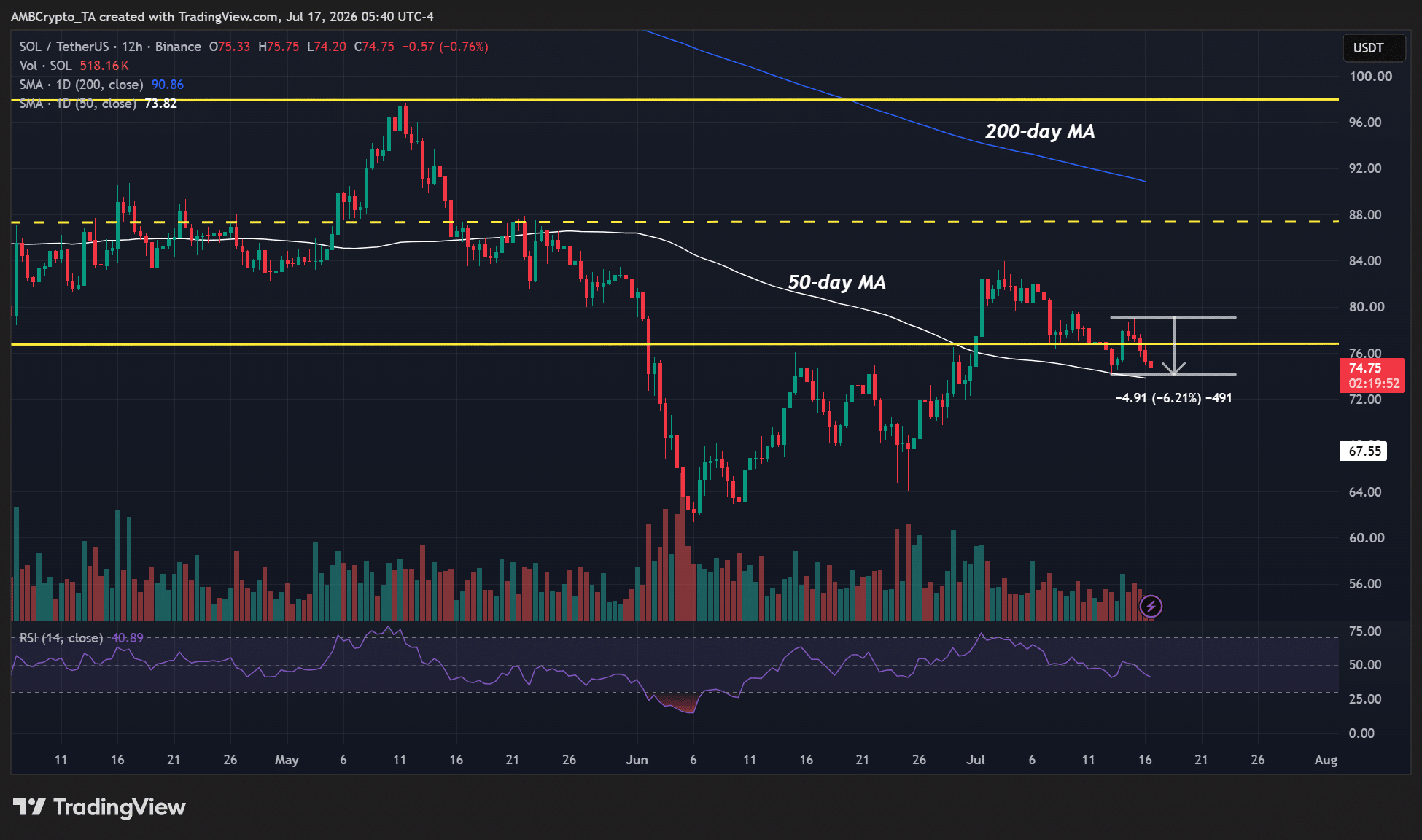
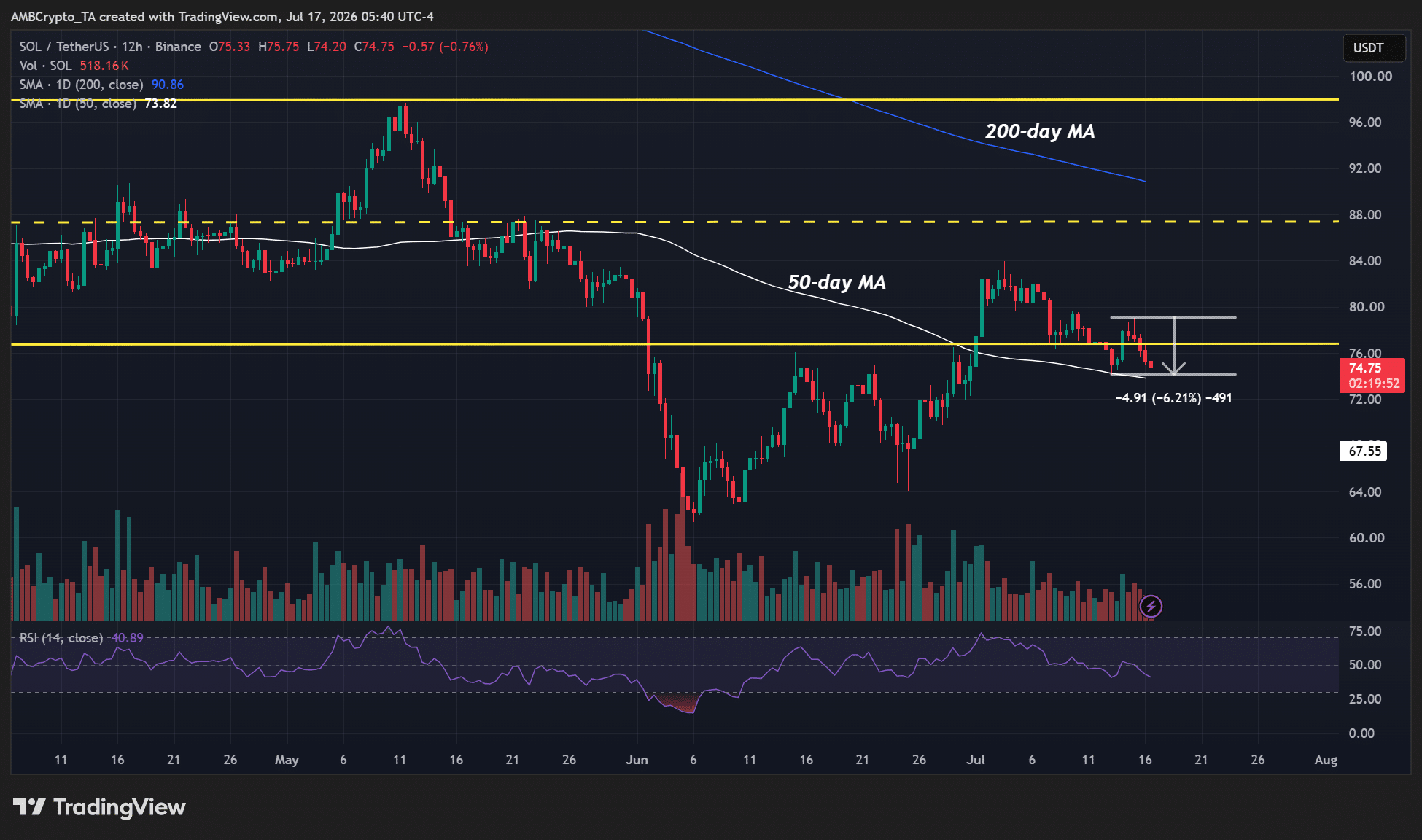
As of writing, SOL was valued at $74.8, down 6% from this week’s high of $79. But the pullback retested a crucial short-term support at the 50-day Moving Average (MA, white).

This dynamic support has stopped the dumps in July. If the trend repeats, relief demand could be possible at the 50-day MA or the $74 level.
Source: SOL/USDT, TradingView

If so, the next upside targets would be $80, $84, or the mid-range level at $88. That would be 8%-18% in upside potential.

But the price reversal projection would be invalidated if bears decisively push Solana [SOL] below the 50-day MA. In such a scenario, another dip below $70 couldn’t be overruled.

Will Morgan Stanley’s move boost Solana crypto?

This raises the most crucial question: what are the potential catalysts that could shape SOL’s price direction in the next few days?

First, on Thursday, Morgan Stanley activated spot trading for Solana [SOL], Bitcoin and Ethereum through its E*TRADE platform. Commenting on the same, Chad Turner, Head of Morgan Stanley Wealth Management Platforms, said,

With the rollout of crypto trading on E*TRADE, we’re advancing our digital assets strategy and bringing new capabilities to clients in an integrated way.

Worth pointing out that more banks and brokerage firms are now supporting spot crypto trading, including Charles Schwab and Fidelity. However, only Morgan Stanley has expanded support for SOL, as the other top-tier banks only support BTC and ETH for now.

It remains to be seen whether this will boost demand for SOL.

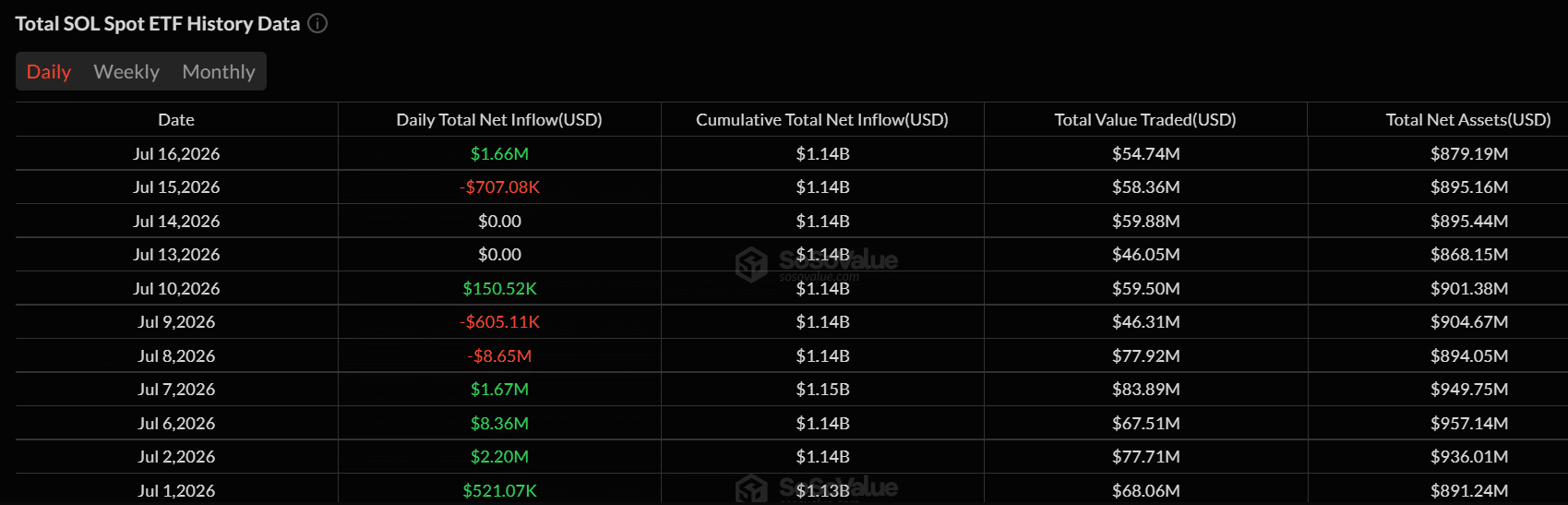
Secondly, U.S. spot ETFs saw a positive daily net inflow of $1.66M on Thursday, breaking the trend of zero or negative outflows seen throughout the week. If inflows remain sustainable, SOL price could defend $74 and attempt a recovery.
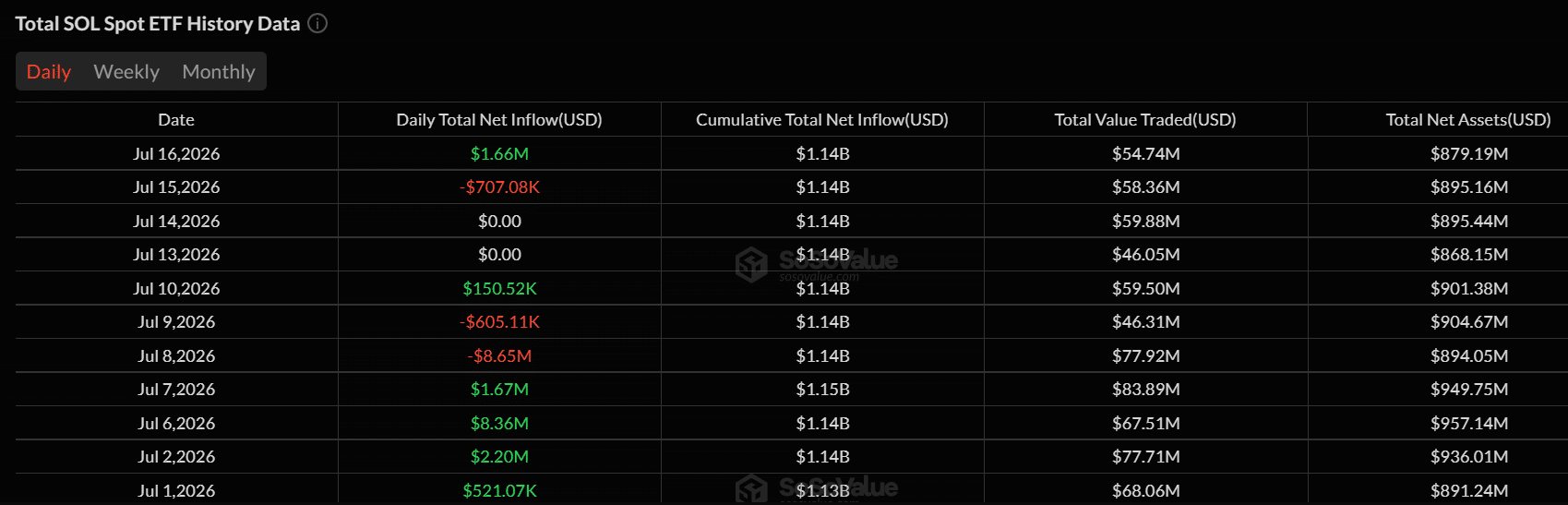
Source: X

In fact, the overall spot SOL accumulation has been strong in the first half of July and in the past 30-days.

However, if macro and geopolitical jitters worsen in the next few days, the potential de-risking could drag SOL lower.


Final Summary

  • Morgan Stanley rolled out support for spot SOL trading via its E*TRADE platform.
  • SOL’s short-term recovery could be determined if bulls hold above $74.

Trending Cryptos

Related Questions

QWhat was the price of Solana (SOL) as of the writing of the article, and what key support level was it retesting?

AAs of writing, Solana (SOL) was valued at $74.8. The pullback was retesting a crucial short-term support level at the 50-day Moving Average (MA), which is approximately at the $74 level.

QAccording to the article, what are the potential upside targets for SOL if the price holds support at the 50-day MA?

AIf the price holds support at the 50-day MA ($74), the next upside targets would be $80, $84, or the mid-range level at $88. This represents an 8% to 18% upside potential.

QWhat recent institutional development was highlighted as a potential catalyst for Solana's price?

AThe article highlighted that Morgan Stanley activated spot trading for Solana (SOL), Bitcoin, and Ethereum through its E*TRADE platform on Thursday. This move could potentially boost demand for SOL.

QWhat trend in U.S. spot ETF flows does the article mention, and how could it impact SOL's price?

AThe article mentions that U.S. spot ETFs saw a positive daily net inflow of $1.66M on Thursday, breaking the trend of zero or negative outflows seen earlier in the week. If these inflows remain sustainable, it could help SOL defend the $74 support level and attempt a recovery.

QWhat condition would invalidate the short-term price reversal projection for SOL, and what could be the consequence?

AThe short-term price reversal projection would be invalidated if bears decisively push Solana (SOL) below the 50-day Moving Average (the $74 level). In such a scenario, another dip below $70 couldn't be overruled.

Related Reads

Live-Action Short Series Forced onto the Big Screen by AI

Live-action short dramas, originally a popular online format, are now attempting to enter the cinema. Several top IPs like "What a Good Girl" and "One Family, Same Class" have received approval for film adaptations. This shift is driven by several pressures within the short drama industry. After rapid growth fueled by low costs and platform support, the sector now faces a slowdown with fewer hits and reduced investment. A major disruptor is the explosive rise of AI-generated short dramas, which dominate new releases and challenge the traditional model with their speed and low cost. Platform policy changes, such as adjustments to revenue guarantees, have further squeezed producers. In this context, film adaptation is seen as a potential new growth path. It offers a chance to extend a short-lived online hit into a longer-lasting IP asset, moving beyond the "fast production, fast consumption" cycle. Established short dramas bring pre-validated stories and emotional appeal to the table, potentially lowering the risk for film investors. However, significant challenges remain. Translating a fast-paced, fragmented viewing experience designed for phones into a compelling cinematic narrative is difficult. Past attempts by popular TV shows and variety programs to make films have often failed due to weak content. A short drama's massive online viewership does not guarantee box office success, as cinema requires a higher commitment of time and money from audiences. Ultimately, the success of these adaptations will depend not on their original popularity, but on their ability to tell complete, emotionally resonant stories that meet the standards of the theatrical market.

marsbit54m ago

Live-Action Short Series Forced onto the Big Screen by AI

marsbit54m ago

Asymmetry of Algorithmic Agency: When AI Makes Decisions for You, You Don't Even Have the Right to Oppose

As AI increasingly makes decisions on our behalf, a critical asymmetry emerges: the entities deploying these systems understand and refine their algorithms, while individuals merely endure the consequences. This article explores the three layers of this "algorithmic agency asymmetry." First, opacity shields system goals, incentives, and flaws, creating a "black box fallacy" where outputs seem objective. Second, algorithms amplify historical biases, repackaging past inequalities in a seemingly neutral, computational form. Third, recursive systems lead to "algorithmic drift," where users train the system and are simultaneously trained by it, shaping their own choices and behaviors. This asymmetry has profound implications, extending into hiring, education, policing, and daily life. Users adapt to what the system rewards, but only see the end result—a score, recommendation, or price—without understanding the underlying logic or manipulated conditions. To rebalance this power dynamic, the article proposes policy interventions: 1) Meaningful transparency and explainability for users affected by AI decisions. 2) Enforceable impact assessments before deploying high-risk systems. 3) Genuine human oversight with the power to challenge outputs. 4) Mandatory post-deployment monitoring and auditing. 5) Outright bans on manipulative or exploitative systems. Finally, fostering widespread "algorithmic literacy" is essential public infrastructure. Ultimately, this asymmetry is a structural power imbalance. Good policy cannot eliminate it but can narrow the gap by making automated influence visible, contestable, auditable, and governable.

marsbit57m ago

Asymmetry of Algorithmic Agency: When AI Makes Decisions for You, You Don't Even Have the Right to Oppose

marsbit57m ago

From StepFun to Galaxy Robots: The Capital Migration Path Behind WAIC Exhibiting Companies

From Stellar Steps to Galactic Generals: The Capital Migration Route Behind WAIC 2026 Exhibiting Enterprises The 2026 World Artificial Intelligence Conference (WAIC) in Shanghai showcased over 1100 exhibitors. Analyzing their financing activities over the past 18 months reveals key capital trends in China's AI industry, with the total raised exceeding 100 billion RMB. **Large Language Models: IPO Window Opens, Capital Concentrates on Leaders** This sector attracted the most capital. Companies like Zhipu and MiniMax have completed Hong Kong IPOs, setting exit benchmarks. StepFun (Stellar Steps), a star example, saw its valuation soar to an estimated $12B through rapid, escalating funding rounds—from millions in 2023 to a $2.5B Pre-IPO round in mid-2026 led by industrial players like ZTE. The trend shows a shift: IPO paths are clear, industrial capital is entering for strategic deployment, and large, concentrated funding rounds favor commercially viable leaders. **Embodied AI: Hyper-Compressed Financing Cycles** This field entered a capital explosion phase. Companies like Galbot (Galactic General) epitomize the trend, raising over 7B RMB across 5 rounds in under 2 years. Early VC backing quickly gave way to investments from industrial giants (Meituan, CATL, SAIC) and finally "national team" funds, signaling its status as a strategic industry. The compressed fundraising pace, as seen with other leaders, indicates high consensus on the sector's potential and intense competition. **AI Chips: Domestic Substitution Enters Deep Waters** Represented by companies like Moore Threads (which completed an 8B RMB IPO as the "first domestic GPU stock"), this sector differs. It faces longer R&D cycles, higher capital thresholds, and stronger policy reliance. Funding often involves state-backed capital and telecom operators, with lower VC participation compared to other AI sectors, reflecting the industry's inherent challenges. **Capital Flow Panorama: Five Key Trends** 1. **Winner-Takes-Most:** Funding is highly concentrated in top players within each sector. 2. **Embodied AI as a New Growth Pole:** It attracts rapid, large-scale funding from industrial chains, akin to the automotive sector. 3. **Industrial Capital Ascendancy:** Strategic investors like ZTE and SAIC are replacing pure financial VCs for technology synergy. 4. **"National Team" Prominence:** State-guided investment funds are actively co-investing, aligning AI with national strategy. 5. **Diversified Exit Paths:** Beyond IPOs, options like M&A and strategic investment are increasing. **Conclusion: Capital is Not Omnipotent** While massive capital influx signals strong market confidence in China's AI outlook, it brings risks: reduced ecosystem diversity due to concentration, potential compromise of corporate independence, and valuation bubble concerns amidst compressed financing. The investor's motive behind a company often reveals more than its technical specs.

marsbit1h ago

From StepFun to Galaxy Robots: The Capital Migration Path Behind WAIC Exhibiting Companies

marsbit1h ago

Before Second Attempt to List on HKEX, Performance of Semiconductor 'Little Giant' Suddenly Deteriorates

Shenzhen Vanguard Semiconductor, a state-level "little giant" specializing in power semiconductor devices, has once again filed for a listing on the Hong Kong Stock Exchange main board, with GF Securities as the sole sponsor. This is its second attempt this year. Backed by prominent investors like Intel Asia-Pacific, OPPO, Xiaomi, and CATL, the company's post-investment valuation soared over 500% to approximately RMB 2.9 billion in just two and a half years. However, a month before its application, China's securities regulator raised six inquiries, focusing on the fairness of share prices for recent new shareholders and potential conflicts of interest related to two employee incentive platforms, suggesting concerns over improper benefit transfers. Financially, the company's performance shifted in the first five months of 2026, recording a net loss of RMB 510,000 compared to a profit of RMB 26.53 million a year earlier. Its overall gross margin also dropped from 22.4% to 17.9%. This was attributed to a decline in revenue share from its high-margin WLCSP products, driven by conservative smartphone maker procurement plans amid market adjustments, leading to a situation of increased revenue but decreased profitability. Furthermore, Vanguard Semiconductor's distribution network underwent a significant overhaul, with the number of authorized distributors plummeting from 658 to 103 within three years, mostly terminated for failing performance metrics. Sales remain heavily reliant on distributors, accounting for 84.1% of revenue in early 2026. Concurrently, customer and supplier concentration risks are rising, with the top five customers contributing 67.9% of revenue. While industry observers note that high customer concentration is common, attention is drawn to whether shareholder relationships, such as with Huaqin Technology's affiliate holding a 2.12% stake, extend to the client level.

marsbit1h ago

Before Second Attempt to List on HKEX, Performance of Semiconductor 'Little Giant' Suddenly Deteriorates

marsbit1h ago

Trading

Spot

Hot Articles

Discussions

Welcome to the HTX Community. Here, you can stay informed about the latest platform developments and gain access to professional market insights. Users' opinions on the price of S (S) are presented below.

活动图片