Can Ethereum keep beating Bitcoin in Q3? Tom Lee’s ETH thesis under pressure

ambcryptoPublished on 2026-07-08Last updated on 2026-07-08

Abstract

Tom Lee's bullish Ethereum thesis faces pressure as Q3 begins. While the ETH/BTC ratio has rallied nearly 5% on optimism surrounding the potential passage of the CLARITY Act, Ethereum's on-chain fundamentals lag. Key metrics like DeFi Total Value Locked and stablecoin supply remain weak. Conversely, Bitcoin is seeing renewed institutional demand, with BlackRock resuming significant purchases. The debate balances Ethereum's regulatory optimism against Bitcoin's strong institutional inflows. For ETH/BTC's Q3 outperformance to sustain, Ethereum's underlying DeFi activity needs to recover.

Tom Lee’s Ethereum conviction heading into Q3 is starting to look like a well-timed move.

For context, BitMine Immersion recently added another 42,197 ETH, taking its holdings to more than 5.74 million ETH.

On the other hand, Michael Saylor’s Strategy sold 3,588 BTC, setting up an interesting ETH vs. BTC treasury debate as Q3 gets underway.

Notably, this debate isn’t just playing out on social media.

As the chart below shows, the ETH/BTC ratio has opened Q3 with a nearly 5% rally after three straight losing quarters. That suggests ETH is beginning to regain relative strength against BTC, supporting Tom Lee’s decision to keep accumulating Ethereum.
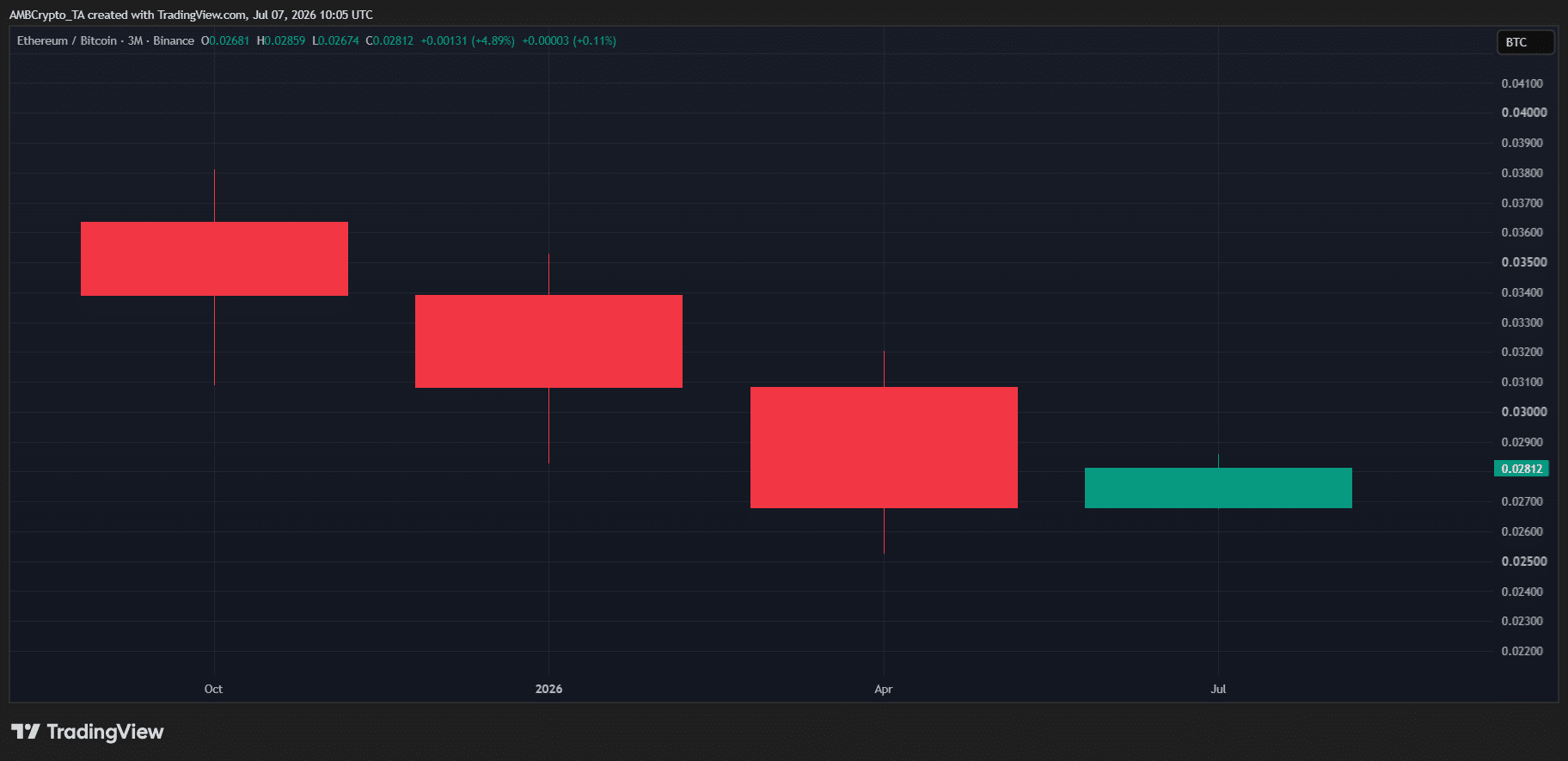
Source: TradingView (ETH/BTC)

However, Tom Lee’s conviction isn’t based on hope alone.

In a recent post on X, BitMine said the improving odds of the CLARITY Act are the main reason behind its growing ETH position.

According to the company, prediction markets now put the odds of the CLARITY Act passing at around 50%, the highest level in two weeks. BitMine argues that regulatory clarity would be a major catalyst for Ethereum, as smart contract platforms become more integrated into everyday finance.

So, from BitMine’s perspective, the recent rise in the ETH/BTC ratio simply reflects the market assigning a higher probability to the CLARITY Act becoming law.

Naturally, the bigger question now is whether that repricing has further to run. Can ETH continue outperforming BTC through the rest of Q3, or is BMNR’s bullish Ethereum [ETH] thesis getting ahead of the fundamentals?

Can Ethereum stay ahead as Bitcoin regains momentum?

BitMine’s ETH accumulation is built around Ethereum’s long-term DeFi story.

But the on-chain data suggests that the narrative hasn’t fully played out yet.

According to DeFiLlama, Ethereum’s DeFi activity remains well below previous highs. Total value locked (TVL) is still under $40 billion, compared with around $89-90 billion before the October correction.

At the same time, Ethereum has started Q3 with its stablecoin supply down by more than $5 billion from roughly $160 billion at the end of June.

In other words, the market is pricing in the CLARITY Act before Ethereum’s on-chain fundamentals have caught up.

Adding to the challenge, BlackRock has resumed buying Bitcoin, recording more than $209 million in net inflows after 11 straight days of selling. The move signals renewed confidence in BTC at a time when ETH’s on-chain fundamentals are still lagging.
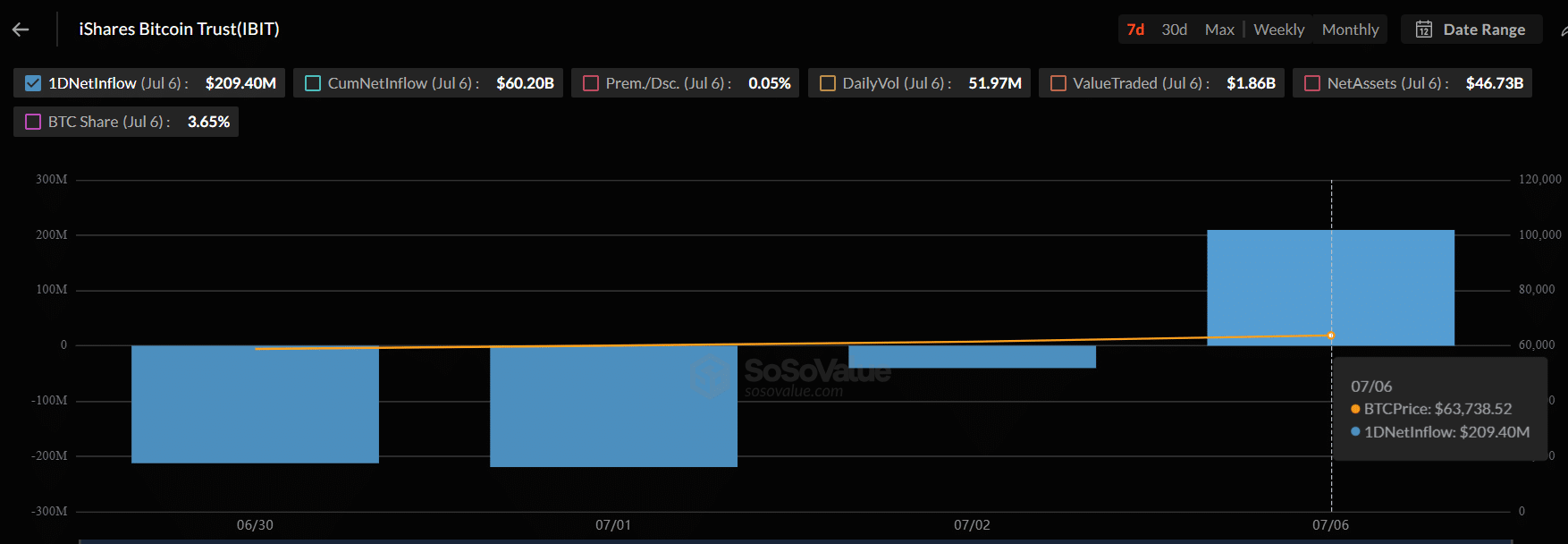
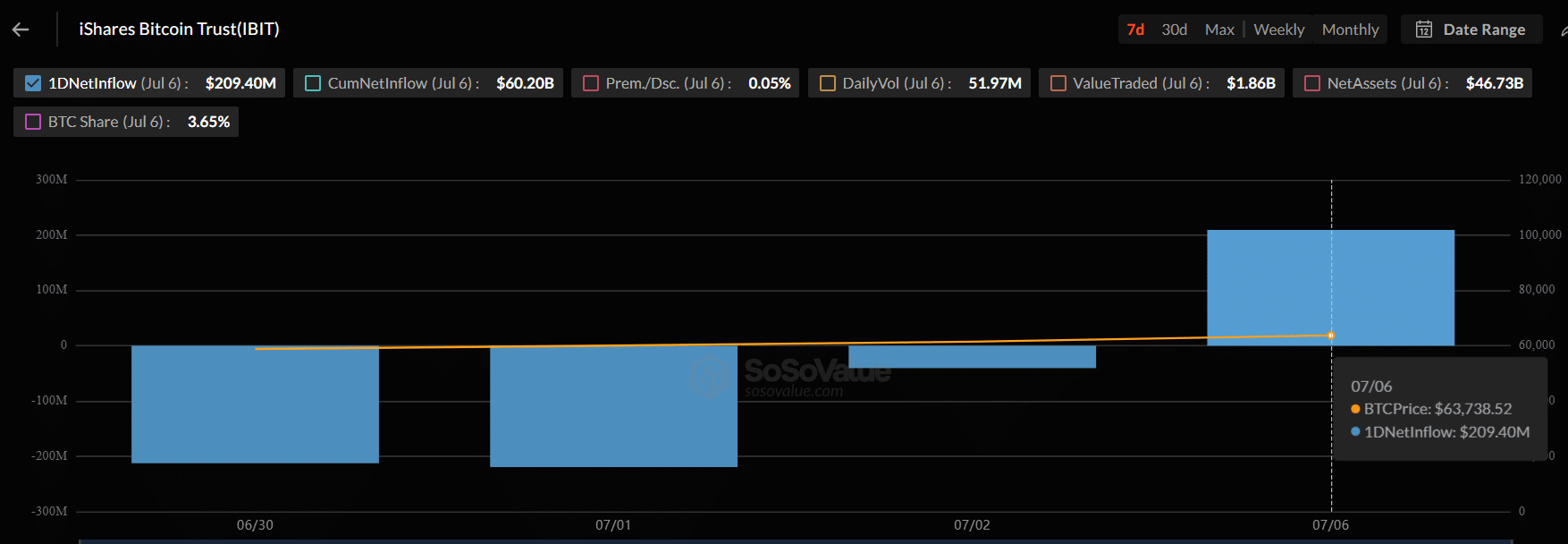
Source: SoSoValue

Against this backdrop, Tom Lee’s ETH thesis looks increasingly ambitious.

Despite Strategy selling BTC, Bitcoin has continued to hold around $64k, suggesting BlackRock’s buying was enough to absorb the supply. That leaves the ETH vs. BTC treasury debate finely balanced, with Ethereum backed by policy optimism while Bitcoin continues to benefit from strong institutional demand.

As a result, the edge still leans toward Bitcoin.

ETH/BTC has rallied on CLARITY “expectation”, but Ethereum’s on-chain activity hasn’t followed through. Bitcoin, meanwhile, is seeing fresh institutional inflows. Unless Ethereum’s DeFi metrics begin to recover, sustaining ETH/BTC’s early Q3 momentum could prove difficult.


Final Summary

  • ETH/BTC is rallying on CLARITY Act optimism, but Ethereum’s DeFi activity hasn’t caught up yet.
  • BlackRock is buying BTC again, giving Bitcoin stronger support and making it harder for ETH/BTC to keep outperforming in Q3.


Trending Cryptos

Related Questions

QWhat is the main reason behind BitMine Immersion's decision to significantly increase its Ethereum holdings, according to the article?

AThe improving odds of the CLARITY Act passing, which BitMine argues would be a major catalyst for Ethereum by providing regulatory clarity.

QHow does the on-chain data for Ethereum's DeFi activity, specifically TVL, compare to previous highs?

AEthereum's Total Value Locked (TVL) in DeFi is still under $40 billion, which is well below the approximately $89-90 billion peak before the October correction.

QWhat recent institutional activity supports Bitcoin's price and potentially challenges Ethereum's outperformance?

ABlackRock has resumed buying Bitcoin, recording over $209 million in net inflows after 11 straight days of selling, signaling renewed institutional confidence in BTC.

QWhat does the early Q3 rally in the ETH/BTC ratio suggest, according to the article's analysis?

AIt suggests Ethereum is beginning to regain relative strength against Bitcoin, and the market is pricing in a higher probability of the CLARITY Act becoming law.

QBased on the article's final summary, what key factor makes it harder for ETH/BTC to sustain its outperformance in Q3?

AWhile ETH/BTC is rallying on CLARITY Act optimism, Bitcoin has stronger support from fresh institutional inflows like those from BlackRock, while Ethereum's on-chain DeFi fundamentals haven't caught up yet.

Related Reads

Not Betting on Goals but on 'Tears': Polymarket Users Argue Over Ronaldo's Final World Cup Match

Title: Beyond Goals, Betting on Tears: Polymarket Users Clash Over Ronaldo's Emotional World Cup Exit On July 6, Portugal's 0-1 loss to Spain in the World Cup round of 16 marked the final tournament for Cristiano Ronaldo. The 41-year-old star's emotional reaction—red eyes, wiping his face, fighting back tears—was captured globally. Concurrently, a fierce debate erupted on the crypto prediction platform Polymarket over a specific market: "Will Ronaldo cry during the 2026 FIFA World Cup?" The market, with over $23 million in volume, saw its "YES" probability surge to 99% after the match, but the result was disputed and entered a final review phase. The core conflict centered on the market's precise rules: it required "clearly visible tears streaming down [Ronaldo's] face" in photos/videos taken on the field or bench area during Portugal's matches. While major media outlets described Ronaldo as "in tears" and footage showed him emotional, "NO" bettors argued visible tear tracks were not conclusively evident, only red eyes and dampness. Polymarket's official clarification on July 8 stated that eligible evidence existed showing Ronaldo crying with visible tears on his face post-match. The dispute now goes to a UMA oracle community vote for resolution. This incident highlights a recurring challenge for prediction markets: they excel with quantifiable events but can spark major controversies over subjective, visual, or emotional interpretations. It also serves as a reminder for participants to scrutinize rule wording meticulously, not rely on general perception. Ultimately, such high-profile disputes drive significant trading volume and attention for the platform.

Foresight News9m ago

Not Betting on Goals but on 'Tears': Polymarket Users Argue Over Ronaldo's Final World Cup Match

Foresight News9m ago

DeepSeek Secretly Builds AI Chip, Specializing in Inference, Project Started a Year Ago with No Public Recruitments

DeepSeek, the Chinese AI company known for its algorithmic models, is secretly developing its own AI chip to reduce dependence on Nvidia, according to a Reuters report. The chip is designed specifically for AI inference, not training, and the project began approximately a year ago. Currently in early stages, DeepSeek is reportedly in discussions with chip design firms, foundries, and memory suppliers. The company, historically focused on algorithmic efficiency, has been discreetly hiring chip design engineers without public job postings. This move aligns with a global trend where major AI model companies like OpenAI and Anthropic are also pursuing custom chip development. DeepSeek founder Liang Wenfeng previously highlighted chip shortages as a challenge. While the company initially trained models on Nvidia H800s and later adapted to Huawei's Ascend chips, it now seeks greater control over its hardware foundation. Designing a competitive AI chip is a significant challenge, requiring years and substantial investment with no guarantee of success. However, DeepSeek's efforts are backed by a recent major funding round of approximately 51 billion RMB (about $7.4 billion) raised in June 2026. The funds are designated for expanding data centers based on domestic chips, developing proprietary AI chips, and recruiting top global talent. Infrastructure plans are also advancing, with job postings for data center design engineers, including projects in locations like Ulanqab, Inner Mongolia. The company remains characteristically low-key, with sources speaking anonymously and no official comment from DeepSeek itself. Nevertheless, this initiative marks a strategic expansion from software algorithms into the hardware layer that powers its AI systems.

marsbit16m ago

DeepSeek Secretly Builds AI Chip, Specializing in Inference, Project Started a Year Ago with No Public Recruitments

marsbit16m ago

Today, Claude Cowork Major Update: Close Your Laptop, It Works for You Overnight

Anthropic's Claude Cowork has received a major upgrade, officially launching on mobile and web platforms. This allows users to manage and monitor tasks from any device, freeing them from needing to stay at their computers. The key innovation is that tasks now run in the cloud on Anthropic's servers, meaning work continues even when a user's personal device is offline or closed. The update merges Chat and Cowork into a single interface and extends usage quotas. Engineers highlight three core capabilities now unified: precise context understanding, support for long-running tasks, and complete independence from a user's physical device. The workflow is described as a full cycle: a user assigns a complex task (e.g., preparing a meeting summary, drafting emails, post-meeting analysis). Claude Cowork autonomously breaks it down, connects to necessary tools like Slack and email, gathers information, and executes. It pauses only for critical user decisions, sending a notification to the user's phone for approval before proceeding. Product managers share use cases like monitoring AI agents during a soccer game or resuming a cloud-based task seamlessly after a flight, emphasizing the new flexibility. The article frames this as part of a larger trend where tech giants (OpenAI, Microsoft, Google) are competing to bring AI agents into the daily workflows of general knowledge workers, not just developers. The ultimate battleground is becoming an indispensable, seamless part of everyday productivity.

marsbit1h ago

Today, Claude Cowork Major Update: Close Your Laptop, It Works for You Overnight

marsbit1h ago

Trading

Spot

Hot Articles

Discussions

Welcome to the HTX Community. Here, you can stay informed about the latest platform developments and gain access to professional market insights. Users' opinions on the price of S (S) are presented below.

活动图片