By The Numbers: How Do Bitcoin, Ethereum, & Dogecoin Compare In Addresses?

bitcoinistPublished on 2025-12-20Last updated on 2025-12-20

Abstract

Santiment's on-chain analysis reveals Ethereum leads in total number of addresses with non-zero balances at 167.96 million, significantly ahead of Bitcoin's 57.62 million. This gap is attributed to Ethereum's robust ecosystem of layer two blockchains and DeFi applications. USDT stablecoin ranks third with 9.63 million addresses, followed by Dogecoin (8.13 million) and XRP (7.41 million). While Bitcoin's holder count has remained relatively flat over the past year, Ethereum has continued to grow, further extending its lead. This growth is supported by a spike in Ethereum's Network Growth metric, which now averages 163,000 new addresses per day compared to 124,000 in July. At the time of writing, Bitcoin was trading around $87,500, down 2% over the week.

On-chain analytics firm Santiment has shared the data about how Bitcoin, Ethereum, and other top coins compare in Total Amount of Holders.

Ethereum Beats Bitcoin, Dogecoin, & Others In Total Amount Of Holders

In a new post on X, Santiment has talked about where the Total Amount of Holders indicator stands for Bitcoin, Dogecoin, and other coins in the cryptocurrency sector today. This metric measures, as its name suggests, the total number of addresses carrying a non-empty balance on a given network.

When the value of this indicator rises, it can be a sign that new investors are joining the blockchain and/or old investors who sold earlier are making a return. The trend can also arise from existing holders creating multiple wallets for accounting or privacy purposes.

In general, all of these factors can be assumed to simultaneously be in action whenever the Total Amount of Holders registers an increase. As such, some net adoption of the cryptocurrency can be considered to have occurred.

On the other hand, the metric going down implies some investors have cleaned out their wallet balances, potentially because they have decided to exit the blockchain.

Now, here is the chart shared by Santiment that shows the trend in the Total Amount of Holders for eight different cryptocurrencies:
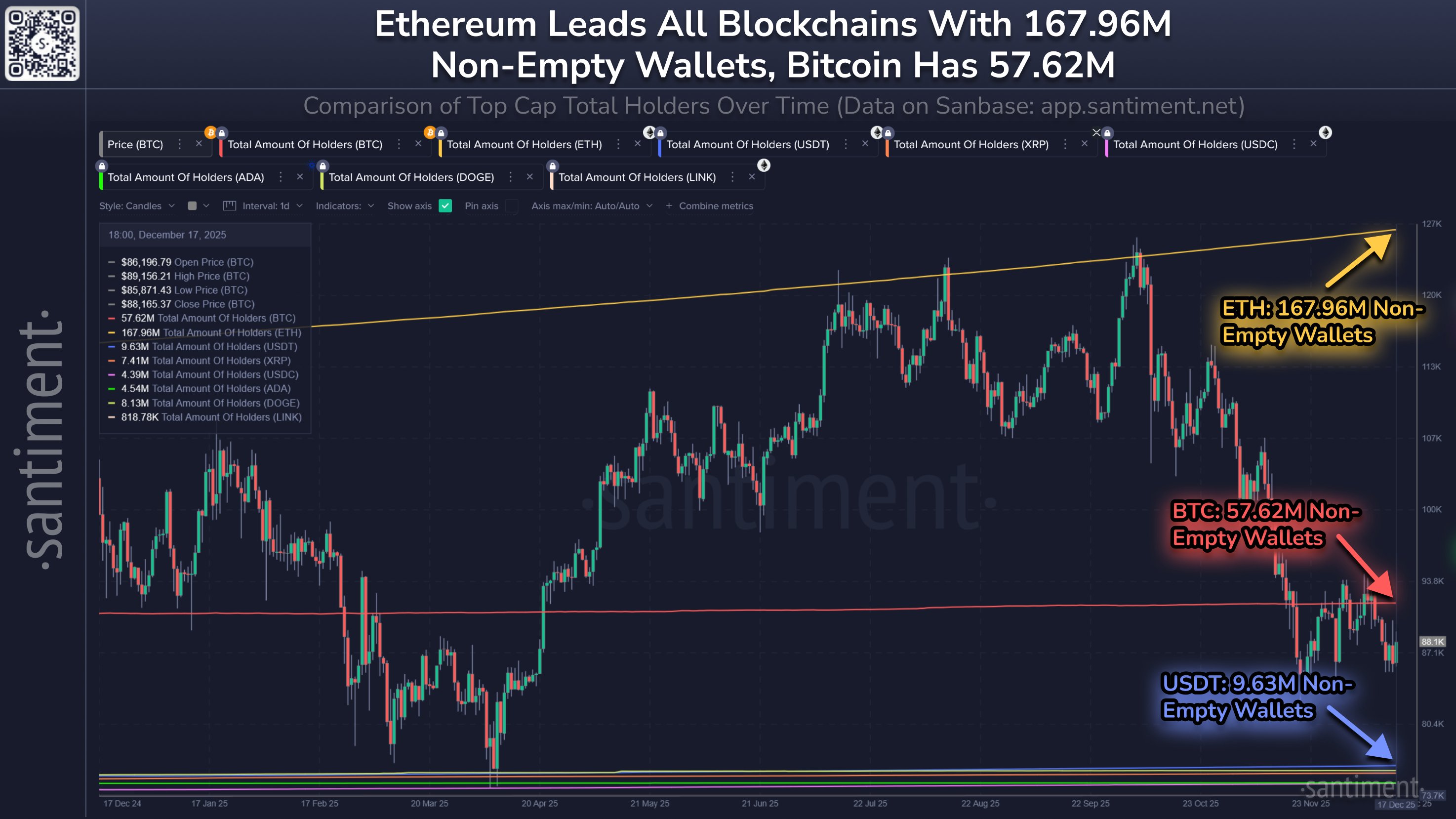
The metric's value appears to be the highest for ETH right now | Source: Santiment on X

As displayed in the above graph, Ethereum is the most dominant cryptocurrency in terms of the Total Amount of Holders, with the metric sitting at 167.96 million. Bitcoin, the next largest network, only hosts a userbase that’s a third of ETH’s (about 57.62 million addresses).

Ethereum’s dominance could be down to the fact that the blockchain hosts a vibrant ecosystem of layer two blockchains and decentralized finance (DeFi) applications, made possible by its smart-contracts system.

The gulf between Bitcoin and third place is again massive, with the stablecoin USDT having 9.63 million non-empty wallets. From USDT on, however, the altcoins are much closer to each other.

Dogecoin and XRP are the cryptocurrencies with the fourth and fifth largest holder counts on the list with the indicator having a value of 8.13 million and 7.41 million, respectively.

From the chart, it’s visible that while Bitcoin has seen a more or less flat trajectory in the Total Amount of Holders during the last year, Ethereum has only been witnessing growth, extending its lead.

The adoption trend for ETH is also visible from another indicator shared by the analytics firm, known as the Network Growth. This metric keeps track of the new addresses appearing on the blockchain.
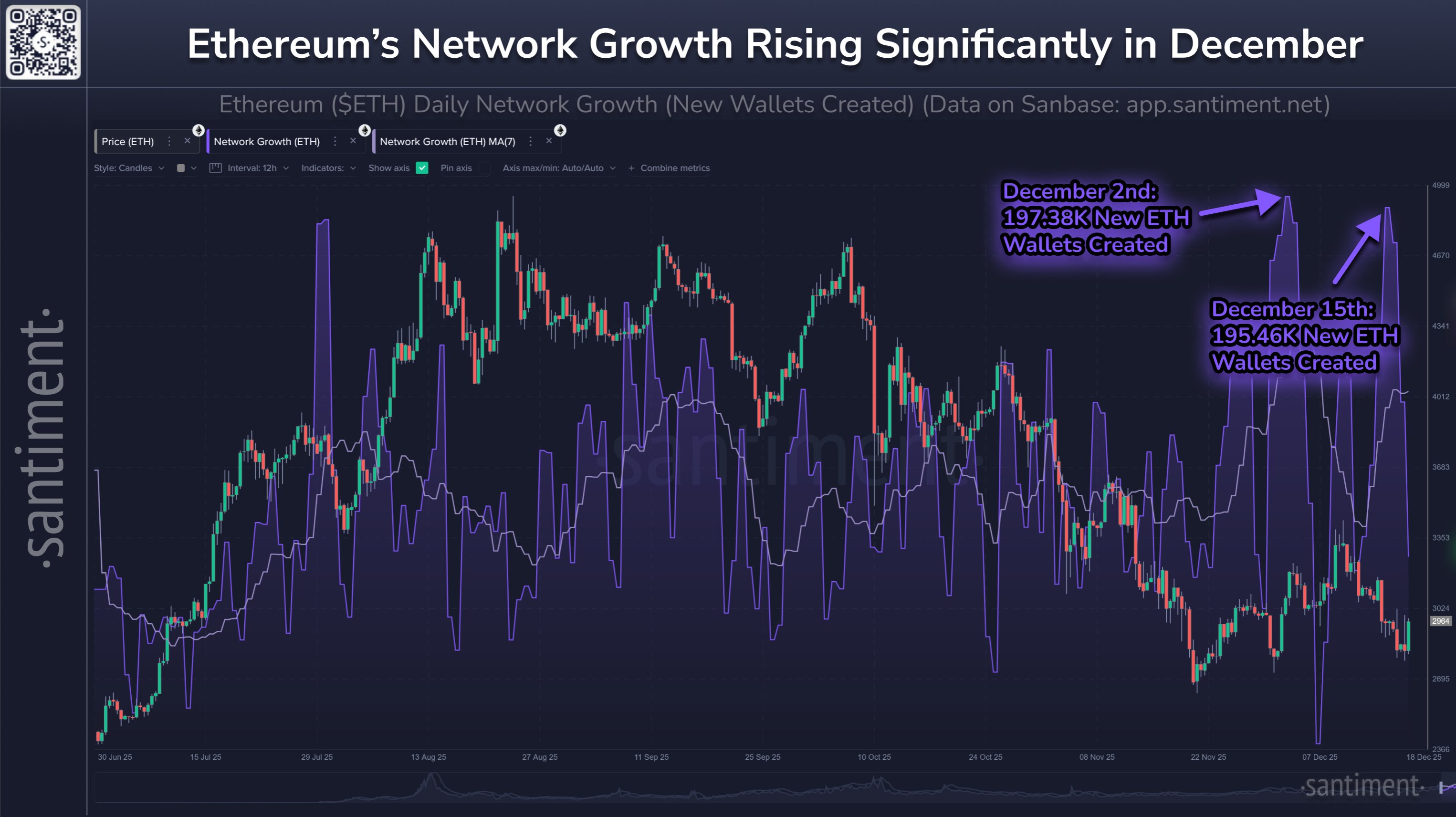
The trend in the ETH Network Growth over the last few months | Source: Santiment on X

As is apparent from the chart, the Ethereum Network Growth has spiked recently. “The #2 market cap is seeing an average of 163K new addresses per day, compared to 124K in July,” noted Santiment.

BTC Price

At the time of writing, Bitcoin is trading around $87,500, down 2% over the last week.

Looks like the price of the coin has consolidated recently | Source: BTCUSDT on TradingView


Related Questions

QWhich cryptocurrency has the highest Total Amount of Holders according to Santiment's data?

AEthereum has the highest Total Amount of Holders with 167.96 million addresses.

QWhat is the Total Amount of Holders for Bitcoin and how does it compare to Ethereum?

ABitcoin has 57.62 million non-empty addresses, which is about one-third of Ethereum's total.

QWhat does an increase in the Total Amount of Holders metric typically indicate?

AAn increase suggests new investors are joining, old investors are returning, or existing holders are creating multiple wallets for accounting or privacy purposes, indicating net adoption.

QHow does Dogecoin rank in terms of Total Amount of Holders among the mentioned cryptocurrencies?

ADogecoin ranks fourth with 8.13 million non-empty addresses, behind Ethereum, Bitcoin, and USDT.

QWhat recent trend has been observed in Ethereum's Network Growth metric?

AEthereum's Network Growth has spiked recently, with an average of 163,000 new addresses per day compared to 124,000 in July.

Related Reads

WeChat Agent Issues a 'Heroic Summons,' Half of the Internet Responds

WeChat AI Agent is on the horizon. The WeChat Open Platform has issued a guide for developers, offering them ways to integrate into the WeChat AI ecosystem. This will enable mini-programs to be discovered and invoked by the AI. Meituan has already announced its integration, allowing users to access services like food delivery through WeChat AI. Other platforms like Ctrip and Tongcheng have followed suit. Furthermore, WeChat is collaborating with major smartphone manufacturers to enable their native AI assistants to perform actions within WeChat, such as initiating calls or sending messages, through a controlled protocol called Agent-to-Agent (A2A). Reports indicate the WeChat AI Agent will be accessible by swiping right on the main interface. It aims to understand user intent within the rich context of chats, groups, and past interactions, then automatically call upon relevant mini-programs to complete tasks like ordering coffee or booking restaurants. This positions it as a potential "super app" with direct access to WeChat's vast ecosystem of services, social connections, and payment systems. Technically, this is a complex endeavor. It requires advanced natural language understanding, a "world model" to predict interactions within mini-programs (UI-Oceanus), multi-model orchestration for cost efficiency, and careful coordination with millions of third-party service providers. Tencent's development follows a "Co-Design" approach, where product teams and the Hunyuan model team collaborate closely, allowing capabilities honed in other AI products (like Yuanbao for chat, ima for search, WorkBuddy for office tasks) to be transferred to the WeChat Agent. Tencent is strategically opting for the A2A protocol over GUI-based automation (which it has blocked in the past), maintaining control over its ecosystem. To manage the immense scale and cost of serving 1.4 billion monthly active users, Tencent is deepening its ties with DeepSeek, known for its cost-effective training, to secure a low-cost inference backbone. The ultimate goal is to solve practical, everyday problems for users within the WeChat ecosystem, moving beyond technical benchmarks to deliver real utility, which Tencent sees as the key to winning in the long-term AI game.

marsbit32m ago

WeChat Agent Issues a 'Heroic Summons,' Half of the Internet Responds

marsbit32m ago

Humanity Loses $31 Million in Attack, Token Price Plummets 90% Due to a Single Private Key

On June 9th, the digital identity project Humanity Protocol suffered a major security breach resulting in over $31 million in losses. According to on-chain analyst Specter, hundreds of wallets holding the project's H token were drained. The attack was confirmed by founder Terence Kwok to be caused by the compromise of a foundation member's private key. As a precaution, users are advised to avoid interacting with Humanity's cross-chain bridge or liquidity pools. The incident caused the H token price to crash over 90%, from around $0.70 to a low of $0.052, wiping its market cap from $2 billion to approximately $35.7 million. The attacker allegedly minted 100 million new H tokens and is selling them for BNB. This breach adds to existing controversies surrounding Humanity Protocol. Founded in 2024, it aimed to verify human users via palm-print biometrics and zero-knowledge proofs. However, a leaked conversation in 2025 revealed that only about 1 million of its 9 million claimed Human IDs had completed biometric verification, suggesting 88% might be bots. Furthermore, the project has faced allegations of being a repackaged product from a Chinese access control vendor, raising privacy and authenticity concerns. Founder Terence Kwok's previous venture, Tink Labs, a hotel smartphone startup that raised $170 million, failed and entered bankruptcy in 2020 after burning through its funding. The current attack highlights the persistent critical issue of private key management in crypto. Unlike smart contract exploits, a private key compromise bypasses all on-chain security mechanisms. With no user compensation plan announced yet, this $31 million breach may be a final blow to the project's credibility, already weakened by previous controversies and a heavily depreciated token.

marsbit1h ago

Humanity Loses $31 Million in Attack, Token Price Plummets 90% Due to a Single Private Key

marsbit1h ago

MicroStrategy Will Not Die in This Downturn: Reflexivity, STRC Anchoring Back to Par, and the Self-Rescue Logic of "Sell Stock, Not Bitcoin"

This article analyzes the recent sharp decline in Bitcoin and MicroStrategy (MSTR), framing it as a targeted "reflexivity" attack. The trigger was MSTR using its cash reserves to buy back convertible notes, raising market concerns about a liquidity crisis. The playbook follows George Soros's principle: market expectations can shape reality. Fears that MSTR might be forced to sell BTC caused panic selling, lowering BTC's price and worsening MSTR's financial ratios, thus reinforcing the negative narrative. The author argues that MSTR's Structured Convertible (STRC), while falling in price, is a floating-rate security that will eventually return to par value (100). The price drop reflects the market demanding a higher yield due to perceived risk, but as a floating-rate instrument, its coupon can adjust, naturally pulling the price back to par over time. This is crucial for MSTR's continued ability to raise funds. The core thesis is that MSTR's best move to counter the attack is to **issue new equity (sell shares)**, not sell its Bitcoin holdings. While selling BTC would solve the immediate cash crunch, it would destroy the company's core investment thesis and premium. It would dilute the BTC per share, likely erase the market premium over its net asset value (mNAV > 1), and worsen its debt-to-asset ratio. Issuing shares while mNAV is high (e.g., 1.25x) allows MSTR to raise cash for reserves without harming shareholder value or the "perpetual accumulation" narrative. It improves the debt ratio and reassures STRC holders, breaking the negative reflexivity cycle. In conclusion, while MSTR could survive this episode even by selling BTC, doing so would fundamentally alter its investment proposition and weaken it for future cycles. The optimal, value-preserving strategy is to sell equity to rebuild reserves and maintain the long-term growth flywheel.

marsbit1h ago

MicroStrategy Will Not Die in This Downturn: Reflexivity, STRC Anchoring Back to Par, and the Self-Rescue Logic of "Sell Stock, Not Bitcoin"

marsbit1h ago

Trading

Spot
Futures

Hot Articles

What is $BITCOIN

DIGITAL GOLD ($BITCOIN): A Comprehensive Analysis Introduction to DIGITAL GOLD ($BITCOIN) DIGITAL GOLD ($BITCOIN) is a blockchain-based project operating on the Solana network, which aims to combine the characteristics of traditional precious metals with the innovation of decentralized technologies. While it shares a name with Bitcoin, often referred to as “digital gold” due to its perception as a store of value, DIGITAL GOLD is a separate token designed to create a unique ecosystem within the Web3 landscape. Its goal is to position itself as a viable alternative digital asset, although specifics regarding its applications and functionalities are still developing. What is DIGITAL GOLD ($BITCOIN)? DIGITAL GOLD ($BITCOIN) is a cryptocurrency token explicitly designed for use on the Solana blockchain. In contrast to Bitcoin, which provides a widely recognized value storage role, this token appears to focus on broader applications and characteristics. Notable aspects include: Blockchain Infrastructure: The token is built on the Solana blockchain, known for its capacity to handle high-speed and low-cost transactions. Supply Dynamics: DIGITAL GOLD has a maximum supply capped at 100 quadrillion tokens (100P $BITCOIN), although details regarding its circulating supply are currently undisclosed. Utility: While precise functionalities are not explicitly outlined, there are indications that the token could be utilized for various applications, potentially involving decentralized applications (dApps) or asset tokenization strategies. Who is the Creator of DIGITAL GOLD ($BITCOIN)? At present, the identity of the creators and development team behind DIGITAL GOLD ($BITCOIN) remains unknown. This situation is typical among many innovative projects within the blockchain space, particularly those aligning with decentralized finance and meme coin phenomena. While such anonymity may foster a community-driven culture, it intensifies concerns about governance and accountability. Who are the Investors of DIGITAL GOLD ($BITCOIN)? The available information indicates that DIGITAL GOLD ($BITCOIN) does not have any known institutional backers or prominent venture capital investments. The project seems to operate on a peer-to-peer model focused on community support and adoption rather than traditional funding routes. Its activity and liquidity are primarily situated on decentralized exchanges (DEXs), such as PumpSwap, rather than established centralized trading platforms, further highlighting its grassroots approach. How DIGITAL GOLD ($BITCOIN) Works The operational mechanics of DIGITAL GOLD ($BITCOIN) can be elaborated on based on its blockchain design and network attributes: Consensus Mechanism: By leveraging Solana’s unique proof-of-history (PoH) combined with a proof-of-stake (PoS) model, the project ensures efficient transaction validation contributing to the network's high performance. Tokenomics: While specific deflationary mechanisms have not been extensively detailed, the vast maximum token supply implies that it may cater to microtransactions or niche use cases that are still to be defined. Interoperability: There exists the potential for integration with Solana’s broader ecosystem, including various decentralized finance (DeFi) platforms. However, the details regarding specific integrations remain unspecified. Timeline of Key Events Here is a timeline that highlights significant milestones concerning DIGITAL GOLD ($BITCOIN): 2023: The initial deployment of the token occurs on the Solana blockchain, marked by its contract address. 2024: DIGITAL GOLD gains visibility as it becomes available for trading on decentralized exchanges like PumpSwap, allowing users to trade it against SOL. 2025: The project witnesses sporadic trading activity and potential interest in community-led engagements, although no noteworthy partnerships or technical advancements have been documented as of yet. Critical Analysis Strengths Scalability: The underlying Solana infrastructure supports high transaction volumes, which could enhance the utility of $BITCOIN in various transaction scenarios. Accessibility: The potential low trading price per token could attract retail investors, facilitating wider participation due to fractional ownership opportunities. Risks Lack of Transparency: The absence of publicly known backers, developers, or an audit process may yield skepticism regarding the project's sustainability and trustworthiness. Market Volatility: The trading activity is heavily reliant on speculative behavior, which can result in significant price volatility and uncertainty for investors. Conclusion DIGITAL GOLD ($BITCOIN) emerges as an intriguing yet ambiguous project within the rapidly evolving Solana ecosystem. While it attempts to leverage the “digital gold” narrative, its departure from Bitcoin's established role as a store of value underscores the need for a clearer differentiation of its intended utility and governance structure. Future acceptance and adoption will likely depend on addressing the current opacity and defining its operational and economic strategies more explicitly. Note: This report encompasses synthesised information available as of October 2023, and developments may have transpired beyond the research period.

363 Total ViewsPublished 2025.05.13Updated 2025.05.13

What is $BITCOIN

Discussions

Welcome to the HTX Community. Here, you can stay informed about the latest platform developments and gain access to professional market insights. Users' opinions on the price of BTC (BTC) are presented below.

活动图片