Original | Odaily Planet Daily (@OdailyChina)
Author | Ding Dang (@XiaMiPP)

Following yesterday's strong breakthrough of the key resistance level at $95,000, BTC continued its upward momentum in the early hours of today, reaching a high of $97,924, currently trading at $96,484; ETH broke through $3,400, currently trading at $3,330; SOL rose to a high of $148, currently trading at $145. Compared to BTC, ETH and SOL are still hovering around key resistance intervals, without forming a clear trend breakthrough.
In derivatives, according to Coinglass data, yesterday's total liquidation across the network reached $680 million, with short positions liquidated at $578 million and long positions at $101 million; Glassnode stated that the market rebound led to short liquidations reaching a new high since the "10/11 crash".
According to msx.com data, while the three major U.S. stock indices closed lower, crypto-related stocks generally rose, with ALTS up over 30.94% and BNC up over 11.81%. This situation is not common. What is driving such a strong rally in the crypto market?
ETF Fund Shift
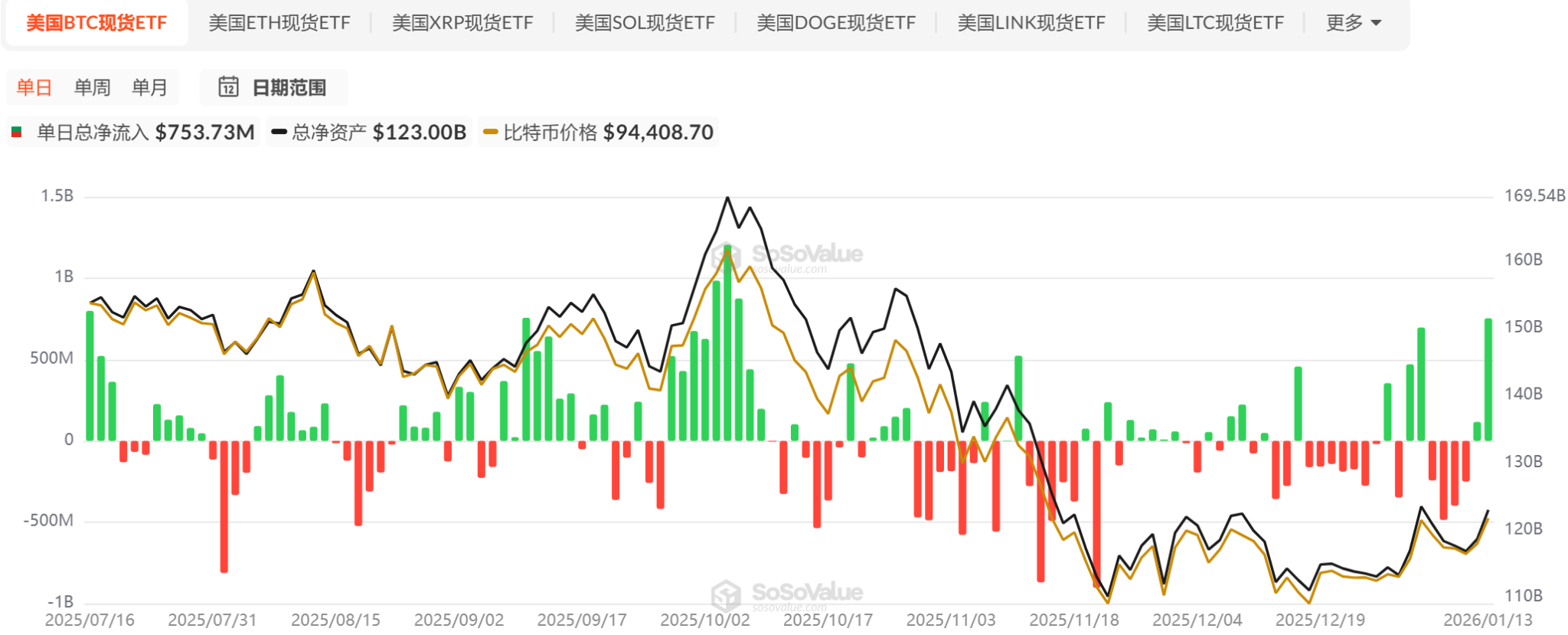
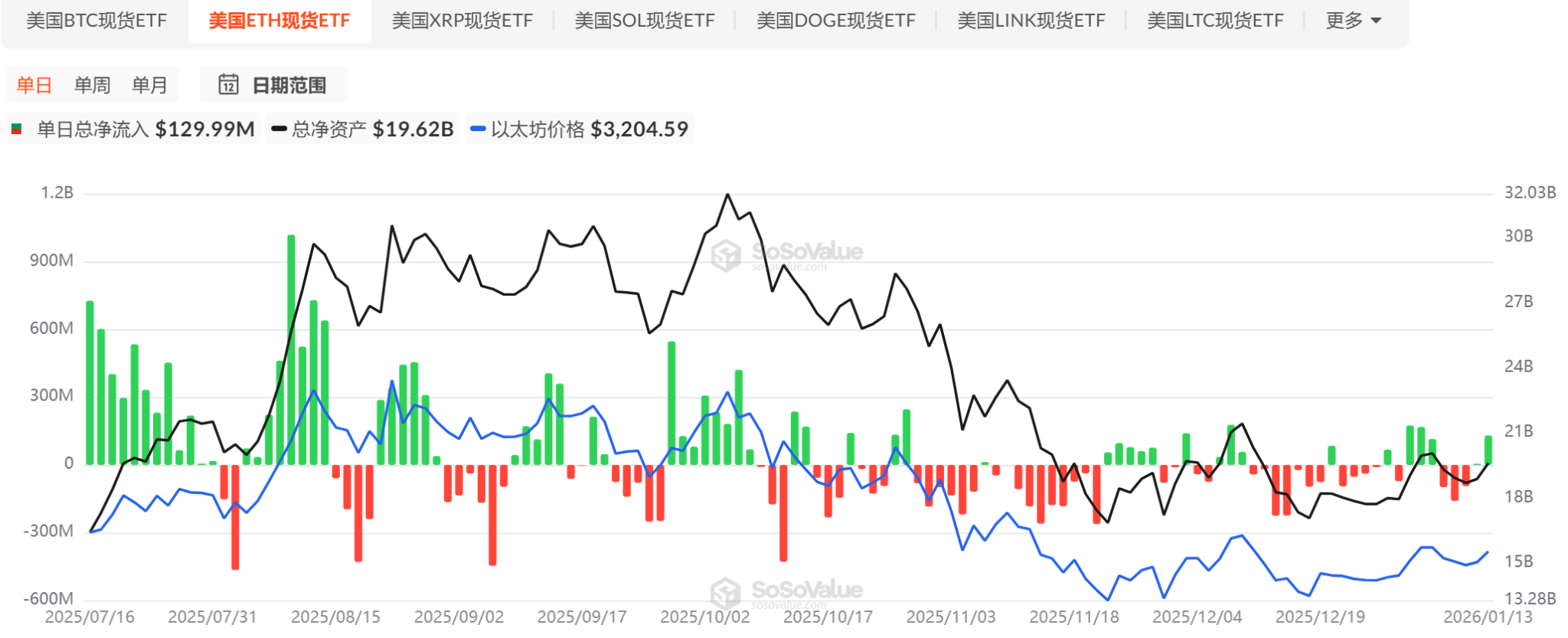
In terms of funds, since mid-October 2025, BTC spot ETFs have been in a state of overall net outflows or small-scale net inflows, indicating a lack of clear incremental fund signals. However, after four consecutive trading days of net outflows last week, BTC spot ETFs turned to two consecutive days of net inflows, with a single-day net inflow of $750 million on January 13, becoming a significant signal for the phase. In contrast, ETH spot ETFs remain weak.
From a price action perspective, a noteworthy change is occurring. Bitcoin's cumulative return during North American trading hours is about 8%, while the European session recorded only a mild gain of about 3%, and the Asian trading session even dragged down the overall performance.
This phenomenon is in stark contrast to the end of 2025. At that time, Bitcoin accumulated a decline of up to 20% during North American hours, with prices once falling back to around $80,000. In the fourth quarter, U.S. market opening hours often came with selling pressure, and spot Bitcoin ETFs faced almost daily outflows.
Now, the strongest returns occur shortly after the U.S. stock market opens, which was precisely Bitcoin's weakest period over the past six months.
Macro Data: No Bad News, But Lacking Easing Catalysts
On the macro level, the December CPI year-on-year remained at 2.7% (unchanged from the previous reading, meeting market expectations), while the core CPI year-on-year slightly rose to 2.7% (previous 2.6%, slightly higher than some expectations), indicating that inflationary pressures still have some stickiness; however, the November PPI year-on-year unexpectedly rose to 3.0% (higher than the expected 2.7%), and retail sales month-on-month also recorded strong growth (exceeding market expectations), showing robust consumer data, which to some extent supports the view that economic growth remains resilient.
Although the December CPI data was generally mild (month-on-month 0.3% met expectations, year-on-year did not accelerate further), inflation has not clearly fallen back to the Fed's comfort zone. Combined with the labor market resilience shown in previous employment reports, the market widely believes that the probability of the Fed maintaining interest rates unchanged at the end-of-January meeting is extremely high, with almost no expectation of a rate cut. This also means that short-term policy easing catalysts are still lacking. According to CME's "FedWatch," the probability of the Fed keeping rates unchanged in January is 95%.
However, rate cut expectations for 2026 are worth anticipating, with Fed Governor Milan reiterating the need for 150 basis points of rate cuts this year.
Regulatory Legislative Progress: CLARITY Act in Focus
Beyond short-term market movements, the most noteworthy mid-to-long-term variable recently is the legislative progress of the CLARITY Act. This bill aims to establish a comprehensive regulatory framework for the U.S. crypto market, with main objectives including:
- Clarifying the regulatory boundaries between the SEC (security-type assets) and CFTC (commodity-type digital assets);
- Defining digital asset classifications (securities, commodities, stablecoins, etc.);
- Introducing stricter disclosure, anti-money laundering, and investor protection requirements, while leaving room for innovation.
With the Senate Banking Committee's revision and vote scheduled for January 15, U.S. crypto legislation has officially entered the "final sprint." Committee Chairman Tim Scott (Republican) released a 278-page revised text on January 13, which followed months of bipartisan closed-door negotiations. It quickly sparked over 70 (some counts say 137) proposed amendments, with disagreements over stablecoin yields and DeFi regulation heating up rapidly. The crypto industry, banking lobby groups, and consumer protection organizations are all involved.
Moreover, the crypto industry itself is not united. On January 14, Coinbase CEO Brian Armstrong publicly withdrew support, stating that after reviewing the text, he believed the bill had "too many issues regarding DeFi bans, stifling stablecoin reward mechanisms, and excessive government surveillance, making it worse than the status quo." He emphasized that Stand With Crypto would score the Thursday revision vote to test whether senators "side with bank profits or consumer/innovation rewards." Industry insiders believe that Coinbase's public opposition is "significant" and could determine the bill's fate.
After Coinbase publicly opposed, several top institutions and associations including a16z, Circle, Kraken, Digital Chamber, Ripple, and Coin Center publicly expressed support for the Senate Republican version, believing that "any clear rules are better than the status quo," which could inject long-term certainty into the market and position the U.S. as the "global crypto hub." (Recommended reading: "CLARITY Deliberation Suddenly Postponed, Why Is the Industry So Divided?")
Other Observations: Strong Ethereum Staking Demand and Strategy Continues to Increase Holdings
Ethereum staking demand remains strong. Currently, the amount of ETH locked in the Beacon Chain has exceeded 36 million, accounting for nearly 30% of the network's circulating supply, with a staking market value exceeding $118 billion, continuously刷新历史新高. The previous highest proportion was 29.54%,出现在 July 2025. The Ethereum network currently has about 900,000 active validators, with about 2.55 million ETH still queued waiting to enter the staking queue. This means that, at least from on-chain behavior, existing stakers' short-term selling意愿 remains limited, and the network overall tends to "lock rather than release."
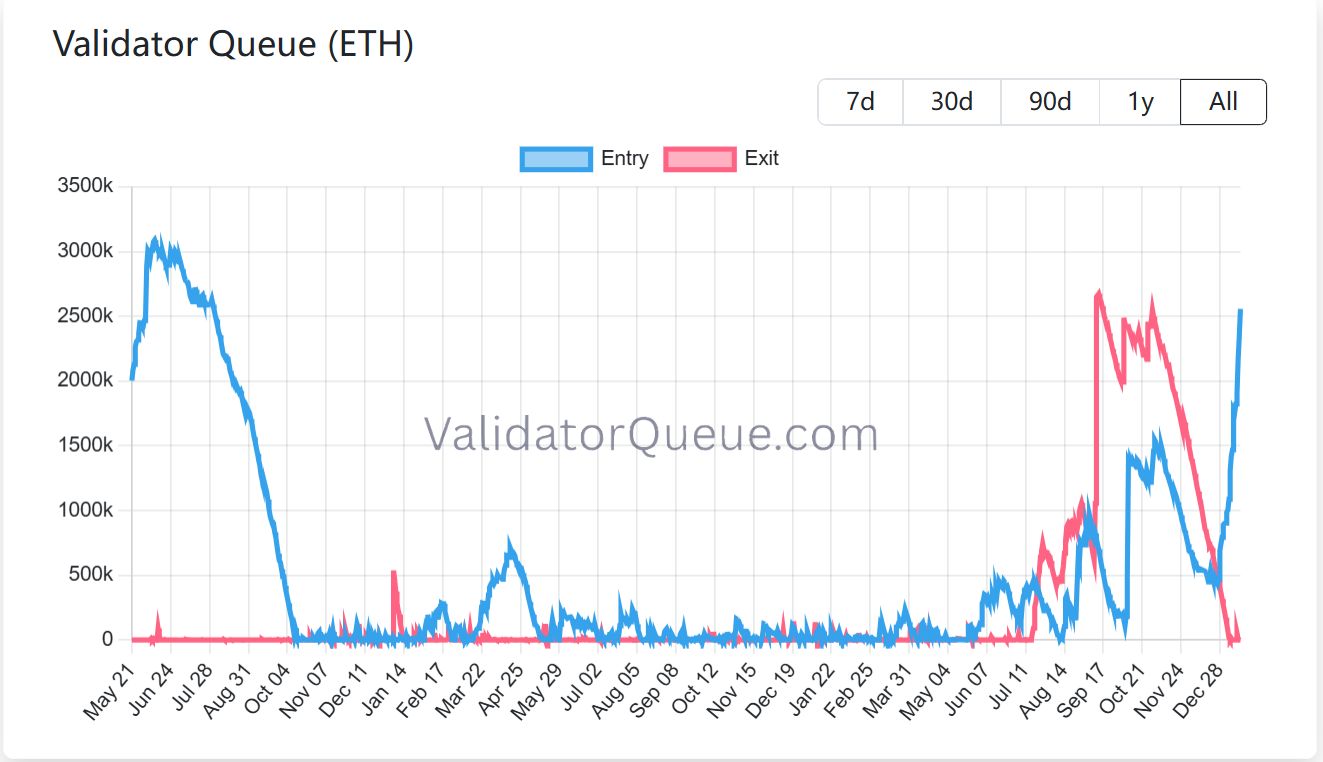
In addition, developer activity and stablecoin transaction volume on Ethereum both hit record highs. Recommended reading: "ETH Staking Data Reversal: Exits Zero VS Entries Surge 1.3 Million, When to Buy the Dip?"
Bitcoin reserve company Strategy (formerly MicroStrategy) continued its long-term accumulation strategy this week, spending approximately $1.25 billion to purchase 13,627 BTC at an average price of about $91,519. Thus, its total Bitcoin holdings have increased to 687,410, worth approximately $65.89 billion, with an overall average cost basis of about $75,353.
Investment bank TD Cowen recently lowered its one-year price target from $500 to $440, citing dilution effects from continuous issuance of common and preferred stock, leading to weaker Bitcoin yield expectations. Analysts expect Strategy to acquire about 155,000 more Bitcoin in fiscal year 2026, higher than previous forecasts, but a higher proportion of equity financing will reduce the growth rate of Bitcoin holdings per share.
TD Cowen also pointed out that although short-term yields are under pressure, related metrics are expected to improve in fiscal year 2027 as Bitcoin prices recover. The report also emphasized that Strategy chose to continue accumulating during the recent Bitcoin price pullback, with most financing proceeds directly used to purchase Bitcoin, showing that its strategic goals remain unchanged. Overall, analysts remain relatively positive about Strategy's long-term value as a "Bitcoin exposure tool" and believe that some of its preferred stock has certain attractiveness in terms of income and capital appreciation. Regarding index inclusion, MSCI has not yet removed Bitcoin reserve companies from the index system, which is seen as a short-term positive, but uncertainty remains in the medium to long term.
Arthur Hayes also stated that his core trading strategy this quarter is to go long on Strategy (MSTR) and Metaplanet (3350), using them as leveraged bets on BTC's return to an upward trend.
Market Outlook: Structural Changes and Rebound Conditions
Overall, the crypto market stands at a critical turning point. Whether the traditional "four-year cycle" still holds will likely be revealed in the coming months.
Crypto market maker Wintermute analyzed in its latest digital asset OTC market review: In 2025, Bitcoin did not exhibit the strong characteristics typical of a four-year cycle, and the altcoin cycle almost disappeared. In their view, this is not a short-term fluctuation or misalignment but a deeper structural change.
Under this premise, Wintermute believes that for a truly strong rebound to occur in 2026, the triggering conditions will be significantly higher than in previous cycles and will no longer rely on a single variable. Specifically, at least one of the following three outcomes needs to be validated.
First, the allocation scope of ETFs and crypto treasury (DAT) companies must expand beyond Bitcoin and Ethereum. Currently, U.S. spot BTC and ETH ETFs objectively concentrate a large amount of new liquidity on a few large-cap assets. While this enhances the stability of top assets, it also significantly compresses market breadth, leading to severe performance divergence. Only when more crypto assets are included in ETF products or corporate balance sheets can the market potentially regain broader participation and a liquidity foundation.
Second, core assets like BTC, ETH, as well as BNB, SOL, etc., need to experience sustained strong rallies again and recreate significant wealth effects. In 2025, the traditional transmission mechanism of "Bitcoin rising - funds spreading to altcoins" basically failed. The average uptrend周期 for altcoins was compressed to about 20 days (compared to about 60 days the previous year), with many tokens weakening under unlock selling pressure. Without sustained拉升 from top assets, funds lack the motivation to溢出 downward, making altcoin行情 difficult to activate.
Third, and most crucially, retail attention needs to truly return to the crypto market. Although retail investors have not completely left, their new funds are currently flowing more into high-growth themes like the S&P 500, AI, robotics, and quantum computing. The extreme drawdowns of 2022-2023, platform bankruptcies, liquidation memories, coupled with the reality of crypto assets underperforming traditional stocks in 2025, have significantly weakened the narrative appeal of "crypto = getting rich quick." Only when retail investors believe again that the crypto market has the potential for超额回报 and return in a scaled manner can the market potentially regain the highly emotional,近乎狂热 upward momentum of the past.
In other words, against the backdrop of structural changes, the future rebound is no longer about "if it will come," but rather "under what conditions and through which path it will be reignited."