BlackRock and Fidelity Drive $297.5 Million Bitcoin ETF Market Recovery

cryptonews.ruPublished on 2026-08-18Last updated on 2026-08-18

Abstract

The crypto ETF market saw a strong rebound, with Bitcoin ETFs attracting nearly $300 million in a single session. Blackrock's IBIT led with $160.23 million inflows, followed by Fidelity's FBTC with $111.90 million, together accounting for over 90% of the daily total. ARK 21Shares' ARKB and Morgan Stanley's MSBT also saw inflows. Concurrently, Ethereum ETFs attracted $30.85 million, led by Blackrock's ETHA. This recovery followed three consecutive days of outflows for Bitcoin funds. Institutional involvement was highlighted by Jane Street disclosing over $1 billion in spot Bitcoin ETF holdings, primarily in Blackrock's IBIT. Harvard Management Company also maintained its IBIT position. While Bitcoin and Ethereum ETFs saw renewed demand, products tied to Solana, XRP, and other altcoins remained quiet with no net flows.

The new week began with a decisive return of capital to the largest cryptocurrency funds. Bitcoin ETFs attracted nearly $300 million in a single session, with BlackRock and Fidelity leading the way, while ether products also showed a broad recovery of their own.

This growth occurred after a challenging end to last week, when Bitcoin funds faced share redemptions for three consecutive days.

BlackRock and Fidelity Stimulate Bitcoin Recovery

Bitcoin ETFs attracted $297.56 million across four funds, with none of the products recording outflows. BlackRock's IBIT fund led the session, attracting $160.23 million in new capital. It was followed by Fidelity's FBTC with $111.90 million, and these two funds accounted for over 90% of the total daily volume.

The ARKB fund from ARK 21Shares attracted $14.18 million, and the MSBT fund from Morgan Stanley attracted $11.24 million. Trading volume for Bitcoin ETFs reached $2.12 billion. The aggregate net asset value at close was $77.41 billion.
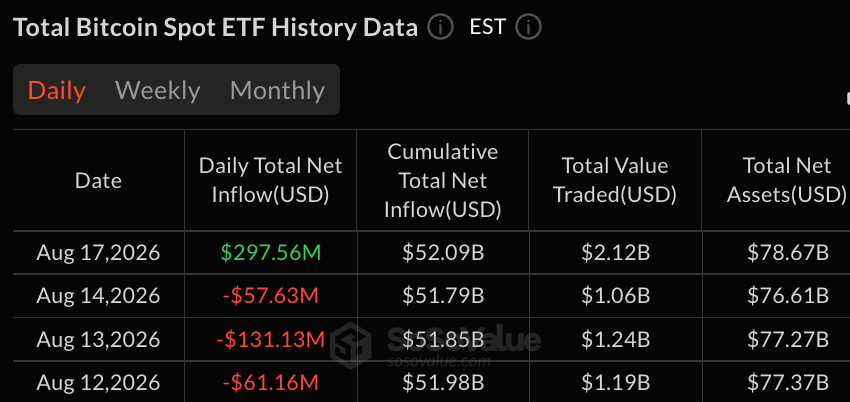
Bitcoin ETFs showed inflows again after three days of outflows. Source: Sosovalue

This session also coincided with new evidence of institutional investor participation in the sector. Quantitative trading firm Jane Street disclosed that as of June 30, its portfolio of U.S. spot Bitcoin ETFs exceeded $1 billion, with approximately $828 million invested in BlackRock's IBIT. The remainder was distributed among products like Fidelity's FBTC and Grayscale's GBTC.

Harvard Management Company also maintained its position in IBIT in the second quarter. As of June 30, this endowment reported ownership of 3,044,612 shares worth $101.4 million, unchanged from the previous quarter after two consecutive quarters of sales.

Ether Joins Recovery While Altcoins Languish

Ether ETFs attracted $30.85 million, with inflows distributed across three funds. BlackRock's ETHA accounted for the majority of demand, with inflows of $25.90 million. Fidelity's FETH fund attracted $4.27 million, and Bitwise's ETHW fund attracted about $682,000.

No ether ETF recorded outflows; total trading volume reached $459.73 million, and the aggregate net asset value at the end of the session was $10.59 billion.

Activity in the rest of the crypto ETF market was subdued. Products based on Solana, XRP, and HYPE recorded no net inflows or redemptions during the session.

Monday's flow data allowed the week to start on a more positive note following seller pressure in recent sessions. Bitcoin once again attracted the bulk of institutional demand, followed on a smaller scale by ether, while the altcoin ETF market largely remained on the sidelines.

end-content

Trending Cryptos

Related Questions

QWhich two firms were the main drivers of the recovery in Bitcoin ETF inflows, according to the article?

ABlackrock and Fidelity were the main drivers, with their IBIT and FBTC funds accounting for over 90% of the total daily volume.

QWhat was the total amount of capital attracted by Bitcoin ETFs in the single session described in the article?

ABitcoin ETFs attracted a total of $297.56 million in new capital during that session.

QWhat evidence of institutional involvement in the Bitcoin ETF sector is mentioned, involving the firm Jane Street?

AQuantitative trading firm Jane Street disclosed that as of June 30, its portfolio of U.S. spot Bitcoin ETFs exceeded $1 billion, with roughly $828 million invested in Blackrock's IBIT.

QHow did Ethereum ETFs perform alongside Bitcoin ETFs during this recovery session?

AEthereum ETFs attracted $30.85 million in inflows. Blackrock's ETHA fund saw the largest demand at $25.90 million, and no Ethereum ETF recorded outflows.

QWhat was the state of the altcoin ETF market (Solana, XRP, HYPE) during the session described?

AThe altcoin ETF market remained subdued. Products based on Solana, XRP, and HYPE recorded no net inflows or redemptions during the session.

Related Reads

Trade.xyz Enters the Prediction Market: Who Has Cheaper Fees Compared to Polymarket?

Trade.xyz has launched its prediction market product, "Events," on the Hyperliquid mainnet. Its initial week saw modest activity: $180k in volume and 263 users. The platform aims to integrate prediction markets into a "universal exchange" vision alongside its existing perpetual contracts. A key focus is its fee structure compared to incumbent Polymarket. Trade.xyz uses Hyperliquid's spot trading fees: a fixed 0.07% for Takers and 0.04% for Makers, with volume-based discounts and additional reductions for HYPE token stakers. Fees are charged upon position closure or settlement. Polymarket employs a dynamic model: Makers pay no fees and receive rebates, while Taker fees vary by market category and are calculated as `C × feeRate × p × (1-p)`, where `p` is the outcome probability. This makes fees highest near 50/50 odds and lower as probability approaches 0% or 100%. In a 50% probability scenario for a $100 Taker trade, Polymarket fees (0.04%-0.07% parameter) range from $1 to $1.75, significantly higher than Trade.xyz's ~$0.07. However, for highly probable outcomes (e.g., 99%) or for Maker orders, Polymarket can be cheaper or even free (e.g., Geopolitics markets). While Trade.xyz currently lags far behind Polymarket in scale, it leverages Hyperliquid's existing liquidity and user base. Its potential lies in combining prediction markets with its proven perpetuals infrastructure, positioning it as a possible challenger in the evolving prediction market space.

marsbit2h ago

Trade.xyz Enters the Prediction Market: Who Has Cheaper Fees Compared to Polymarket?

marsbit2h ago

Bankless Swap Strategy Success Methodology: How to Screen Undervalued Tokens from VVV to Hyperliquid?

Title: Bankless on Identifying Undervalued Tokens: From VVV to Hyperliquid Summary: In a shifting crypto market, the investment focus is moving from infrastructure narratives to applications with verifiable business models and revenue. This Bankless podcast discussion with Austin Barack of Relayer Capital analyzes how tokens like Venice (VVV), Hyperliquid (HYPE), Pump.fun (PUMP), and ether.fi (ETHFI) can be evaluated based on their fundamentals. Key points include: 1) The market is shifting from chasing growth narratives to finding the intersection of growth and reasonable valuation. 2) Token value is increasingly linked to observable value flow through mechanisms like protocol revenue used for buybacks/burns (e.g., Venice, Hyperliquid). However, this is not a direct equivalent to stock dividends, as token rights are less formalized. 3) Revenue quality and sustainability matter more than just the amount. For instance, Pump.fun's low valuation reflects market skepticism about meme coin trading longevity, despite its resilient revenue over two years. 4) Market categorizations can lag behind business evolution. ether.fi is now primarily a neo-bank/payments platform, not just a restaking protocol, which may create a pricing disconnect. 5) While real revenue can provide a valuation floor and reduce correlation with crypto cycles, these tokens are not fully decoupled from broader market trends. The core argument is that the next phase of crypto valuation will be driven by applications that convert real usage into sustainable revenue and credibly share a portion of that value with token holders, moving towards an application-based economy.

marsbit2h ago

Bankless Swap Strategy Success Methodology: How to Screen Undervalued Tokens from VVV to Hyperliquid?

marsbit2h ago

Trading

Spot

Hot Articles

What is $BITCOIN

DIGITAL GOLD ($BITCOIN): A Comprehensive Analysis Introduction to DIGITAL GOLD ($BITCOIN) DIGITAL GOLD ($BITCOIN) is a blockchain-based project operating on the Solana network, which aims to combine the characteristics of traditional precious metals with the innovation of decentralized technologies. While it shares a name with Bitcoin, often referred to as “digital gold” due to its perception as a store of value, DIGITAL GOLD is a separate token designed to create a unique ecosystem within the Web3 landscape. Its goal is to position itself as a viable alternative digital asset, although specifics regarding its applications and functionalities are still developing. What is DIGITAL GOLD ($BITCOIN)? DIGITAL GOLD ($BITCOIN) is a cryptocurrency token explicitly designed for use on the Solana blockchain. In contrast to Bitcoin, which provides a widely recognized value storage role, this token appears to focus on broader applications and characteristics. Notable aspects include: Blockchain Infrastructure: The token is built on the Solana blockchain, known for its capacity to handle high-speed and low-cost transactions. Supply Dynamics: DIGITAL GOLD has a maximum supply capped at 100 quadrillion tokens (100P $BITCOIN), although details regarding its circulating supply are currently undisclosed. Utility: While precise functionalities are not explicitly outlined, there are indications that the token could be utilized for various applications, potentially involving decentralized applications (dApps) or asset tokenization strategies. Who is the Creator of DIGITAL GOLD ($BITCOIN)? At present, the identity of the creators and development team behind DIGITAL GOLD ($BITCOIN) remains unknown. This situation is typical among many innovative projects within the blockchain space, particularly those aligning with decentralized finance and meme coin phenomena. While such anonymity may foster a community-driven culture, it intensifies concerns about governance and accountability. Who are the Investors of DIGITAL GOLD ($BITCOIN)? The available information indicates that DIGITAL GOLD ($BITCOIN) does not have any known institutional backers or prominent venture capital investments. The project seems to operate on a peer-to-peer model focused on community support and adoption rather than traditional funding routes. Its activity and liquidity are primarily situated on decentralized exchanges (DEXs), such as PumpSwap, rather than established centralized trading platforms, further highlighting its grassroots approach. How DIGITAL GOLD ($BITCOIN) Works The operational mechanics of DIGITAL GOLD ($BITCOIN) can be elaborated on based on its blockchain design and network attributes: Consensus Mechanism: By leveraging Solana’s unique proof-of-history (PoH) combined with a proof-of-stake (PoS) model, the project ensures efficient transaction validation contributing to the network's high performance. Tokenomics: While specific deflationary mechanisms have not been extensively detailed, the vast maximum token supply implies that it may cater to microtransactions or niche use cases that are still to be defined. Interoperability: There exists the potential for integration with Solana’s broader ecosystem, including various decentralized finance (DeFi) platforms. However, the details regarding specific integrations remain unspecified. Timeline of Key Events Here is a timeline that highlights significant milestones concerning DIGITAL GOLD ($BITCOIN): 2023: The initial deployment of the token occurs on the Solana blockchain, marked by its contract address. 2024: DIGITAL GOLD gains visibility as it becomes available for trading on decentralized exchanges like PumpSwap, allowing users to trade it against SOL. 2025: The project witnesses sporadic trading activity and potential interest in community-led engagements, although no noteworthy partnerships or technical advancements have been documented as of yet. Critical Analysis Strengths Scalability: The underlying Solana infrastructure supports high transaction volumes, which could enhance the utility of $BITCOIN in various transaction scenarios. Accessibility: The potential low trading price per token could attract retail investors, facilitating wider participation due to fractional ownership opportunities. Risks Lack of Transparency: The absence of publicly known backers, developers, or an audit process may yield skepticism regarding the project's sustainability and trustworthiness. Market Volatility: The trading activity is heavily reliant on speculative behavior, which can result in significant price volatility and uncertainty for investors. Conclusion DIGITAL GOLD ($BITCOIN) emerges as an intriguing yet ambiguous project within the rapidly evolving Solana ecosystem. While it attempts to leverage the “digital gold” narrative, its departure from Bitcoin's established role as a store of value underscores the need for a clearer differentiation of its intended utility and governance structure. Future acceptance and adoption will likely depend on addressing the current opacity and defining its operational and economic strategies more explicitly. Note: This report encompasses synthesised information available as of October 2023, and developments may have transpired beyond the research period.

2.6k Total ViewsPublished 2025.05.13Updated 2025.05.13

What is $BITCOIN

Discussions

Welcome to the HTX Community. Here, you can stay informed about the latest platform developments and gain access to professional market insights. Users' opinions on the price of BTC (BTC) are presented below.

活动图片