Bitmine Ethereum Holdings Surpass 4M — Can ETH Price Surge to Tom Lee’s $62,000 Prediction?

ccn.comPublished on 2025-12-23Last updated on 2025-12-23

Abstract

Bitmine, the world's largest corporate holder of Ethereum, has increased its holdings to over 4 million ETH, valued at more than $12 billion. The company purchased an additional 13,412 ETH worth approximately $40.6 million on December 22, contributing to a weekly accumulation of nearly 99,000 tokens. Bitmine Chairman Tom Lee remains highly bullish on Ethereum’s long-term value, predicting it could surge as high as $62,000 if it reaches a 0.25 ratio against Bitcoin. He argues Ethereum is "grossly undervalued" at current prices and positioned to benefit significantly from the tokenization of traditional assets like stocks and real estate. However, AI models like ChatGPT and Grok express caution. While acknowledging Ethereum’s strong fundamentals and institutional adoption, they highlight near-term challenges including low seller exhaustion, weak momentum, and high market volatility. Technical analysis suggests ETH could drop toward $2,740 if selling pressure continues, though a breakout above $3,163 remains possible with improved volume and sentiment. At the time of reporting, Ethereum was trading around $2,967.

Bitmine, the world’s largest corporate holder of Ethereum, has increased its Ethereum holdings beyond 4 million tokens following its latest purchase.

The company now holds 4,066,062 ether, worth over $12 billion at current market prices, according to company disclosures.

Tom Lee, chairman of Bitmine, has remained heavily bullish on Ethereum’s long-term price, recently predicting it could surge as high as $62,000 — but is it possible?

Try Our Recommended Crypto Exchanges
Sponsored
Disclosure
We sometimes use affiliate links in our content, when clicking on those we might receive a commission at no extra cost to you. By using this website you agree to our terms and conditions and privacy policy.
"}' data-trk="68df7fd8872238d510dfbf06" href="https://clicks.pipaffiliates.com/c?c=1104900&l=en&p=1" rel="nofollow" target="_blank">
XM.com<\/h3>"}' data-trk="68df7fd8872238d510dfbf06" href="https://clicks.pipaffiliates.com/c?c=1104900&l=en&p=1" rel="nofollow" target="_blank">

XM.com

promotions
Get 100% Bonus up to $100 on your first Deposit.<\/strong>"}' data-trk="68df7fd8872238d510dfbf06" href="https://clicks.pipaffiliates.com/c?c=1104900&l=en&p=1" rel="nofollow" target="_blank"> Get 100% Bonus up to $100 on your first Deposit.
Coins
28
Claim Offer
"}' data-trk="6899b9831836d97539c51aa6" href="https://www.bitunix.com/" rel="nofollow" target="_blank">
Bitunix<\/h3>"}' data-trk="6899b9831836d97539c51aa6" href="https://www.bitunix.com/" rel="nofollow" target="_blank">

Bitunix

promotions
Receive up to $100,000 worth of exclusive gifts for newcomers upon registration.<\/strong>"}' data-trk="6899b9831836d97539c51aa6" href="https://www.bitunix.com/" rel="nofollow" target="_blank"> Receive up to $100,000 worth of exclusive gifts for newcomers upon registration.
Coins
151
Claim Offer
"}' data-trk="67adf8d4f12aaec7e4808bf5" href="https://bonus.bitget.com/CCN12" rel="nofollow" target="_blank">
Bitget<\/h3>"}' data-trk="67adf8d4f12aaec7e4808bf5" href="https://bonus.bitget.com/CCN12" rel="nofollow" target="_blank">

Bitget

promotions
Earn rewards worth up to 5,000 USDT on your first deposit<\/strong>"}' data-trk="67adf8d4f12aaec7e4808bf5" href="https://bonus.bitget.com/CCN12" rel="nofollow" target="_blank"> Earn rewards worth up to 5,000 USDT on your first deposit
Coins
88
Claim Offer

Bitmine Expands Ethereum Treasury

According to on-chain analytics firm Lookonchain, Bitmine’s most recent purchase on Dec. 22 saw the company acquire 13,412 ETH for approximately $40.6 million.

Over the past week, Bitmine added 98,852 ether to its balance sheet, bringing its total holdings to 4,066,062 ETH.

The company said the tokens were acquired at an average price of $2,991 per ether.

“Bitmine continues to add steadily to its ETH holdings, adding 98,852 ETH in the past week, and Bitmine holdings now exceed the crucial 4 million ETH tokens,” Lee said in a statement.

Bitmine began accumulating Ethereum in June and has become the largest corporate holder of the asset in less than six months.

“We are making rapid progress towards the ‘alchemy of 5%’ and we are already seeing the synergies borne from our substantial ETH holdings,” Lee said.

Lee’s Bullish Ethereum Prediction

At the beginning of the month, Lee said Ethereum was positioned to benefit from tokenization and was currently “grossly undervalued.”

“Ethereum this year is having its 1971 moment,” Lee said, comparing the current transition to the end of the gold standard for the U.S. dollar.

“In 2025, we’re tokenizing everything — stocks, bonds, real estate — and Wall Street is going to create products on a smart contract platform,” he said.


“The vast majority of that infrastructure is being built on Ethereum.”

He added that Ethereum at $3,000 was “grossly undervalued.”

Lee said that if Ethereum returns to its long-term average valuation relative to Bitcoin, its price could reach approximately $12,000.

In a higher-ratio scenario, he said Ethereum trading at 0.25 relative to Bitcoin would see a price near $62,000.

With Bitmine making progress toward accumulating 5% of the total Ethereum supply, CCN asked ChatGPT and Grok whether Lee’s bullish price predictions could become reality.

ChatGPT Says Long-Term Case Strong

When asked to assess Ethereum’s outlook, OpenAI’s ChatGPT highlighted the asset’s structural advantages.

“Ethereum’s long-term investment case is supported by network effects, institutional adoption, and its central role in tokenization infrastructure,” the model said.

However, ChatGPT noted that price appreciation of the magnitude outlined by Lee would likely require sustained demand growth and a significant shift in risk sentiment.

“In the near term, Ethereum may continue to face resistance. It would require a huge, momentous change for Lee’s predictions to come into play,” it said.

“Ethereum, Bitcoin, and other cryptocurrencies can achieve massive growth in short spans of time, but at some point predictions have to be grounded in realism,” it added.

Grok Not Convinced

Grok, the AI chatbot developed by xAI, was more openly skeptical of the bullish projections.

“Ethereum has one of the best narratives in crypto — and one of the most patient markets ignoring it,” Grok said.

The model said large price projections often underestimate how long markets can remain indifferent.

“People have been calling Ethereum ‘undervalued’ for years,” Grok said. “That doesn’t make them wrong, but it does make timing their victory extremely painful.”

Grok added that institutional accumulation alone is not enough to drive prices higher.

“One company buying millions of ETH doesn’t magically flip market structure,” it said.

“Until leverage, volume, and risk appetite line up, Ethereum can stay boring longer than bulls can stay confident.”

While Grok acknowledged Ethereum’s role in tokenization, it cautioned against extrapolating that into near-term price action.

“Ethereum can be the backbone of finance and still trade sideways. Markets care about liquidity first, vision second,” it said.

CCN’s Reality Check

According to CCN’s analysis, Ethereum’s recent lack of upside follow-through has coincided with weakening on-chain and derivatives indicators.

“The Seller Exhaustion Constant has fallen to 0.027, its lowest level since June,” said CCN analyst Victor Olanrewaju.

“Such a low value suggests that sellers have not yet reached a point of exhaustion, meaning supply continues to meet—or outweigh—demand,” he added.

ETH Seller Exhaustion Constant | Credit: Glassnode

From a technical perspective, Ethereum continues to trade within a descending channel, Olanrewaju reported.

“If current conditions persist, Ethereum could drift toward the $2,740 region,” he said.

However, he added that a slowdown in selling pressure may “allow Ethereum’s price to reassert itself above the upper boundary of the descending channel.”

“In that scenario, a move toward $3,163 would come back into focus, though such a breakout would require confirmation from momentum and volume,” Olanrewaju concluded.

At the time of reporting, Ethereum was trading at around $2,967, up over 4% in a month, but down 3.15% in 24 hours. The asset remains extremely volatile.

Top Picks for Ethereum
  • Best Exchanges for Ethereum Get A Great Offer When You Join These Exchanges
  • Buy Ethereum Fast & Easy How To Buy Ethereum With a Credit Card Now
  • Best Online Casinos for Ethereum See Our Picks for the Best Crypto Gambling Sites

Related Questions

QWhat is the current amount of Ethereum held by Bitmine and what is its approximate value?

ABitmine currently holds 4,066,062 Ethereum tokens, which are worth over $12 billion at current market prices.

QWhat is Tom Lee's most optimistic price prediction for Ethereum and what is the reasoning behind it?

ATom Lee's most optimistic prediction is $62,000 for Ethereum. He bases this on a scenario where Ethereum trades at a 0.25 ratio relative to Bitcoin, driven by its fundamental role as the infrastructure for tokenizing assets like stocks, bonds, and real estate.

QAccording to the on-chain analytics firm Lookonchain, what was the size and cost of Bitmine's most recent Ethereum purchase?

AAccording to Lookonchain, Bitmine's most recent purchase on Dec. 22 was for 13,412 ETH, acquired for approximately $40.6 million.

QWhat was the overall sentiment of the AI model Grok regarding the near-term price potential for Ethereum?

AGrok was skeptical of the near-term price potential, stating that institutional accumulation alone is not enough to drive prices and that 'Ethereum can be the backbone of finance and still trade sideways,' emphasizing that markets care about liquidity first.

QWhat technical level does CCN analyst Victor Olanrewaju suggest Ethereum could drift towards if current market conditions persist?

AVictor Olanrewaju suggested that if current conditions persist, Ethereum's price could drift toward the $2,740 region, based on its position within a descending channel and a low Seller Exhaustion Constant reading.

Related Reads

Bitroot Public Chain Invited to Attend Tencent Cloud Singapore AI Conference, Discussing the Future Alongside Solana

On May 19, Bitroot, an emerging Layer 1 blockchain, participated in the Tencent Cloud AI Summit in Singapore alongside key industry players like Solana Foundation. The event explored the intersection of AI infrastructure, enterprise applications, AI Agents, and Web3. Bitroot's invitation, despite being pre-mainnet, highlights industry interest in its focus on high-performance, AI-native architecture tailored for future AI Agent execution and verifiable on-chain automation. Bitroot CEO Juan Jose emphasized that AI competition is shifting from model performance to data, real-world application scenarios, and trust infrastructure. He argued that for AI Agents to evolve from assistants to autonomous executors managing transactions and assets, they require low-latency, low-cost, and high-throughput blockchain environments. Bitroot aims to address this through its EVM-compatible design, optimistic parallel execution, and a consensus mechanism targeting high scalability. Currently in its Testnet 5.0 phase, Bitroot reports metrics like over 50,000 peak TPS and sub-0.3 second average block time. Its narrative positions it within a growing landscape where next-generation Layer 1s like Monad and Aptos also compete on performance, while Bitroot differentiates by integrating AI computational capabilities natively across its stack. The summit underscored that the fusion of AI and Web3 is moving from concept to infrastructure competition, where networks balancing performance, security, and verifiability will be crucial for enabling scalable AI-driven applications.

marsbit7m ago

Bitroot Public Chain Invited to Attend Tencent Cloud Singapore AI Conference, Discussing the Future Alongside Solana

marsbit7m ago

Hedge Fund Q1 Interpretation: Everyone Is Selling Software, Buying Chips

Hedge Funds and Mutual Funds Aligned in Q1: Dumping Software, Buying Chips A clear consensus emerged among major U.S. hedge funds and mutual funds in Q1: they were simultaneously selling software stocks and pouring capital into the semiconductor sector. This aggressive rotation pushed semiconductor exposure in hedge fund long portfolios to a record high. Hedge funds delivered a 7% return year-to-date, while only 30% of large-cap active mutual funds outperformed their benchmarks. The average short interest for S&P 500 constituents rose to 3% of market cap, the highest since 2011. Within technology, the structural shift was stark. Hedge funds' semiconductor weighting hit an all-time high, while software fell to its lowest since 2019. Excluding Microsoft, mutual funds' relative overexposure to semis vs. software was the largest since 2012. Microsoft was among the most net-sold stocks by both groups. Hedge funds net purchased semiconductor names like LRCX and AMAT. Strategies diverged on leverage and cash. Hedge funds increased their net exposure to near a one-year high after an initial cut. Mutual funds raised their cash allocation, though it remains historically low at 1.4%. Sector alignment was high in Industrials (both overweight) but divergent in Tech: hedge funds increased their Tech net tilt by a record 853 basis points, while mutual funds reduced theirs. Clear splits also appeared in Financials and Consumer Discretionary. Four stocks appeared on both Goldman's hedge fund VIP and mutual fund overweight lists: BA, MA, MRVL, and V. This "shared favorites" basket has returned 10% YTD, outperforming the equal-weight S&P 500. Notably, all "Magnificent Seven" stocks are on the hedge fund VIP list but are uniformly underweighted by mutual funds.

marsbit17m ago

Hedge Fund Q1 Interpretation: Everyone Is Selling Software, Buying Chips

marsbit17m ago

The Evolution Path of Physical Bitcoin

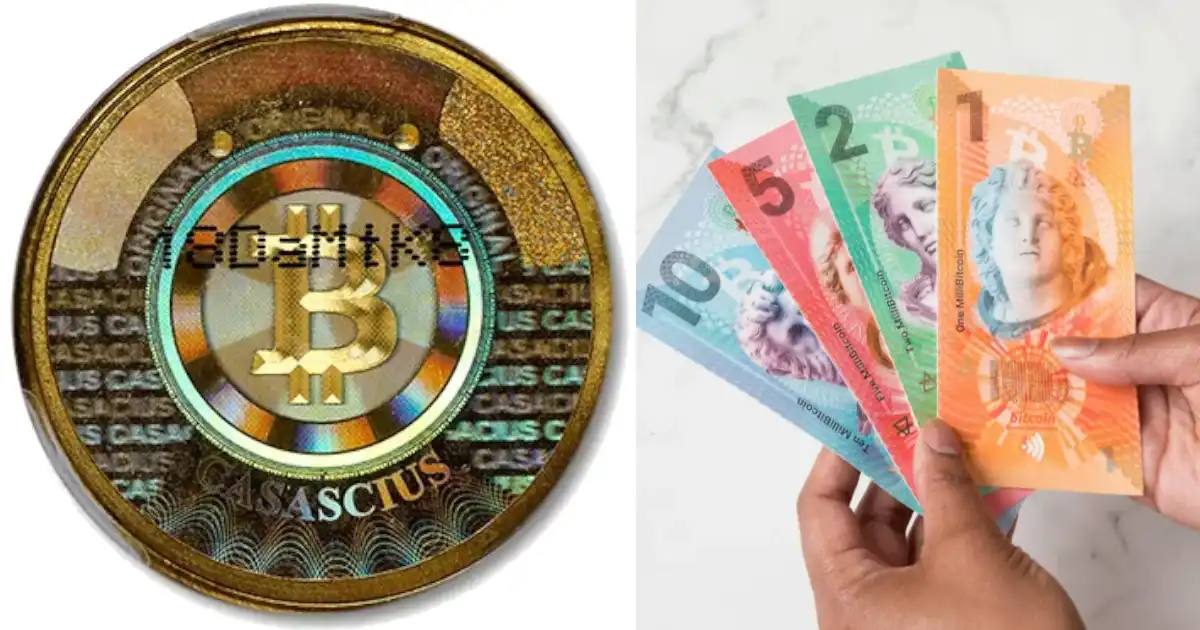
The Evolution of Physical Bitcoin Bitcoin's digital nature is its core strength, enabling self-custody and rapid global transfers. However, its intangibility also hinders mainstream adoption. For over a decade, creators have attempted to materialize Bitcoin while preserving its cash-like properties, yielding notable results. Casascius Coins, launched in 2011, were the first and most iconic physical Bitcoin. Creator Mike Caldwell generated private keys offline, printed them on coins, and sealed them with tamper-evident holograms. This model relied on user trust in the centralized issuer. Production ceased in 2013 due to regulatory pressure from FinCEN. RavenBit Coins emerged in 2014 aiming to decentralize minting by letting users generate and apply their own keys. However, this led to trust issues with numerous untrusted minters and insecure key generation methods. In 2016, Coinkite introduced Opendimes—a breakthrough in bearer asset technology. These USB-shaped devices generate and store keys internally. Funds can be received by checking the public key, but spending requires physically breaking the device to extract the private key. While innovative and open-source, its cost (~$20) and form factor limit its use for small, everyday transactions. Satochip's Satodime, a card-shaped device using similar secure chip technology, followed. It supports NFC interaction and comes in various forms. While potentially cheaper in bulk (~13€), it remains a high-security hardware wallet, not a low-cost cash substitute. A fundamental cost barrier exists. For physical Bitcoin to achieve widespread commercial use, hardware costs must drop below $1 to match the production cost of fiat banknotes. Current secure chips capable of running Bitcoin's cryptographic algorithms (like secp256k1) are too expensive. Chips like NXP's NTAG X DNA (~$3) show cost-reduction potential but lack native Bitcoin curve support. Projects like OfflineCash embed chips in banknote-like paper, but face challenges with durability, the need for custom Bitcoin-enabled chips, and the inherent requirement for users to verify balances online—which conflicts with Bitcoin's trustless ideal. Coinkite's Tapsigner, a ~$20 card with a proprietary Bitcoin NFC chip, is seen as a more practical step forward. It functions as a reloadable hardware wallet for contactless payments, solving the "change" problem and focusing on real-world retail integration, a direction also pursued by companies like Cash App and Square. In summary, the journey to physical Bitcoin has progressed from trusted centralized mints (Casascius) to user-generated keys (RavenBit) and finally to self-contained secure hardware (Opendimes, Satodime, Tapsigner). The core challenge remains developing a sufficiently low-cost, durable, and truly trustless physical bearer asset that can function like cash in daily transactions. Current solutions are either too expensive or introduce new trust assumptions, keeping the ideal of ubiquitous physical Bitcoin just out of reach for now.

marsbit1h ago

The Evolution Path of Physical Bitcoin

marsbit1h ago

Trading

Spot
Futures

Hot Articles

Discussions

Welcome to the HTX Community. Here, you can stay informed about the latest platform developments and gain access to professional market insights. Users' opinions on the price of S (S) are presented below.

活动图片