BitMine Buys Over 40,000 ETH As Sell-Off Deepens, Shrugs Off Massive Paper Losses

bitcoinistPublished on 2026-02-11Last updated on 2026-02-11

Abstract

BitMine Immersion Technologies acquired 40,613 ETH (worth $83–84 million) during a market downturn, increasing its total holdings to approximately 4.32–4.33 million ETH. Despite facing an estimated $7.5–8 billion in unrealized paper losses due to Ether's price decline, Executive Chairman Tom Lee defended the strategy, viewing the dip as a buying opportunity and predicting a V-shaped recovery. The company’s stock (BMNR) fell roughly 5% following the announcement, reflecting investor concern over the immediate impact on net asset value. BitMine continues to stake part of its ETH to generate yield, betting on long-term price appreciation. The outcome hinges on Ether’s price trajectory and the firm’s ability to manage short-term losses through staking returns and strategic patience.

BitMine Immersion Technologies kept buying as prices fell, scooping up 40,613 ETH during last week’s sell-off. Reports say the purchase totaled roughly $83–$84 million, made when Ether traded near $2,020 per token.

BitMine’s Growing Stake And The Man At The Helm

According to recent coverage, the move pushed BitMine’s total Ethereum holdings to around 4.32–4.33 million ETH, a stash worth billions at current prices. Executive chairman Tom Lee has framed the dip as an attractive entry point and has voiced confidence in a bounce back.

Paper Losses Widen As Prices Slide

Reports note that the firm’s large cost basis for its accumulated ETH has left its treasury sitting on multibillion-dollar unrealized losses.

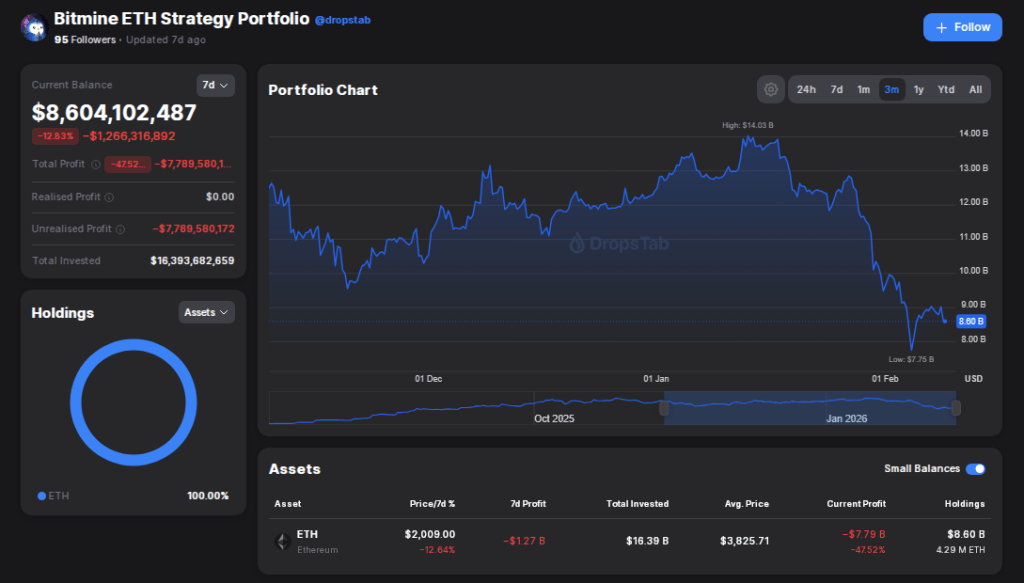
Estimates in the latest pieces place those paper losses between about $7.5 billion and $8 billion, depending on which price is used to mark the holdings. That gap widened as Ether fell from higher levels into the low-$2Ks.

BitMine faces an estimated $7.7 billion paper loss on its ETH holdings. Source: DropsTab

Market And Shareholder Response

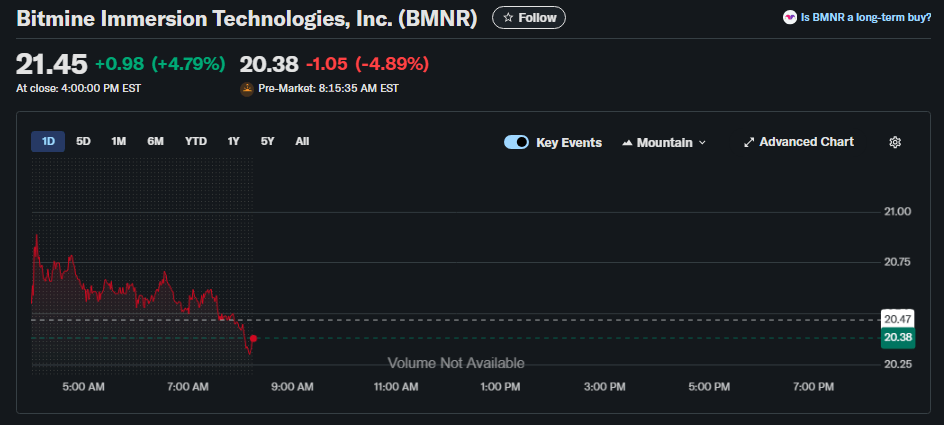
BitMine’s aggressive buying did not calm all investors. News outlets tracked a drop in the company’s stock (BMNR), which was reported down roughly 5% in pre-market trading around the same time the ETH buy was disclosed.

Traders appear to be weighing the long-term thesis against the immediate hit to the company’s net asset value.

Six‐month performance of BitMine (BMNR) stock. Source: Yahoo Finance

Why The Company Is Still Adding

Reports say BitMine sees this as part of an intentional treasury play. Some of the firm’s ETH is staked, which generates yield and can help offset paper losses over time.

Tom Lee has forecast a strong rebound, calling for a V-shaped recovery in ether. That kind of outlook explains why purchases came even while the market was weak.

ETHUSD trading at $2,012 on the 24-hour chart: TradingView

What To Watch Next

Short term, price moves in ether and shifts in investor sentiment will be the clearest signals. If ETH stages a steady climb, the unrealized losses will shrink quickly.

If the token continues to trade lower, the company’s paper loss metrics will remain a headline for shareholders and analysts.

Reports say details such as financing, staking returns, and any further disclosed buys will shape how investors view the firm’s risk profile.

BitMine’s choice to keep buying at lower levels is a clear bet on future price recovery. Whether that bet pays off for shareholders depends on the market’s next moves, and on whether patience and staking income can outweigh a large short-term drawdown.

Featured image from Thomas Fuller/SOPA Images/LightRocket via Getty Images, chart from TradingView

Related Questions

QHow much ETH did BitMine purchase during the recent sell-off and at what approximate price?

ABitMine purchased 40,613 ETH during the sell-off at a price near $2,020 per token, totaling roughly $83–$84 million.

QWhat is the estimated value of the paper losses on BitMine's ETH holdings, and why did this gap widen?

AThe estimated paper losses on BitMine's ETH holdings are between $7.5 billion and $8 billion. This gap widened as the price of Ether fell from higher levels into the low-$2,000s.

QHow did the market and shareholders initially react to BitMine's aggressive ETH purchase?

AThe market reaction was negative, with BitMine's stock (BMNR) dropping roughly 5% in pre-market trading. Traders were weighing the long-term investment thesis against the immediate hit to the company's net asset value.

QWhat are the two main reasons provided for why BitMine continued to buy ETH despite the market weakness?

ABitMine views this as an intentional treasury play. First, some of the ETH is staked, generating yield to help offset paper losses over time. Second, Executive Chairman Tom Lee has forecast a strong V-shaped recovery for Ether.

QWhat future factors will shape how investors view the risk profile of BitMine's strategy?

AKey factors include short-term price moves in Ether, shifts in investor sentiment, details on how the purchases were financed, the returns from staking, and any further disclosed cryptocurrency buys.

Related Reads

From Return to Resignation: Chen Hang's 437 Days at DingTalk

The 437-Day Return and Departure of Chen Hang at DingTalk This article chronicles the 437-day period from March 31, 2025, to June 11, 2026, when Chen Hang (also known as "No Move") returned as CEO of DingTalk, the enterprise communication platform he originally founded, only to later step down. Chen Hang, the creator of DingTalk in 2015, was brought back by Alibaba in 2025 after the company acquired his subsequent startup, HHO. His return was driven by Alibaba's renewed focus on AI and DingTalk's strategic role as its key to-B AI application. However, his aggressive management style, marked by strict work policies like mandatory clock-ins and extended hours, quickly caused internal friction and was criticized as being at odds with Alibaba's culture. Despite the internal turmoil, Chen Hang drove significant product launches. In August 2025, he unveiled "AI DingTalk 1.0," featuring new products like the AI-native entry point "DingTalk ONE." By March 2026, he announced "Wukong," touted as the world's first enterprise-grade AI-native work platform, representing a fundamental rebuild of DingTalk's architecture. The turning point came in early June 2026. A detailed internal post criticizing DingTalk's work culture went viral, followed by a public critique from a former executive. This prompted an unprecedented public rebuke from the Alibaba Partners Committee, which stated such management was not aligned with company values. One day later, on June 11, Alibaba announced Chen Hang's departure. He was succeeded by Chen Yusen, a 32-year-old technical expert known for founding cybersecurity firm Changting Technology. While Chen Hang's tenure laid the technical foundation for DingTalk's AI transformation with "Wukong," his leadership style ultimately led to his replacement as the company seeks a new direction under younger leadership.

marsbit10m ago

From Return to Resignation: Chen Hang's 437 Days at DingTalk

marsbit10m ago

The 2026 Landscape of Decentralized AI: Why Blockchain is the Inevitable 'Antidote' for AI?

Decentralized AI 2026 Landscape: Why Blockchain is AI's Essential "Antidote" Centralized AI faces structural bottlenecks—expensive compute, concentrated control, unverifiable outputs, and difficult data access—that cannot be solved by capital or code alone. Blockchain offers a path to make intelligence open, verifiable, and economically accessible. The decentralized AI stack comprises: * **Infrastructure:** The foundation with compute, verifiable inference, distributed training, data/storage, and privacy/verification layers. Projects like Akash, Render, and Filecoin provide cheaper, decentralized alternatives for raw resources. * **Middleware:** The coordination layer for agent discovery, identity, and commerce. Key players include Bittensor (a network of specialized AI subnets), Virtuals (an agent economy OS), and frameworks providing agent identity and tooling. * **Applications & Services:** Dominated by Agentic Finance (AI agents executing on-chain actions based on natural language) and Agentic Payments (machine-to-machine transactions using blockchain as a settlement layer). Projects like Giza, Infinit Labs, and x402 are enabling these use cases. Key trends for 2026-2027 show AI demand outgrowing infrastructure, compute becoming an asset class, and tokenomics emerging as a structural advantage for coordinating capital, compute, and data. While still early—with adoption uneven and revenue often trailing token incentives—projects like Bittensor, NEAR, and Venice demonstrate decentralized AI is evolving from a narrative into a new model for coordinating intelligence.

Foresight News30m ago

The 2026 Landscape of Decentralized AI: Why Blockchain is the Inevitable 'Antidote' for AI?

Foresight News30m ago

Trading

Spot
Futures

Hot Articles

Discussions

Welcome to the HTX Community. Here, you can stay informed about the latest platform developments and gain access to professional market insights. Users' opinions on the price of ETH (ETH) are presented below.

活动图片