Bitcoin’s price bottom in limbo: Why BTC–gold correlation matters now

ambcryptoPublished on 2026-03-19Last updated on 2026-03-19

Abstract

The market is currently driven by investor psychology, with Bitcoin's price bottom remaining uncertain. Despite recent macro pressures from inflation and West Asian tensions, Bitcoin has shown relative resilience compared to gold. Key indicators like the Coinbase Premium Index (-0.002) and Crypto Fear and Greed Index reflect weakening U.S. buying pressure and a shift to "fear" sentiment. A notable $150 million long liquidation occurred, the largest since early March. However, Bitcoin’s inverse correlation with gold (-0.88, the lowest since November 2022) acts as a critical bullish signal. While gold and silver faced trillion-dollar losses, Bitcoin’s $50 billion market cap drop was contained, reinforcing its role as a hedge. This BTC-gold dynamic is pivotal for sentiment and potential bottom formation amid ongoing macro uncertainty.

The market is back at a stage where investor psychology is likely to drive the next move.

So far, crypto has stayed relatively insulated from the macro FUD surrounding the West Asian crisis. However, the latest inflation print is a reminder that it may still be too early to call a definitive bottom for Bitcoin [BTC], especially after its 3.61% daily close in the red.

In short, macro pressure is beginning to seep into BTC. One of the clearest signs is the Coinbase Premium Index (CPI). The index has dropped sharply, falling over 106% in a single day to -0.002. In fact, this marks its steepest pullback this week, signaling weakening buying pressure from U.S. investors.
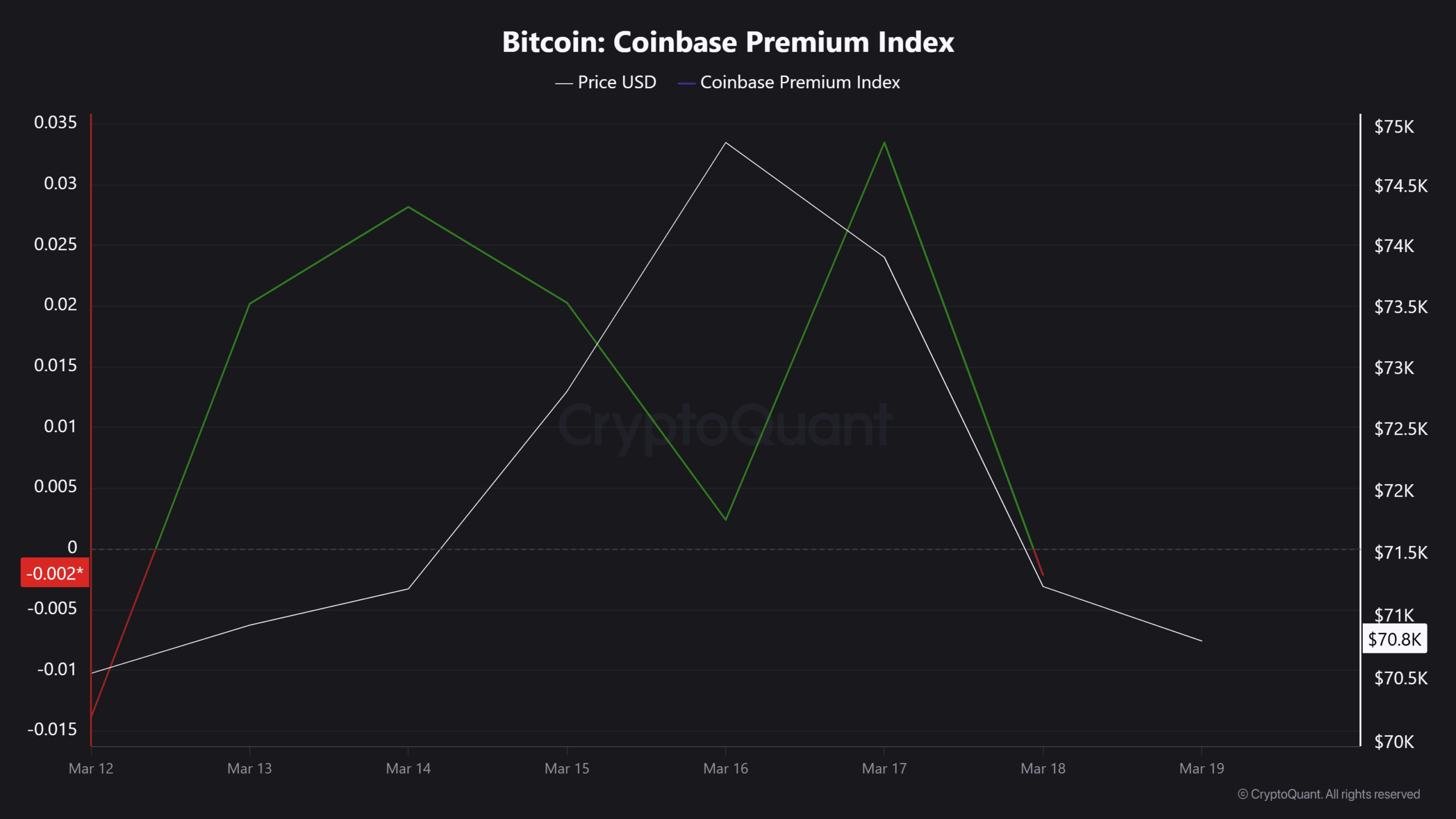
Source: CryptoQuant

Meanwhile, the Crypto Fear and Greed Index has slipped back into the “fear” zone after briefly moving into neutral, which had aligned with BTC reclaiming the $74k level. From a technical standpoint, this shift in sentiment made the recent long squeeze almost inevitable, as bullish positioning ran into macro headwinds.

Data from CoinGlass shows that nearly $150 million in long positions were wiped out, marking the biggest liquidation event since early March. Put together, the drop in sentiment indicators and the scale of long liquidations suggest the market is rotating back into a risk-off mode.

Against this backdrop, BTC’s sideways chop around $70k suggests it’s still too early to confidently call a bottom. Price is holding, but the lack of strong follow-through on the upside shows that conviction remains weak. That said, a key CryptoQuant metric indicates Bitcoin could still keep sentiment supportive if this correlation continues to hold.

A critical correlation could help Bitcoin avoid extreme fear

To hold current levels, the market needs strong risk appetite, as sentiment still drives price action.

Otherwise, BTC risks losing its footing, especially with macro FUD continuing to weigh on confidence. If this pressure sticks, it likely won’t take much for sentiment to slip back into the “extreme fear” zone, particularly with BTC still trading over 40% below its $126k peak, leaving a large share of holders underwater.

According to AMBCrypto, the BTC-gold correlation could play a key psychological role. Technically, Bitcoin’s push toward $74k came as the ratio dropped 15%, matching BTC’s 10.4% gain. The result? The Bitcoin-to-Gold correlation hit -0.88, its lowest level since November 2022, highlighting a strong inverse relationship.
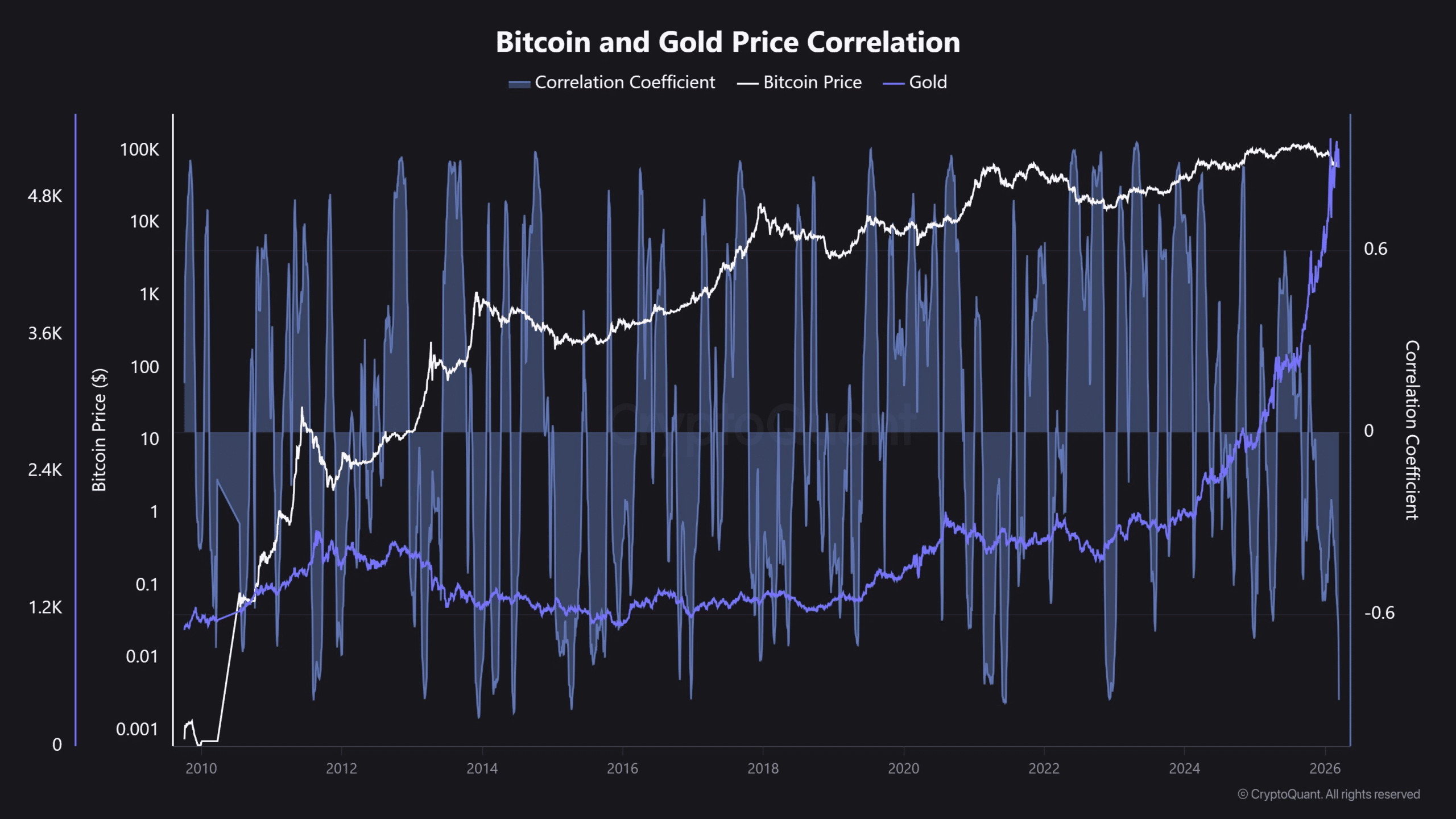
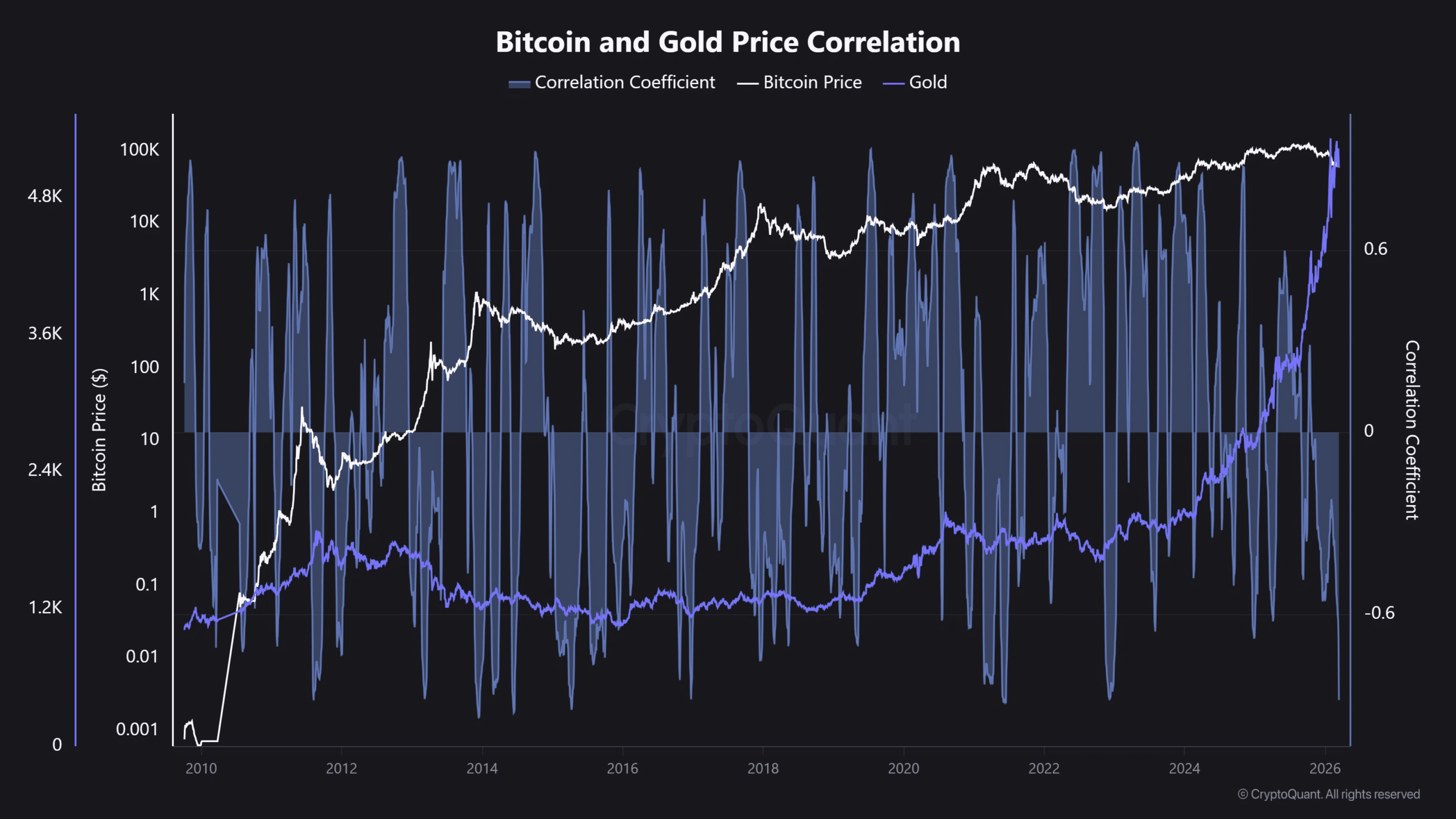
Source: CryptoQuant

Put simply, Bitcoin’s relative strength versus gold continues to serve as a key bullish signal.

From a technical standpoint, the latest inflation report triggered massive trillion-dollar losses across gold and silver, yet BTC only gave up around $50 billion in market cap, keeping its slide relatively contained even as broader FUD rattled risk assets.

Consequently, that resilience is playing a key role in holding sentiment. If Bitcoin continues to show strength, capital rotation could remain robust, reinforcing its role as a preferred hedge for investors while macro volatility keeps shaking the broader market.

In this cycle, Bitcoin’s potential bottom therefore appears closely linked to this BTC–gold dynamic, making the correlation a critical indicator to watch as the market navigates uncertainty.


Final Summary

  • Despite trillion-dollar losses in gold and silver, Bitcoin’s limited $50 billion market cap drop highlights resilience that helps support market sentiment.
  • The strong inverse relationship signals that Bitcoin’s bottom may be closely tied to this dynamic, making it a key indicator for navigating risk-off conditions.


Trending Cryptos

Related Questions

QWhat is the current state of the Coinbase Premium Index and what does it indicate about U.S. investor behavior?

AThe Coinbase Premium Index has dropped sharply, falling over 106% in a single day to -0.002, marking its steepest pullback this week. This signals weakening buying pressure from U.S. investors.

QHow did the recent inflation report impact Bitcoin compared to traditional assets like gold and silver?

AThe inflation report triggered massive trillion-dollar losses across gold and silver, yet Bitcoin only gave up around $50 billion in market cap, keeping its slide relatively contained and highlighting its resilience.

QWhat is the significance of the Bitcoin-to-Gold correlation hitting -0.88?

AA correlation of -0.88, the lowest since November 2022, highlights a strong inverse relationship. This means Bitcoin's relative strength versus gold serves as a key bullish signal and helps support market sentiment.

QWhat recent event caused the Crypto Fear and Greed Index to slip back into the 'fear' zone?

AThe index slipped back into the 'fear' zone after briefly moving into neutral, a shift that was aligned with a recent long squeeze where nearly $150 million in long positions were liquidated due to macro headwinds.

QAccording to the article, why is it still too early to confidently call a bottom for Bitcoin's price?

AIt is too early to call a bottom because, despite price holding around $70k, there is a lack of strong follow-through on the upside, weak conviction, and ongoing macro FUD that continues to weigh on investor confidence and risk appetite.

Related Reads

Bernstein Analysis: Can the $142 Billion Long-Term Order Hold Up the Memory Cycle?

Bernstein revisits long-term agreements (LTAs) in the memory industry, highlighting new contracts with purchase commitments, minimum prices, and financial guarantees signed by Micron and SanDisk. These aim to provide an earnings floor for the coming years. Micron has 16 strategic customer agreements, with 14 representing approximately $100 billion in minimum revenue and about $22 billion in cash deposits/commitments. SanDisk has contracts for around $42 billion in minimum revenue and over $11 billion in guarantees. Combined, these ~$33 billion in guarantees make it more costly for major clients to walk away. However, Bernstein models that the potential revenue needing protection over 3-5 years is around $5.2 trillion. The existing guarantees thus cover only about 0.6% of that scale. While LTAs provide a cushion, they cannot fully shield profits in a severe downturn, as clients may still find it cheaper to breach contracts if spot prices fall deeply below floor prices. LTAs are most suitable for large, credit-worthy customers like U.S. cloud service providers with stable, high-volume AI infrastructure needs. Consumer segments (phones, PCs) and some Chinese clients are less likely to adopt them, leaving an estimated 30-50% of the DRAM/NAND market exposed to spot price volatility. AI demand (e.g., HBM for training, storage for inference) supports higher valuations and makes LTAs more attractive for locking in high-demand customers. Yet, Bernstein stresses that LTAs soften, but do not eliminate, the memory cycle. Their true test will come in the next downturn, revealing whether clients honor contracts and whether guarantees provide sufficient pain to maintain supplier discipline.

marsbit13m ago

Bernstein Analysis: Can the $142 Billion Long-Term Order Hold Up the Memory Cycle?

marsbit13m ago

Dialogue with Jia Hang | Looking Back at Two Decades of Chinese Payment Going Global

**Summary: A Conversation with Jia Hang on Two Decades of China's Payment Globalization** Jia Hang, a veteran with over twenty years in payments, reflects on China's attempts to build a global payment network through three key phases: UnionPay (card networks), Alipay+ (digital wallets), and now, stablecoins. His journey began at UnionPay International, aiming to establish China's card network abroad. While successful in following Chinese tourists ("where Chinese go, UnionPay goes"), it struggled to achieve true global scale. The core lesson: card networks like Visa/Mastercard's unassailable advantage isn't just technical standards, but their deeply entrenched **governance and profit-sharing models** that create powerful network effects. Competing as the "same species" is nearly impossible. At Ant Group, he led Alipay+, a strategy to bypass card networks by interconnecting local e-wallets worldwide. While innovative, it faced a similar ceiling. Mobile QR payments and card swipes were essentially **the same species competing for the same pie**, lacking a disruptive value proposition for users or a sustainable new incentive model to replace the card networks' established flywheel. Today, at Singapore's DCS, Jia focuses on stablecoin-based payments. He argues stablecoins represent a fundamental shift. They are not competing with Visa for consumer payments but challenging the **traditional banking and account system for value movement**. Products like "U Cards" (stablecoin-linked payment cards) are transitional, leveraging existing card networks for acceptance while building new rails. The real potential lies in stablecoins enabling seamless, low-cost global value transfer, potentially reorganizing the financial infrastructure around **accounts rather than cards**. Jia believes stablecoin adoption for local retail payments, cross-border transactions, and as high-yield savings vehicles is becoming irreversible. This could gradually reduce reliance on traditional fiat channels, especially in regions with weak currencies or capital controls. The quest for the "next global payment network" continues, now centered on whether stablecoins can successfully bridge Web2 and Web3, establish new governance, and create compelling user value beyond mere cost reduction.

marsbit36m ago

Dialogue with Jia Hang | Looking Back at Two Decades of Chinese Payment Going Global

marsbit36m ago

Circle's Stock Price Plunges 76%, Hong Kong Dollar Stablecoin Set to Launch Within Two Weeks

Circle's stock price has plunged approximately 76% from its 2023 peak, reflecting a major market revaluation. Despite this, Circle President Heath Tarbert emphasized the company's focus on long-term execution and its dominant position with USDC's $73 billion circulation across 34 blockchains. The competitive landscape is intensifying. A new consortium-backed stablecoin, Open USD, is attempting to challenge incumbents by sharing reserve yields with partners. More significantly, Visa's new stablecoin platform, initially supporting Open USD while also being compatible with USDC, could erode Circle's network effects. In response, Circle is expanding into real-world payments through partnerships like the one with Japan's JCB. Separately, Tether (USDT) faces a two-year compliance window under new U.S. regulations, requiring it to adjust its reserve composition away from assets like Bitcoin and loans towards cash and U.S. Treasuries. Meanwhile, in Hong Kong, Standard Chartered-backed fintech firm Dian Dian is poised to launch a licensed HKD-pegged stablecoin (HKDAP), moving the industry into a phase where the real test is integrating licensed stablecoins into actual payment flows and corporate treasury systems. The sharp decline in Circle's stock underscores a broader shift: the stablecoin market is moving from a winner-takes-all dynamic to a multi-player competitive arena where execution, compliance, and real-world utility are becoming paramount.

marsbit37m ago

Circle's Stock Price Plunges 76%, Hong Kong Dollar Stablecoin Set to Launch Within Two Weeks

marsbit37m ago

Trading

Spot

Hot Articles

What is $BITCOIN

DIGITAL GOLD ($BITCOIN): A Comprehensive Analysis Introduction to DIGITAL GOLD ($BITCOIN) DIGITAL GOLD ($BITCOIN) is a blockchain-based project operating on the Solana network, which aims to combine the characteristics of traditional precious metals with the innovation of decentralized technologies. While it shares a name with Bitcoin, often referred to as “digital gold” due to its perception as a store of value, DIGITAL GOLD is a separate token designed to create a unique ecosystem within the Web3 landscape. Its goal is to position itself as a viable alternative digital asset, although specifics regarding its applications and functionalities are still developing. What is DIGITAL GOLD ($BITCOIN)? DIGITAL GOLD ($BITCOIN) is a cryptocurrency token explicitly designed for use on the Solana blockchain. In contrast to Bitcoin, which provides a widely recognized value storage role, this token appears to focus on broader applications and characteristics. Notable aspects include: Blockchain Infrastructure: The token is built on the Solana blockchain, known for its capacity to handle high-speed and low-cost transactions. Supply Dynamics: DIGITAL GOLD has a maximum supply capped at 100 quadrillion tokens (100P $BITCOIN), although details regarding its circulating supply are currently undisclosed. Utility: While precise functionalities are not explicitly outlined, there are indications that the token could be utilized for various applications, potentially involving decentralized applications (dApps) or asset tokenization strategies. Who is the Creator of DIGITAL GOLD ($BITCOIN)? At present, the identity of the creators and development team behind DIGITAL GOLD ($BITCOIN) remains unknown. This situation is typical among many innovative projects within the blockchain space, particularly those aligning with decentralized finance and meme coin phenomena. While such anonymity may foster a community-driven culture, it intensifies concerns about governance and accountability. Who are the Investors of DIGITAL GOLD ($BITCOIN)? The available information indicates that DIGITAL GOLD ($BITCOIN) does not have any known institutional backers or prominent venture capital investments. The project seems to operate on a peer-to-peer model focused on community support and adoption rather than traditional funding routes. Its activity and liquidity are primarily situated on decentralized exchanges (DEXs), such as PumpSwap, rather than established centralized trading platforms, further highlighting its grassroots approach. How DIGITAL GOLD ($BITCOIN) Works The operational mechanics of DIGITAL GOLD ($BITCOIN) can be elaborated on based on its blockchain design and network attributes: Consensus Mechanism: By leveraging Solana’s unique proof-of-history (PoH) combined with a proof-of-stake (PoS) model, the project ensures efficient transaction validation contributing to the network's high performance. Tokenomics: While specific deflationary mechanisms have not been extensively detailed, the vast maximum token supply implies that it may cater to microtransactions or niche use cases that are still to be defined. Interoperability: There exists the potential for integration with Solana’s broader ecosystem, including various decentralized finance (DeFi) platforms. However, the details regarding specific integrations remain unspecified. Timeline of Key Events Here is a timeline that highlights significant milestones concerning DIGITAL GOLD ($BITCOIN): 2023: The initial deployment of the token occurs on the Solana blockchain, marked by its contract address. 2024: DIGITAL GOLD gains visibility as it becomes available for trading on decentralized exchanges like PumpSwap, allowing users to trade it against SOL. 2025: The project witnesses sporadic trading activity and potential interest in community-led engagements, although no noteworthy partnerships or technical advancements have been documented as of yet. Critical Analysis Strengths Scalability: The underlying Solana infrastructure supports high transaction volumes, which could enhance the utility of $BITCOIN in various transaction scenarios. Accessibility: The potential low trading price per token could attract retail investors, facilitating wider participation due to fractional ownership opportunities. Risks Lack of Transparency: The absence of publicly known backers, developers, or an audit process may yield skepticism regarding the project's sustainability and trustworthiness. Market Volatility: The trading activity is heavily reliant on speculative behavior, which can result in significant price volatility and uncertainty for investors. Conclusion DIGITAL GOLD ($BITCOIN) emerges as an intriguing yet ambiguous project within the rapidly evolving Solana ecosystem. While it attempts to leverage the “digital gold” narrative, its departure from Bitcoin's established role as a store of value underscores the need for a clearer differentiation of its intended utility and governance structure. Future acceptance and adoption will likely depend on addressing the current opacity and defining its operational and economic strategies more explicitly. Note: This report encompasses synthesised information available as of October 2023, and developments may have transpired beyond the research period.

956 Total ViewsPublished 2025.05.13Updated 2025.05.13

What is $BITCOIN

Discussions

Welcome to the HTX Community. Here, you can stay informed about the latest platform developments and gain access to professional market insights. Users' opinions on the price of BTC (BTC) are presented below.

活动图片