Bitcoin’s ‘next major buying opportunity’ forms in Q4 – Former NASA researcher explains why!

ambcryptoPublished on 2026-07-10Last updated on 2026-07-10

Abstract

Bitcoin's price rose 2.32% to $64,380.20, yet failed to breach the $80k resistance level from mid-May. While technical indicators like RSI and MACD suggest continued bullish momentum, on-chain data from CryptoQuant reveals a mixed picture. The market appears to be in a transitional phase, with U.S. investor caution evident through $10 billion in ETF outflows since October 2025 and a persistently negative Coinbase Premium. However, new large investors (whales) are accumulating BTC, absorbing selling pressure and potentially preventing steeper declines. Analyst Benjamin Cowen and others remain optimistic, pointing to historical cycles. One analyst cites a 4-year cycle model, suggesting Q4 2026 could present the next major buying opportunity, with significant potential gains in 2027. Another analyst, Adam Livingston, notes Bitcoin is currently trading only 19.2% above its realized price—well below the historical average premium of 81.9%—and that similar past valuations have led to substantial medium-term returns. Overall, despite weak short-term sentiment and a lack of new capital inflows, the community anticipates a strong future trajectory for Bitcoin based on cyclical patterns and current undervaluation.

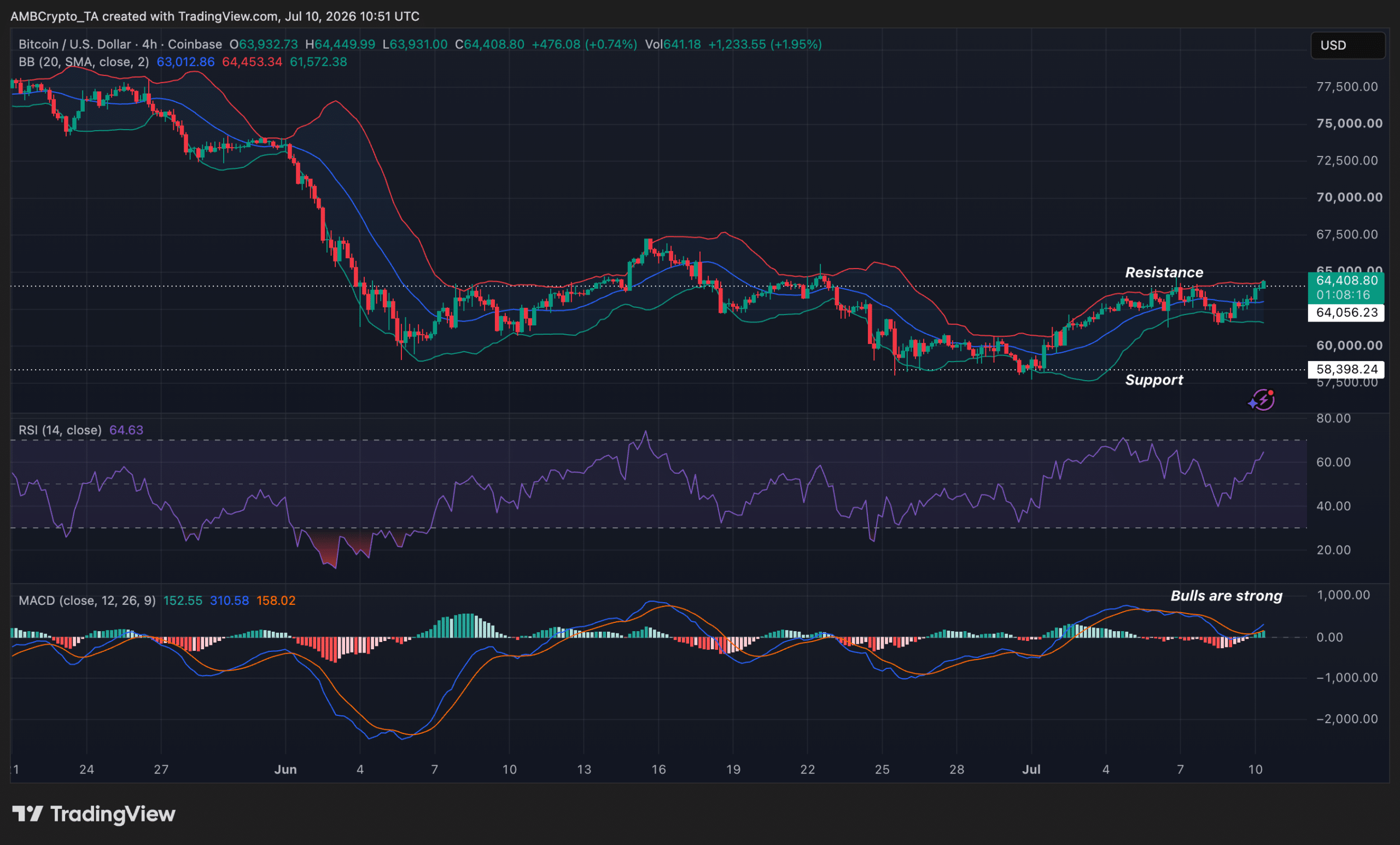
After a 2.32% increase over the previous day, Bitcoin [BTC] was trading at $64,380.20 at press time.

The leading cryptocurrency, however, failed to overcome the resistance level at $80k, which it last reached in mid-May, despite the increase.

Even though the four-hour chart’s RSI and MACD indicators, as well as the narrowing Bollinger bands, further imply that the bullish narrative is here to stay.
Source: Trading View

On-chain metrics raise red flags

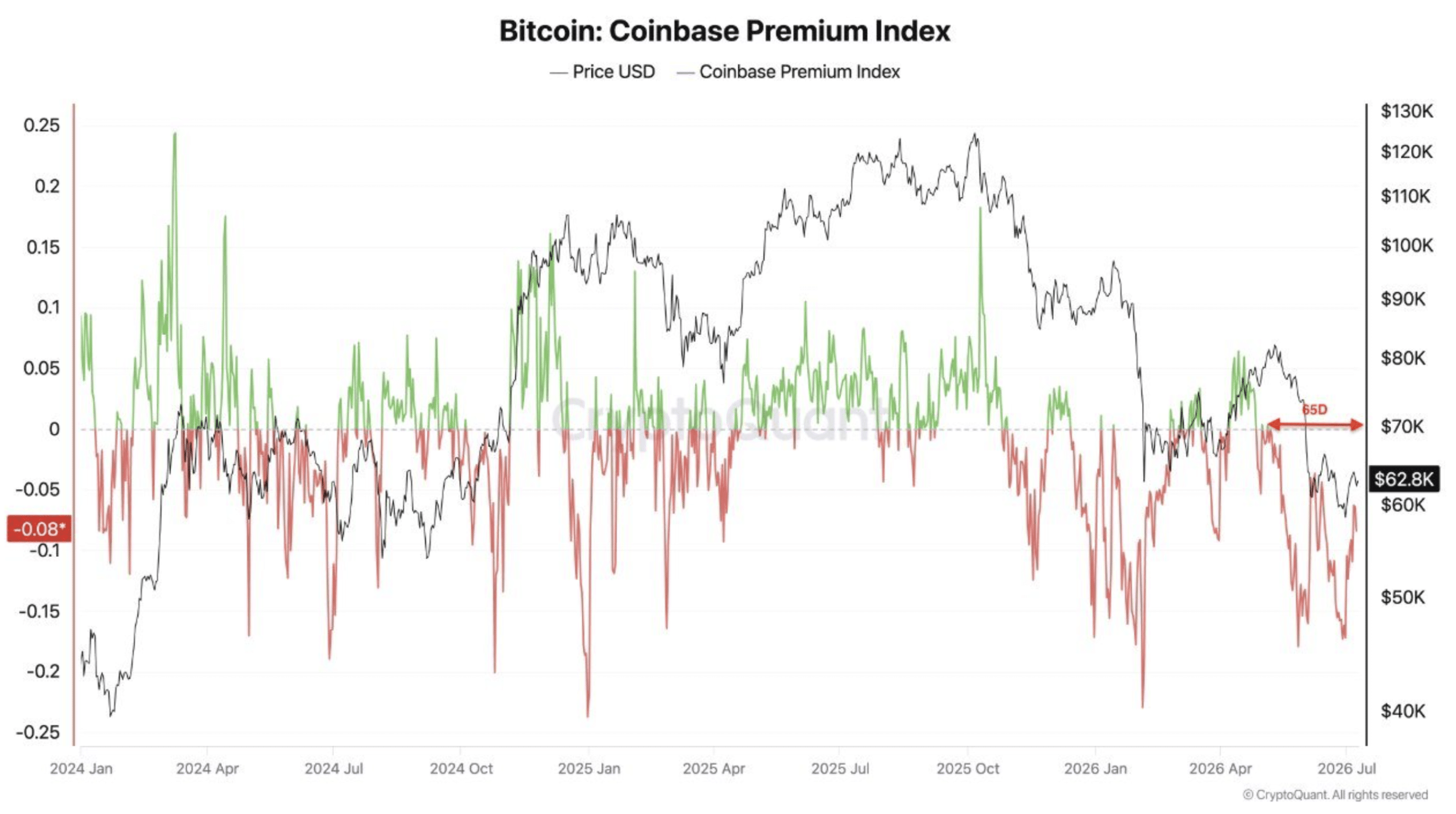
Nonetheless, the data from CryptoQuant’s most recent analysis paints a bleak picture, indicating that Bitcoin is not in a bear market or a confirmed recovery, but rather is in a transitional phase.

On the one hand, conventional U.S. investors are being cautious.

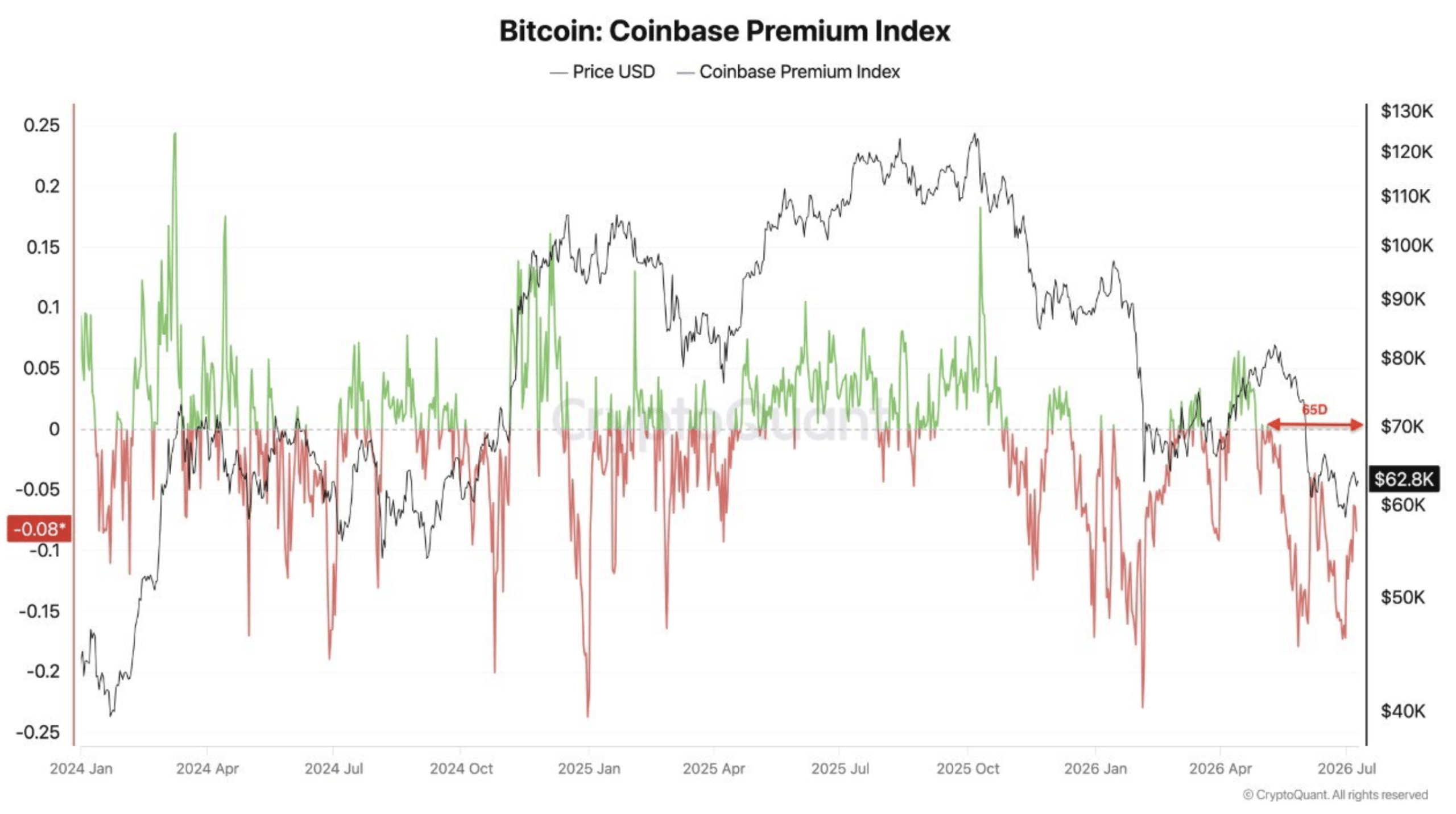
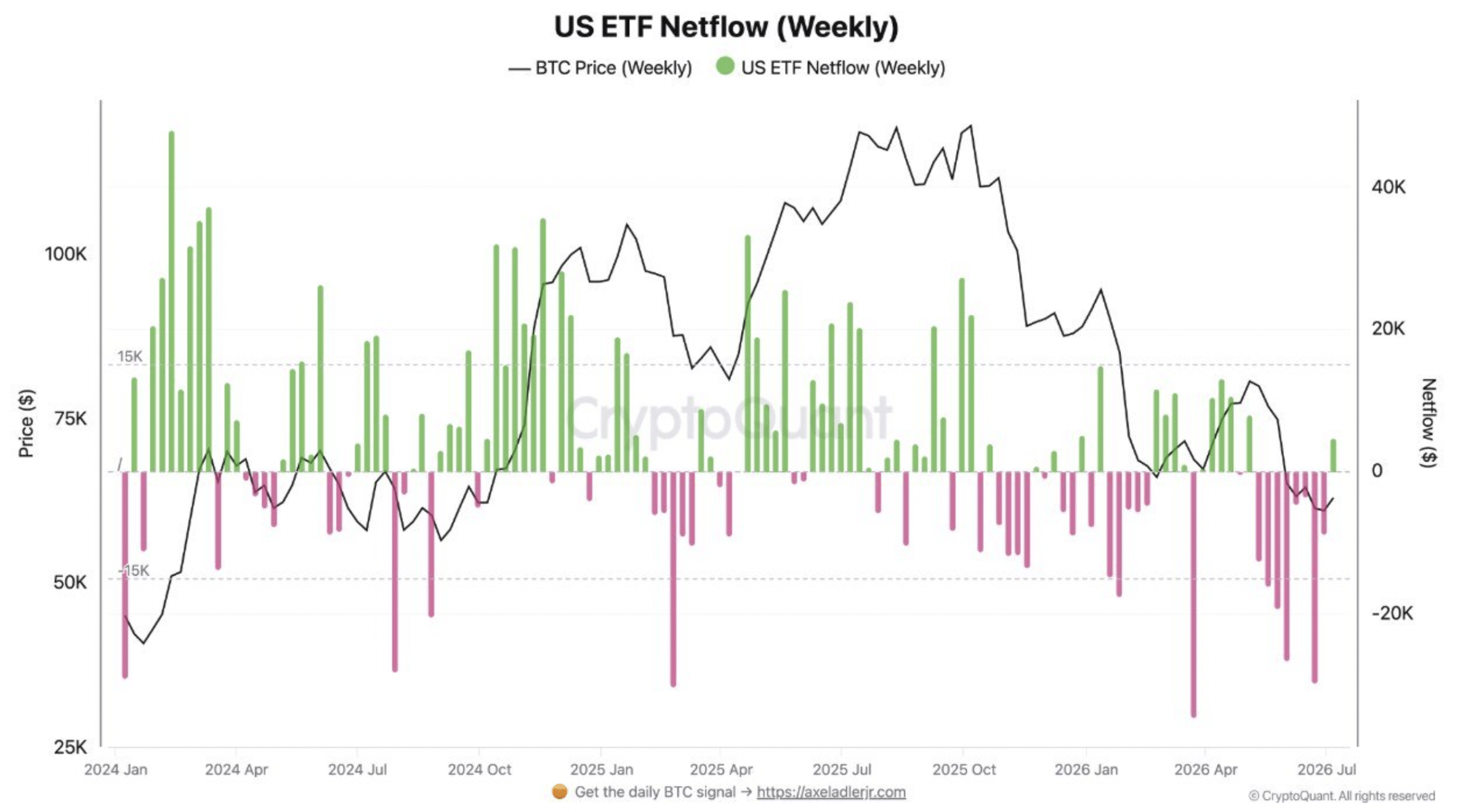
This is because since October 2025, about $10 billion has been pulled out of spot Bitcoin ETFs. Additionally, the Coinbase Premium has been negative for 65 days in a row, suggesting that buying demand from American institutions and individual investors is not strong.
Source: CryptoQuant

However, on-chain data reveals that new Bitcoin whales are progressively gaining more BTC, as the supply of the cryptocurrency shifts from older, long-term holders to more large, recent investors.

This indicates that although ETF selling pressure indicates a weak market sentiment, big buyers are covertly consuming that supply, which may be preventing further declines.
Source: CryptoQuant

Community backs Bitcoin

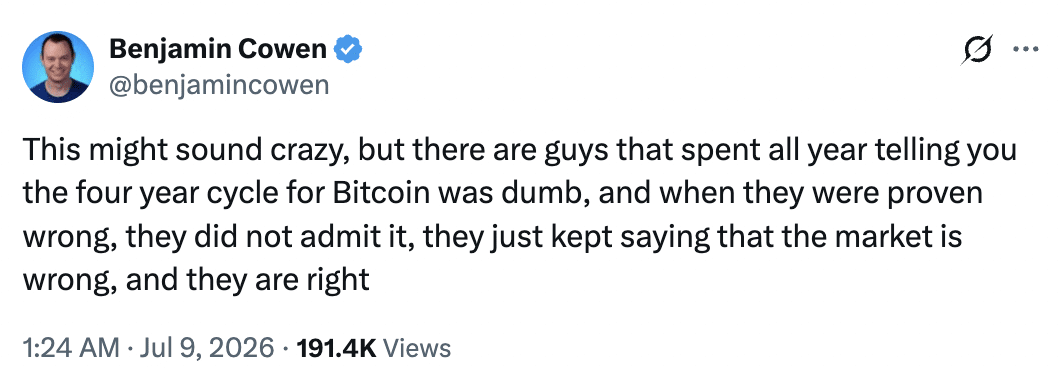
In fact, disregarding these negative metrics, former NASA researcher Benjamin Cowen pointed out,
Source: Benjamin Cowen/X

Indeed, according to another analyst, there might be a recurrent four-year cycle in Bitcoin and the larger cryptocurrency market.

According to the analyst, an anonymous 4chan user correctly forecasted the peak of the Bitcoin market in October 2025, and this prediction is consistent with another independent cycle model.

He added,

If the cycle repeats, Q4 2026 could mark the next major buying opportunity and 2027 is gets crazy.

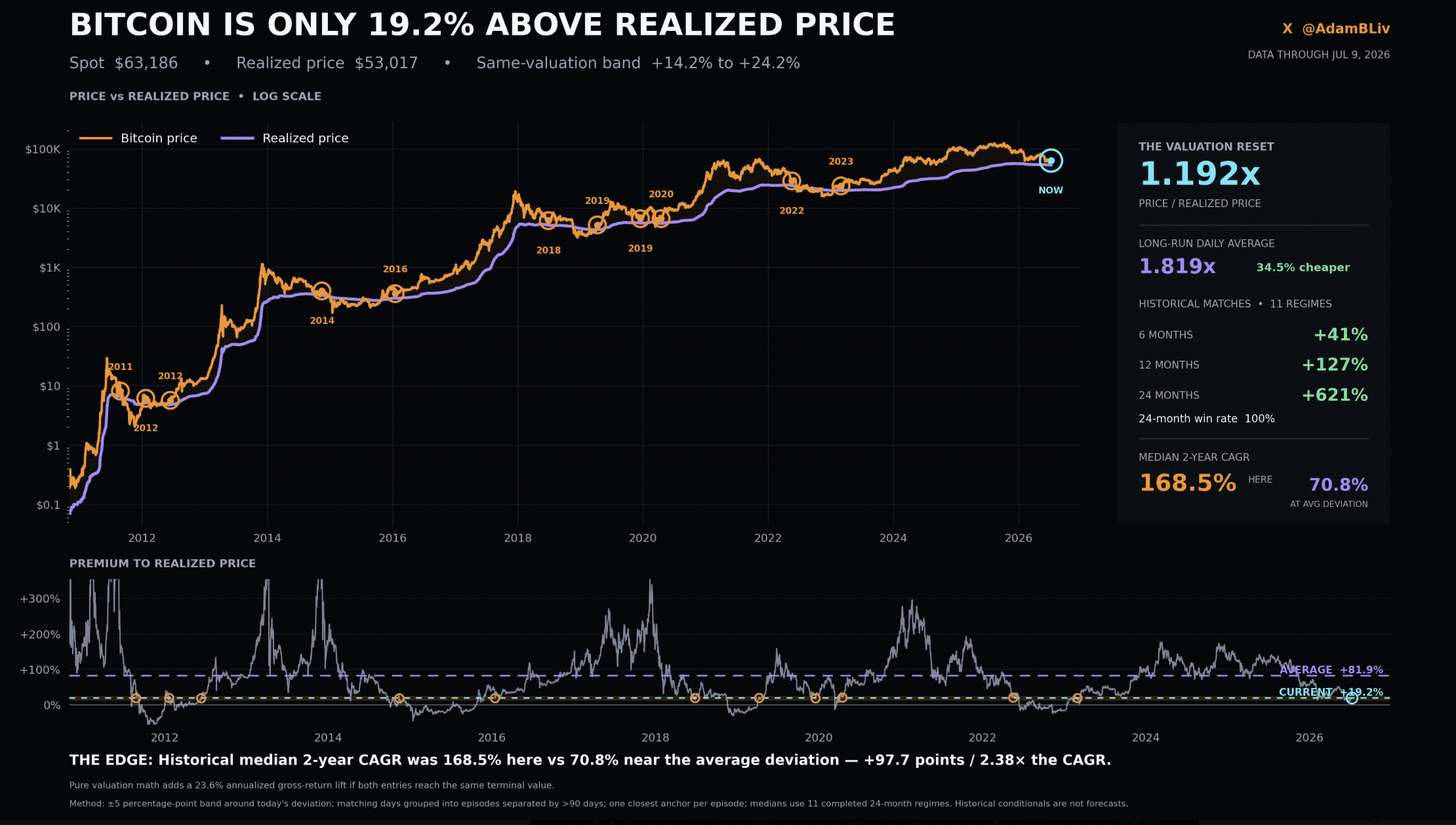
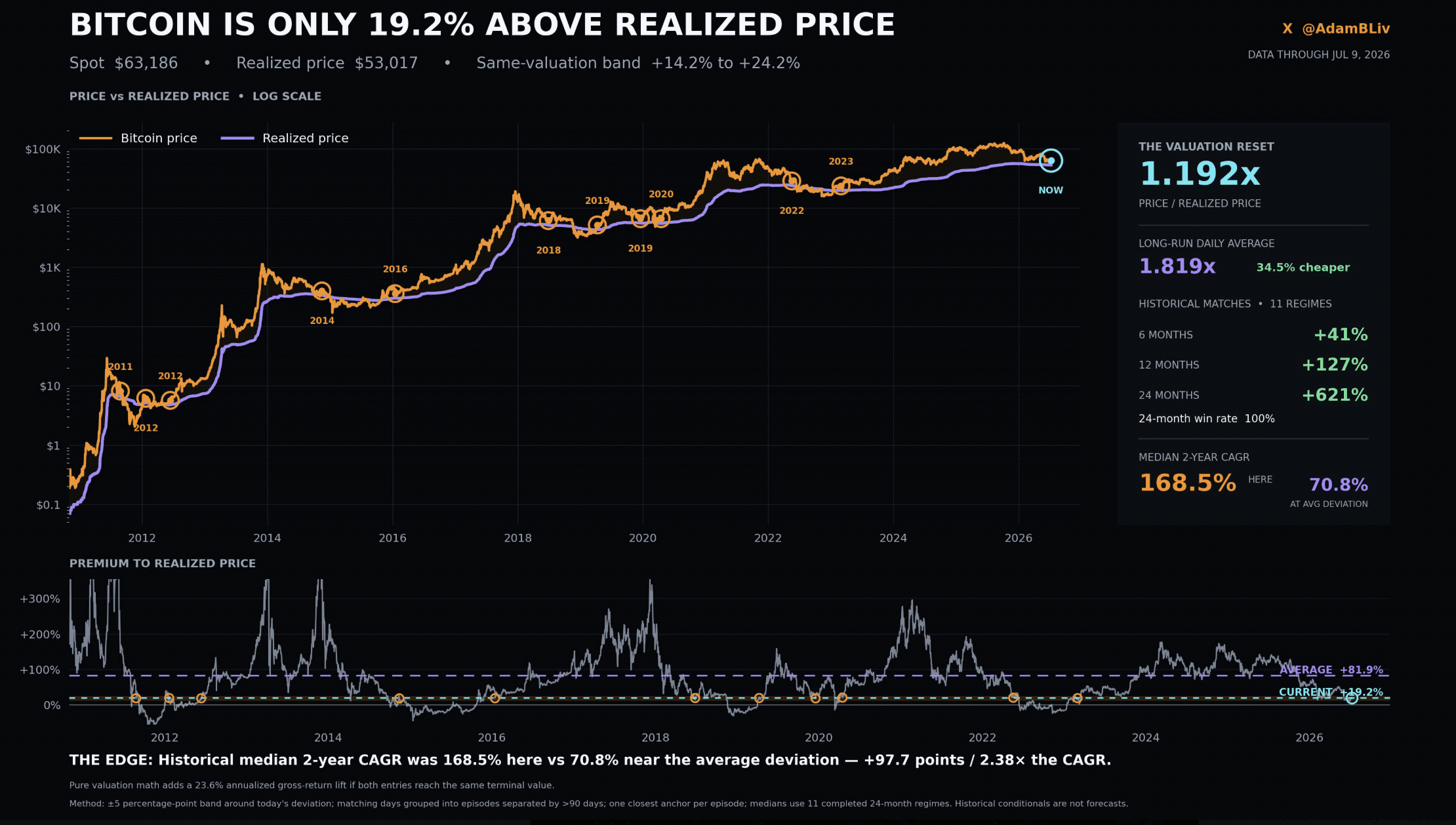
Similar to other opinions about Bitcoin, Adam Livingston contends that BTC seems to be undervalued because it is currently only 19.2% above its realized price, which is the average on-chain purchase price of all BTC, as opposed to an average premium of 81.9% in the past.

According to Livingston’s analysis of previous times when Bitcoin traded at comparable valuation levels, all completed historical regimes produced positive two-year returns, with median returns of 41% after six months, 127% after a year, and 621% after two years.
Source: X

Nonetheless, AMBCrypto recently pointed out that better sentiment may have trouble spurring the kind of broad purchasing that is required for a long-lasting recovery until new capital returns to spot markets.


Final Summary

  • Bitcoin price action is showing bullish momentum, but on-chain metrics are raising eyebrows.
  • The community is also optimistic about Bitcoin’s upcoming trajectory.

Trending Cryptos

Related Questions

QWhat is the current trading price of Bitcoin, and what key resistance level has it failed to overcome?

ABitcoin was trading at $64,380.20 at press time. It has failed to overcome the resistance level at $80k, which it last reached in mid-May.

QWhat do on-chain metrics from CryptoQuant suggest about the current state of the Bitcoin market?

AOn-chain metrics from CryptoQuant suggest that Bitcoin is not in a bear market or a confirmed recovery, but rather is in a transitional phase. The data shows weak buying demand from U.S. institutions and investors, evidenced by significant outflows from spot Bitcoin ETFs and a negative Coinbase Premium. However, new Bitcoin whales are accumulating supply, which may be preventing further price declines.

QAccording to former NASA researcher Benjamin Cowen, what should long-term investors focus on regarding Bitcoin's price?

AAccording to former NASA researcher Benjamin Cowen, long-term investors should focus less on the short-term price of Bitcoin and more on the long-term adoption of Bitcoin and the global monetary expansion.

QWhen could the next major Bitcoin buying opportunity occur, according to an analyst citing a four-year cycle?

AAccording to an analyst citing a recurrent four-year cycle in the cryptocurrency market, if the cycle repeats, Q4 2026 could mark the next major buying opportunity for Bitcoin.

QAccording to analyst Adam Livingston, why does Bitcoin appear to be undervalued, and what potential returns does historical data suggest?

AAccording to analyst Adam Livingston, Bitcoin appears undervalued because it is currently only 19.2% above its realized price (average on-chain purchase price), compared to a historical average premium of 81.9%. Analysis of previous times at similar valuation levels shows all historical regimes produced positive two-year returns, with median returns of 41% after six months, 127% after a year, and 621% after two years.

Related Reads

After Aave's Exit and TVL's Sharp Fluctuation, Where Does MegaETH's Valuation Anchor Lie?

Following the withdrawal of Aave and a sharp drop in its Total Value Locked (TVL), the valuation of the high-performance DeFi blockchain MegaETH faces scrutiny. Once a highly anticipated project with a fully diluted valuation (FDV) reaching around $2 billion, MegaETH saw its TVL plummet from a May peak of $245 million to just over $30 million in July, a roughly 70% decline. Its native token, MEGA, currently trades around $0.048 with a market cap of approximately $54 million and an FDV of about $480 million. The report identifies a core vulnerability: MegaETH's TVL was heavily dependent on a single protocol, Aave V3, which at its peak contributed around 90% of the chain's TVL. A significant portion of this capital is attributed to leveraged yield-farming strategies involving stablecoins like USDe. When the profitability of these strategies diminished, capital rapidly exited, exposing the lack of diversified, sustainable activity. Three key mismatches between MegaETH's valuation and its fundamentals are highlighted: 1. **Valuation vs. Real Usage:** With an FDV of ~$4.8B but only ~$1M in annualized protocol revenue and ~2,600 daily active addresses, the valuation appears disconnected from current economic activity. 2. **Token Narrative vs. Ecosystem Reality:** Despite its DeFi narrative, nearly 80% of the chain's recent protocol revenue comes from a trading card game, Monster, not from core DeFi applications like Aave. The chain's native stablecoin, USDM, also shows low trading volume and a declining market cap. 3. **Short-Term Hype vs. Long-Term Delivery:** Initial hype from token generation, blue-chip integrations, and influencer support has faded. Major protocols like Uniswap now hold minimal TVL on the chain, indicating that early capital was largely transient and driven by incentives rather than organic demand. The situation reflects a broader market trend where investors are becoming less tolerant of valuations based on inflated TVL and narrative, demanding clearer evidence of sustainable transactions, revenue, and ecosystem development. While MEGA's price may experience short-term rebounds from market sentiment, a fundamental re-rating likely depends on the team's ability to convert its remaining resources into tangible, user-retaining applications and genuine ecosystem growth.

链捕手6h ago

After Aave's Exit and TVL's Sharp Fluctuation, Where Does MegaETH's Valuation Anchor Lie?

链捕手6h ago

Goldman Sachs In-Depth Report: Who Will Be the Long-Term Winners in China's AI Large Model Industry?

Goldman Sachs Report: China's AI Models at an Inflection Point China's open-source/open-weight large language models (LLMs) have reached performance parity with top global proprietary models, according to a Goldman Sachs report. This is driven by architectural innovations and higher parameter efficiency, allowing Chinese models to achieve comparable capabilities at 2%-10% the parameter size and significantly lower cost. The market is evolving into a two-tiered structure: a high-end segment (e.g., GLM5.2, Qwen3.7 Max) with premium pricing and a low-end, price-sensitive segment for global SMEs and individual users. Key points: * **Cost & Performance:** Innovations like Mixture of Experts (MoE) enable high performance with smaller models. Projects like Meituan's LongCat 2.0, trained on domestic hardware, highlight progress in tech self-sufficiency. * **Open-Source Strategy:** Most Chinese players use open-source/open-weight models for flexibility and ecosystem growth. However, Goldman notes this may underreport actual deployment and revenue. A shift toward "open-weight + community license" models with revenue sharing (e.g., MiniMax) could improve monetization. * **Market Shift & Global Expansion:** Enterprise AI adoption is shifting from "token maximization" to "ROI-first." International expansion, especially in non-US markets, is a major growth driver. Chinese models are increasingly available on global platforms like AWS Bedrock and Microsoft Copilot. * **Competitive Landscape:** Using a framework based on pricing power, cost advantage, and financial strength, Goldman identifies **Zhipu AI and DeepSeek** as the strongest in foundational text models, and **ByteDance** as the leader in multimodal/video generation. The report maintains Buy ratings on MiniMax and Kuaishou. * **Market Growth:** China's AI model API and subscription revenue is projected to grow from an estimated ¥35 billion in 2026 to ¥879 billion by 2030.

marsbit6h ago

Goldman Sachs In-Depth Report: Who Will Be the Long-Term Winners in China's AI Large Model Industry?

marsbit6h ago

Trading

Spot

Hot Articles

Discussions

Welcome to the HTX Community. Here, you can stay informed about the latest platform developments and gain access to professional market insights. Users' opinions on the price of S (S) are presented below.

活动图片