Bitcoin’s ‘greatest evolution’ lies beyond the protocol: Michael Saylor

ambcryptoPublished on 2026-07-06Last updated on 2026-07-06

Abstract

Michael Saylor predicts Bitcoin's most significant evolution over the next decade will not stem from protocol changes but from the expansion of its surrounding financial ecosystem. He emphasizes that Bitcoin's stability is a strength, and while halving events will tighten supply, future price growth will be driven primarily by institutional capital from spot ETFs, corporate treasuries, sovereign wealth funds, and other large financial entities. Saylor also cautions about risks like "paper Bitcoin," custodial centralization, and regulatory scrutiny but remains optimistic, expecting Bitcoin to be more widely held, institutionalized, and integrated by 2036. This outlook comes alongside MicroStrategy's continued aggressive accumulation of Bitcoin, growing its holdings significantly despite market volatility and criticism.

In a recent appearance on X, Strategy’s Michael Saylor shed light on the most significant shift in Bitcoin [BTC] over the next decade. Saylor noted that the shift will not happen due to frequent protocol changes, but rather to the sharp growth of the financial ecosystem that surrounds it.

He said,

Bitcoin’s greatest evolution over the next decade will come from changing less at the protocol layer and mattering more everywhere else.

AD

Saylor paints an optimistic picture for Bitcoin

Saylor claims that Bitcoin‘s resistance to change is actually one of its greatest strengths rather than a weakness. He argues that while Bitcoin’s halving events will continue to play an important role, they will no longer be the primary driver of its price.

Now Saylor believes that Bitcoin has entered a new phase where institutional adoption is becoming far more significant than miner issuance.

Instead of relying mainly on retail buyers, Bitcoin’s future growth is expected to be driven by large-scale capital inflows from spot ETFs, corporate treasuries, sovereign wealth funds, banks, pension funds, insurance companies, derivatives markets, and other financial institutions.

The halving tightens supply. Capital flows set the growth trajectory.

The other side of the coin

However, Saylor does caution about several dangers, such as the emergence of “paper Bitcoin,” in which financial institutions issue more claims to Bitcoin than they actually possess. This could in turn lead to liquidity crises akin to those observed in conventional finance.

Additionally, he draws attention to the dangers of custodial centralization, the heightened government oversight of exchanges and custodians, and whether transaction fees by themselves can keep the network afloat as block rewards diminish. Despite these obstacles, Saylor maintains his optimism, as he said,

By 2036, I expect Bitcoin to be more widely held, more deeply institutionalized, more politically important, more financially integrated, and more fiercely defended.

Current market conditions surrounding Strategy

These statements are in response to growing criticism of Saylor’s Strategy, with major players such as JPMorgan beginning to question the company’s Bitcoin sales strategy.

Still, by mid-2026, Strategy’s Bitcoin holdings had grown from less than 1% of the circulating supply in 2021 to over 4%, reflecting an aggressive accumulation strategy.
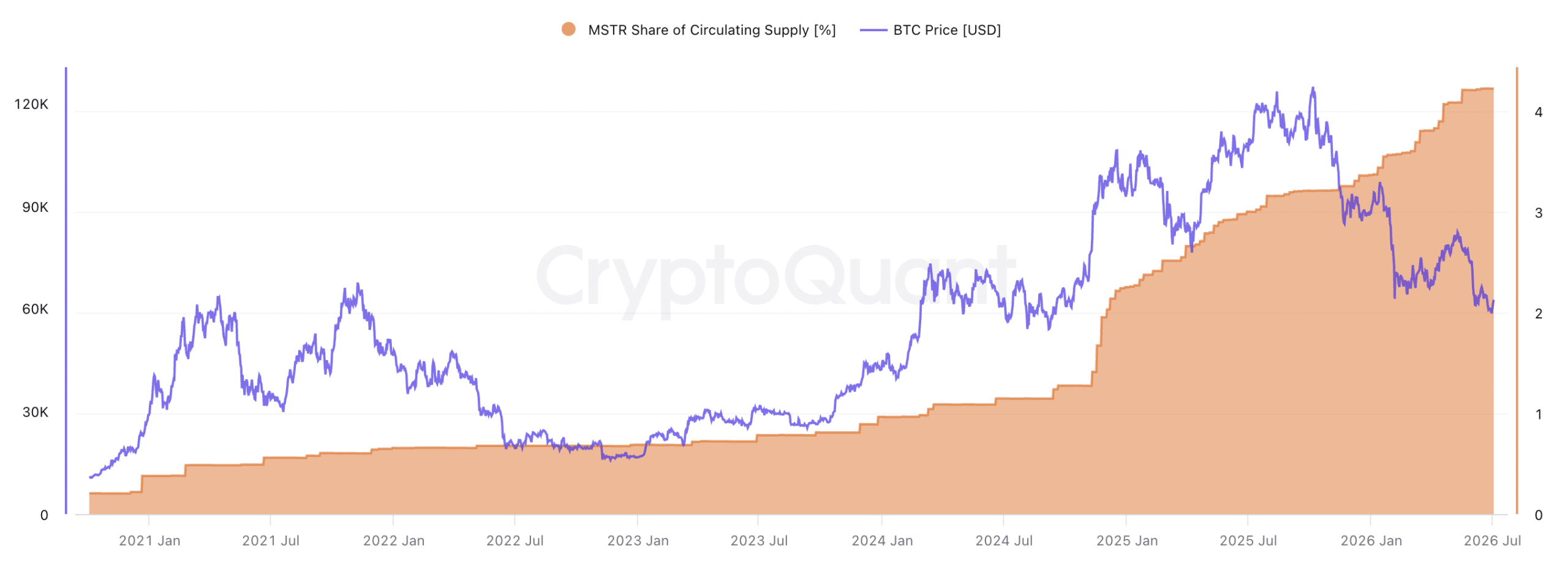
Source: CryptoQuant

The pace of purchases accelerated in late 2024, with the company continuing to buy even as Bitcoin traded near record highs and later corrected. In contrast, Bitcoin’s price experienced significant volatility, reaching new highs before pulling back multiple times.


Final Summary

  • Saylor argues that this time, Bitcoin’s halving events will no longer be the primary driver of its price.
  • Despite highlighting the risks surrounding Bitcoin, Saylor is eyeing an optimistic future for Bitcoin.


Trending Cryptos

Related Questions

QAccording to Michael Saylor, where will Bitcoin's most significant evolution over the next decade primarily come from?

AAccording to Michael Saylor, Bitcoin's greatest evolution over the next decade will come from changing less at the protocol layer and mattering more everywhere else, driven by the sharp growth of the surrounding financial ecosystem.

QWhat does Michael Saylor believe will drive Bitcoin's future growth instead of retail buyers?

AHe believes Bitcoin's future growth will be driven by large-scale capital inflows from institutional sources such as spot ETFs, corporate treasuries, sovereign wealth funds, banks, pension funds, insurance companies, derivatives markets, and other financial institutions.

QWhat potential risk regarding 'paper Bitcoin' does Michael Saylor caution about?

AHe cautions about the risk of financial institutions issuing more claims to Bitcoin than they actually possess, which could lead to liquidity crises similar to those seen in traditional finance.

QBy 2036, what are Michael Saylor's expectations for Bitcoin?

ABy 2036, Saylor expects Bitcoin to be more widely held, more deeply institutionalized, more politically important, more financially integrated, and more fiercely defended.

QHow did the percentage of Bitcoin's circulating supply held by Saylor's company, MicroStrategy, change between 2021 and mid-2026?

AMicroStrategy's Bitcoin holdings grew from less than 1% of the circulating supply in 2021 to over 4% by mid-2026, reflecting an aggressive accumulation strategy.

Related Reads

Fed Research: Crypto Investors Driven by Beliefs, Returns Change Their Decisions

A new working paper from the Federal Reserve Bank of Cleveland provides a novel explanation for cryptocurrency's divergence from traditional financial assets. It finds that American crypto investors are distinguished not by demographics or risk tolerance alone, but by their radically different beliefs about future returns. This divergence in expectations better explains who owns crypto than factors like age or income, a reversal of the pattern seen with stocks or bonds. The research, based on surveys of up to 25,000 US households, shows crypto owners expected an average 22% annual return, compared to just 7% for non-owners. A one-percentage-point increase in an individual's expected return was linked to a 0.8-point rise in ownership likelihood. A randomized experiment revealed that simply showing information about Bitcoin's past 12-month performance increased respondents' desired crypto portfolio share by about 47% and spurred subsequent purchases, primarily among those who previously felt uninformed. The study suggests this dynamic—where past gains attract new buyers, pushing prices higher and reinforcing bullish beliefs—could fuel speculative bubbles. It also indicates crypto wealth gains are treated more like "gambling winnings" than permanent income, boosting purchases of durable goods but not everyday spending. The broader conclusion is that crypto volatility stems partly from investor disagreement and learning, not just market fundamentals. With widespread misunderstanding and shifting expectations driven by performance data, price swings are likely to remain a defining feature of the asset class. Future retail demand may depend not just on Bitcoin's price, but on what information investors receive about its past performance.

cryptonews.ru22m ago

Fed Research: Crypto Investors Driven by Beliefs, Returns Change Their Decisions

cryptonews.ru22m ago

Trading

Spot

Hot Articles

Discussions

Welcome to the HTX Community. Here, you can stay informed about the latest platform developments and gain access to professional market insights. Users' opinions on the price of S (S) are presented below.

活动图片