Bitcoin’s back above $94K: Is the BTC bull run back on?

cointelegraphPublished on 2025-12-09Last updated on 2025-12-09

Abstract

Bitcoin has reclaimed the $94,000 level, signaling a potential return of the bullish trend despite underlying liquidity concerns. The price broke through key resistance at $93,500, reinforcing short-term upward momentum ahead of the FOMC meeting. However, liquidity metrics remain subdued, with the bid-ask ratio showing weaker buyer participation compared to previous rallies. While U.S. investors show modest accumulation signs, retail enthusiasm—particularly in Korean markets—has cooled. The market awaits further confirmation of a sustained trend reversal post-FOMC.

Bitcoin (BTC) bulls appear to be back in control of the short-term trend, pushing the BTC price above $94,000, despite underlying liquidity indicators raising a red flag.

Key takeaways:

  • Bitcoin has reclaimed $94,000, strengthening the short-term bullish structure after a few days of indecision.

  • Bid-ask liquidity remained muted despite the breakout, indicating that buyers are stepping in but not yet in sufficient size.

Bitcoin maintains uptrend ahead of FOMC meeting

Bitcoin struggled to secure a decisive daily close above $93,000 following the initial break in structure on Dec. 3. With the broader market bracing for the upcoming FOMC meeting, traders had largely adopted a wait-and-see stance, resulting in a few days of sideways consolidation.

That changed on Tuesday as BTC pushed cleanly through $93,500, producing the higher high needed to restore short-term bullish momentum.
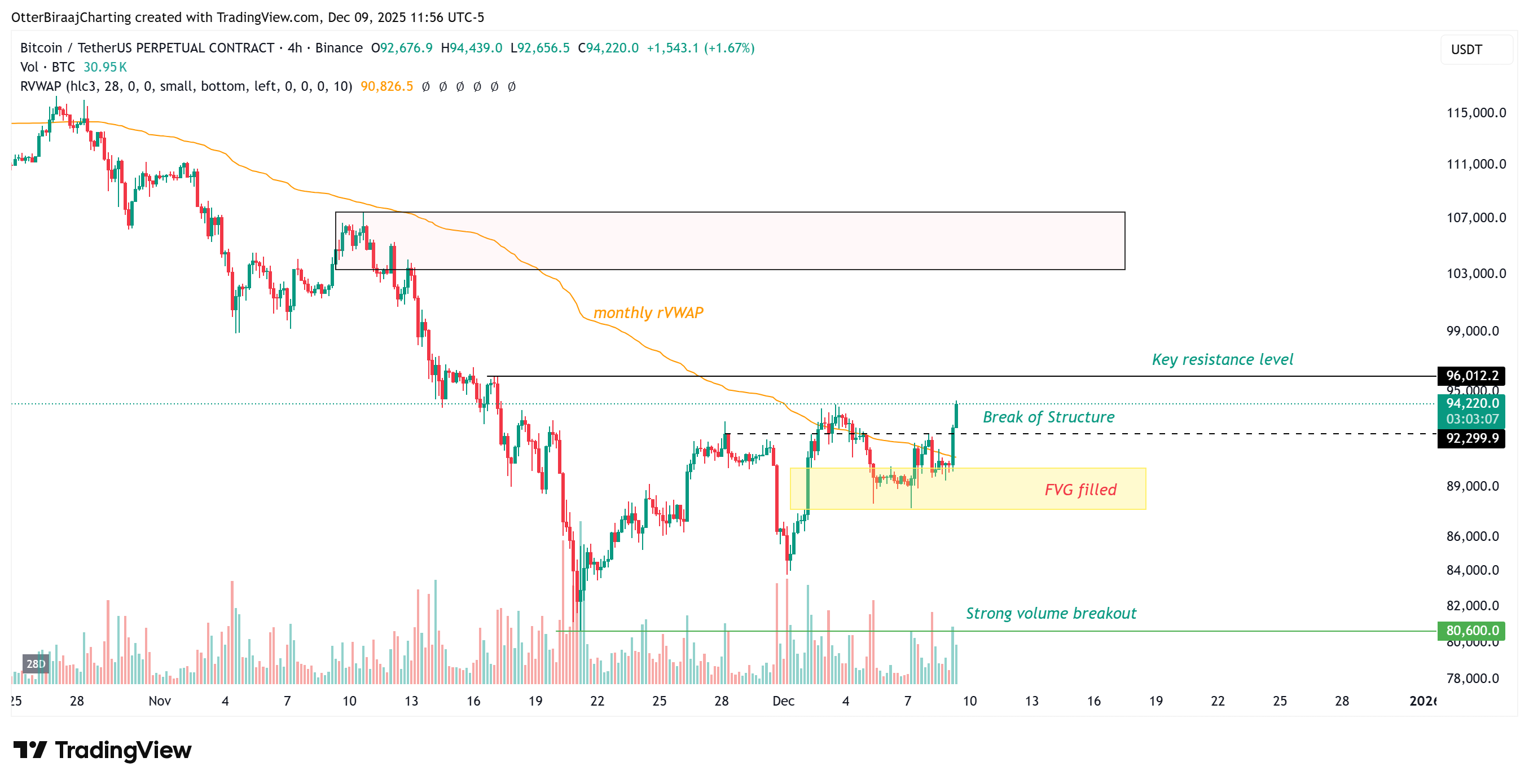
Bitcoin four-hour chart. Source: Cointelegraph/TradingView

On the four-hour chart, BTC had previously absorbed the entire fair value gap (FVG) between $87,500 and $90,000, but was unable to trigger a follow-up impulse. The latest breakout invalidated that hesitation and signals renewed strength despite the volatility of macroeconomic events.

Even with the upside shift, BTC still traded near the monthly VWAP (volume-weighted average price) on both the four-hour and one-day timeframes. A sustained hold above the monthly VWAP following the FOMC would further confirm a momentum-backed trend reversal.

Trader Jelle, reflecting on recent sideways movement, noted:

“Pretty boring day so far, with $BTC still chopping around the monthly open... Watch for a lower low below 87.6 or a clean break of the grey box at 93k.”

With $93,000 now cleared ahead of the FOMC event, market bias leans toward the upside, though traders may remain sensitive to any post-meeting volatility.

Related: Bitcoin retail inflows to Binance ‘collapse’ to 400 BTC record low in 2025

Bitcoin price rallies but liquidity remains in question

Despite Bitcoin’s bullish price shift, liquidity metrics are not yet flashing full confidence. Bitcoin’s bid-ask ratio has stayed relatively low and inconsistent. During November’s steep drop from $100,000 to $80,000, the ratio turned positive as large bids absorbed the sell-off. But the current rebound has not shown the same aggressive bidding, implying that the move above $93,500 is price-led, with new demand still catching up.
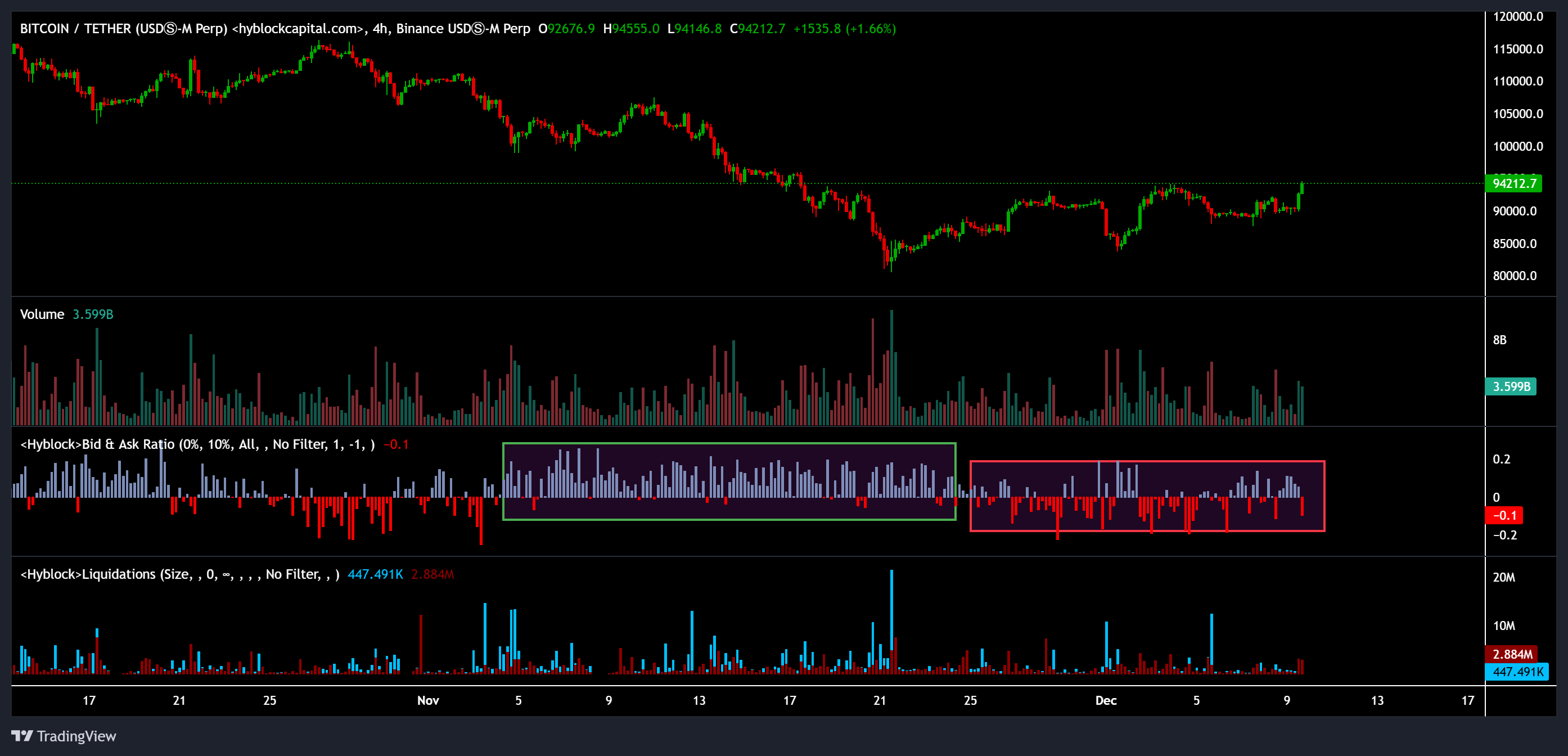
Bitcoin bia-ask ratio and liquidation data analysis. Source: Hyblock

This underscored a market where buyers are acting, but not in the heavy, committed clusters typical of strong uptrends. For now, price strength outpaces depth strength.

Bitcoin’s exchange pricing premium data revealed an equally nuanced story.

The Korea Premium Index, a key gauge of retail sentiment, has cooled sharply. Earlier this year, Korean markets regularly traded at premiums during rallies; however, that enthusiasm has since faded to near-flat or slightly negative territory, a sign that retail speculators are not yet chasing the move.

Meanwhile, the Coinbase Premium Index, a proxy for US investors, has turned positive again. Historically, modest positive readings point toward spot accumulation during early-stage trend reversals.

Related: Bitcoin Hash Ribbons flash ‘buy’ signal at $90K: Will BTC price rebound?

This article does not contain investment advice or recommendations. Every investment and trading move involves risk, and readers should conduct their own research when making a decision.


Trending Cryptos

Related Reads

2026 Mid-Year Report On-Chain RWA: Tokenized Stock Market Cap Doubles in a Year, But 90% of Rights Are Hollow Shells

The 2026 Mid-Year Report on On-Chain RWA highlights a significant growth in tokenized stock market capitalization, which nearly doubled from $951 million in March to $1.89 billion by July. However, the report reveals a fundamental contradiction in this "layer 2.5" ecosystem: products with the strongest legal foundation (like regulated U.S. infrastructure) lack liquidity and distribution, while freely tradable offshored wrapper products often lack substantive ownership rights. The increase is driven largely by a few products (SECZ, FGRS, STRCx) and platforms (Ondo, xStocks, Securitize collectively hold over 85% share). While distributed value across networks like Ethereum, Solana, and BNB Chain has grown, the market remains fragmented. Products referencing the same underlying asset (e.g., Apple stock) are distinct legal liabilities with different intermediaries and jurisdictional rules, offering varying degrees of legal claim. The report cautions that headline numbers are misleading, as they reflect changes in distributed token value—driven by issuance, conversions, and price movements—not pure investor inflows. True "canonical shares" with legal ownership, wide wallet distribution, institutional liquidity, and independent on-chain price discovery do not yet exist at scale. Tokenized treasuries show stronger product-market fit, and ETFs may be easier to scale than single stocks. The core takeaway is a trade-off: legal certainty versus liquidity and composability.

marsbit49m ago

2026 Mid-Year Report On-Chain RWA: Tokenized Stock Market Cap Doubles in a Year, But 90% of Rights Are Hollow Shells

marsbit49m ago

Coldcard Hardware Wallet Hacked: 594 Bitcoin Withdrawn in 25 Minutes

The Coldcard hardware wallet has been compromised, with hackers stealing approximately 594.5 Bitcoin (~$40 million) from 500 addresses in just 25 minutes. The root cause was a critical software bug, undetected for five years, which disabled the device's secure chip for generating true random numbers. This led to the creation of private keys based on predictable data like the processor's serial number, drastically reducing cryptographic security. The attackers exploited this offline by brute-forcing possible seed phrases, finding active addresses on the public ledger, and signing transactions. Initially, Coinkite (Coldcard's maker) claimed only older models were at risk but later admitted all devices running the compromised firmware were vulnerable. CEO Rodolphe Novak (NVK) apologized but ruled out financial compensation for affected users. To secure funds, owners must urgently update their firmware to specific safe versions, generate a completely new seed phrase on the updated device, and transfer all assets to new addresses created with that new seed. While a BIP-39 passphrase can help, it does not replace this migration process. Other Coinkite products like TAPSIGNER were not affected. This incident underscores that even specialized hardware requires rigorous, independent code audits, especially for cryptographic functions. It parallels past failures, like a 2006 OpenSSL bug in Debian, and raises questions about whether automated code analysis can ever fully replace human scrutiny in critical security areas.

cryptonews.ru3h ago

Coldcard Hardware Wallet Hacked: 594 Bitcoin Withdrawn in 25 Minutes

cryptonews.ru3h ago

Trading

Spot

Hot Articles

Discussions

Welcome to the HTX Community. Here, you can stay informed about the latest platform developments and gain access to professional market insights. Users' opinions on the price of S (S) are presented below.

活动图片