Bitcoiners push for quantum-resistant BIP-360 upgrade as debate heats up

cointelegraphPublished on 2025-12-18Last updated on 2025-12-18

Abstract

A group of Bitcoin advocates and fund managers is urging the network to accelerate the adoption of quantum-resistant cryptography, citing BIP-360 as a potential solution. Proponents like Charles Edwards of Capriole warn that a significant portion of Bitcoin could be vulnerable to quantum attacks within years and argue for a migration deadline by 2028. However, critics including Adam Back of Blockstream dismiss these concerns as premature, stating quantum threats are “decades away” and emphasizing that Bitcoin doesn’t rely on encryption vulnerable to near-term quantum breaks. Debate continues as Taproot adoption declines, possibly reflecting user anxiety, while alternative quantum-resistant signature schemes like hash-based proposals from Blockstream Research gain attention.

A small but growing group of Bitcoin advocates and crypto fund managers is urging the network to accelerate work on quantum-resistant signatures, arguing that the perception of a future “quantum threat” could become a market risk long before it becomes a practical one.

Some supporters are pointing to a draft Bitcoin Improvement Proposal known as BIP-360, which would introduce a post-quantum signature option for Bitcoin addresses that could be vulnerable to future advances in quantum computing.

The implementation must be finalized and deployed in 2026, said Charles Edwards, the founder of quantitative Bitcoin (BTC) and digital asset fund Capriole.

However, the implementation of the new standard would require wider consensus among hardware wallet providers, node operators and cryptocurrency exchanges, added Capriole in a Thursday X post. Around “20-30% of Bitcoin will be taken by a quantum hacker in the next few years,” Edwards said. “I believe we should burn all coins that do not migrate to BIP-360 by 2028.”
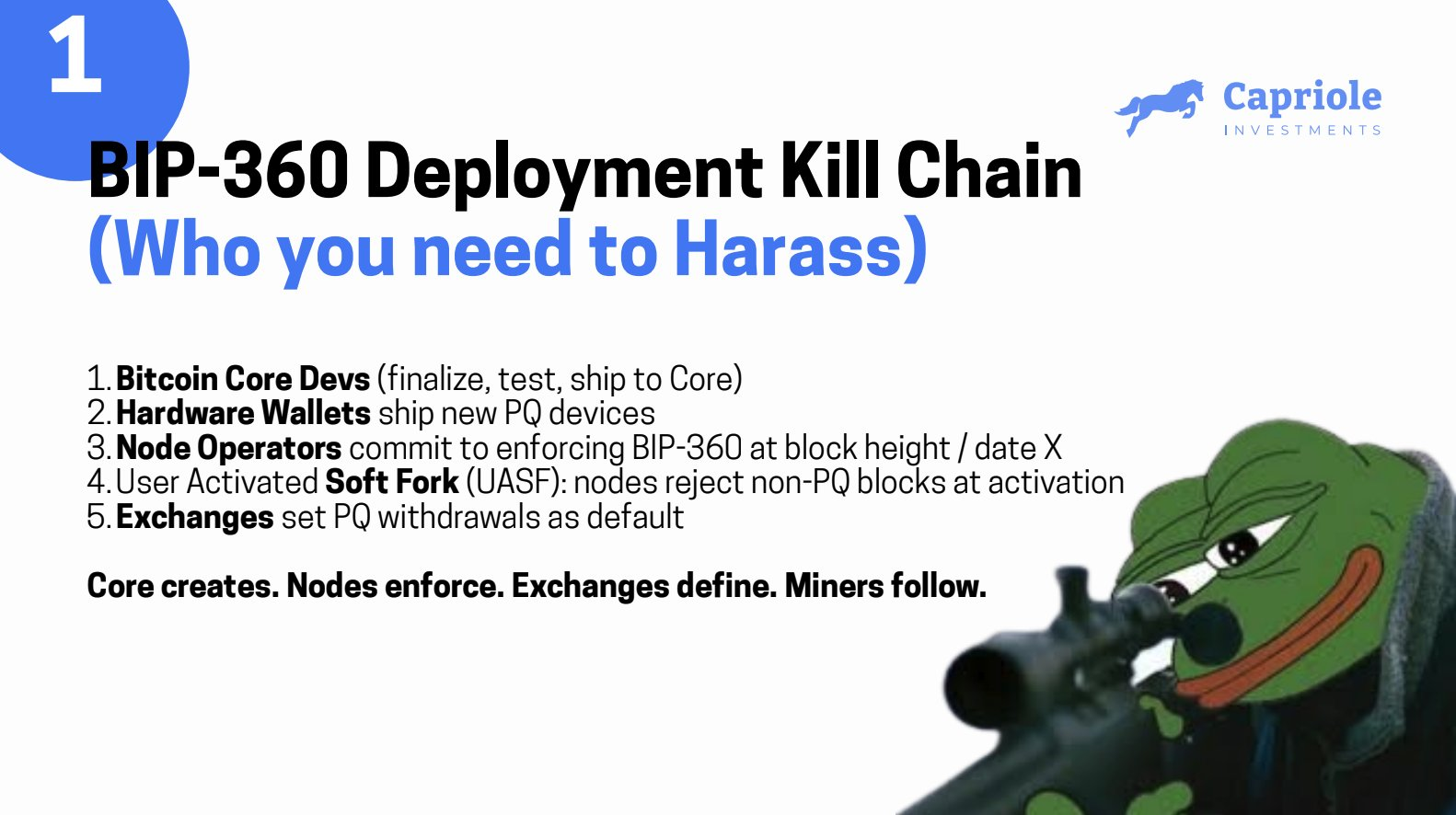
Source: Charles Edwards

Related: Bitcoin treasuries stall in Q4, but largest holders keep stacking sats

However, other industry watchers see quantum computing as a short-term risk for Bitcoin’s price.

“Pro-tip for quantum FUD promoters. Bitcoin does not use encryption. Get your basics right, or it’s a tell,” wrote Adam Back, co-founder and CEO of Blockstream, and the inventor of Hashcash, in a Thursday X post, adding that the quantum computing threat is still “decades away.”

Samson Mow, the CEO of Bitcoin technology company Jan3, also mocked the idea of early quantum computing threatening the Bitcoin network.

“Quantum computing can’t even factor 21, yet people are panic selling because they think it will kill Bitcoin,” wrote Mow in a Wednesday X post.

Related: Bitcoin investor loses retirement fund in AI-fueled romance scam

Taproot questions and competing proposals

Bitcoin’s latest Taproot format, which is perceived as quantum vulnerable, is declining in usage, from 42% of transactions in 2024 to just 20%, signaling that users may be worried about Bitcoin's quantum threat.
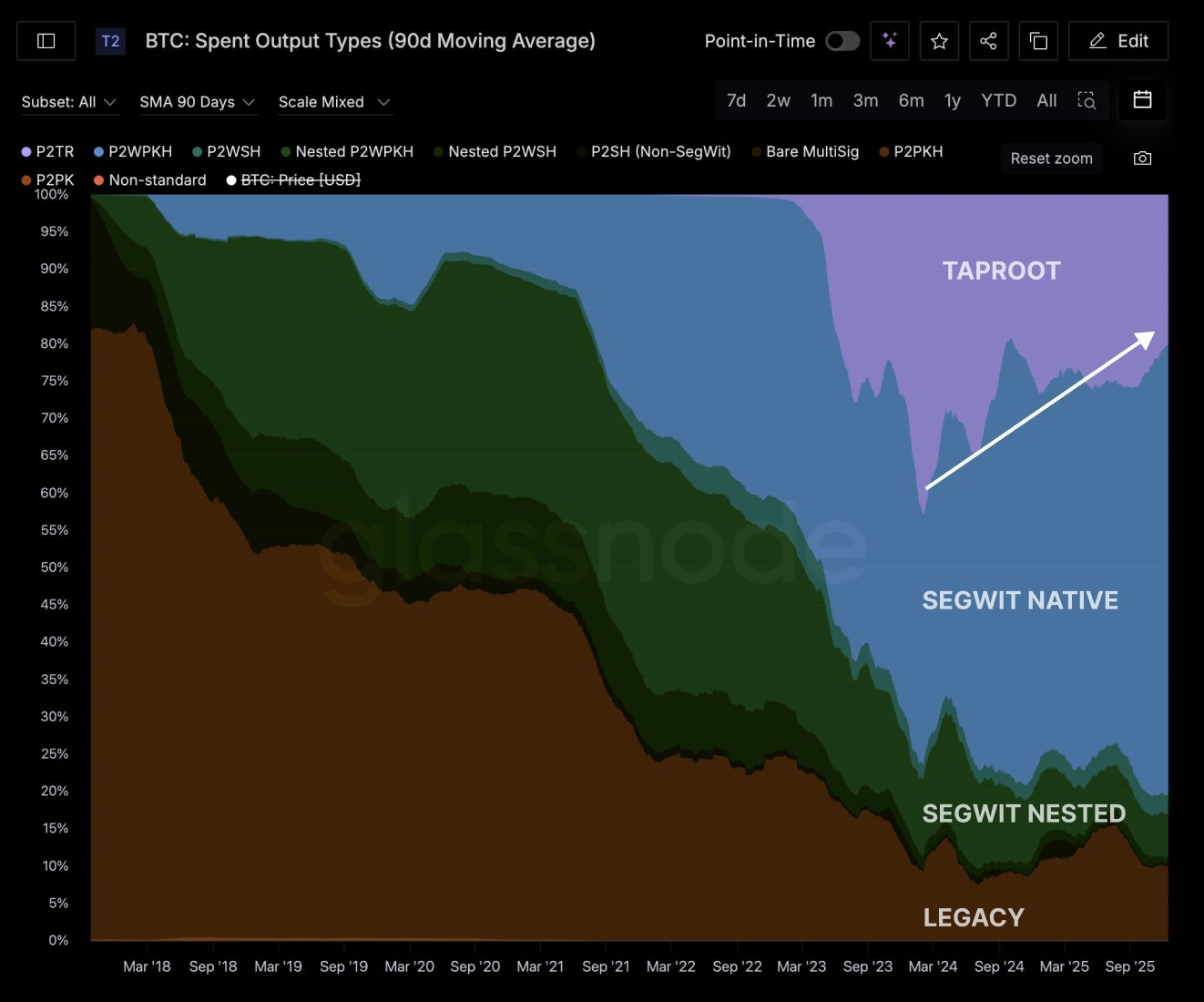
Source: Willy Woo

“I’ve NEVER seen the latest format losing adoption before. Taproot is Quantum Vulnerable, while older SegWit and Legacy are not,” wrote Bitcoin analyst Willy Woo, in a Wednesday X post.

Bitcoin’s Taproot update is the most important upgrade the cryptocurrency has experienced since 2017, when Segregated Witness (SegWit) was activated. Taproot aimed to upgrade the privacy and efficiency of the Bitcoin network.

Meanwhile, Back, one of the leading cryptographers, proposed a new hash-based signature scheme as a promising post-quantum alternative for Bitcoin, where security would rely solely on hash function assumptions similar to the ones currently used in the Bitcoin network’s design.
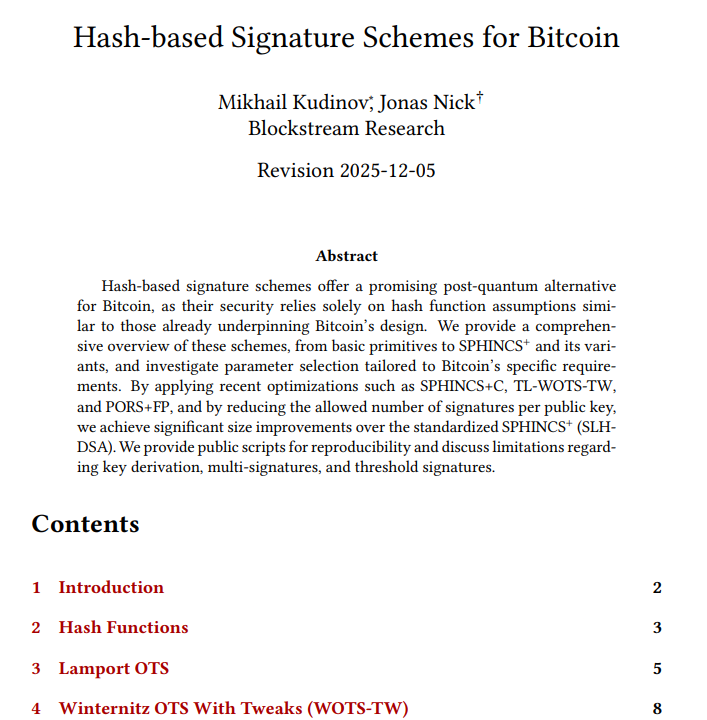
Hash-based signature schemes for Bitcoin, research paper. Source: Blockstream Research

Hash-based signature schemes like ECDSA and Schnorr signatures “offer a promising path for securing Bitcoin in a post-quantum world,” according to the paper released by Back’s Blockstream Research on Dec. 5.

The Elliptic Curve Digital Signature Algorithm (ECDSA) uses elliptic-curve cryptography to verify the authenticity and integrity of a message. Schnorr signatures are another signature scheme praised for enhancing privacy and reducing data size, due to their ability to combine multiple signatures into one.

Magazine: Bitcoin vs. the quantum computer threat — Timeline and solutions (2025–2035)

Related Questions

QWhat is the main purpose of the proposed BIP-360 upgrade for Bitcoin?

AThe main purpose of the proposed BIP-360 upgrade is to introduce a post-quantum signature option for Bitcoin addresses, making them resistant to potential future attacks from advanced quantum computers.

QAccording to Charles Edwards, by when must the quantum-resistant implementation be deployed, and what is his proposal for non-migrated coins?

ACharles Edwards stated that the implementation must be finalized and deployed by 2026, and he proposed that all coins not migrated to BIP-360 by 2028 should be burned.

QWhy is Bitcoin's Taproot format considered a decline in usage significant, as noted by Willy Woo?

AThe decline in Taproot usage, from 42% of transactions in 2024 to just 20%, is significant because it is the first time a newer Bitcoin format has lost adoption. This signals that users may be concerned about Taproot's vulnerability to quantum threats, unlike older SegWit and Legacy formats.

QWhat alternative post-quantum solution did Adam Back and Blockstream Research propose for Bitcoin?

AAdam Back and Blockstream Research proposed a new hash-based signature scheme as a post-quantum alternative. This scheme's security relies solely on hash function assumptions, similar to those already used in Bitcoin's design, with ECDSA and Schnorr signatures being highlighted as promising paths.

QWhat are the differing views on the immediacy of the quantum computing threat to Bitcoin, as presented in the article?

AThe article presents differing views: Charles Edwards and others see it as a near-term market risk, urging immediate action. In contrast, Adam Back and Samson Mow consider the quantum threat to be decades away or currently insignificant, with Mow mocking the idea that quantum computing, which 'can't even factor 21,' is a reason for panic selling.

Related Reads

First Batch of Keynote Speakers and Partners Announced! Web2+3 Summit: Defining the Next Generation of Digital Economy

Web2+3 Summit: Defining the Next Generation of Digital Economy The 6th BEYOND International Technology Innovation Expo (BEYOND Expo 2026), Asia's largest tech and ecosystem exhibition, is launching a dedicated Web2+3 stage for the first time. Co-hosted by BEYOND Expo and ChainNeXT Group, the Web3 Summit will take place from May 28–30, 2026. Against the backdrop of accelerating global tech integration, the boundaries between Web2 and Web3 are rapidly blurring. With clearer global regulations for blockchain-driven internet (Web3) and the special issuance of a Hong Kong dollar stable币 license by the Hong Kong SAR government on April 10, 2026, Web3's decentralized principles are quickly merging with traditional industries (Web2) such as e-commerce, finance, and artificial intelligence. Focused on blockchain-driven digital economy elements, the summit will center on three core principles—implementability, commercial viability, and compliance. It will bring together top Web3 experts to discuss key integration areas like stablecoin payment finance (PayFi), real-world asset tokenization (RWA), and decentralized AI (DeAI), unveiling new opportunities for industrial innovation. The first wave of confirmed speakers includes Jack Kong (Director of Hong Kong Cyberport, Chairman of Nano Labs), Yat Siu (Chairman of Animoca Brands), Michael Wu (Co-founder & CEO of Amber Group), Michael Heinrich (Co-founder & CEO of 0G), and Art Abal (Co-founder of Vana). More Web3 ecosystem pioneers, AI, and fintech experts will be announced soon. Core forum topics include: - Web2+DeAI: New AI Paradigms Driven by Decentralized Infrastructure - Web2+RWA: Real-World Asset Tokenization and Global Liquidity - Web2+PayFi: Cross-Border Payments and Financial Innovation Powered by Crypto Infrastructure - Web2+3 AI: Autonomous Agents and the Crypto Economy - Web2+3 Wealth: On-Chain and Off-Chain Integrated Investment Ecosystems - Web2+3 Commerce: A New Landscape for Global Trade Driven by Stablecoins Additional agenda details will be released in the near future.

marsbit1h ago

First Batch of Keynote Speakers and Partners Announced! Web2+3 Summit: Defining the Next Generation of Digital Economy

marsbit1h ago

Trading

Spot
Futures

Hot Articles

How to Buy PUSH

Welcome to HTX.com! We've made purchasing Push Protocol (PUSH) simple and convenient. Follow our step-by-step guide to embark on your crypto journey.Step 1: Create Your HTX AccountUse your email or phone number to sign up for a free account on HTX. Experience a hassle-free registration journey and unlock all features.Get My AccountStep 2: Go to Buy Crypto and Choose Your Payment MethodCredit/Debit Card: Use your Visa or Mastercard to buy Push Protocol (PUSH) instantly.Balance: Use funds from your HTX account balance to trade seamlessly.Third Parties: We've added popular payment methods such as Google Pay and Apple Pay to enhance convenience.P2P: Trade directly with other users on HTX.Over-the-Counter (OTC): We offer tailor-made services and competitive exchange rates for traders.Step 3: Store Your Push Protocol (PUSH)After purchasing your Push Protocol (PUSH), store it in your HTX account. Alternatively, you can send it elsewhere via blockchain transfer or use it to trade other cryptocurrencies.Step 4: Trade Push Protocol (PUSH)Easily trade Push Protocol (PUSH) on HTX's spot market. Simply access your account, select your trading pair, execute your trades, and monitor in real-time. We offer a user-friendly experience for both beginners and seasoned traders.

3.3k Total ViewsPublished 2024.03.29Updated 2025.04.02

How to Buy PUSH

Discussions

Welcome to the HTX Community. Here, you can stay informed about the latest platform developments and gain access to professional market insights. Users' opinions on the price of PUSH (PUSH) are presented below.

活动图片