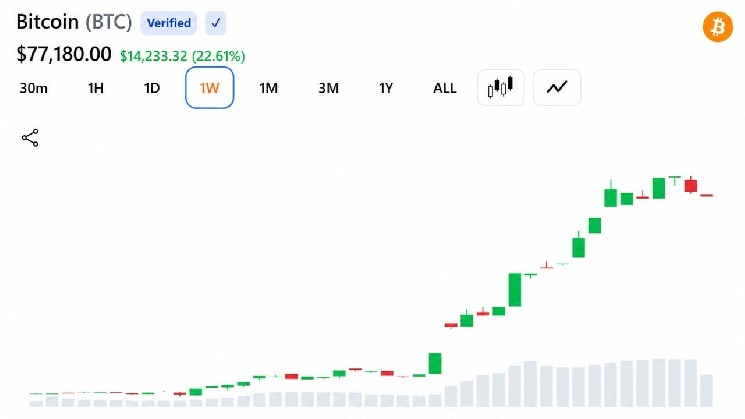
Bitcoin weekly RSI falls to the most oversold levels since $15K BTC price

cointelegraphPublished on 2025-12-19Last updated on 2025-12-19

Abstract

Bitcoin's weekly Relative Strength Index (RSI) has dropped to its most oversold level since early 2023, when BTC traded near $15,000–$17,000. The RSI reading of 35 suggests potential for a short-term bounce, though some caution that past oversold conditions were followed by further declines of up to 58%. On-chain data indicates Bitcoin is undervalued at current prices, with the NVT Golden Cross metric signaling structural undervaluation. Historically, such levels have preceded significant rallies, including a 350% surge after the 2022 bear market bottom. Analysts are divided on whether a rebound is imminent or if more downside is likely.

Bitcoin (BTC) traders expected a short-term bounce as a key BTC price metric sank to its lowest levels in almost three years. Data from Cointelegraph Markets Pro and TradingView revealed extremely “oversold” conditions on the BTC/USD relative strength index (RSI).

Key takeaways:

  • Bitcoin’s “most oversold” RSI, historically tied to major BTC price rallies, suggests a price reversal in the short term.

  • Bitcoin’s network value-to-transaction ratio shows it is undervalued at current levels.

BTC price dip sends RSI back to 2023

Bitcoin’s 36% drop to $80,500 on Nov. 21 from its all-time high of $126,000 has significantly impacted high-time frame RSI.

Related: Bitcoin rebounds on Japan rate hike as Arthur Hayes sees dollar at 200 yen

On the weekly chart, the RSI fell from local highs of 64 in September to 35 at the time of writing, levels last seen in January 2023 when Bitcoin traded around $15,500-$17,000.

“Historically, when the weekly RSI tags this level, it’s time to pay attention,” said analyst Jelle in an X post on Friday, adding:

“Either we’re close to a bottom, or we’re in for a lot more pain soon enough.”
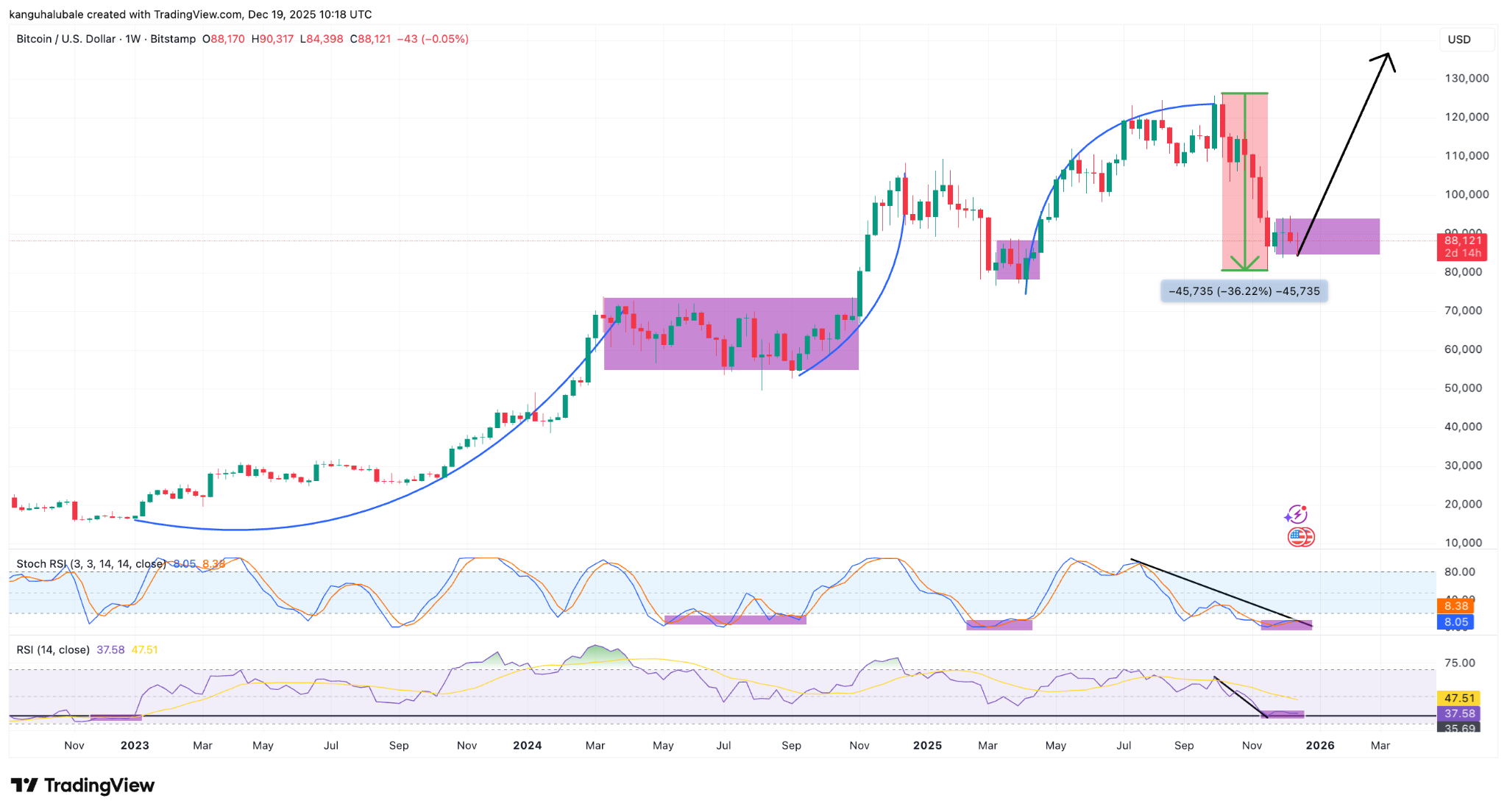
BTC/USD weekly chart. Source: Cointelegraph/TradingView

RSI measures trend strength and contains three key levels for observers: the 30 oversold boundary, the 50 midpoint and the 70 overbought threshold.

When the price crosses these levels, depending on the direction, traders can make inferences about the future of a given uptrend or downtrend. During bull markets, ETH regularly spends extended periods in overbought territory.

“Bitcoin looks the most oversold it’s been all cycle,” said Mister Crypto in a Friday X post, referring to the Stochastic RSI, also shown in the two-week chart below.

“A bounce is very likely.”
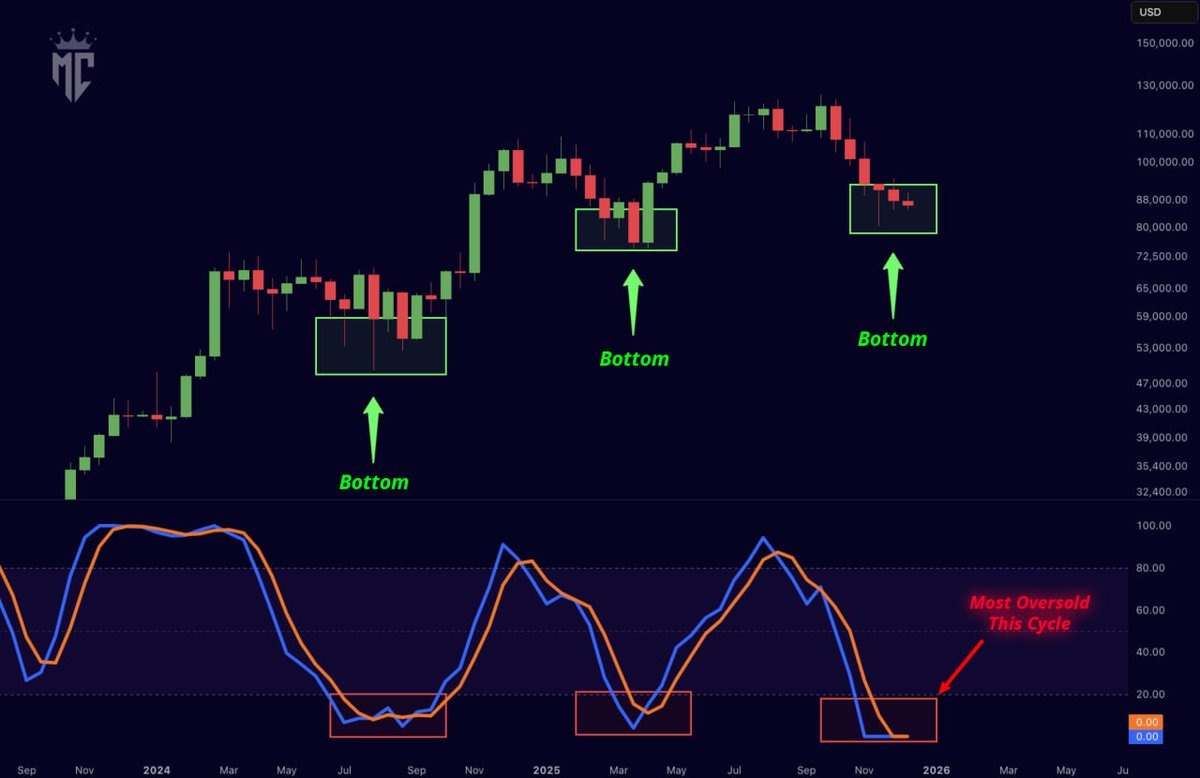
BTC/USD two-week chart. Source: Mister Crypto

Not all traders were quick to suggest that the BTC price was due for a relief bounce due to the overbought conditions.

“When $BTC was this oversold in 2018, it dumped another 49%. In 2022, it dumped another 58%,” said YouTuber Lark Davis in an X post, adding that Bitcoin could go another 40% lower.

“These bottoms can take way longer to form than you think, and they can bring more pain than you think.”

As Cointelegraph reported, a heavy concentration of liquidity clusters above the spot price supports the case of a possible short-term BTC/USD reversal.

Bitcoin is currently undervalued at $87,000

Onchain data provider CryptoQuant has explained how Bitcoin could currently be undervalued based on its network value to transaction (NVT), a metric that compares market cap to its actual network usage.

The chart below shows that Bitcoin’s NVT Golden Cross dropped to a historically depressed level near -0.6, “a zone that reflects a structural undervaluation of the network,” CryptoQuant analyst MorenoDV_ said in his latest Quicktake analysis.

The metric has increased slightly to -0.32 over the last few days, an indication that the price is beginning to realign with transaction-driven fundamentals after a sharp valuation discount.

However, “indicator remains in negative territory, meaning Bitcoin is still priced conservatively relative to its network utility,” the analyst said, adding:

“The present setup points to a market transitioning from deep undervaluation toward equilibrium, a phase historically associated with accumulation and structurally healthier price discovery.”
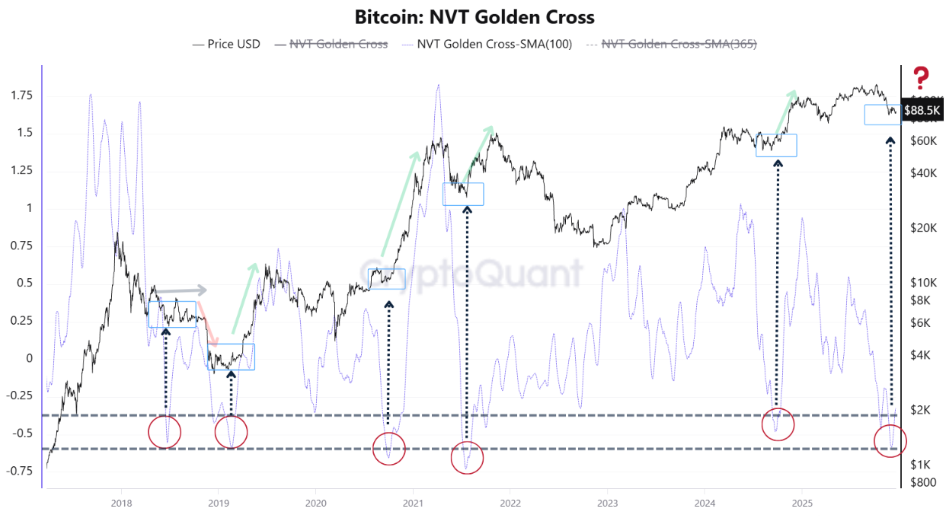
Bitcoin: NVT golden cross. Source: CryptoQuant

“Price is now recovering, but valuation is still discounted relative to usage,” said analyst CryptosRus in response to MorenoDV_ analysis, adding:

“That setup has only shown up a handful of times in Bitcoin’s history.”

Note that the last two times when the NVT Golden Cross reached such levels were in April 2025 and at the bottom of the 2022 bear market, preceding 60% and 350% BTC price rallies, respectively.

This article does not contain investment advice or recommendations. Every investment and trading move involves risk, and readers should conduct their own research when making a decision. While we strive to provide accurate and timely information, Cointelegraph does not guarantee the accuracy, completeness, or reliability of any information in this article. This article may contain forward-looking statements that are subject to risks and uncertainties. Cointelegraph will not be liable for any loss or damage arising from your reliance on this information.


Trending Cryptos

Related Questions

QWhat is the current weekly RSI level for Bitcoin and why is it significant?

AThe current weekly RSI for Bitcoin has fallen to 35, which is significant because it's the most oversold level since January 2023 when Bitcoin was trading around $15,500-$17,000. Historically, such oversold RSI levels have been tied to major price rallies.

QAccording to the article, what does the NVT Golden Cross metric suggest about Bitcoin's current valuation?

AThe NVT Golden Cross metric has dropped to a historically depressed level near -0.6, indicating that Bitcoin is structurally undervalued. Even after a slight recovery to -0.32, it remains in negative territory, suggesting Bitcoin is still priced conservatively relative to its network utility.

QWhat are the contrasting views among analysts regarding the oversold RSI conditions?

AAnalyst Jelle and Mister Crypto suggest that the oversold conditions indicate a potential bottom or a likely bounce. In contrast, YouTuber Lark Davis warns that historically, when it was this oversold in 2018 and 2022, Bitcoin dumped another 49% and 58% respectively, indicating potential for more pain and a longer bottom formation.

QHow much has Bitcoin's price dropped from its all-time high mentioned in the article?

ABitcoin's price has dropped 36% from its all-time high of $126,000 to $80,500 as of November 21st.

QWhat historical price rallies followed the last two times the NVT Golden Cross reached similar depressed levels?

AThe last two times the NVT Golden Cross reached such depressed levels were in April 2025 and at the bottom of the 2022 bear market, which preceded Bitcoin price rallies of 60% and 350% respectively.

Related Reads

Founder of Baixing.com: The Notion That Large Language Models Will Devour Everything, I Believe Half of It

Founder of Baixing.com: I Only Half-Believe the Saying “Large Language Models Will Devour Everything” Author: Wang Jianshuo, Founder of Baixing.com Many proclaim that large models are everything, but the author is skeptical. He argues that such sweeping claims often stem from a limited understanding of the future. Drawing parallels to past technologies like electricity and the internet—which were predicted to “devour everything” but didn’t—he suggests that large language models (LLMs) are better seen as a foundational base. Like electricity, this base is essential for modern development, but its real value emerges only when applied to specific scenarios through various “machines” or “tools” (e.g., Claude Code for programming, Claude Design for design). The author acknowledges that LLMs may indeed replace many existing software systems built on rigid rules, workflows, and forms (e.g., CRMs, SaaS tools), as these are precisely what LLMs excel at processing. However, he emphasizes that beyond software, elements like customer data, execution capabilities (e.g., booking a flight), trust, and physical-world interactions will not be “devoured.” Instead, he foresees that after streamlining existing software, LLMs will open up a larger space for innovative, next-generation applications. These new tools will likely feature fluid interfaces and rely less on fixed rules, unleashing greater creativity. The author cautions against short-sightedness, recalling how in 2004 many believed internet giants like Sina, Sohu, and NetEase would monopolize the market—only to be proven wrong by subsequent disruptions. In conclusion, while LLMs are a crucial foundation and a current focal point, the true mainstream of this wave lies in the diverse applications built atop them to solve concrete problems. The phrase “devour everything” is imprecise; the real opportunity lies in identifying and leveraging the areas where LLMs do bring transformative change.

marsbit13m ago

Founder of Baixing.com: The Notion That Large Language Models Will Devour Everything, I Believe Half of It

marsbit13m ago

Founder of Baixing.com: I Only Half Believe in the Notion that Large Language Models Devour Everything

The founder of Baixing Wang states that while large language models (LLMs) are an extremely important foundational technology—akin to electricity or the internet—he only "half believes" the notion that they will "consume everything." He argues that LLMs provide a base layer of intelligence, but real-world value and transformation come from integrating this intelligence into specific applications and devices designed for particular scenarios—like how electricity powers various appliances from washing machines to TVs. He agrees LLMs will likely consume or replace a significant portion of existing rule-based, workflow-driven software (e.g., many SaaS systems, CRMs), as these are precisely what LLMs excel at handling. However, numerous other elements—such as customer data, execution capabilities (e.g., booking a flight), trust, and physical-world interactions—will not be consumed. Wang emphasizes that after LLMs absorb certain software layers, they will open up a much larger space for innovation: new types of "streaming" software with less rigid interfaces, where fixed rules are managed by AI. This next wave of applications built on top of the stable LLM foundation is where the true mainstream opportunity lies. He cautions against the short-sightedness of declaring any technology as all-consuming, drawing parallels to past premature predictions about internet giants monopolizing the web. The key is to find opportunities within the areas LLMs do transform.

链捕手18m ago

Founder of Baixing.com: I Only Half Believe in the Notion that Large Language Models Devour Everything

链捕手18m ago

Trading

Spot

Hot Articles

What is $BITCOIN

DIGITAL GOLD ($BITCOIN): A Comprehensive Analysis Introduction to DIGITAL GOLD ($BITCOIN) DIGITAL GOLD ($BITCOIN) is a blockchain-based project operating on the Solana network, which aims to combine the characteristics of traditional precious metals with the innovation of decentralized technologies. While it shares a name with Bitcoin, often referred to as “digital gold” due to its perception as a store of value, DIGITAL GOLD is a separate token designed to create a unique ecosystem within the Web3 landscape. Its goal is to position itself as a viable alternative digital asset, although specifics regarding its applications and functionalities are still developing. What is DIGITAL GOLD ($BITCOIN)? DIGITAL GOLD ($BITCOIN) is a cryptocurrency token explicitly designed for use on the Solana blockchain. In contrast to Bitcoin, which provides a widely recognized value storage role, this token appears to focus on broader applications and characteristics. Notable aspects include: Blockchain Infrastructure: The token is built on the Solana blockchain, known for its capacity to handle high-speed and low-cost transactions. Supply Dynamics: DIGITAL GOLD has a maximum supply capped at 100 quadrillion tokens (100P $BITCOIN), although details regarding its circulating supply are currently undisclosed. Utility: While precise functionalities are not explicitly outlined, there are indications that the token could be utilized for various applications, potentially involving decentralized applications (dApps) or asset tokenization strategies. Who is the Creator of DIGITAL GOLD ($BITCOIN)? At present, the identity of the creators and development team behind DIGITAL GOLD ($BITCOIN) remains unknown. This situation is typical among many innovative projects within the blockchain space, particularly those aligning with decentralized finance and meme coin phenomena. While such anonymity may foster a community-driven culture, it intensifies concerns about governance and accountability. Who are the Investors of DIGITAL GOLD ($BITCOIN)? The available information indicates that DIGITAL GOLD ($BITCOIN) does not have any known institutional backers or prominent venture capital investments. The project seems to operate on a peer-to-peer model focused on community support and adoption rather than traditional funding routes. Its activity and liquidity are primarily situated on decentralized exchanges (DEXs), such as PumpSwap, rather than established centralized trading platforms, further highlighting its grassroots approach. How DIGITAL GOLD ($BITCOIN) Works The operational mechanics of DIGITAL GOLD ($BITCOIN) can be elaborated on based on its blockchain design and network attributes: Consensus Mechanism: By leveraging Solana’s unique proof-of-history (PoH) combined with a proof-of-stake (PoS) model, the project ensures efficient transaction validation contributing to the network's high performance. Tokenomics: While specific deflationary mechanisms have not been extensively detailed, the vast maximum token supply implies that it may cater to microtransactions or niche use cases that are still to be defined. Interoperability: There exists the potential for integration with Solana’s broader ecosystem, including various decentralized finance (DeFi) platforms. However, the details regarding specific integrations remain unspecified. Timeline of Key Events Here is a timeline that highlights significant milestones concerning DIGITAL GOLD ($BITCOIN): 2023: The initial deployment of the token occurs on the Solana blockchain, marked by its contract address. 2024: DIGITAL GOLD gains visibility as it becomes available for trading on decentralized exchanges like PumpSwap, allowing users to trade it against SOL. 2025: The project witnesses sporadic trading activity and potential interest in community-led engagements, although no noteworthy partnerships or technical advancements have been documented as of yet. Critical Analysis Strengths Scalability: The underlying Solana infrastructure supports high transaction volumes, which could enhance the utility of $BITCOIN in various transaction scenarios. Accessibility: The potential low trading price per token could attract retail investors, facilitating wider participation due to fractional ownership opportunities. Risks Lack of Transparency: The absence of publicly known backers, developers, or an audit process may yield skepticism regarding the project's sustainability and trustworthiness. Market Volatility: The trading activity is heavily reliant on speculative behavior, which can result in significant price volatility and uncertainty for investors. Conclusion DIGITAL GOLD ($BITCOIN) emerges as an intriguing yet ambiguous project within the rapidly evolving Solana ecosystem. While it attempts to leverage the “digital gold” narrative, its departure from Bitcoin's established role as a store of value underscores the need for a clearer differentiation of its intended utility and governance structure. Future acceptance and adoption will likely depend on addressing the current opacity and defining its operational and economic strategies more explicitly. Note: This report encompasses synthesised information available as of October 2023, and developments may have transpired beyond the research period.

656 Total ViewsPublished 2025.05.13Updated 2025.05.13

What is $BITCOIN

Discussions

Welcome to the HTX Community. Here, you can stay informed about the latest platform developments and gain access to professional market insights. Users' opinions on the price of BTC (BTC) are presented below.

活动图片