Bitcoin Treasury Firm Matador's $58M Share Sale Approved to Expand Holdings

cointelegraphPublished on 2025-12-24Last updated on 2025-12-24

Abstract

Matador Technologies has received regulatory approval from the Ontario Securities Commission to raise up to $58.4 million through a share sale. The funds will be used to expand its Bitcoin holdings, targeting 1,000 BTC by the end of 2026. Currently, the company holds 175 BTC, making it the 90th largest corporate Bitcoin holder. Despite the announcement, its stock fell 3.57%. Matador aims to eventually accumulate 1% of Bitcoin’s fixed supply, or roughly 210,000 BTC. The move reflects a broader trend of institutional Bitcoin adoption, though some companies have recently sold portions of their BTC reserves due to market pressures.

Bitcoin financial services firm Matador Technologies has been given the regulatory green light to sell up to 80 million Canadian dollars ($58.4 million) worth of company shares, which it will use to help reach its goal of owning 1,000 Bitcoin before the end of 2026.

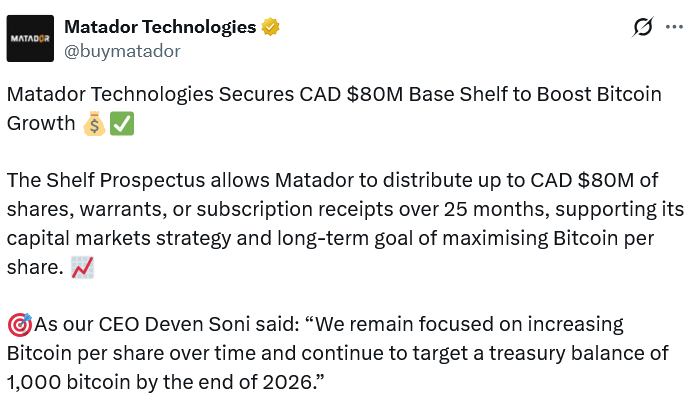
Matador said on Tuesday that the Ontario Securities Commission permitted it to issue $58.4 million worth of common shares, warrants, subscription receipts, debt securities, or units over a 25-month effective period.

Matador CEO Deven Soni said the firm is "focused on increasing Bitcoin per share over time and continue to target a treasury balance of 1,000 Bitcoin by the end of 2026."

Matador currently holds 175 Bitcoin (BTC) worth $15.3 million, making it the 90th largest corporate Bitcoin holder, BitcoinTreasuries.NET data shows.

Matador’s chief visionary, Mark Voss, said it would closely monitor Bitcoin’s volatility and navigate the current market cycle to deploy capital at the most opportune times.
Source: Matador Technologies


Shares in Matador (MATA) fell on the news, closing Tuesday down 3.57%.

More than 190 publicly traded companies now hold Bitcoin on their balance sheets, continuing the trend of institutional Bitcoin adoption after spot Bitcoin exchange-traded funds launched in the US last year.

However, many companies that adopted Bitcoin buying strategies have seen their share prices slide as crypto markets retraced and the initial hype faded, prompting some analysts to question the long-term sustainability of Bitcoin treasury strategies.

Related: IMF says El Salvador in talks to sell state-run Chivo Bitcoin wallet

Some corporate Bitcoin holders have begun selling portions of their Bitcoin reserves to meet balance-sheet obligations amid a tightening in market conditions.

Chip maker Sequans sold 970 BTC in early November to redeem outstanding convertible debt, backsliding on its goal to accumulate 100,000 BTC over the next five years.

Matador bought 175 BTC in first year of treasury

Matador builds products to help traditional finance firms enter the Bitcoin ecosystem and announced that it would become a Bitcoin treasury company a year ago, on Dec. 23, 2024.

In July, Matador said it plans to expand its targeted 1,000 BTC holdings by 2026 to 6,000 BTC before the end of 2027.

Its grand goal is to obtain 1% of Bitcoin’s fixed supply, which amounts to about 210,000 BTC.

Michael Saylor’s Strategy is the only corporate Bitcoin holder that has accumulated that amount to date.

Magazine: Quantum attacking Bitcoin would be a waste of time: Kevin O’Leary

Trending Cryptos

Related Questions

QWhat is the primary purpose of Matador Technologies' approved $58.4 million share sale?

AThe primary purpose is to raise capital to help the company reach its goal of owning 1,000 Bitcoin before the end of 2026.

QHow many Bitcoin does Matador currently hold, and what is its ranking among corporate holders?

AMatador currently holds 175 Bitcoin, making it the 90th largest corporate Bitcoin holder.

QWhat is Matador's long-term, 'grand goal' for its Bitcoin holdings?

AMatador's grand goal is to obtain 1% of Bitcoin's fixed supply, which amounts to approximately 210,000 BTC.

QHow did the market react to the news of Matador's approved share sale?

AShares in Matador (MATA) fell on the news, closing down 3.57%.

QAccording to the article, why have some corporate Bitcoin holders begun selling portions of their reserves?

ASome corporate Bitcoin holders have begun selling portions of their reserves to meet balance-sheet obligations amid a tightening in market conditions.

Related Reads

WEEX TradFi Trading Competition Kicks Off, 50,000 USDT Prize Pool First-Come, First-Served, Open a Position and Get 5 U

WEEX Exchange Launches "TradFi Trading Competition" with a 50,000 USDT Prize Pool Amidst a crypto market downturn, WEEX Exchange highlights the growth of tokenized traditional finance (TradFi) assets as a key trend, allowing users to trade stocks, ETFs, and commodities using crypto. The platform has launched a "TradFi Trading Competition" from July 9th to 23rd, featuring a 50,000 USDT prize pool. The campaign offers three reward tiers: 1. **New User Bonus (25,000 USDT pool):** New users depositing ≥100 USDT, completing a specified spot trade, and one TradFi contract trade (margin ≥10 USDT) receive 200 USDT. 2. **Volume-Based Rewards (20,000 USDT pool):** All users can earn tiered bonuses for achieving TradFi contract trading volumes of 5,000 USDT (3 USDT), 20,000 USDT (10 USDT), and 100,000 USDT (50 USDT). Rewards are stackable. 3. **Participation Reward:** Any user opening a TradFi contract trade during the event receives 5 USDT instantly. The article promotes WEEX's TradFi features, which include trading tokenized shares of companies like NVIDIA and Tesla using USDT, 24/7 trading, fractional share investing starting from $5, and high leverage up to 100x for hedging. It positions these features as solutions to traditional investing barriers like high fees, strict trading hours, and high share prices. The summary concludes by encouraging users to join the competition and leverage WEEX's platform to access global TradFi markets.

marsbit47m ago

WEEX TradFi Trading Competition Kicks Off, 50,000 USDT Prize Pool First-Come, First-Served, Open a Position and Get 5 U

marsbit47m ago

Switching Chains for Another Shot at Success: Can It Really 'Change One's Destiny'?

Recent months have witnessed a wave of established blockchain projects migrating to new public chains, notably Base and Arbitrum, coupled with strategic pivots in their business models—essentially "re-starting" elsewhere. Examples include Sophon (moving from ZKsync to Base to cut $3M+ annual costs and focus on consumer apps), Moonbeam (shifting from Polkadot to Base to pursue decentralized AI), and Secret Network (planning a move from Cosmos to Arbitrum to explore privacy-AI integrations, though its token price plunged 30% post-announcement). A common thread is that these migrating projects are primarily layer-1 or layer-2 chains now seeking relevance in AI and real-world consumer applications. This trend highlights the relative stagnation of ecosystems like Polkadot and Cosmos, which are seeing significant outflows. However, the community remains skeptical about whether such chain-hopping truly enables a turnaround. Historical cases like y00ts NFTs (which moved from Solana to Polygon and back to Ethereum) and Synthetix (which retreated from a multi-chain strategy) show that migration often fails to deliver expected benefits and can add complexity. In today's more rational market, devoid of easy narrative or airdrop红利, simply changing chains is unlikely to be a silver bullet. For both migrating projects and destination chains, the real challenge lies not in attracting projects but in developing actual use cases that retain users.

marsbit51m ago

Switching Chains for Another Shot at Success: Can It Really 'Change One's Destiny'?

marsbit51m ago

Does Switching Chains to Re-entrepreneur Really "Change One's Destiny"?

Amid a recent wave of blockchain migrations, several established projects, including Sophon, Moonbeam, and Secret Network, are moving to new ecosystems like Base and Arbitrum. Unlike past migrations driven by hype or security, these moves are often accompanied by strategic pivots, such as shifting focus to consumer applications, AI, or privacy-AI integration, effectively representing a "re-startup" attempt. However, the crypto community has reacted cautiously. Following Secret Network's announcement of its planned migration to Arbitrum, its token price plummeted over 30% in 24 hours. While migrating to more cost-efficient, higher-traffic, or technologically suitable chains can be a pragmatic choice, history shows that such moves rarely guarantee success. Examples like the y00ts NFT project, which moved from Solana to Polygon and then to Ethereum, or Synthetix’s retreat from a multi-chain strategy, illustrate the challenges and often underwhelming results. The current market environment, characterized by greater user rationality and the partial validation of past narratives, makes a successful "pivot via migration" even more difficult. Simultaneously, destination chains themselves face challenges in demonstrating sustainable user adoption beyond merely attracting migrating projects. Ultimately, the competition is shifting from which chain can onboard the most projects to which can genuinely foster real-world application and retain users.

链捕手56m ago

Does Switching Chains to Re-entrepreneur Really "Change One's Destiny"?

链捕手56m ago

June Transaction Volume Doubles: x402 Ecosystem Continues to Expand, Content Monetization Narrative Faces Crucial Test

X402, a protocol for AI and data services, experienced significant growth in June. Its transaction volume doubled compared to May, primarily driven by the AI inference routing service BlockRun. The ecosystem expanded with new integrations: Apify enabled data scraping services, Exa extended its AI search to Solana, and Seal launched 'Hacks', a marketplace for automated AI agents. The protocol itself received crucial upgrades, including 'Builder Codes' for tracking and affiliate systems and 'Batch Settlement' to enable practical micropayments for high-frequency AI tasks. Major external validation came from tech giants. Amazon Web Services (AWS) launched a solution for AI traffic metering at its edge nodes. More significantly, Cloudflare opened its waitlist for a Content Monetization Gateway. This gateway allows websites to charge AI bots and other automated agents for accessing content, using x402 for stablecoin payments. This addresses a core internet monetization problem and represents x402's most promising path to mass adoption, though Cloudflare's CEO noted current blockchain scalability remains a critical hurdle. Current leading use cases are AI inference routing and paid data feeds. However, the large-scale real-world test with Cloudflare's gateway will be decisive in determining if x402 can transition from a useful tool to a fundamental infrastructure component for a new web economy where AI agents pay for the content they consume.

Foresight News1h ago

June Transaction Volume Doubles: x402 Ecosystem Continues to Expand, Content Monetization Narrative Faces Crucial Test

Foresight News1h ago

Trading

Spot

Hot Articles

Discussions

Welcome to the HTX Community. Here, you can stay informed about the latest platform developments and gain access to professional market insights. Users' opinions on the price of S (S) are presented below.

活动图片