Autor: CryptoSlate
Compilación: TechFlow de Shenchao
Enlace original: https://cryptoslate.com/bitcoin-rocketed-15-to-get-back-above-70000-but-the-options-market-is-currently-pricing-in-a-terrifying-new-floor/
Guía de lectura de Shenchao:
Después de un violento rebote de 60.000 a 70.000 dólares en 24 horas, Bitcoin parece haber recuperado el terreno perdido, pero la lógica subyacente muestra que esto no se debió a una firme compra al contado, sino a un reequilibrio forzado de posiciones y a un squeeze de posiciones cortas provocado por la recuperación del mercado macro. Este artículo analiza en profundidad las causas de esta "convulsión aterradora" a principios de febrero de 2026: desde las expectativas de contracción de liquidez tras el nombramiento de Kevin Warsh por Trump, hasta la presión sobre los mineros que alcanzaron mínimos históricos de rentabilidad. Aunque el precio ha vuelto a superar los 70.000 dólares, los operadores de opciones están apostando fuertemente a una posible segunda caída a 50.000-60.000 dólares a finales de febrero, revelando la frágil emoción del mercado y la complejo juego financiero subyacente bajo la apariencia de un "rebote violento".
Bitcoin se disparó desde los 60.000 dólares hasta superar los 70.000 en menos de 24 horas, borrando la brutal caída del 14% que había puesto a prueba todas las teorías de "compra en mínimos" del mercado.
La velocidad de esta reversión —un rebote del 12% en un día y un 17% desde el mínimo intradía— fue lo suficientemente violenta como para dar la sensación de que se trataba del polvo asentado tras una liquidación. Sin embargo, el mecanismo detrás del rebote cuenta otra historia: fue más una combinación de estabilización entre activos y un reequilibrio forzado de posiciones, que una demanda al contado masiva impulsada por la convicción.
Mientras tanto, el mercado de derivados sigue estando lleno de posiciones de protección bajistas, cuya fijación de precios sugiere que los 70.000 dólares podrían ser sólo una estación de paso, y no un verdadero suelo.
Oleada de liquidaciones frente a presión macro
El 5 de febrero, el mercado abrió alrededor de 73.100 dólares, subió brevemente y luego se desplomó, cerrando en 62.600 dólares. Según datos de CoinGlass, la caída intradía resultó en la liquidación de aproximadamente 1.000 millones de dólares en posiciones apalancadas de Bitcoin.
Esta cifra por sí sola es suficiente para ilustrar el efecto dominó de las ventas forzadas, pero el panorama general era aún peor.
Los datos de CoinGlass muestran que el interés abierto (Open Interest) de los futuros de Bitcoin había caído desde unos 61.000 millones de dólares la semana anterior a 49.000 millones, lo que significa que el mercado ya había comenzado a desapalancarse antes de que llegara la última oleada de ventas.
El desencadenante no fue interno de las criptomonedas. Los informes de los medios calificaron esta venta como un empeoramiento del sentimiento de riesgo, impulsado principalmente por las ventas de acciones tecnológicas y la volatilidad de los metales preciosos: la plata cayó hasta un 18% a alrededor de 72,21 dólares, arrastrando consigo a todos los activos de riesgo relacionados.
La investigación de Deribit confirmó este efecto de contagio, señalando que el sentimiento en los derivados giró hacia un pesimismo extremo: tasas de financiación negativas, estructura temporal de volatilidad implícita invertida y el sesgo de reversión al riesgo (Risk-reversal skew) 25-delta压低 a aproximadamente -13%.
Este es un estado típico de "miedo extremo", en el que la disposición de las posiciones amplifica la volatilidad de los precios en ambas direcciones.
La narrativa de política económica añadió leña al fuego. Según Reuters, la reacción del mercado a la elección del presidente electo Donald Trump de Kevin Warsh como presidente de la Fed fue violenta, y los operadores lo interpretaron como una señal de futura contracción del balance y endurecimiento de la liquidez.
Mientras tanto, los mineros enfrentaban una enorme presión sobre sus ganancias. Según TheMinerMag, el precio del hash (Hash price) cayó por debajo de 32 dólares por PH/s, y se esperaba que la dificultad de la red se redujera aproximadamente un 13,37% en dos días. Pero este mecanismo de alivio aún no había tenido efecto antes de que el precio rompiera el soporte.
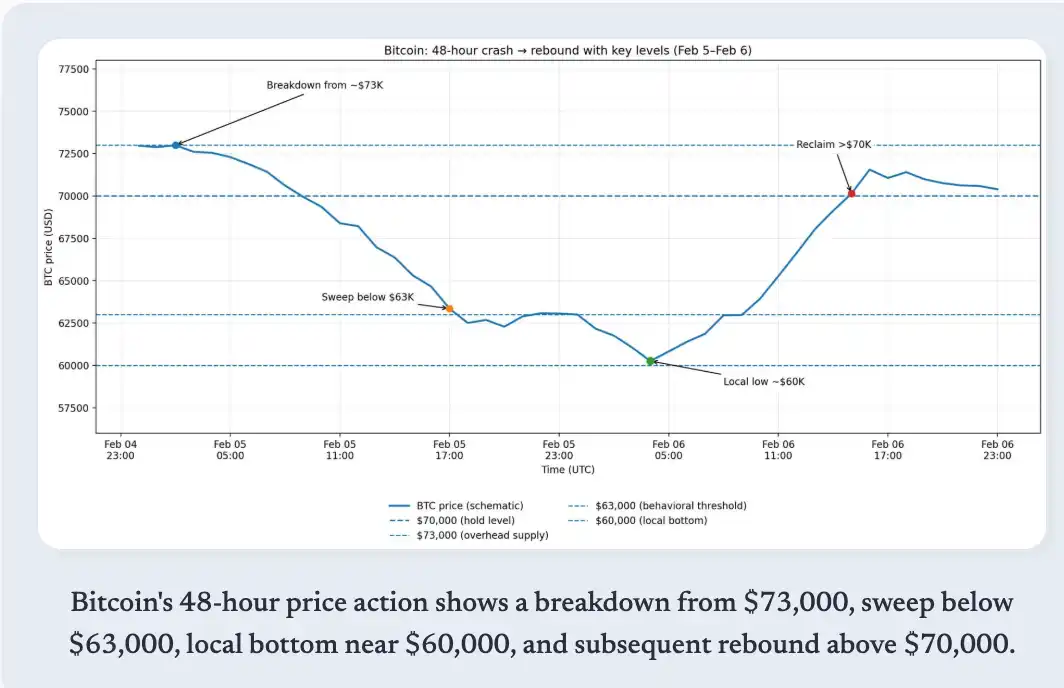
La acción del precio de Bitcoin en 48 horas, mostrando el colapso desde 73.000 dólares, la ruptura por debajo de 63.000 dólares (stop-loss), la formación de un fondo local cerca de 60.000 dólares y el posterior rebote por encima de 70.000 dólares.
Reversión macro y mecanismo de squeeze
El 6 de febrero abrió al precio de cierre del día anterior, luego cayó a un mínimo intradía cercano a 60.000 dólares, antes de dispararse hasta un máximo de 71.422 dólares. Después de tres intentos fallidos de superar este nivel, el precio retrocedió por debajo de los 70.000 dólares.
El catalizador no provino del interior de la industria crypto, sino de un giro brusco en la tendencia entre activos. Wall Street tuvo un rendimiento sólido: el S&P 500 subió un 1,97%, el Nasdaq un 2,18%, el Dow Jones un 2,47% y el índice de semiconductores de Filadelfia (SOX) se disparó un 5,7%.
Los precios de los metales se recuperaron violentamente, el oro subió un 3,9%, la plata un 8,6%, mientras que el índice del dólar cayó un 0,2%, liberando señales de un entorno financiero más laxo.
Bitcoin fluctuó mecánicamente junto con este cambio. La correlación fue evidente: cuando las acciones tecnológicas se estabilizaron y los metales repuntaron, Bitcoin fue arrastrado al alza a través de la exposición común al riesgo.
Sin embargo, la violencia del rebote también reflejó el posicionamiento en derivados. Un sesgo de casi -13%, tasas de financiación negativas y una estructura de volatilidad invertida crearon unas condiciones en las que cualquier impulso macro positivo podía desencadenar covering de cortos (Short-covering) y reequilibrios forzados de posiciones.
Este rebote fue esencialmente impulsado por un evento de liquidez y amplificado por el cierre de posiciones cortas congestionadas.
Aun así, las señales prospectivas siguen inclinándose hacia la baja. Los datos de Derive muestran que, en las opciones con vencimiento el 27 de febrero, existe una gran concentración de interés abierto de opciones put en strikes de 60.000 a 50.000 dólares.
Sean Dawson de Derive dijo a Reuters que la demanda de protección a la baja es "extrema". Esto no es un análisis retrospectivo, sino que los operadores, incluso después del rebote, siguen cubriéndose explícitamente contra el próximo riesgo de caída.
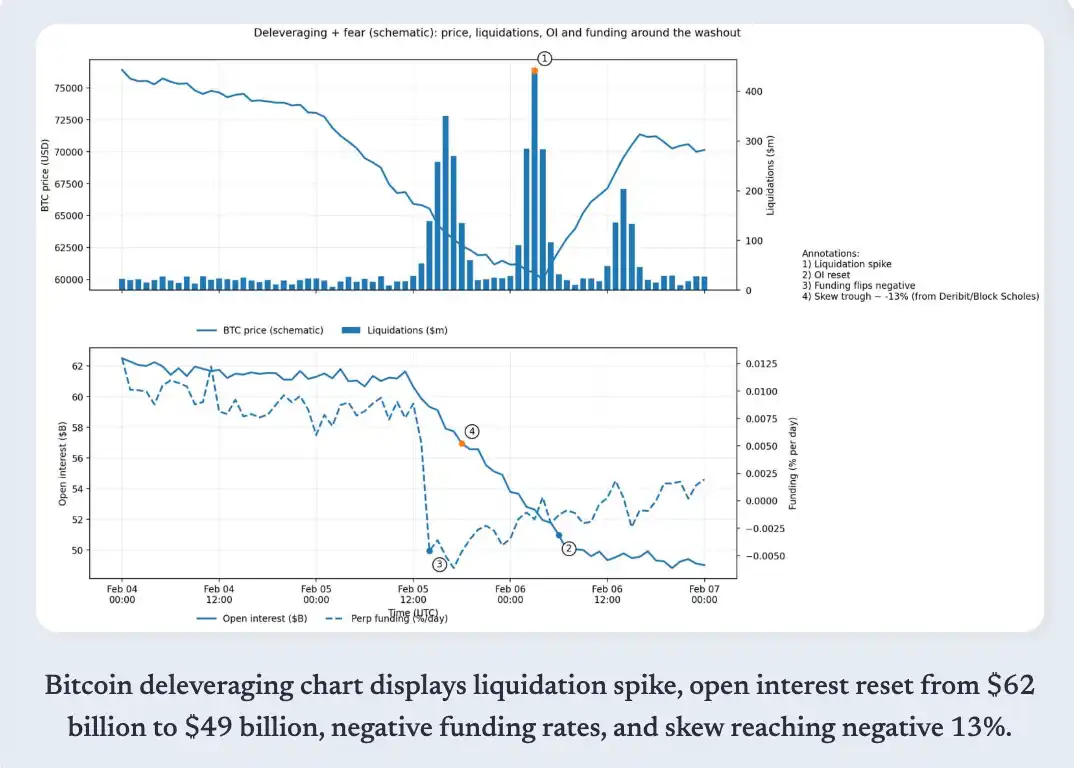
Gráfico de desapalancamiento de Bitcoin, que muestra el pico de liquidaciones, el interés abierto reiniciado de 62.000 a 49.000 millones de dólares, tasas de financiación negativas y un sesgo que tocó -13%.
¿Pueden mantenerse los 70.000 dólares? Marco de análisis
La lógica para mantener los 70.000 dólares se basa en tres condiciones.
Primero, el rebote macro necesita ser sostenido, las acciones tecnológicas deben continuar estabilizándose, y los rendimientos de los bonos estadounidenses y el dólar no deben volver a endurecerse. Este repunte fue una clara联动 entre activos; si las acciones estadounidenses vuelven a caer, Bitcoin no podrá mantenerse al margen.
En segundo lugar, el apalancamiento debe continuar enfriándose y no debe haber nuevas ventas forzadas. El interés abierto ya ha disminuido significativamente, reduciendo el riesgo de una "caída en vacío".
Tercero, la presión sobre los mineros necesita aliviarse sustancialmente cuando entre en vigor el ajuste de dificultad. Si el precio se mantiene estable dentro de la ventana de ajuste, se espera que la reducción de dificultad del 13,37% disminuya la presión de venta marginal y permita que la tasa de hash se estabilice.
Y hay tres razones que respaldan la观点 de una nueva sacudida:
Primero, el posicionamiento en opciones sigue siendo bajista. La mayor concentración de puts para finales de febrero está en 60.000-50.000 dólares, una señal prospectiva incrustada en la probabilidad implícita del mercado, y no un sentimiento rezagado.
En segundo lugar, las señales de derivados siguen siendo frágiles. El sesgo extremo, las tasas de financiación negativas frecuentes recientemente y la estructura de volatilidad invertida se ajustan más al carácter de "rebote de alivio (Relief rally)" dentro de un sistema de miedo, que a una inversión de tendencia.
Tercero, los datos de flujos de ETF muestran salidas continuas. Hasta el 5 de febrero, las salidas netas mensuales de los ETF de Bitcoin habían llegado a 690 millones de dólares. Aunque los datos del 6 de febrero aún no se han publicado, el patrón existente indica que los asignadores institucionales aún no han pasado de la "reducción de riesgo (De-risking)" a la "reincorporación (Re-engagement)".
Cuadro de señales
| Indicador | Última lectura / Estado (al momento de redactar) | Confirmación alcista (qué cambio se necesita ver) | Continuación bajista (qué vigilar) | Fuente |
| Derivados | Tasa de financiación de perpetuals | Valor negativo (por debajo de 0%) —— estado "extremadamente bajista" | La tasa de financiación se vuelve positiva y se estabiliza en las principales plataformas (no sólo un pulso de 1-2 horas) | La tasa de financiación se mantiene negativa / fluctúa repetidamente durante las oscilaciones de precios → riesgo de "rebote para atraer compras" |
| Riesgo de opciones | Reversión al riesgo 25D (Sesgo) | Sesgo a corto plazo tan bajo como ~ -13% (demanda de puts se dispara) | El sesgo se recupera hacia 0 (disminuye la demanda de protección a la baja) y se estabiliza | El sesgo mantiene valores negativos profundos (compra protectora continua) |
| Apalancamiento | Interés Abierto Futuros (OI) | Desapalancamiento / OI disminuye (fase de liquidación forzada); informes recientes muestran que ~$55B equivalentes en posiciones salieron en 30 días | El OI se estabiliza (sin reapalancamiento rápido) y el precio se mantiene en $70K | El OI se acumula rápidamente durante el rebote → aumenta la probabilidad de la próxima oleada de liquidaciones |
| Flujos | Flujo neto ETF spot BTC | Salida neta: 4 feb -$544.9M, 5 feb -$434.1M | Las salidas se desaceleran hasta estabilizarse, luego se convierten en pequeñas entradas | Las salidas se aceleran (aparición consecutiva de niveles de -$400M a -$500M)→ riesgo de sacudida repetida |
| Minería | Precio Hash + Ajuste Dificultad | Precio Hash < $32/PH/s (mínimo histórico); se espera reducción de dificultad del 13.37% | Llega la reducción de dificultad y la tasa de hash se estabiliza (alivia la presión de venta de mineros) | El precio hash cae further / La tasa de hash se desconecta significativamente → aumenta la venta de mineros / flujo de inventario |
El verdadero significado de los 70.000 dólares
Este nivel de precio en sí mismo no tiene magia. Su importancia radica en que se encuentra por encima del cluster de absorción en cadena de 66.900 a 70.600 dólares identificado por Glassnode.
Mantener los 70.000 dólares significa que este cluster ha absorbido suficiente oferta para estabilizar temporalmente el precio. Sin embargo, mantenerse no sólo requiere soporte técnico, sino también el regreso de la demanda al contado, el cierre de las posiciones de cobertura en derivados y la estabilización de los flujos institucionales.
El rebote desde 60.000 dólares fue real, pero su composición es crucial. Si las condiciones macro cambian, la estabilidad entre activos también se revertirá.
El cierre de posiciones forzadas creó un rebote mecánico, que no necesariamente se traduce en una tendencia sostenida. Los operadores de opciones aún están fijando precios que reflejan una posibilidad significativa de caer hacia 50.000-60.000 dólares en las próximas tres semanas.
Bitcoin recuperó los 70.000 dólares, pero actualmente se está consolidando por debajo de ese nivel. Esto sugiere una pausa antes de la próxima prueba, y el resultado de esa próxima prueba dependerá de que se den tres condiciones de forma consecutiva: el mantenimiento de la preferencia por el riesgo macro, la desaceleración o reversión de las salidas de ETF, y el regreso a la normalidad del sentimiento en derivados.
El mercado dio un violento tirón hacia arriba, pero la curva a plazo y los datos de flujo indican que los operadores aún no han comenzado a apostar por su persistencia. Los 70.000 dólares no son el final, son sólo la línea de base que decidirá el ganador de la下一阶段论战.




















