Bitcoin: Retail FOMO is back – Here’s why that’s bad news for BTC

ambcryptoPublished on 2026-03-20Last updated on 2026-03-20

Abstract

Bitcoin faces renewed retail FOMO around the $70k resistance level, which may signal bearish pressure rather than bullish momentum. Recent data shows over $130 million in hourly inflows to Binance, indicating speculative trading. Coupled with increasing short positions and a declining CVD (indicating weak spot demand), this suggests traders are chasing fear and taking profits rather than genuine accumulation. Although stablecoin market caps have rebounded, providing liquidity, the lack of strong follow-through makes a breakout above $75k unlikely. Retail behavior currently represents a key vulnerability for BTC.

Whenever the market hits resistance, people naturally start watching for FOMO.

Presently, Bitcoin [BTC] is hovering around $70k, having dropped about 3.5% over the past week. That’s a classic sign of weak follow-through, leaving the market split between those looking to “buy the dip” and those holding onto recent gains.

AMBCrypto recently highlighted that 48k BTC moved out of STHs, showing many traders were quick to take profits rather than chase FOMO. Moreover, a recent CryptoQuant report offered a deeper look into retail behavior, showing patterns of inflows that often line up with market turning points.
Source: CryptoQuant

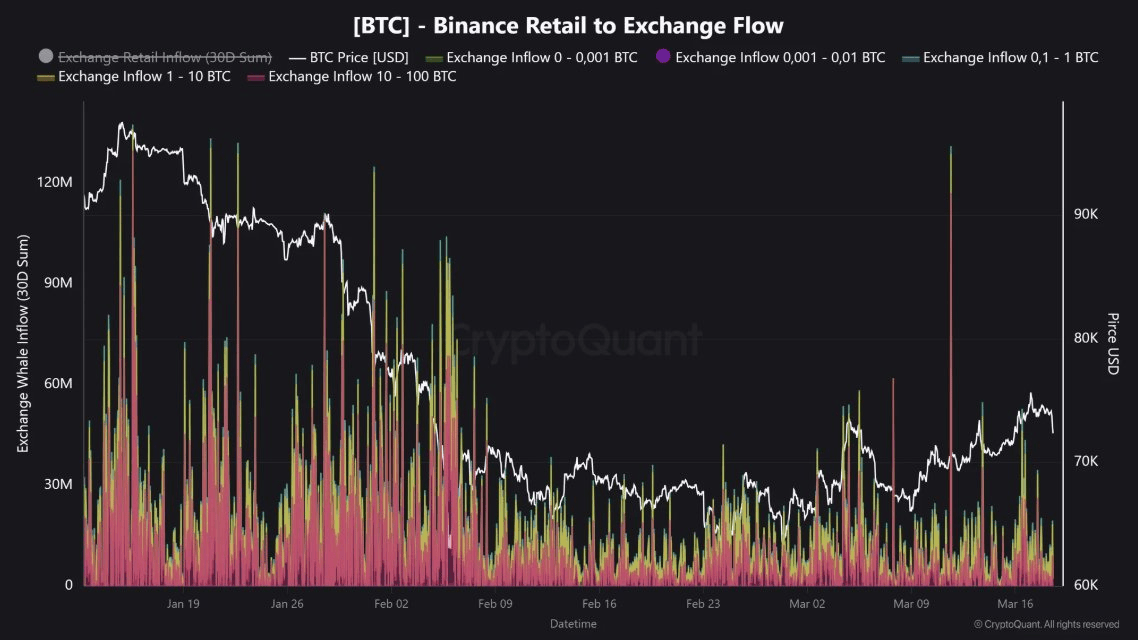
Looking at the chart above, Binance is seeing some serious retail activity. On the 11th of March, a massive $131.8 million flowed into the exchange in just one hour. However, that momentum didn’t stop there: About $55 million came in on the 13th of March, followed by another $50 million three days later.

From a technical standpoint, spikes like this usually mean retail traders are moving funds onto the exchange to trade, whether chasing momentum, taking profits, or setting up short-term positions.

According to AMBCrypto, these inflows act as a key signal for spotting FOMO, especially around Bitcoin’s $70k level.

Notably, when layered with other indicators, they provide a clearer view of where the market is headed.

Retail frenzy raises questions about Bitcoin’s breakout

The recent retail moves into Binance aren’t happening in isolation.

Take the $50 million inflow on the 16th of March. Technically, it lined up with Bitcoin hitting resistance at $75k, kicking off three days of declines, triggering long-liquidation sweeps, and pushing BTC down to $70k. Now, it looks like “speculative FOMO” is creeping back in.
Source: CryptoQuant

CoinGlass data shows fresh shorts piling up, while a falling CVD points to weak Spot demand. In other words, bears are leaning into the downside, and the surge in retail inflows suggests traders are chasing momentum, taking positions even as the market signals caution.

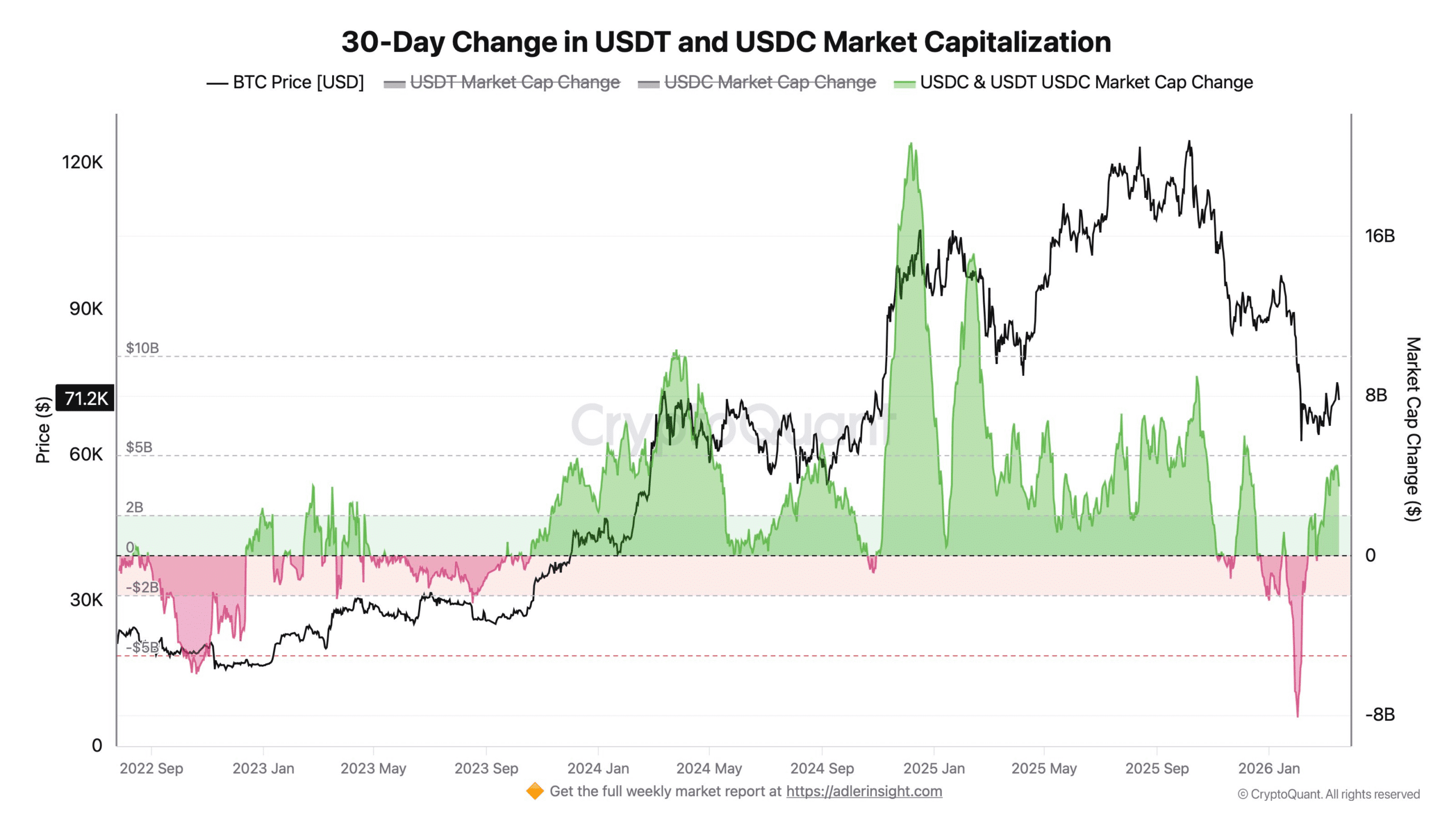
Adding to the mix, the USDT and USDC market caps just reversed from -$8.1 billion to +$4.5 billion, indicating that liquidity returned to the broader market. Normally, that would be a bullish signal, as more liquidity around Bitcoin’s $70k level usually means FOMO is creeping back in.

However, when you layer in rising retail inflows and growing short positions, that liquidity starts to feel more like speculative betting than genuine “dip-buying” pressure. In other words, retail traders are chasing FUD, betting on the downside, and taking profits near the top.

If this trend continues, Bitcoin’s push past $75k will need stronger follow-through, which the falling CVD suggests isn’t happening. As a result, with FUD outweighing FOMO around resistance, a breakdown looks more likely, making retail flows Bitcoin’s biggest “weak spot” right now.


Final Summary

  • Surging retail inflows, rising shorts, and a falling CVD suggest traders are chasing FUD rather than genuine “dip-buying,” creating a key weak spot for Bitcoin.
  • Meanwhile, stablecoin caps have rebounded, but without strong follow-through, BTC’s breakout past $75k remains under bearish control.


Related Questions

QWhat is the main concern raised in the article regarding retail FOMO and Bitcoin's price?

AThe article argues that the return of retail FOMO, characterized by speculative inflows and short positions, is bad news for Bitcoin as it suggests traders are chasing momentum and betting on the downside rather than genuine long-term buying, making a price breakdown more likely.

QWhat data from CryptoQuant was used to identify heightened retail activity on Binance?

ACryptoQuant data showed a massive inflow of $131.8 million into Binance in one hour on March 11th, followed by $55 million on March 13th and another $50 million on March 16th, indicating serious retail trading activity.

QAccording to the article, what does a falling CVD (Cumulative Volume Delta) indicate for the market?

AA falling CVD points to weak spot market demand, suggesting a lack of strong buying pressure and follow-through, which is a bearish signal for Bitcoin's price.

QHow did the change in stablecoin market caps (USDT and USDC) factor into the analysis?

AThe combined USDT and USDC market caps reversed from -$8.1 billion to +$4.5 billion, indicating that liquidity returned to the market. However, the article suggests this liquidity is being used for speculative betting rather than genuine 'dip-buying'.

QWhat key event on March 16th was linked to the $50 million inflow into Binance?

AThe $50 million inflow on March 16th coincided with Bitcoin hitting resistance at $75k, which kicked off three days of price declines and triggered long-liquidation sweeps, pushing the price down to $70k.

Related Reads

From Theft to Re-entry: How Was $292 Million "Laundered"?

A sophisticated crypto laundering operation was executed following the $292 million hack of Kelp DAO on April 18. The attack, attributed to the North Korean Lazarus group, began with anonymous infrastructure preparation using Tornado Cash to fund wallets untraceably. The hacker exploited a vulnerability in Kelp’s cross-chain bridge, stealing 116,500 rsETH. To avoid crashing the market, the attacker used Aave and Compound as laundering tools—depositing the stolen rsETH as collateral to borrow $190 million in clean, liquid ETH. This move triggered a bank run on Aave, causing an $8 billion drop in TVL. After consolidating funds, the attacker fragmented them across hundreds of wallets to evade detection. A major breakpoint was THORChain, where over $460 million in volume—30 times its usual activity—was processed in 24 hours, converting ETH into Bitcoin. This shift to Bitcoin’s UTXO model exponentially increased tracing complexity by shattering funds into countless untraceable fragments. The final destination was Tron-based USDT, the primary channel for illicit crypto flows. From there, funds were cashed out via OTC brokers in China and Southeast Asia, using unlicensed underground banks and UnionPay networks outside Western sanctions scope. Ultimately, the laundered money supports North Korea’s weapons programs, which rely heavily on crypto hacking for foreign currency. The incident underscores structural challenges in DeFi: its openness, composability, and lack of central control make such laundering not just possible, but inherently difficult to prevent.

marsbit3m ago

From Theft to Re-entry: How Was $292 Million "Laundered"?

marsbit3m ago

Google and Amazon Simultaneously Invest Heavily in a Competitor: The Most Absurd Business Logic of the AI Era Is Becoming Reality

In a span of four days, Amazon announced an additional $25 billion investment, and Google pledged up to $40 billion—both direct competitors pouring over $65 billion into the same AI startup, Anthropic. Rather than a typical venture capital move, this signals the latest escalation in the cloud wars. The core of the deal is not equity but compute pre-orders: Anthropic must spend the majority of these funds on AWS and Google Cloud services and chips, effectively locking in massive future compute consumption. This reflects a shift in cloud market dynamics—enterprises now choose cloud providers based on which hosts the best AI models, not just price or stability. With OpenAI deeply tied to Microsoft, Anthropic’s Claude has become the only viable strategic asset for Google and Amazon to remain competitive. Anthropic’s annualized revenue has surged to $30 billion, and it is expanding into verticals like biotech, positioning itself as a cross-industry AI infrastructure layer. However, this funding comes with constraints: Anthropic’s independence is challenged as it balances two rival investors, its safety-first narrative faces pressure from regulatory scrutiny, and its path to IPO introduces new financial pressures. Globally, this accelerates a "tri-polar" closed-loop structure in AI infrastructure, with Microsoft-OpenAI, Google-Anthropic, and Amazon-Anthropic forming exclusive model-cloud alliances. In contrast, China’s landscape differs—investments like Alibaba and Tencent backing open-source model firm DeepSeek reflect a more decoupled approach, though closed-source models from major cloud providers still dominate. The $65 billion bet is ultimately about securing a seat at the table in an AI-defined future—where missing the model layer means losing the cloud war.

marsbit6h ago

Google and Amazon Simultaneously Invest Heavily in a Competitor: The Most Absurd Business Logic of the AI Era Is Becoming Reality

marsbit6h ago

Computing Power Constrained, Why Did DeepSeek-V4 Open Source?

DeepSeek-V4 has been released as a preview open-source model, featuring 1 million tokens of context length as a baseline capability—previously a premium feature locked behind enterprise paywalls by major overseas AI firms. The official announcement, however, openly acknowledges computational constraints, particularly limited service throughput for the high-end DeepSeek-V4-Pro version due to restricted high-end computing power. Rather than competing on pure scale, DeepSeek adopts a pragmatic approach that balances algorithmic innovation with hardware realities in China’s AI ecosystem. The V4-Pro model uses a highly sparse architecture with 1.6T total parameters but only activates 49B during inference. It performs strongly in agentic coding, knowledge-intensive tasks, and STEM reasoning, competing closely with top-tier closed models like Gemini Pro 3.1 and Claude Opus 4.6 in certain scenarios. A key strategic product is the Flash edition, with 284B total parameters but only 13B activated—making it cost-effective and accessible for mid- and low-tier hardware, including domestic AI chips from Huawei (Ascend), Cambricon, and Hygon. This design supports broader adoption across developers and SMEs while stimulating China's domestic semiconductor ecosystem. Despite facing talent outflow and intense competition in user traffic—with rivals like Doubao and Qianwen leading in monthly active users—DeepSeek has maintained technical momentum. The release also comes amid reports of a new funding round targeting a valuation exceeding $10 billion, potentially setting a new record in China’s LLM sector. Ultimately, DeepSeek-V4 represents a shift toward open yet realistic infrastructure development in the constrained compute landscape of Chinese AI, emphasizing engineering efficiency and domestic hardware compatibility over pure model scale.

marsbit6h ago

Computing Power Constrained, Why Did DeepSeek-V4 Open Source?

marsbit6h ago

Trading

Spot
Futures

Hot Articles

Discussions

Welcome to the HTX Community. Here, you can stay informed about the latest platform developments and gain access to professional market insights. Users' opinions on the price of S (S) are presented below.

活动图片