Bitcoin May Avoid Immediate Quantum Upgrade With New Workaround: Study

bitcoinistPublished on 2026-04-10Last updated on 2026-04-10

Abstract

A new study proposes a "Quantum Safe Bitcoin" (QSB) workaround that could protect new BTC transactions from quantum attacks without requiring a change to the Bitcoin protocol. Developed by StarkWare's Avihu Levy, the method operates within Bitcoin's existing rules, replacing elliptic curve math with a hash-to-signature puzzle that relies on brute-force computation, which is resistant to quantum attacks. This approach is praised by some, like StarkWare's CEO, as a way to make Bitcoin quantum-safe today. However, critics note it doesn't address vulnerabilities in existing exposed public keys or dormant wallets, which hold an estimated 1.7 million BTC. The scheme is also computationally expensive, costing $75-$150 per transaction, making it suitable only for large transfers and not for daily use or scaling solutions like the Lightning Network. While presented as a temporary fix, the researchers acknowledge that long-term protocol-level changes are still the preferred solution. The proposal emerges amid ongoing debate in the Bitcoin community about how to address quantum computing threats, following recent research that has intensified the discussion.

A Bitcoin transaction that costs $75 to $150 in GPU compute is not built for daily use, but it may still matter.

StarkWare chief product officer Avihu Levy has put forward a scheme called Quantum Safe Bitcoin, or QSB, that he says could make new BTC transfers resistant to quantum attacks without changing the Bitcoin protocol.

The proposal is designed to work even against a large quantum computer running Shor’s algorithm.

A Workaround Inside Bitcoin’s Existing Rules

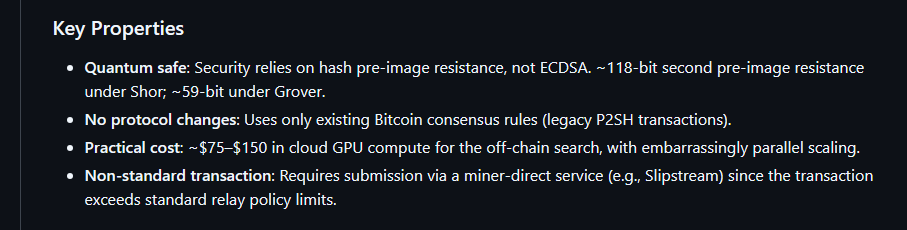
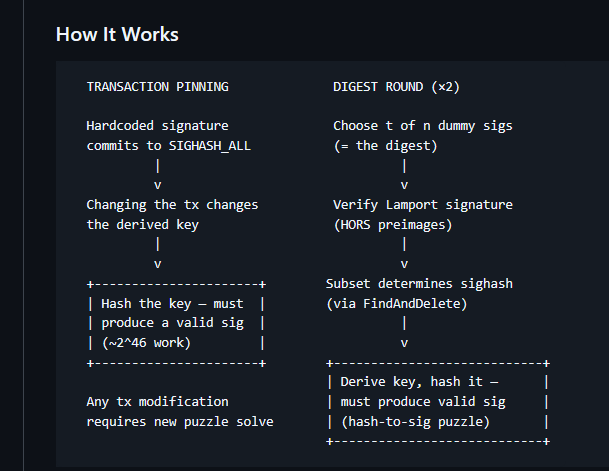
Levy’s plan stays within the crypto’s current legacy script limits and does not require a soft fork. Instead of relying on elliptic curve math, QSB swaps in a hash-to-signature puzzle.

In simple terms, the sender must find an input whose hash output happens to look like a valid ECDSA signature, a process that depends on brute-force work rather than the kind of math quantum computers are expected to break.
Source: Github

That makes the scheme unusual. It does not try to rebuild Bitcoin from the ground up. It tries to bolt on a narrow shield using rules that already exist.

The researchers describe it as a temporary answer while the bigger question of its long-term quantum defense remains unsettled.

BTCUSD currently trading at $71,771. Chart: TradingView

Praise, Pushback And A Narrow Use Case

StarkWare CEO Eli Ben-Sasson called the work “huge” and said it essentially makes Bitcoin quantum-safe today. But not everyone agrees with that framing.

Bitcoin ESG specialist Daniel Batten said the claim goes too far because the paper does not address exposed public keys or dormant wallets.
Source: Github

He pointed to an estimated 1.7 million BTC sitting in early P2PK addresses that could be vulnerable if a quantum computer becomes powerful enough to crack them.

The new scheme also comes with a sharp limit on who might use it. According to the proposal, it is more complex than a standard BTC transaction and only makes sense for large transfers. The reported compute cost makes it a poor fit for routine payments.

A Temporary Fix, Not The Final Answer

The debate around quantum risk has already split the Bitcoin community. Some argue for leaving Bitcoin unchanged to preserve its original design.

Others want vulnerable coins frozen or burned. A separate group wants the protocol upgraded to support quantum-safe signatures.

Image: Post Quantum

Levy’s proposal lands in the middle of that fight, giving users a last-resort option while skipping the need for network-wide consensus.

The researchers still say protocol-level changes are the better long-term path. They also acknowledged that the QSB approach is non-standard, does not scale to all users, and does not cover use cases such as the Lightning Network.

The timing of the paper matters too. Google published research in March that added fresh pressure to the debate, and Lightning Labs chief technology officer Olaoluwa Osuntokun followed with a quantum fallback prototype on Wednesday.

Featured image from Pixabay, chart from TradingView

Trending Cryptos

Related Questions

QWhat is the name of the proposed scheme to make Bitcoin quantum-safe without changing the protocol?

AThe proposed scheme is called Quantum Safe Bitcoin, or QSB.

QHow does the QSB scheme differ from a standard Bitcoin transaction in terms of its underlying mechanism?

AInstead of relying on elliptic curve math, QSB uses a hash-to-signature puzzle that requires brute-force work to find an input whose hash output resembles a valid ECDSA signature.

QAccording to the article, what is a major limitation of the QSB proposal regarding its practical use?

AThe QSB scheme is more complex and has a high compute cost (estimated $75-$150 per transaction), making it only suitable for large transfers and a poor fit for routine, daily payments.

QWhich specific group of existing Bitcoin holdings does Daniel Batten argue are not protected by this new proposal?

ADaniel Batten points out that the proposal does not address the vulnerability of an estimated 1.7 million BTC sitting in early P2PK (Pay-to-Public-Key) addresses.

QWhat do the researchers behind the QSB proposal acknowledge as the better long-term solution for quantum resistance?

AThe researchers acknowledge that protocol-level changes are the better long-term path for achieving quantum resistance, as QSB is a non-standard, non-scalable temporary fix.

Related Reads

Uncertainty persists regarding cryptocurrency regulation, and there is a possibility of delay in passing the Clarity Act! Here are the details

The U.S. Senate's vote on the CLARITY Act, which aims to establish a legal framework for the crypto market, faces a potential delay. Priority on the Senate agenda is being given to a Russia sanctions bill and confirmations of federal officials, making a vote on the crypto bill after next week increasingly likely. Senate tradition of handling only one contentious bill at a time further complicates early consideration of the CLARITY Act. Key political disagreements persist, notably over provisions to restrict cryptocurrency trading by senior government officials and elected representatives, including potentially former President Donald Trump. A bipartisan consensus has not been reached. This uncertainty raises doubts about whether a vote can occur before the Senate's August recess. If disputes intensify, the bill's passage could be jeopardized not only for this year but potentially until 2026. Even if the Senate approves the bill, it would still require a revote in the House of Representatives and the President's signature to become law, potentially prolonging the establishment of a comprehensive regulatory framework long awaited by the crypto industry. The Clarity Act is considered crucial for clarifying which agencies will oversee digital assets, defining their legal status, and setting operational principles. Industry advocates argue its passage would boost institutional investor confidence and strengthen the U.S. position in the global digital asset market.

cryptonews.ru2m ago

Uncertainty persists regarding cryptocurrency regulation, and there is a possibility of delay in passing the Clarity Act! Here are the details

cryptonews.ru2m ago

SWIFT Shared Ledger Launches Live Pilot, How Will the 50-Year-Old Payment Network Reconstruct the Financial System?

SWIFT, a global financial messaging provider with a 50-year history, has launched a live pilot of a blockchain-based "shared ledger" in July 2026, involving 17 major banks. This marks a direct move by traditional finance to upgrade its core payment infrastructure using blockchain technology, transforming SWIFT's role from a messaging channel to a "value orchestration layer" for digital payments. The system is built on Hyperledger Besu (EVM-compatible) and integrates Chainlink's CCIP for cross-chain interoperability. It deepens the fusion of the ISO 20022 messaging standard with smart contracts to automate compliance (KYC/AML). The primary settlement medium in this network is "tokenized deposits"—digital representations of traditional bank deposits, not independent stablecoins—preserving the existing two-tier banking system. The move introduces "atomic settlement" (24/7, instant) but requires banks to adopt "pre-funding" models, increasing demands on liquidity management. It presents direct competitive pressure on native blockchain payment tokens (e.g., XRP) by offering an efficient, bank-backed alternative for cross-border settlement. Significant regulatory hurdles remain, including legal jurisdiction over cross-border digital assets, legal definitions of "settlement finality" for smart contracts, and balancing blockchain transparency with data privacy/localization laws. Technologies like zero-knowledge proofs may be needed to resolve privacy-compliance conflicts. Industry views are mixed: participating banks and SWIFT emphasize extending trusted, compliant finance into the digital realm with real-time efficiency, while crypto analysts warn of potential "liquidity backlash" as capital flows back to the traditional, now-tech-enhanced banking system. This pilot signifies that traditional finance and crypto are entering a phase of direct competition and fusion at the infrastructure level, likely leading to a future of interconnected, highly regulated financial networks rather than a fully decentralized system.

marsbit12m ago

SWIFT Shared Ledger Launches Live Pilot, How Will the 50-Year-Old Payment Network Reconstruct the Financial System?

marsbit12m ago

Trading

Spot

Hot Articles

What is $BITCOIN

DIGITAL GOLD ($BITCOIN): A Comprehensive Analysis Introduction to DIGITAL GOLD ($BITCOIN) DIGITAL GOLD ($BITCOIN) is a blockchain-based project operating on the Solana network, which aims to combine the characteristics of traditional precious metals with the innovation of decentralized technologies. While it shares a name with Bitcoin, often referred to as “digital gold” due to its perception as a store of value, DIGITAL GOLD is a separate token designed to create a unique ecosystem within the Web3 landscape. Its goal is to position itself as a viable alternative digital asset, although specifics regarding its applications and functionalities are still developing. What is DIGITAL GOLD ($BITCOIN)? DIGITAL GOLD ($BITCOIN) is a cryptocurrency token explicitly designed for use on the Solana blockchain. In contrast to Bitcoin, which provides a widely recognized value storage role, this token appears to focus on broader applications and characteristics. Notable aspects include: Blockchain Infrastructure: The token is built on the Solana blockchain, known for its capacity to handle high-speed and low-cost transactions. Supply Dynamics: DIGITAL GOLD has a maximum supply capped at 100 quadrillion tokens (100P $BITCOIN), although details regarding its circulating supply are currently undisclosed. Utility: While precise functionalities are not explicitly outlined, there are indications that the token could be utilized for various applications, potentially involving decentralized applications (dApps) or asset tokenization strategies. Who is the Creator of DIGITAL GOLD ($BITCOIN)? At present, the identity of the creators and development team behind DIGITAL GOLD ($BITCOIN) remains unknown. This situation is typical among many innovative projects within the blockchain space, particularly those aligning with decentralized finance and meme coin phenomena. While such anonymity may foster a community-driven culture, it intensifies concerns about governance and accountability. Who are the Investors of DIGITAL GOLD ($BITCOIN)? The available information indicates that DIGITAL GOLD ($BITCOIN) does not have any known institutional backers or prominent venture capital investments. The project seems to operate on a peer-to-peer model focused on community support and adoption rather than traditional funding routes. Its activity and liquidity are primarily situated on decentralized exchanges (DEXs), such as PumpSwap, rather than established centralized trading platforms, further highlighting its grassroots approach. How DIGITAL GOLD ($BITCOIN) Works The operational mechanics of DIGITAL GOLD ($BITCOIN) can be elaborated on based on its blockchain design and network attributes: Consensus Mechanism: By leveraging Solana’s unique proof-of-history (PoH) combined with a proof-of-stake (PoS) model, the project ensures efficient transaction validation contributing to the network's high performance. Tokenomics: While specific deflationary mechanisms have not been extensively detailed, the vast maximum token supply implies that it may cater to microtransactions or niche use cases that are still to be defined. Interoperability: There exists the potential for integration with Solana’s broader ecosystem, including various decentralized finance (DeFi) platforms. However, the details regarding specific integrations remain unspecified. Timeline of Key Events Here is a timeline that highlights significant milestones concerning DIGITAL GOLD ($BITCOIN): 2023: The initial deployment of the token occurs on the Solana blockchain, marked by its contract address. 2024: DIGITAL GOLD gains visibility as it becomes available for trading on decentralized exchanges like PumpSwap, allowing users to trade it against SOL. 2025: The project witnesses sporadic trading activity and potential interest in community-led engagements, although no noteworthy partnerships or technical advancements have been documented as of yet. Critical Analysis Strengths Scalability: The underlying Solana infrastructure supports high transaction volumes, which could enhance the utility of $BITCOIN in various transaction scenarios. Accessibility: The potential low trading price per token could attract retail investors, facilitating wider participation due to fractional ownership opportunities. Risks Lack of Transparency: The absence of publicly known backers, developers, or an audit process may yield skepticism regarding the project's sustainability and trustworthiness. Market Volatility: The trading activity is heavily reliant on speculative behavior, which can result in significant price volatility and uncertainty for investors. Conclusion DIGITAL GOLD ($BITCOIN) emerges as an intriguing yet ambiguous project within the rapidly evolving Solana ecosystem. While it attempts to leverage the “digital gold” narrative, its departure from Bitcoin's established role as a store of value underscores the need for a clearer differentiation of its intended utility and governance structure. Future acceptance and adoption will likely depend on addressing the current opacity and defining its operational and economic strategies more explicitly. Note: This report encompasses synthesised information available as of October 2023, and developments may have transpired beyond the research period.

1.1k Total ViewsPublished 2025.05.13Updated 2025.05.13

What is $BITCOIN

Discussions

Welcome to the HTX Community. Here, you can stay informed about the latest platform developments and gain access to professional market insights. Users' opinions on the price of BTC (BTC) are presented below.

活动图片