Bitcoin Hovers Below $70K – Breakout Soon or is $HYPER a Safer Bet?

bitcoinistPublished on 2026-02-10Last updated on 2026-02-10

Abstract

Bitcoin is consolidating below the $70,000 resistance level, with technical analysis suggesting a potential breakout toward $85,000–$100,000 if it clears the $72,500 resistance. However, a break below the $60,000 support could trigger a decline toward $52,000. On-chain data indicates accumulation, but low rally volumes suggest caution against fake-outs. Amid Bitcoin’s sideways movement, attention is shifting to Bitcoin Hyper ($HYPER), a Bitcoin Layer 2 solution using the Solana Virtual Machine (SVM) to enable high-speed smart contracts on Bitcoin. The project has raised over $31 million in its presale, with significant whale activity, including a $500,000 purchase. While Bitcoin’s macro outlook remains bullish, $HYPER is positioned as a high-risk, high-reward bet on Bitcoin’s scaling future. This article is for informational purposes only and not financial advice. Cryptocurrencies are volatile, and readers should conduct their own research before investing.

Trusted Editorial content, reviewed by leading industry experts and seasoned editors. Ad Disclosure

Quick Facts:

  • ➡️ Bitcoin is consolidating under $70k; technicals suggest a breakout toward $85k-$100k if resistance at $72.5k clears.
  • ➡️ The primary downside risk is losing the $60k support, which could trigger a liquidation cascade toward $52k.
  • ➡️ Bitcoin Hyper uses the Solana Virtual Machine (SVM) to bring high-speed smart contracts to Bitcoin, raising over $31M in early capital.
  • ➡️ On-chain metrics show accumulation, but low volume on current rallies warrants caution regarding potential fake-outs.

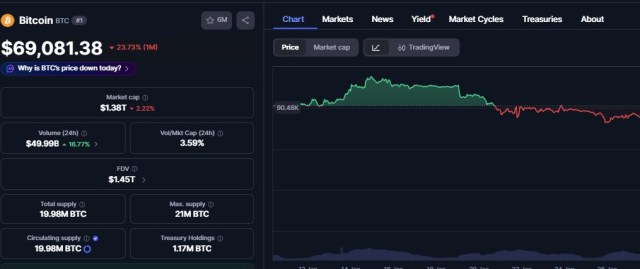
Bitcoin is currently engaged in a tense standoff with the psychological $70,000 barrier, a ceiling that has held firm for weeks.

The market is witnessing a classic consolidation pattern: volatility compressing, leverage flushing, and price trading in a tight range. Historically, this quiet precedes a violent move. While retail traders grow impatient with the chop, on-chain data tells a different story beneath the surface.

The main culprit for this hesitation? A messy mix of macroeconomic ambiguity and short-term profit-taking. Yet, the macro thesis remains solid. With institutional ETF flows providing a soft floor and global liquidity cycles turning, the math favors a breakout. The question isn’t if Bitcoin breaks higher, but when the post-halving supply shock finally dries up the available liquidity on exchanges.

This compression phase forces capital to make a choice. While Bitcoin prepares for its next leg up, risk-tolerant capital is already rotating. Traders looking to maximize the coming cycle are hedging spot holdings with high-beta infrastructure plays.

That rotation suggests that while Bitcoin targets a conservative 2x, emerging protocols like Bitcoin Hyper ($HYPER) are capturing attention (and liquidity) for their potential to fix Bitcoin’s scaling issues before the bull market truly heats up.

Learn more about $HYPER here.

Technical Outlook: The Path to $100K Requires a Clean Break

Despite the immediate resistance at $70,000, Bitcoin’s high-timeframe structure remains aggressively bullish.

Analysts are eyeing the convergence of the 50-day and 200-day moving averages, a setup that historically signals trend continuation rather than reversal. Plus, the Relative Strength Index (RSI) has reset from overbought territory. That gives the asset room to run without overheating.

For the bulls to win, Bitcoin needs to reclaim the $72,500 level with real volume. A daily close above that zone would invalidate the bearish divergence and open a path toward price discovery.

Most technical models project that once $74,000 clears, the psychological vacuum pulls price rapidly toward the $85,000–$90,000 range. Consensus suggests a breakout here puts the $100,000 milestone in play by late Q3, fueled by corporate treasury adoption and ETF rebalancing.

However, risks remain. If the $60,000 support fails during a macro shakeout, the structure weakens significantly.

  • Bull Case: A high-volume breach of $72,000 targets $88,000 in the medium term.
  • Base Case: Another 2-3 weeks of chop between $64,000 and $71,000.
  • Invalidation: A weekly close below $58,500 signals a deeper correction is needed to find liquidity.

Watch spot volume on Coinbase closely. If price pushes up while volume drops? It’s likely a fake-out.

Smart Money Rotates to Bitcoin Hyper ($HYPER) for L2 Utility

As Bitcoin battles resistance, sophisticated investors are looking at the rails that will power the network’s future. The focus is shifting toward Bitcoin Hyper ($HYPER), the first Bitcoin Layer 2 integrating the Solana Virtual Machine (SVM).

While Bitcoin serves as pristine collateral, digital gold, it’s frankly too slow and expensive for DeFi. Bitcoin Hyper solves this by anchoring to Bitcoin for security while using SVM for high-speed execution.

The market’s appetite is clear. According to the official presale page, Bitcoin Hyper has raised $31.3M, with tokens currently priced at $0.0136754. That capital inflow suggests strong conviction in the ‘Bitcoin DeFi’ narrative.

By allowing developers to write in Rust and deploy dApps that settle on Bitcoin, the project bridges the gap between Bitcoin’s $1.3 trillion liquidity and modern functionality.

Whale activity backs this up. Etherscan records show that 3 whale wallets alone have accumulated $1M. The largest transaction, a $500K buy, occurred on Jan 15, 2026. (Note: Large-scale buy orders during a presale usually indicate institutional due diligence is finished).

Still, caution is necessary. Layer 2 protocols are high-risk environments subject to execution hurdles. While the promise of high APY staking and a Decentralized Canonical Bridge is appealing, $HYPER remains a beta play on the ecosystem’s expansion.

Buy $HYPER here.

This article is not financial advice. Cryptocurrencies are volatile assets. The content provided is for informational purposes only. Your should conduct your own independent research and consult with financial professionals before making any investment decisions.

Editorial Process for bitcoinist is centered on delivering thoroughly researched, accurate, and unbiased content. We uphold strict sourcing standards, and each page undergoes diligent review by our team of top technology experts and seasoned editors. This process ensures the integrity, relevance, and value of our content for our readers.

patrubogdan

Follow

Full Profile

Related Posts

Crypto And Banks Clash Again Over ‘Skinny’ Fed Accounts Ahead Of Tuesday’s Meeting

South Korea To Probe Crypto Exchanges, Tighten Regulations After Bithumb $40B Bitcoin Error

Crypto Clarity At Standstill In Congress, Says Fed Governor On Market Structure Bill

Why Japan’s “Takaichi Trade” Could Pressure the Crypto Market Despite Post-Election Rebound

Bitcoin’s Quantum Risk Is Smaller Than Feared, Researcher Says

Cango Liquidates $305M in Bitcoin: Market Volatility Spikes While $MAXI Sees Gains

Related Questions

QWhat is the current price level Bitcoin is struggling to break above, and what is the key resistance level that needs to be cleared for a potential breakout?

ABitcoin is currently struggling to break above the psychological $70,000 barrier. The key resistance level that needs to be cleared for a potential breakout is $72,500.

QAccording to the technical analysis, what are the potential price targets for Bitcoin if it successfully breaks above the $72,500 resistance?

AIf Bitcoin successfully breaks above the $72,500 resistance, technical models project a path toward the $85,000–$90,000 range, with the $100,000 milestone potentially in play by late Q3.

QWhat is the primary downside risk for Bitcoin's price mentioned in the article, and what could it trigger?

AThe primary downside risk is Bitcoin losing the $60,000 support level. This could trigger a liquidation cascade toward $52,000.

QWhat is Bitcoin Hyper ($HYPER) and how does it aim to solve a key limitation of the Bitcoin network?

ABitcoin Hyper ($HYPER) is the first Bitcoin Layer 2 that integrates the Solana Virtual Machine (SVM). It aims to solve Bitcoin's limitation of being too slow and expensive for DeFi by anchoring to Bitcoin for security while using the SVM for high-speed execution, enabling developers to build dApps that settle on Bitcoin.

QHow much capital has the Bitcoin Hyper ($HYPER) project raised in its presale, according to the article?

AAccording to the article, the Bitcoin Hyper project has raised $31.3 million in its early capital presale.

Related Reads

With 300 Million Financing to Accumulate ETH, the Hidden Concerns Behind BitMine's High-Yield Preferred Shares

BitMine, led by Thomas Lee, plans to raise up to $300 million through an initial public offering of 3 million shares of perpetual Series A preferred stock on the NYSE (ticker: BMNP). The stock offers a fixed 9.5% annual dividend. The funds are intended to further the company's accumulation of Ethereum, expand its staking node operations, and for general corporate purposes. This move comes as BitMine faces significant challenges. Its massive Ethereum holdings, over 5.3 million ETH (roughly 4.5% of circulating supply), are currently at an unrealized loss exceeding $8.5 billion due to the crypto market downturn. The company's core business model relies on staking these ETH holdings to generate yield, which it presents as the primary means to cover the new, substantial annual dividend obligation of approximately $28.5 million if the offering is fully subscribed. While the model is similar to MicroStrategy's bitcoin-focused strategy of using capital markets to fund crypto acquisitions, BitMine's product differs with its fixed, non-adjustable dividend rate. The company acknowledges risks, stating dividend payments could also come from cash reserves, asset sales, or future financing, and warns that staking yields may underperform or be illiquid during market stress. The 9.5% fixed rate reflects the higher risk premium demanded from investors for a company heavily exposed to Ethereum's volatility.

Foresight News3m ago

With 300 Million Financing to Accumulate ETH, the Hidden Concerns Behind BitMine's High-Yield Preferred Shares

Foresight News3m ago

A Year of Observing Agent Payments: The Cold Reality Behind the Hot Narrative

A Year in Agent Payments: The Cold Reality Behind a Hot Narrative This article examines the current state of "Agent payments," a year after it became a major trend at the intersection of AI, payments, and crypto. Despite significant investments from major players like Stripe, Visa, and Google, the author—having built products and spoken with merchants and developers—finds genuine, large-scale demand still lacking. Key findings across several hyped scenarios reveal structural challenges: * **Agent-to-Merchant Commerce:** For most product categories (e.g., clothing, electronics), AI shopping via chat is inferior to traditional visual e-commerce. Merchant interest is largely defensive, focused on future-proofing rather than current consumer demand. True potential exists only in specific, high-frequency/low-decision scenarios (like food orders) or for simplifying broken checkout experiences, but these require massive consumer distribution, favoring incumbents. * **Agent-to-API/Machine Commerce:** While stablecoin micropayments are touted for API calls, developers already solve small-value payments via prepaid credits and subscriptions. Large SaaS providers prefer enterprise contracts over fragmented micro-pricing. The market exists for long-tail services outside the top providers but is inherently smaller than the hype suggests. * **Agent-to-Agent Payments:** This remains a theoretical long-term vision with negligible real transaction volume. The core challenges—discovery, trust, negotiation, dispute resolution—are unsolved. While the potential for a new, high-speed settlement layer is real, it is not the current market. * **Agent Finance:** This is the sole area with existing, paying customers (fund managers, DeFi users). AI enhances real-time monitoring and autonomous rebalancing, offering real capability gains. However, competition favors established, regulated institutions with existing licenses and client relationships. The author concludes that the core deficiency in the Agent economy is not merely a payment layer, but a more complex **coordination** capability—figuring out how Agents and humans work together, verify task completion, and settle outcomes. Payment is just one component of settlement, which is itself part of coordination. For large companies, investing now is a defensive, long-term bet with minimal cost. For startups, however, the imperative is to find markets that exist today, not wait for a future wave that remains on the horizon.

marsbit5m ago

A Year of Observing Agent Payments: The Cold Reality Behind the Hot Narrative

marsbit5m ago

China's First Embodied Data Compliance Outbound: How Does Paxini Become a Game-Changer for Industry Development?

"Embodied Intelligence Data Compliance Goes Global: A Breakthrough Moment. At the 2026 World Intelligent Industry Expo, Paxini, the sole Chinese company authorized for cross-border embodied data transfer, launched a pioneering project in Tianjin. This marks the first officially approved case of its kind in China, resolving a major industry bottleneck for compliant international data flow. As the ultimate direction of AI evolution, embodied intelligence relies on vast, multi-modal physical world interaction data. Despite booming global demand, stringent compliance had previously trapped the domestic industry. Paxini's breakthrough establishes a formal compliance framework, setting a benchmark for standardized development. The core of Paxini's success lies in its industry-leading data infrastructure and compliant security architecture, aligning with national data strategy. It operates a large-scale 'data collection factory' for high-quality, multi-modal data and has established a full-chain compliant pathway from 'collection-processing-certification-outbound transfer'. This dual advantage in data scale/quality and compliance secures its leadership. Beyond immediate commercial impact, the project signifies long-term strategic value: international market validation from top-tier financial institutions and the compounding benefits of ecosystem building. High-quality physical world data possesses enduring value. By solving fundamental infrastructure and compliance challenges, Paxini not only contributes a 'Chinese model' to the global embodied intelligence industry but also solidifies a key competitive moat for the long haul. This enables safe, efficient global flow of China's quality embodied data, amplifying its influence in the intelligent manufacturing landscape."

marsbit7m ago

China's First Embodied Data Compliance Outbound: How Does Paxini Become a Game-Changer for Industry Development?

marsbit7m ago

Macroeconomic Origins of the African Payments Market Structure

Africa’s payment landscape exhibits the world’s highest mobile money penetration and fastest cryptocurrency adoption. This is not a market anomaly but a macroeconomic inevitability driven by deep structural factors: a vast, young population, heavy reliance on commodity exports and remittances generating massive cross‑border payment needs, and a chronically underdeveloped formal banking system plagued by de‑risking, high inflation, and currency instability. This vacuum has allowed mobile money (e.g., M‑Pesa) to become the primary payment channel domestically, while cryptocurrencies—particularly stablecoins—serve as a store of value against local‑currency depreciation and a lower‑cost cross‑border medium. The key divide is the Sahara: North Africa integrates with the MENA oil‑centric financial system, while Sub‑Saharan Africa, facing acute dollar shortages and fragmented currencies, is the epicenter of this fintech surge. Structural reliance on dollars, driven by trade deficits and weak local currency credibility, creates persistent dollar scarcity, which crypto and mobile payments effectively address. Efforts like the Pan‑African Payment and Settlement System (PAPSS) aim at de‑dollarization, but these alternatives will remain essential as long as underlying economic constraints—commodity dependence, limited industrialization, and financial exclusion—persist.

marsbit18m ago

Macroeconomic Origins of the African Payments Market Structure

marsbit18m ago

Trading

Spot
Futures

Hot Articles

What is $BITCOIN

DIGITAL GOLD ($BITCOIN): A Comprehensive Analysis Introduction to DIGITAL GOLD ($BITCOIN) DIGITAL GOLD ($BITCOIN) is a blockchain-based project operating on the Solana network, which aims to combine the characteristics of traditional precious metals with the innovation of decentralized technologies. While it shares a name with Bitcoin, often referred to as “digital gold” due to its perception as a store of value, DIGITAL GOLD is a separate token designed to create a unique ecosystem within the Web3 landscape. Its goal is to position itself as a viable alternative digital asset, although specifics regarding its applications and functionalities are still developing. What is DIGITAL GOLD ($BITCOIN)? DIGITAL GOLD ($BITCOIN) is a cryptocurrency token explicitly designed for use on the Solana blockchain. In contrast to Bitcoin, which provides a widely recognized value storage role, this token appears to focus on broader applications and characteristics. Notable aspects include: Blockchain Infrastructure: The token is built on the Solana blockchain, known for its capacity to handle high-speed and low-cost transactions. Supply Dynamics: DIGITAL GOLD has a maximum supply capped at 100 quadrillion tokens (100P $BITCOIN), although details regarding its circulating supply are currently undisclosed. Utility: While precise functionalities are not explicitly outlined, there are indications that the token could be utilized for various applications, potentially involving decentralized applications (dApps) or asset tokenization strategies. Who is the Creator of DIGITAL GOLD ($BITCOIN)? At present, the identity of the creators and development team behind DIGITAL GOLD ($BITCOIN) remains unknown. This situation is typical among many innovative projects within the blockchain space, particularly those aligning with decentralized finance and meme coin phenomena. While such anonymity may foster a community-driven culture, it intensifies concerns about governance and accountability. Who are the Investors of DIGITAL GOLD ($BITCOIN)? The available information indicates that DIGITAL GOLD ($BITCOIN) does not have any known institutional backers or prominent venture capital investments. The project seems to operate on a peer-to-peer model focused on community support and adoption rather than traditional funding routes. Its activity and liquidity are primarily situated on decentralized exchanges (DEXs), such as PumpSwap, rather than established centralized trading platforms, further highlighting its grassroots approach. How DIGITAL GOLD ($BITCOIN) Works The operational mechanics of DIGITAL GOLD ($BITCOIN) can be elaborated on based on its blockchain design and network attributes: Consensus Mechanism: By leveraging Solana’s unique proof-of-history (PoH) combined with a proof-of-stake (PoS) model, the project ensures efficient transaction validation contributing to the network's high performance. Tokenomics: While specific deflationary mechanisms have not been extensively detailed, the vast maximum token supply implies that it may cater to microtransactions or niche use cases that are still to be defined. Interoperability: There exists the potential for integration with Solana’s broader ecosystem, including various decentralized finance (DeFi) platforms. However, the details regarding specific integrations remain unspecified. Timeline of Key Events Here is a timeline that highlights significant milestones concerning DIGITAL GOLD ($BITCOIN): 2023: The initial deployment of the token occurs on the Solana blockchain, marked by its contract address. 2024: DIGITAL GOLD gains visibility as it becomes available for trading on decentralized exchanges like PumpSwap, allowing users to trade it against SOL. 2025: The project witnesses sporadic trading activity and potential interest in community-led engagements, although no noteworthy partnerships or technical advancements have been documented as of yet. Critical Analysis Strengths Scalability: The underlying Solana infrastructure supports high transaction volumes, which could enhance the utility of $BITCOIN in various transaction scenarios. Accessibility: The potential low trading price per token could attract retail investors, facilitating wider participation due to fractional ownership opportunities. Risks Lack of Transparency: The absence of publicly known backers, developers, or an audit process may yield skepticism regarding the project's sustainability and trustworthiness. Market Volatility: The trading activity is heavily reliant on speculative behavior, which can result in significant price volatility and uncertainty for investors. Conclusion DIGITAL GOLD ($BITCOIN) emerges as an intriguing yet ambiguous project within the rapidly evolving Solana ecosystem. While it attempts to leverage the “digital gold” narrative, its departure from Bitcoin's established role as a store of value underscores the need for a clearer differentiation of its intended utility and governance structure. Future acceptance and adoption will likely depend on addressing the current opacity and defining its operational and economic strategies more explicitly. Note: This report encompasses synthesised information available as of October 2023, and developments may have transpired beyond the research period.

363 Total ViewsPublished 2025.05.13Updated 2025.05.13

What is $BITCOIN

Discussions

Welcome to the HTX Community. Here, you can stay informed about the latest platform developments and gain access to professional market insights. Users' opinions on the price of BTC (BTC) are presented below.

活动图片