Bitcoin Heist to Payday: South Korean Prosecutors Turn Phished Coins Into Cash

bitcoinistPublished on 2026-03-11Last updated on 2026-03-11

Abstract

South Korean prosecutors from the Gwangju District Office sold 320.8 Bitcoin, worth approximately 31.5 billion won, that were recovered from a phishing incident. The BTC, originally seized from an illegal gambling operation, was lost during a transfer but later returned to a wallet controlled by prosecutors. They liquidated the assets on a domestic exchange over 11 days to avoid market disruption. This incident highlights ongoing challenges for governments in securely managing seized digital assets, following a previous case where private keys were leaked. The sale underscores law-enforcement liquidations as a structural source of BTC supply and the complexities of converting crypto to cash without affecting prices.

The Gwangju District Prosecutors’ Office sold off all of 320 (BTC) recovered from hackers and returned them to the national treasury.

The Bitcoin Heist

According to a piece published by Chosun Ilbo, The Gwangju District Prosecutors’ Office announced on March 10 that it had “sold all 320.8 Bitcoins at market price, repatriating 31.5 billion won to the national treasury.” The Bitcoins were originally seized from Ms. A, the daughter of operators of a ₩390 billion illegal gambling ring, despite being lost later during the process of transferring the seized Bitcoin to the national treasury. They were then recovered on February 18, when “the Bitcoins returned to an existing wallet, where the prosecutors controlled the keys, without their knowledge”, as reported by Korean outlet Digital Asset.

From Phishing Fiasco To Perfect Recovery

The re-recovered Bitcoin were liquidated on a domestic exchange and converted into roughly ₩31 billion that have now been transferred to the National Treasury. Prosecutors stress they executed the sale gradually over 11 days, from February 24 to March 6, to avoid disturbing the market price, while an internal probe into how the assets were lost in the first place is still ongoing

A Repeated Incident

This is not the first time South Korea has a major custody failure. On February, authorities accidentally leaked private keys in public documents, which led to the theft of 4 million tokens, roughly valued at $4.8 million. These repeated incident raises the evident hard question about whether governments, or at least SK’ government, are prepared to safeguard digital assets they confiscate.

It’s worth noting that South Korea is rapidly building a legal and operational playbook for seized crypto, with the Supreme Court recently ruling that bitcoin held on local exchanges can be legally treated as an “object of seizure” under the Criminal Procedure Act.

For traders, the Gwangju sale is another reminder that law‐enforcement liquidations are now a structural source of BTC supply, and for policymakers, it underscores that seizing coins is only half the battle: securing them and exiting positions without roiling markets is quickly becoming a new kind of sovereign market risk.
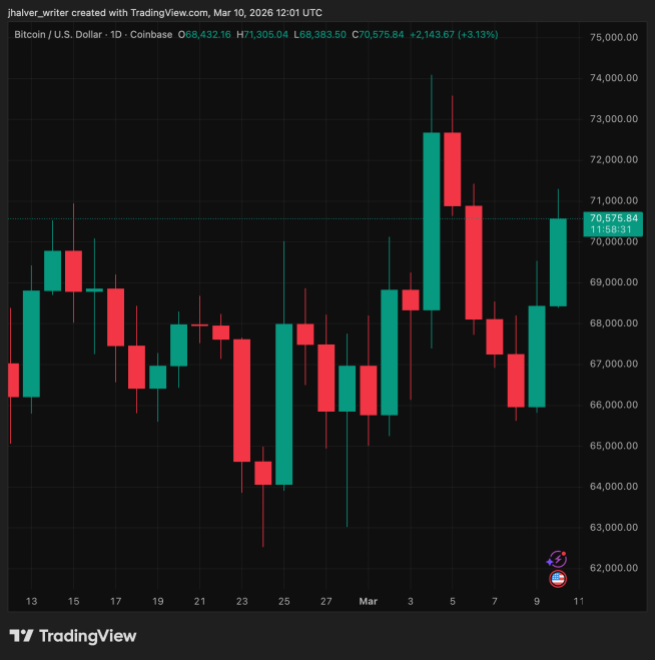
BTC's price trends to the upside on the daily chart. Source: BTCUSD on Tradingview

Cover image from ChatGPT, BTCUSD chart from Tradingview

Related Questions

QWhat was the Gwangju District Prosecutors' Office's action regarding the 320.8 Bitcoins they recovered?

AThe Gwangju District Prosecutors' Office sold all 320.8 Bitcoins at market price and returned the proceeds of 31.5 billion won to the national treasury.

QFrom whom were the Bitcoins originally seized, and what was the source of these funds?

AThe Bitcoins were originally seized from Ms. A, the daughter of the operators of a 390 billion won illegal gambling ring.

QHow did the prosecutors manage to recover the Bitcoins after they were lost during the transfer process?

AThe Bitcoins were recovered when they 'returned to an existing wallet, where the prosecutors controlled the keys, without their knowledge' on February 18.

QWhat precaution did the prosecutors take when liquidating the Bitcoin to avoid market impact?

AThe prosecutors executed the sale gradually over 11 days, from February 24 to March 6, to avoid disturbing the market price.

QWhat broader issue for governments do these repeated custody failures in South Korea highlight?

AThese incidents raise the question of whether governments, or at least South Korea's government, are prepared to safeguard the digital assets they confiscate.

Related Reads

Bitwise: Bullish on Bitcoin's Performance in the Second Half of the Year, AI and Regulation Will Spark a New Altcoin Season

Bitwise CIO Matt Hougan and Research Lead Ryan Rasmussen express strong bullish sentiment on Bitcoin's long-term prospects, suggesting that its $1 million price target may be too conservative. They argue Bitcoin serves a dual role: as digital gold and a potential global settlement asset, especially amid declining trust in traditional monetary systems. Despite a weak Q1 2026 where nearly all crypto assets and prices saw double-digit declines, the analysts remain optimistic due to strong forward-looking catalysts, including institutional adoption via Bitcoin ETFs from major firms like Morgan Stanley and Goldman Sachs. Geopolitical instability, such as Iran’s mention of using Bitcoin for international payments, increases the value of Bitcoin’s “out-of-the-money call option” as a non-political, global settlement currency. This enhances its appeal beyond a mere store of value. . Additionally, Hougan highlights that a clearer regulatory token framework under current SEC leadership, combined with AI efficiency gains and high-performance blockchains, could fuel a new “altseason” by late 2026. This may lead to a wave of legitimate, value-capturing token projects, unlike the earlier ICO boom. . Bitwise also announced an Avalanche ETF, citing its unique architecture and rapid growth in real-world asset (RWA) tokenization, which has surged 10x to nearly $30 billion in two years. The firm believes Layer 1 blockchains are still early in their growth cycle, with significant potential ahead.

marsbit19m ago

Bitwise: Bullish on Bitcoin's Performance in the Second Half of the Year, AI and Regulation Will Spark a New Altcoin Season

marsbit19m ago

Trading

Spot
Futures

Hot Articles

What is $BITCOIN

DIGITAL GOLD ($BITCOIN): A Comprehensive Analysis Introduction to DIGITAL GOLD ($BITCOIN) DIGITAL GOLD ($BITCOIN) is a blockchain-based project operating on the Solana network, which aims to combine the characteristics of traditional precious metals with the innovation of decentralized technologies. While it shares a name with Bitcoin, often referred to as “digital gold” due to its perception as a store of value, DIGITAL GOLD is a separate token designed to create a unique ecosystem within the Web3 landscape. Its goal is to position itself as a viable alternative digital asset, although specifics regarding its applications and functionalities are still developing. What is DIGITAL GOLD ($BITCOIN)? DIGITAL GOLD ($BITCOIN) is a cryptocurrency token explicitly designed for use on the Solana blockchain. In contrast to Bitcoin, which provides a widely recognized value storage role, this token appears to focus on broader applications and characteristics. Notable aspects include: Blockchain Infrastructure: The token is built on the Solana blockchain, known for its capacity to handle high-speed and low-cost transactions. Supply Dynamics: DIGITAL GOLD has a maximum supply capped at 100 quadrillion tokens (100P $BITCOIN), although details regarding its circulating supply are currently undisclosed. Utility: While precise functionalities are not explicitly outlined, there are indications that the token could be utilized for various applications, potentially involving decentralized applications (dApps) or asset tokenization strategies. Who is the Creator of DIGITAL GOLD ($BITCOIN)? At present, the identity of the creators and development team behind DIGITAL GOLD ($BITCOIN) remains unknown. This situation is typical among many innovative projects within the blockchain space, particularly those aligning with decentralized finance and meme coin phenomena. While such anonymity may foster a community-driven culture, it intensifies concerns about governance and accountability. Who are the Investors of DIGITAL GOLD ($BITCOIN)? The available information indicates that DIGITAL GOLD ($BITCOIN) does not have any known institutional backers or prominent venture capital investments. The project seems to operate on a peer-to-peer model focused on community support and adoption rather than traditional funding routes. Its activity and liquidity are primarily situated on decentralized exchanges (DEXs), such as PumpSwap, rather than established centralized trading platforms, further highlighting its grassroots approach. How DIGITAL GOLD ($BITCOIN) Works The operational mechanics of DIGITAL GOLD ($BITCOIN) can be elaborated on based on its blockchain design and network attributes: Consensus Mechanism: By leveraging Solana’s unique proof-of-history (PoH) combined with a proof-of-stake (PoS) model, the project ensures efficient transaction validation contributing to the network's high performance. Tokenomics: While specific deflationary mechanisms have not been extensively detailed, the vast maximum token supply implies that it may cater to microtransactions or niche use cases that are still to be defined. Interoperability: There exists the potential for integration with Solana’s broader ecosystem, including various decentralized finance (DeFi) platforms. However, the details regarding specific integrations remain unspecified. Timeline of Key Events Here is a timeline that highlights significant milestones concerning DIGITAL GOLD ($BITCOIN): 2023: The initial deployment of the token occurs on the Solana blockchain, marked by its contract address. 2024: DIGITAL GOLD gains visibility as it becomes available for trading on decentralized exchanges like PumpSwap, allowing users to trade it against SOL. 2025: The project witnesses sporadic trading activity and potential interest in community-led engagements, although no noteworthy partnerships or technical advancements have been documented as of yet. Critical Analysis Strengths Scalability: The underlying Solana infrastructure supports high transaction volumes, which could enhance the utility of $BITCOIN in various transaction scenarios. Accessibility: The potential low trading price per token could attract retail investors, facilitating wider participation due to fractional ownership opportunities. Risks Lack of Transparency: The absence of publicly known backers, developers, or an audit process may yield skepticism regarding the project's sustainability and trustworthiness. Market Volatility: The trading activity is heavily reliant on speculative behavior, which can result in significant price volatility and uncertainty for investors. Conclusion DIGITAL GOLD ($BITCOIN) emerges as an intriguing yet ambiguous project within the rapidly evolving Solana ecosystem. While it attempts to leverage the “digital gold” narrative, its departure from Bitcoin's established role as a store of value underscores the need for a clearer differentiation of its intended utility and governance structure. Future acceptance and adoption will likely depend on addressing the current opacity and defining its operational and economic strategies more explicitly. Note: This report encompasses synthesised information available as of October 2023, and developments may have transpired beyond the research period.

363 Total ViewsPublished 2025.05.13Updated 2025.05.13

What is $BITCOIN

Discussions

Welcome to the HTX Community. Here, you can stay informed about the latest platform developments and gain access to professional market insights. Users' opinions on the price of BTC (BTC) are presented below.

活动图片















