Bitcoin flashes 3 macro-bottom signals – But can BTC reach $70K?

ambcryptoPublished on 2026-07-22Last updated on 2026-07-22

Abstract

The article discusses Bitcoin's recent price movement above $66,000 and a shift in market analysis from focusing on a local bottom to a potential macro-cycle bottom. It cites a crypto analyst noting that BTC has flashed three historical technical signals that previously coincided with major market bottoms in 2015, 2019, and 2022, suggesting the current zone could be a strong long-term accumulation area. However, the article also highlights a significant challenge: despite the price breakout, on-chain data shows a lack of supporting liquidity. Stablecoin dominance is rising while the total stablecoin market cap is shrinking, with capital continuing to leave exchanges. This divergence indicates that while the technical setup is bullish, the rally may struggle to sustain enough momentum for a decisive move into the $70,000 region without an influx of fresh capital.

The market narrative is finally shifting from a local bottom to a macro bottom.

From a technical standpoint, Bitcoin’s breakout above $66,000 has sparked a wave of bullish sentiment.

Many analysts are arguing that the cycle low may already be in. While BTC was stuck consolidating between $60k- $65k, the discussion largely revolved around whether it was simply a local bottom.

Now, however, the focus is gradually shifting toward a move into the $70,000 region.

Looking at the charts, that shift isn’t entirely without merit.

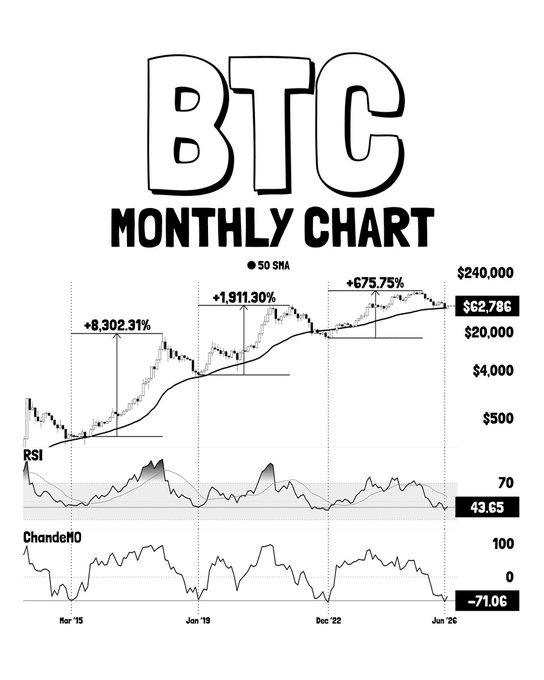
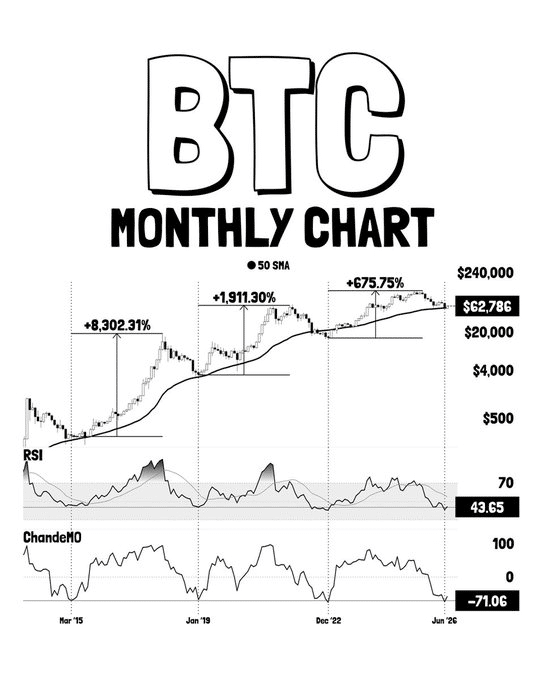
According to crypto analyst Ali Martinez, Bitcoin has once again flashed the same three technical signals that have historically coincided with macro cycle bottoms.

Those signals include the monthly RSI dropping to around 43.65, the Chande Momentum Oscillator (CMO) falling to roughly -71, and Bitcoin trading near its 50-month moving average.
Source: X

Notably, the pattern has repeated across previous cycles.

In 2015, the setup appeared around $235 before Bitcoin [BTC] went on to rally more than 8,300%.

In early 2019, it flashed near $3,333, preceding a gain of 1,900%. The same technical cluster returned in late 2022, around $16k, shortly after Bitcoin bottomed near $15k, before the market rallied 675%.

Interestingly, Bitcoin’s correction to $58k last month triggered this same setup once again.

So, if history is any guide, this alignment has consistently marked one of Bitcoin’s strongest long-term accumulation zones, adding weight to the idea that the market may already be transitioning from a local bottom to a macro one.

Liquidity remains Bitcoin’s biggest test

Bullish continuation ultimately depends on liquidity, and that’s where Bitcoin’s rally could still face a key test.

From a technical standpoint, stablecoin dominance has climbed to around 13%, narrowing the gap with Ethereum’s 10%+ market dominance.

At the same time, the total stablecoin market cap has fallen by more than $10 billion over the past month, suggesting capital is still flowing out rather than back into the crypto.

Notably, on-chain data supports this trend.

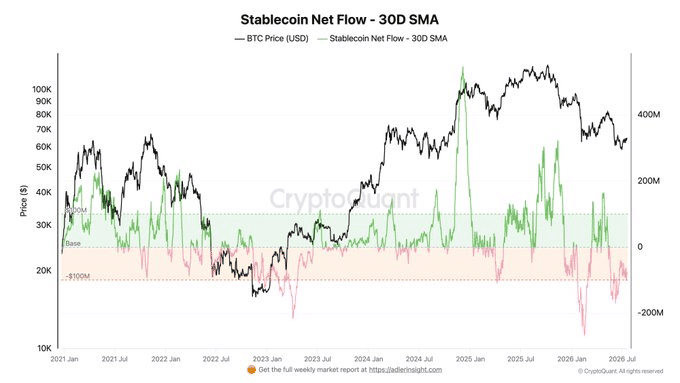
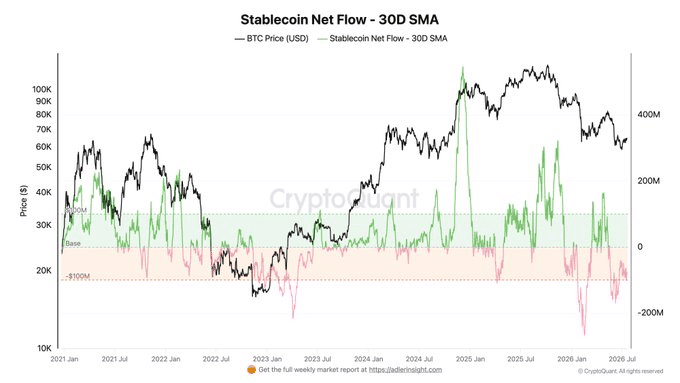
As the chart below shows, Bitcoin is holding above $65,000, but the liquidity needed to sustain the rally appears to be fading. Stablecoins have been leaving exchanges for 35 consecutive days, while Bitcoin has yet to see a meaningful pickup in spot accumulation.
Source: CryptoQuant

In other words, price is breaking out, but liquidity isn’t following.

Against this backdrop, the shift from a local bottom to a macro bottom may still need stronger confirmation.

While Bitcoin’s breakout above $66,000 is technically bullish. However, the lack of fresh liquidity suggests the move could struggle to sustain enough momentum for a decisive breakout into the $70k zone.


Final Summary


Trending Cryptos

Related Questions

QWhat are the three technical signals that, according to analyst Ali Martinez, have historically coincided with Bitcoin's macro cycle bottoms?

AThe three signals are: the monthly RSI dropping to around 43.65, the Chande Momentum Oscillator (CMO) falling to roughly -71, and Bitcoin trading near its 50-month moving average.

QWhat does the current trend in stablecoin data suggest about liquidity for a potential Bitcoin rally?

AThe stablecoin market cap has fallen by over $10 billion, and stablecoins have been leaving exchanges for 35 consecutive days. This suggests capital is flowing out of crypto, and the liquidity needed to sustain a rally may be fading.

QBased on the article, what is the main challenge Bitcoin faces in reaching the $70,000 zone despite its technical breakout?

AThe main challenge is a lack of fresh liquidity. While the price is breaking out, on-chain data shows liquidity isn't following, which could prevent the rally from sustaining enough momentum for a decisive breakout above $70,000.

QAccording to historical patterns mentioned, what typically followed the appearance of the three technical signals in previous Bitcoin cycles?

AHistorically, the appearance of these signals marked strong long-term accumulation zones and preceded major rallies. For example, after the signals appeared in 2015, Bitcoin rallied over 8,300%; in 2019, it gained 1,900%; and in late 2022, the market rallied 675%.

QWhat shift in market narrative is discussed in the beginning of the article?

AThe market narrative is shifting from debating whether a recent low was just a local bottom to considering that Bitcoin may be forming a macro cycle bottom, with focus moving toward a potential push into the $70,000 region.

Related Reads

The Clarity Act's Journey Through Congress: The Thorny Path of Bipartisan Compromise in the U.S.

The U.S. Congress is struggling to advance the crypto market structure bill known as the Clarity Act, with bipartisan compromise proving difficult. Key hurdles include unresolved disputes over "yield" products and, more critically, the inclusion of strong ethics provisions for elected officials—a non-negotiable demand for many Democrats. While a compromise on yield was reached in May, securing only limited Democratic support in committee, the separate Senate Agriculture Committee version later passed with no Democratic votes due to the ethics impasse. As Republicans push for a full Senate vote in July, demands for ethics rules have expanded, and other contentious issues like developer protections and concerns from law enforcement and large banks further complicate negotiations. Despite consensus on the need for legislation, the path forward is unclear. Recent discussions between senators and White House officials aim to find acceptable ethics language. Some lawmakers question whether a compromise text can garner enough bipartisan support, with one Democrat stating the current proposal lacks the strong ethics provisions required for their vote. Potential short-term goals for the crypto community include symbolic Senate action before the August recess, a longer-term aim for passage by 2026, or establishing a detailed framework that addresses ethics and other compromises. The process remains arduous, relying on the traditional, vote-by-vote effort to build bipartisan support.

marsbit11m ago

The Clarity Act's Journey Through Congress: The Thorny Path of Bipartisan Compromise in the U.S.

marsbit11m ago

Are Kalshi and Polymarket Founders at Odds? This Business Rivalry Is More Brutal Than You Think

"The Rivalry Between Kalshi and Polymarket Founders Turns Bitter and Litigious" The intense feud between Tarek Mansour, CEO of Kalshi, and Shayne Coplan, founder of Polymarket, has escalated far beyond typical business competition into personal animosity and regulatory battles. Both lead billion-dollar prediction market platforms, but their approaches differ sharply. Kalshi positions itself as the compliant operator, securing U.S. regulatory approval before launching. In contrast, Polymarket initially operated offshore, allowing U.S. users to access its platform via VPN, which drew regulatory scrutiny. The conflict reached a peak in November 2024 when FBI agents raided Coplan's New York apartment. While Coplan publicly blamed political motives, his team privately suspected Kalshi was involved. According to sources, Kalshi's lawyers had previously reported Polymarket's operations to federal prosecutors, highlighting its accessibility to U.S. users despite a ban. This incident fueled mutual accusations and underhanded tactics, including social media smear campaigns and attempts to sabotage each other's major business deals. Their rivalry also played out in Washington, influencing regulatory debates. Kalshi actively lobbied against Polymarket's practices, framing them as illegal and unethical. Polymarket, after facing a CFTC fine and investigation, later acquired a licensed U.S. firm to launch a domestic app, regaining a foothold. Despite the hostility, both companies have seen massive growth, with combined trading volumes soaring. However, increased regulatory scrutiny, particularly around insider trading on Polymarket's platform, continues to pose challenges. The founders' deep-seated mutual disdain ensures their battle for market dominance remains as much a personal vendetta as a commercial one.

marsbit19m ago

Are Kalshi and Polymarket Founders at Odds? This Business Rivalry Is More Brutal Than You Think

marsbit19m ago

Bank of America Quietly Positions: Could $6 Trillion in Bank Deposits Flow into Stablecoins?

Bank of America (BofA) is making strategic moves in digital assets, appointing senior leaders to advance a platform covering stablecoins, tokenized deposits, custody, and crypto settlement. This comes amid a broader discussion about the potential migration of trillions in bank deposits to stablecoins. A cited TBAC report estimated up to $6.6 trillion in transactional deposits could be at risk of moving to stablecoins long-term, a point BofA's CEO previously conditioned on stablecoins being allowed to pay interest. The regulatory landscape is evolving, with the GENIUS Act setting a final implementation deadline for January 2027. Major banks, however, are not waiting; JPMorgan, Citi, BofA, and others are already developing tokenized deposit networks and services. Industry observers note that while retail crypto trading is sluggish, institutional adoption of stablecoins for real-world use cases is driving growth. Despite the activity, some analysts remain cautious, noting banks have a long history of blockchain announcements and that true structural change is slow. The stablecoin market itself has seen a recent dip from its peak. Optimistic projections, however, foresee significant growth, with stablecoin settlement volume already reaching $33 trillion in 2025. The race is on for the post-January 2027 landscape, where regulatory clarity is expected to accelerate the fusion of traditional finance and crypto.

marsbit24m ago

Bank of America Quietly Positions: Could $6 Trillion in Bank Deposits Flow into Stablecoins?

marsbit24m ago

Trading

Spot

Hot Articles

What is $BITCOIN

DIGITAL GOLD ($BITCOIN): A Comprehensive Analysis Introduction to DIGITAL GOLD ($BITCOIN) DIGITAL GOLD ($BITCOIN) is a blockchain-based project operating on the Solana network, which aims to combine the characteristics of traditional precious metals with the innovation of decentralized technologies. While it shares a name with Bitcoin, often referred to as “digital gold” due to its perception as a store of value, DIGITAL GOLD is a separate token designed to create a unique ecosystem within the Web3 landscape. Its goal is to position itself as a viable alternative digital asset, although specifics regarding its applications and functionalities are still developing. What is DIGITAL GOLD ($BITCOIN)? DIGITAL GOLD ($BITCOIN) is a cryptocurrency token explicitly designed for use on the Solana blockchain. In contrast to Bitcoin, which provides a widely recognized value storage role, this token appears to focus on broader applications and characteristics. Notable aspects include: Blockchain Infrastructure: The token is built on the Solana blockchain, known for its capacity to handle high-speed and low-cost transactions. Supply Dynamics: DIGITAL GOLD has a maximum supply capped at 100 quadrillion tokens (100P $BITCOIN), although details regarding its circulating supply are currently undisclosed. Utility: While precise functionalities are not explicitly outlined, there are indications that the token could be utilized for various applications, potentially involving decentralized applications (dApps) or asset tokenization strategies. Who is the Creator of DIGITAL GOLD ($BITCOIN)? At present, the identity of the creators and development team behind DIGITAL GOLD ($BITCOIN) remains unknown. This situation is typical among many innovative projects within the blockchain space, particularly those aligning with decentralized finance and meme coin phenomena. While such anonymity may foster a community-driven culture, it intensifies concerns about governance and accountability. Who are the Investors of DIGITAL GOLD ($BITCOIN)? The available information indicates that DIGITAL GOLD ($BITCOIN) does not have any known institutional backers or prominent venture capital investments. The project seems to operate on a peer-to-peer model focused on community support and adoption rather than traditional funding routes. Its activity and liquidity are primarily situated on decentralized exchanges (DEXs), such as PumpSwap, rather than established centralized trading platforms, further highlighting its grassroots approach. How DIGITAL GOLD ($BITCOIN) Works The operational mechanics of DIGITAL GOLD ($BITCOIN) can be elaborated on based on its blockchain design and network attributes: Consensus Mechanism: By leveraging Solana’s unique proof-of-history (PoH) combined with a proof-of-stake (PoS) model, the project ensures efficient transaction validation contributing to the network's high performance. Tokenomics: While specific deflationary mechanisms have not been extensively detailed, the vast maximum token supply implies that it may cater to microtransactions or niche use cases that are still to be defined. Interoperability: There exists the potential for integration with Solana’s broader ecosystem, including various decentralized finance (DeFi) platforms. However, the details regarding specific integrations remain unspecified. Timeline of Key Events Here is a timeline that highlights significant milestones concerning DIGITAL GOLD ($BITCOIN): 2023: The initial deployment of the token occurs on the Solana blockchain, marked by its contract address. 2024: DIGITAL GOLD gains visibility as it becomes available for trading on decentralized exchanges like PumpSwap, allowing users to trade it against SOL. 2025: The project witnesses sporadic trading activity and potential interest in community-led engagements, although no noteworthy partnerships or technical advancements have been documented as of yet. Critical Analysis Strengths Scalability: The underlying Solana infrastructure supports high transaction volumes, which could enhance the utility of $BITCOIN in various transaction scenarios. Accessibility: The potential low trading price per token could attract retail investors, facilitating wider participation due to fractional ownership opportunities. Risks Lack of Transparency: The absence of publicly known backers, developers, or an audit process may yield skepticism regarding the project's sustainability and trustworthiness. Market Volatility: The trading activity is heavily reliant on speculative behavior, which can result in significant price volatility and uncertainty for investors. Conclusion DIGITAL GOLD ($BITCOIN) emerges as an intriguing yet ambiguous project within the rapidly evolving Solana ecosystem. While it attempts to leverage the “digital gold” narrative, its departure from Bitcoin's established role as a store of value underscores the need for a clearer differentiation of its intended utility and governance structure. Future acceptance and adoption will likely depend on addressing the current opacity and defining its operational and economic strategies more explicitly. Note: This report encompasses synthesised information available as of October 2023, and developments may have transpired beyond the research period.

971 Total ViewsPublished 2025.05.13Updated 2025.05.13

What is $BITCOIN

Discussions

Welcome to the HTX Community. Here, you can stay informed about the latest platform developments and gain access to professional market insights. Users' opinions on the price of BTC (BTC) are presented below.

活动图片