Bitcoin Dominance Shifts: Crypto Usage Spreads Beyond Bitcoin as $HYPER Keeps Gaining

bitcoinistPublished on 2026-02-04Last updated on 2026-02-04

Abstract

The cryptocurrency market is shifting from passive Bitcoin holding to active yield-seeking on Layer 2 infrastructure. Capital is flowing toward solutions that unlock liquidity and utility within the Bitcoin ecosystem rather than leaving it. Bitcoin Hyper ($HYPER) is leading this transition as a Bitcoin Layer 2 solution integrating the Solana Virtual Machine (SVM), enabling sub-second transaction finality and high-performance execution while maintaining Bitcoin's security. The project has raised over $31.2M in its presale, with significant whale purchases indicating strong institutional interest. This technological convergence allows for DeFi, gaming, and high-speed payments directly on Bitcoin, addressing scalability limitations and bridging risks associated with cross-chain transactions.

Trusted Editorial content, reviewed by leading industry experts and seasoned editors. Ad Disclosure

Quick Facts:

  • ➡️ Market Shift: Capital is moving from passive Bitcoin holding to active yield-seeking on Layer 2 infrastructure.
  • ➡️ TTechnological Convergence: The integration of the Solana Virtual Machine (SVM) on Bitcoin enables sub-second finality for the first time.
  • ➡️ Smart Money Flow: Bitcoin Hyper has raised over $31.2M, with confirmed whale purchases signaling strong institutional interest.
  • ➡️ Utility Focus: New protocols are unlocking DeFi, gaming, and high-speed payments directly within the Bitcoin security perimeter.

The narrative around digital assets is undergoing a fundamental structural shift. Sure, Bitcoin remains the undisputed king of market capitalization.

But look at the on-chain metrics: capital is flowing toward infrastructure designed to unlock liquidity, not just store it. The era of Bitcoin solely as ‘digital gold’ is fading. The market is pivoting toward ‘programmable Bitcoin.’ That evolution matters.

It signals that investors aren’t satisfied with passive holding anymore, they’re demanding yield, velocity, and utility from their $BTC allocations.

What most coverage misses is that this liquidity isn’t leaving the Bitcoin ecosystem. It’s moving up the stack. Historically, mainnet congestion and restrictive scripting pushed developers toward Solana or Ethereum. But let’s be honest: bridging assets across different consensus mechanisms creates security risks that institutions just won’t touch.

The data points to a massive appetite for solutions that keep collateral anchored to Bitcoin’s security model while offering the execution speed of modern smart contract chains.

This demand for scalability without security compromise has created a breakout moment for Layer 2 solutions. As usage spreads beyond simple peer-to-peer transfers, projects merging Proof-of-Work security with high-performance execution are capturing market share.

Leading this charge is Bitcoin Hyper ($HYPER), a protocol bridging the gap between Bitcoin’s settlement assurance and the high-frequency demands of modern DeFi.

You can buy $HYPER here.

Bitcoin Hyper Breaks Through Core Limitations With SVM Integration

The bottleneck for Bitcoin adoption in DeFi has always been technical, not financial. Bitcoin’s base layer manages roughly 7 transactions per second (TPS) with 10-minute block times. For complex trading or gaming?

That’s impossible. Bitcoin Hyper ($HYPER) fixes this by integrating the Solana Virtual Machine (SVM) directly as a Layer 2 execution environment.

That architectural decision changes the game. By using a modular approach, Bitcoin L1 for settlement, SVM L2 for execution, Bitcoin Hyper delivers sub-second finality. It allows developers to write in Rust and deploy dApps that feel as snappy as Solana but settle on Bitcoin.
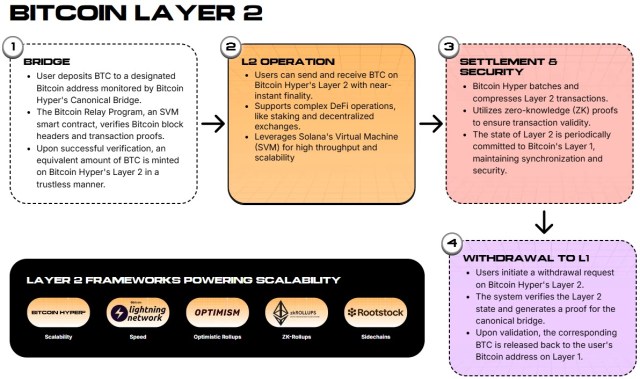
This opens the door for high-speed payments and sophisticated DeFi protocols like derivatives (which require real-time liquidation engines that the mainnet simply can’t handle).

The linchpin? A Decentralized Canonical Bridge. It lets users transfer value without entrusting funds to centralized custodians, solving the ‘bridge risk’ that has plagued crypto for years. Plus, with an SDK and API in Rust, there’s a clear strategy to onboard existing Solana talent into the Bitcoin economy.

.Learn more about Bitcoin Hyper here.

$HYPER Presale Surge Signals Institutional Appetite for Bitcoin Scalability

Financial metrics suggest the market is pricing in a major shift toward Bitcoin L2s. According to the official presale page, Bitcoin Hyper ($HYPER) has raised an impressive $31.2M so far, with tokens currently priced at $0.0136751.
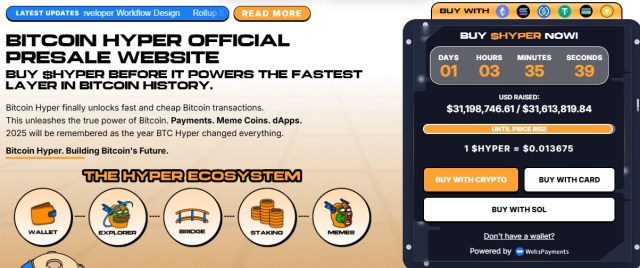
That level of capital injection during a presale phase is notable. It indicates validation not just from retail speculators, but from deeper-pocketed investors hunting for infrastructure plays.

Smart money appears to be positioning early. On-chain data from Etherscan shows three whale wallets accumulated $1M in recent transactions.

The tokenomics structure reinforces this long-term alignment. The protocol offers high APY for staking immediately after the Token Generation Event (TGE), with a modest 7-day vesting period for presale stakers. This mechanism reduces immediate sell pressure while rewarding participants who actually engage with governance.

As the first-ever Bitcoin Layer 2 to leverage the SVM, $HYPER is positioning itself to capture the liquidity currently dormant in hundreds of millions of idle BTC wallets.

Get your $HYPER today.

This article is for informational purposes only and does not constitute financial advice. Cryptocurrency investments carry high risks, including total loss of capital. Always perform your own due diligence before investing.

Editorial Process for bitcoinist is centered on delivering thoroughly researched, accurate, and unbiased content. We uphold strict sourcing standards, and each page undergoes diligent review by our team of top technology experts and seasoned editors. This process ensures the integrity, relevance, and value of our content for our readers.

patrubogdan

Follow

Full Profile

Related Posts

Crypto Market Structure Bill Nears Key Moment As CFTC Chair Signals Progress Within Months

Dubai’s $280M Diamond Tokenization Sets RWA Precedent as Bitcoin Hyper Secures $31.2M

Aave Scraps Avara and Family Wallet as SUBBD Momentum Builds

Binance Crushes Competition With $155B Asset Surge; $HYPER Emerging as Bitcoin L2 Leader

Criptomoneda prometedora para invertir ante el cambio de sentimiento: el auge de la infraestructura Bitcoin

Criptomoneda prometedora para invertir mientras cambia el sentimiento del mercado: Bitcoin Hyper redefine la Capa 2

Trending Cryptos

Related Questions

QWhat is the main shift happening in the cryptocurrency market according to the article?

AThe main shift is capital moving from passive Bitcoin holding to active yield-seeking on Layer 2 infrastructure, signaling a pivot towards 'programmable Bitcoin' that offers utility, yield, and velocity.

QWhat key technological innovation does Bitcoin Hyper ($HYPER) use to solve Bitcoin's scalability issues?

ABitcoin Hyper integrates the Solana Virtual Machine (SVM) as a Layer 2 execution environment, enabling sub-second finality and high-performance smart contracts while settling on Bitcoin's secure base layer.

QHow much funding has Bitcoin Hyper ($HYPER) raised in its presale, and what does this indicate?

ABitcoin Hyper has raised over $31.2 million in its presale, indicating strong institutional interest and validation from deep-pocketed investors seeking Bitcoin scalability solutions.

QWhat specific problem does Bitcoin Hyper's Decentralized Canonical Bridge solve?

AIt solves the 'bridge risk' problem by allowing users to transfer value between layers without entrusting funds to centralized custodian, enhancing security and decentralization.

QWhat types of applications does the article suggest Bitcoin Hyper's technology will enable?

AThe technology will enable high-speed DeFi protocols (like derivatives with real-time liquidation), gaming applications, and sophisticated payment systems that require sub-second finality, all secured by Bitcoin's base layer.

Related Reads

New ChatGPT Feature: AI Begins Monitoring Users

OpenAI has launched "Computer History," a new feature for its ChatGPT desktop app on macOS, designed to track user activity across applications and websites. This allows the AI model to use this data to provide more accurate and personalized responses in subsequent conversations. The feature, released on August 13th, is available to Pro, Business, and Enterprise subscribers. However, its rollout in the European Economic Area, the UK, and Switzerland is delayed as OpenAI works to align the tool with local data processing regulations. Computer History operates in the background, logging user activity into a temporary timeline. Users can review, manage, or delete this history via the app's interface or macOS menu bar. The feature is opt-in and requires explicit user activation in the settings. This release replaces and expands upon an earlier experimental project called Chronicle. OpenAI states the new version is more computationally efficient and offers improved privacy controls. The launch coincides with other AI advancements from the company, including a high-speed GPT-5.6 model. The article notes potential technical risks associated with the predecessor, Chronicle, such as prompt injection vulnerabilities and unencrypted local data storage. It also highlights the competitive landscape, where similar memory features are being developed by rivals like Anthropic's Claude and Google's Gemini. The delayed European rollout underscores the ongoing challenge of balancing deep personalization with stringent data protection laws.

cryptonews.ru1h ago

New ChatGPT Feature: AI Begins Monitoring Users

cryptonews.ru1h ago

GPT-5 Also Has Tip-of-the-Tongue Moments, Google Tested 4.5 Million Times: The Keys Are Lost

Google researchers have discovered that advanced AI models like GPT-5 and Gemini 3 experience a phenomenon akin to the human "tip-of-the-tongue" state, where they possess knowledge but fail to retrieve it. Their study, "Empty Shelves or Lost Keys?" (ICML 2026), introduces the "Knowledge Portrait" framework to analyze factual knowledge in models, distinguishing between failure to encode a fact versus failure to recall it. Testing on 13 models across 2.15 million queries from the WikiProfile benchmark revealed that state-of-the-art models successfully encode 95-98% of facts into their parameters. However, when asked directly, they fail to recall 26-34% of these known facts. Enabling chain-of-thought ("thinking") reasoning reduces this recall failure to 11-12%, recovering 40-65% of the previously unrecalled but encoded facts. The research identifies two key bottlenecks: recalling obscure ("long-tail") facts and answering reversed queries (e.g., "Who is Tom Cruise's mother?" vs. "Whose son is Tom Cruise?"). While scaling model size effectively reduces encoding failures, it does little to improve recall rates. In larger models, recall failure becomes the dominant source of factual errors, accounting for over 70% of mistakes in GPT-5.2. The findings suggest that for top models, the primary challenge is no longer storing knowledge but accessing it efficiently. Future accuracy gains may depend more on improved inference-time methods and "meta-cognitive" abilities, enabling models to recognize when they need to engage in deeper reasoning to retrieve information they already know.

marsbit1h ago

GPT-5 Also Has Tip-of-the-Tongue Moments, Google Tested 4.5 Million Times: The Keys Are Lost

marsbit1h ago

Trading

Spot

Hot Articles

What is $BITCOIN

DIGITAL GOLD ($BITCOIN): A Comprehensive Analysis Introduction to DIGITAL GOLD ($BITCOIN) DIGITAL GOLD ($BITCOIN) is a blockchain-based project operating on the Solana network, which aims to combine the characteristics of traditional precious metals with the innovation of decentralized technologies. While it shares a name with Bitcoin, often referred to as “digital gold” due to its perception as a store of value, DIGITAL GOLD is a separate token designed to create a unique ecosystem within the Web3 landscape. Its goal is to position itself as a viable alternative digital asset, although specifics regarding its applications and functionalities are still developing. What is DIGITAL GOLD ($BITCOIN)? DIGITAL GOLD ($BITCOIN) is a cryptocurrency token explicitly designed for use on the Solana blockchain. In contrast to Bitcoin, which provides a widely recognized value storage role, this token appears to focus on broader applications and characteristics. Notable aspects include: Blockchain Infrastructure: The token is built on the Solana blockchain, known for its capacity to handle high-speed and low-cost transactions. Supply Dynamics: DIGITAL GOLD has a maximum supply capped at 100 quadrillion tokens (100P $BITCOIN), although details regarding its circulating supply are currently undisclosed. Utility: While precise functionalities are not explicitly outlined, there are indications that the token could be utilized for various applications, potentially involving decentralized applications (dApps) or asset tokenization strategies. Who is the Creator of DIGITAL GOLD ($BITCOIN)? At present, the identity of the creators and development team behind DIGITAL GOLD ($BITCOIN) remains unknown. This situation is typical among many innovative projects within the blockchain space, particularly those aligning with decentralized finance and meme coin phenomena. While such anonymity may foster a community-driven culture, it intensifies concerns about governance and accountability. Who are the Investors of DIGITAL GOLD ($BITCOIN)? The available information indicates that DIGITAL GOLD ($BITCOIN) does not have any known institutional backers or prominent venture capital investments. The project seems to operate on a peer-to-peer model focused on community support and adoption rather than traditional funding routes. Its activity and liquidity are primarily situated on decentralized exchanges (DEXs), such as PumpSwap, rather than established centralized trading platforms, further highlighting its grassroots approach. How DIGITAL GOLD ($BITCOIN) Works The operational mechanics of DIGITAL GOLD ($BITCOIN) can be elaborated on based on its blockchain design and network attributes: Consensus Mechanism: By leveraging Solana’s unique proof-of-history (PoH) combined with a proof-of-stake (PoS) model, the project ensures efficient transaction validation contributing to the network's high performance. Tokenomics: While specific deflationary mechanisms have not been extensively detailed, the vast maximum token supply implies that it may cater to microtransactions or niche use cases that are still to be defined. Interoperability: There exists the potential for integration with Solana’s broader ecosystem, including various decentralized finance (DeFi) platforms. However, the details regarding specific integrations remain unspecified. Timeline of Key Events Here is a timeline that highlights significant milestones concerning DIGITAL GOLD ($BITCOIN): 2023: The initial deployment of the token occurs on the Solana blockchain, marked by its contract address. 2024: DIGITAL GOLD gains visibility as it becomes available for trading on decentralized exchanges like PumpSwap, allowing users to trade it against SOL. 2025: The project witnesses sporadic trading activity and potential interest in community-led engagements, although no noteworthy partnerships or technical advancements have been documented as of yet. Critical Analysis Strengths Scalability: The underlying Solana infrastructure supports high transaction volumes, which could enhance the utility of $BITCOIN in various transaction scenarios. Accessibility: The potential low trading price per token could attract retail investors, facilitating wider participation due to fractional ownership opportunities. Risks Lack of Transparency: The absence of publicly known backers, developers, or an audit process may yield skepticism regarding the project's sustainability and trustworthiness. Market Volatility: The trading activity is heavily reliant on speculative behavior, which can result in significant price volatility and uncertainty for investors. Conclusion DIGITAL GOLD ($BITCOIN) emerges as an intriguing yet ambiguous project within the rapidly evolving Solana ecosystem. While it attempts to leverage the “digital gold” narrative, its departure from Bitcoin's established role as a store of value underscores the need for a clearer differentiation of its intended utility and governance structure. Future acceptance and adoption will likely depend on addressing the current opacity and defining its operational and economic strategies more explicitly. Note: This report encompasses synthesised information available as of October 2023, and developments may have transpired beyond the research period.

1.8k Total ViewsPublished 2025.05.13Updated 2025.05.13

What is $BITCOIN

Discussions

Welcome to the HTX Community. Here, you can stay informed about the latest platform developments and gain access to professional market insights. Users' opinions on the price of BTC (BTC) are presented below.

活动图片