Bitcoin Didn’t ‘Fail’ Digital Gold: Markets Misread The Thesis, Galaxy’s Thorn Says

bitcoinistPublished on 2026-02-18Last updated on 2026-02-18

Abstract

Galaxy Digital's head of research, Alex Thorn, refutes the claim that Bitcoin has failed as "digital gold," arguing the term was always about its fundamental monetary properties—scarcity, durability, divisibility, and self-sovereignty—not a guarantee it would trade in lockstep with gold. Thorn emphasizes that Bitcoin's core value proposition, rooted in Satoshi Nakamoto's vision, lies in its unique ability to be transmitted digitally, a feature physical gold lacks. He frames the "digital gold" narrative not as a short-term correlation trade, but as a long-term thesis that the market may eventually value Bitcoin similarly to a monetary metal. Despite recent underperformance relative to gold, Thorn asserts Bitcoin's fundamentals remain strong and unchanged.

Galaxy Digital head of research Alex Thorn is pushing back on a growing critique that Bitcoin has “failed” its digital gold promise, arguing that the label was always about BTC’s monetary properties, not a guarantee it would trade like bullion in every macro regime.

In a post on X, Thorn said Bitcoin’s “failure to trade like gold as part of ‘the debasement trade’ since Sep. ‘25’ damaged its narrative with new entrants,” but framed that disappointment as a category error. “When bitcoiners said ‘digital gold’ they were describing its fundamental properties, not that it’s high beta to gold today,” he wrote, adding: “it comes from Satoshi.”

To make the point, Thorn shared a screenshot of a 2010 Bitcointalk exchange in which Satoshi Nakamoto offered a thought experiment about money emerging from scarcity plus transferability.

“Imagine there was a base metal as scarce as gold but with the following properties: boring grey in colour; not a good conductor of electricity; not particularly strong, but not ductile or easily malleable either; not useful for any practical or ornamental purpose,” Satoshi wrote. “And one special, magical property: can be transported over a communications channel. If it somehow acquired any value at all for whatever reason, then anyone wanting to transfer wealth over a long distance could buy some, transmit it, and have the recipient sell it.”

Thorn’s framing is that the “digital gold” analogy is rooted in that passage: Bitcoin resembles a scarce commodity in key monetary characteristics, while adding a feature that physical metals cannot match, native global portability over communications rails.

Bitcoin’s ‘Digital Gold’ Narrative As A Gap Trade

Thorn argued Satoshi’s point wasn’t that the market must price Bitcoin in tight relation to gold at all times, but that BTC’s structural attributes can support a gold-like monetary role if the market eventually converges on that valuation. In Thorn’s telling, the investment thesis is the spread between “fundamental gold-like properties” and the market’s willingness to price Bitcoin alongside gold and the probability of that spread narrowing.

He described Bitcoin’s underlying profile in terms commonly cited by long-term holders: scarcity and durability, with additional monetary traits such as divisibility and self-sovereignty, then pointed to transferability as the differentiator that makes the analogy more than branding. The “alpha,” in this framework, is not short-term co-movement with bullion, but the possibility that the market ultimately prices BTC more like a monetary metal.

The exchange drew agreement from 10T Holdings founder Dan Tapiero, who replied: “Well said.” Tapiero also suggested the current mood around Bitcoin feels like a familiar cycle reset: “So much fear out there on btc. Like the good ol days again.”

Not everyone accepted the premise. One user responded, “It never traded like gold. Just because people branded it like gold doesn’t mean it’s true.” Thorn replied: “that’s literally what i’m saying in the post,” underscoring that his argument is precisely that “digital gold” was never a promise of constant gold-like trading behavior.

Thorn also downplayed the idea that anything material has changed recently in Bitcoin itself. “Basically nothing has changed about bitcoin in the last 5 months,” he wrote, adding that “if anything the fundamentals are even more appealing.”

At press time, BTC traded at $68,048.
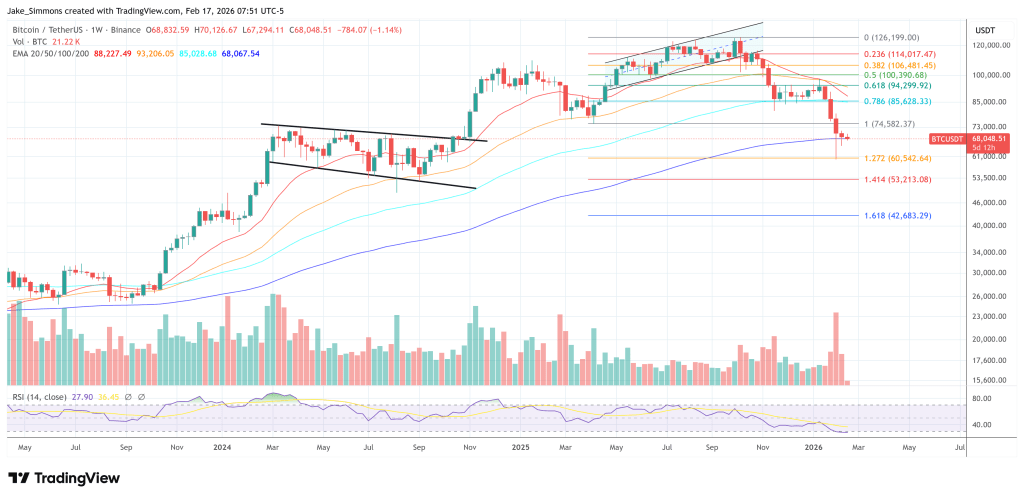
BTC must stay above the 200-week EMA, 1-week chart | Source: BTCUSDT on TradingView.com

Related Questions

QAccording to Alex Thorn, what was the original meaning of the 'digital gold' label for Bitcoin?

AAlex Thorn argues that the 'digital gold' label was always about Bitcoin's fundamental monetary properties, such as scarcity and transferability, not a guarantee that it would trade like bullion in every macro regime.

QWhat key property did Satoshi Nakamoto describe that differentiates Bitcoin from physical gold?

ASatoshi Nakamoto described a key 'magical property': Bitcoin 'can be transported over a communications channel,' giving it native global portability that physical metals cannot match.

QHow does Thorn describe the investment thesis for Bitcoin in relation to gold?

AThorn describes the investment thesis as the spread between Bitcoin's fundamental gold-like properties and the market's willingness to price it alongside gold, focusing on the probability of that spread narrowing over time.

QWhat was Dan Tapiero's reaction to Thorn's argument, and what did he compare the current market mood to?

ADan Tapiero agreed with Thorn's argument, replying 'Well said,' and suggested the current fearful mood around Bitcoin feels like a familiar cycle reset, reminiscent of 'the good ol days.'

QHow does Thorn respond to the critique that Bitcoin never traded like gold?

AThorn agrees with the critique, stating that his argument is precisely that 'digital gold' was never a promise of constant gold-like trading behavior, but rather a description of its monetary properties.

Related Reads

Anthropic Cries Wolf: Is the AGI Threat Real, or Just an IPO Story?

Anthropic has published an article titled "When AI builds itself," discussing the emerging concept of "recursive self-improvement," where AI begins to actively participate in designing, training, testing, and optimizing its own subsequent versions. The company presents internal data showing that by May 2026, over 80% of code merged into its codebase was written by Claude, its AI model. Claude's capabilities have expanded to handling complex, open-ended engineering tasks, achieving a 76% success rate in such areas, and even contributing to research processes, such as optimizing code performance and conducting AI safety experiments. Anthropic outlines an evolution from human-driven development to AI-assisted workflows, culminating in the current stage where AI agents can autonomously write, run, and delegate code. The company cautions that the path toward a "closed loop," where AI continuously improves itself, is becoming visible. It calls for coordinated global mechanisms to potentially slow or pause frontier AI development to allow safety research and societal structures to catch up. However, the timing of this warning coincides with Anthropic's preparations for an IPO, framing the narrative not just as a safety concern but also as a demonstration of Claude's advanced capabilities and its integral role in accelerating Anthropic's own R&D—creating a potential "flywheel" effect for competitive advantage. This contrasts with OpenAI's recent, more policy-oriented discussion of the same risks, highlighting the competitive dynamics in the AI industry as companies position themselves in both the technological and regulatory landscape.

marsbit44m ago

Anthropic Cries Wolf: Is the AGI Threat Real, or Just an IPO Story?

marsbit44m ago

BIT Research: ETF Purchases Have Slowed, Strategy (MicroStrategy) Has Slowed, What Else Can Drive Bitcoin's Rise?

Market Refocus on Inflation and Rate Expectations Weighs on Bitcoin Currently, the market is in a phase of macro-repricing dominated by inflation and interest rate expectations. Bitcoin, which previously benefited from easy liquidity and low inflation, is seeing its core bullish drivers weaken. These drivers were market expectations for interest rate cuts and strong inflows from Bitcoin ETFs and institutions like MicroStrategy (referred to as "Strategy" in the text). The logic has shifted. Recent high inflation data (e.g., CPI hitting 3.8% in a May 2026 report) has caused the market to sharply reduce its rate cut expectations for 2025 and even price in potential hikes. This is a key constraint for Bitcoin, as it lacks cash flows and is highly sensitive to rate expectations. Concurrently, institutional capital flows have slowed significantly. Following the hot CPI data, Bitcoin ETFs saw accelerated outflows, with around $4.3 billion leaving over a period. MicroStrategy's ability to keep adding substantial Bitcoin to its balance sheet is also diminishing. Together, ETF and MicroStrategy holdings total roughly $110 billion, but their momentum as growth engines is cooling. In summary, Bitcoin's current pressure stems not from its own fundamentals but from a changing macro environment. As long as inflation stays elevated, Bitcoin is likely to remain in a consolidating phase. However, historically, inflation eventually peaks. Once it recedes and rate cut expectations rebuild, institutional capital could return, potentially fueling a new and more robust recovery phase for Bitcoin.

marsbit52m ago

BIT Research: ETF Purchases Have Slowed, Strategy (MicroStrategy) Has Slowed, What Else Can Drive Bitcoin's Rise?

marsbit52m ago

Earning 1000 Trillion in Half a Year, 'Pocketing' 20 Million per Capita: This Round of Wealth Creation in the Korean Stock Market is Unprecedented in Scale

The South Korean stock market is experiencing an unprecedented wealth surge in 2026, with household equity and fund asset values soaring by over 1,000 trillion KRW (~$730bn) year-to-date. This translates to an average per capita wealth increase of roughly 20 million KRW, fueled by a historic 109% rally in the KOSPI index. The boom is driven by three converging forces: an AI-driven semiconductor supercycle boosting giants like Samsung and SK Hynix; the government's "Value-Up" market reforms addressing long-standing corporate governance issues; and aggressive real estate regulations that have locked capital within financial markets, preventing profits from flowing back into property. This has triggered a wealth effect, boosting high-end consumption significantly. However, the gains are highly concentrated. The two semiconductor behemoths account for over half the index's value, but retail investors own relatively low stakes in them, systematically missing the biggest rallies. Wealth and consumption benefits are skewed towards luxury goods and imported cars, bypassing mainstream retail. Further risks stem from excessive leverage, with high trading volume in leveraged ETFs, and a market sentiment heavily reliant on the AI sector's fortunes and speculative rumors. While this cycle marks a potential shift from real estate to equities as a primary wealth generator for Koreans, its sustainability, amid structural imbalances and leverage, remains a critical test.

marsbit57m ago

Earning 1000 Trillion in Half a Year, 'Pocketing' 20 Million per Capita: This Round of Wealth Creation in the Korean Stock Market is Unprecedented in Scale

marsbit57m ago

Trading

Spot
Futures

Hot Articles

Discussions

Welcome to the HTX Community. Here, you can stay informed about the latest platform developments and gain access to professional market insights. Users' opinions on the price of S (S) are presented below.

活动图片