Bitcoin Deposits on Sui's Hashi Bridge Surpass 1.1 Million in 3 Weeks

cryptonews.ruPublished on 2026-08-18Last updated on 2026-08-18

Abstract

Analysts report that activity on the Hashi bridge testnet from Sui has remained high since its launch on July 22. In just three weeks, total deposits exceeded 1.1 million BTC, with withdrawals reaching 165,000. This rapid growth suggests early interest from retail and institutional investors in moving native Bitcoin to the Sui network without converting it into a synthetic token—a model gaining attention after major bridge hacks in recent years. First introduced by the Sui Foundation in March 2026, Hashi is a decentralized primitive designed to allow Bitcoin ($BTC) to serve as collateral for on-chain lending and borrowing markets. It has progressed from a closed devnet to the current public testnet. Notably, the Bitcoin DeFi (BTCFi) sector has faced challenges in 2026, with total value locked (TVL) in Layer-2 solutions down roughly 74% from 2025 highs. Hashi's approach of keeping BTC on its native chain, rather than "wrapping" it, is a direct response to this market skepticism. The early deposit and withdrawal figures provide Sui with an argument that this model is finding an audience despite the broader downturn. Unlike traditional wrapped-asset bridges, Hashi does not move Bitcoin out of the Bitcoin network. Users deposit native $BTC, Sui validators confirm the transaction, and the protocol mints hBTC—a representative token usable as programmable collateral. The underlying Bitcoin remains in its own chain. Security is based on a multi-layered architecture featuring a 2-of...

Analysts from Onchain report that activity on the Hashi testnet from Sui has remained high since its launch on July 22nd: in just three weeks, the cumulative deposit volume exceeded 1.1 million, while withdrawals reached 165,000.
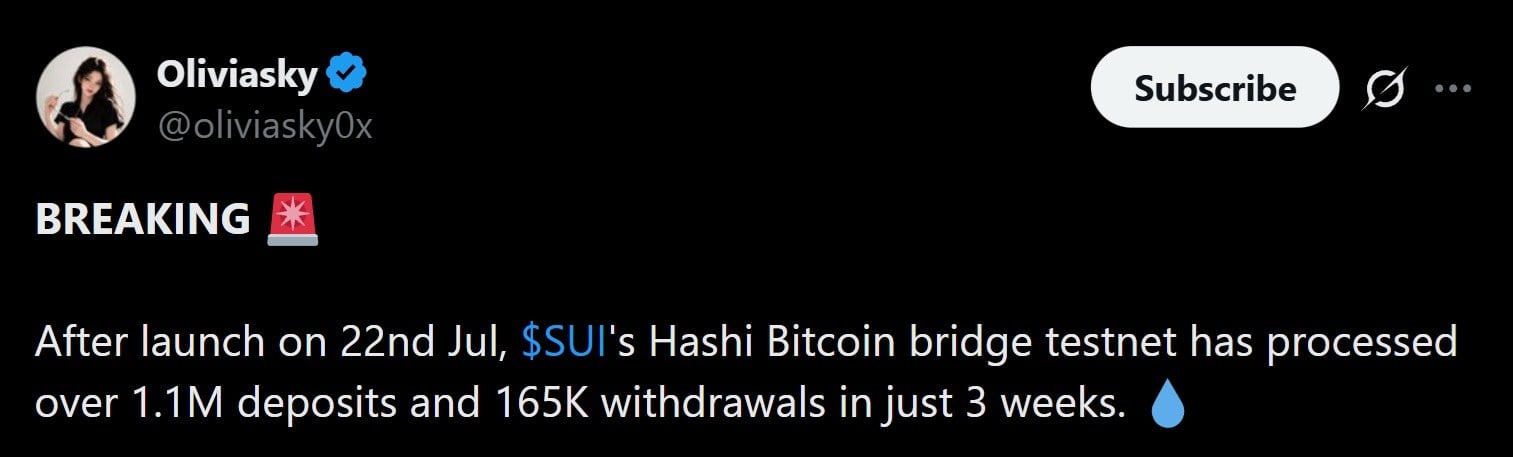
These figures appear to indicate early interest from retail and institutional investors in transferring native Bitcoin to the Sui network without converting the asset into a synthetic token—a model that has come under intense scrutiny in other chains after repeated bridge attacks in recent years led to the theft of hundreds of millions of dollars from storage systems.

Hashi was first introduced by the Sui Foundation in March 2026 as a decentralized primitive designed to allow Bitcoin ($BTC) to serve as collateral in on-chain lending and borrowing markets. The project completed a closed devnet phase before launching the current public testnet, providing developers with SDKs and integration guides ahead of the eventual mainnet launch.

Regarding the numbers, it's worth noting that 2026 has been a tough year for Bitcoin-related decentralized finance (DeFi): the total value locked (TVL) in Layer 2 BTCFi fell by approximately 74% compared to 2025 highs and stood at around 91,000 $BTC by mid-year. Hashi's proposition of maintaining $BTC in its native chain, rather than "wrapping" it, is a direct response to this skepticism. The early deposit and withdrawal data gives Sui an argument that this approach is finding its audience despite the overall market downturn.

How Hashi Preserves Bitcoin in Its Original Form

Unlike traditional wrapped-asset bridges, Hashi does not move Bitcoin out of the Bitcoin network. Instead, users deposit native $BTC, Sui validators confirm the transaction, and the protocol mints hBTC—a representative token that can be used as programmable collateral for institutional lending and borrowing of stablecoins, while the underlying Bitcoin remains on its own chain.

Security is based on a multi-layered architecture where deposits are secured by a "2-of-2" multi-signature scheme, requiring signatures from protocol validators using Multi-Party Computation (MPC)—a cryptographic scheme where no single party ever possesses the full private key.

Finally, withdrawals pass through a "Guardian Layer"—a customizable risk management system functioning as a "circuit breaker" that verifies large withdrawal requests against pre-set thresholds before confirming them. Overall, this architecture is designed to avoid the single points of failure that made older cross-chain bridges vulnerable to attacks.

Institutional Investors Back the Protocol

Currently, over 25 organizations are stress-testing the system, including custody and trading giants like BitGo and Cumberland, as well as Swissborg, Fluid, and Ledger. Their involvement spans trading desks, custody infrastructure, and asset management platforms, indicating demand for compliant, non-custodial ways to utilize idle Bitcoin in DeFi without taking on the counterparty risk that plagued earlier "wrapped" Bitcoin bridges.

The protocol's revenue model relies on interest rate spreads between depositor yields and the amount borrowers pay for Bitcoin-backed loans, rather than inflationary token emissions to incentivize activity.

This structure mirrors the pricing approach of traditional credit departments and, according to Sui investors, is likely to prove more sustainable once testnet incentives fade and real capital is at stake.

If Hashi ultimately manages to capture even a small share of the $1.4 trillion Bitcoin market in on-chain lending, it would become one of the most significant examples to date of interaction between the Bitcoin balance sheet and non-Bitcoin DeFi ecosystems.


Trending Cryptos

Related Questions

QWhat key achievement is reported regarding deposits on the Sui Hashi bridge within its first three weeks?

AThe cumulative volume of deposits on the Sui Hashi bridge testnet exceeded 1.1 million bitcoins within three weeks of its launch on July 22nd.

QHow does the Hashi bridge differ from traditional wrapped asset bridges in handling Bitcoin?

AUnlike traditional wrapped asset bridges, Hashi does not move Bitcoin out of the Bitcoin network. Instead, it mints a representative token (hBTC) on Sui for use in DeFi, while the underlying native Bitcoin remains secured in its own chain.

QWhat major security concern in the cross-chain bridge space does Hashi aim to address?

AHashi aims to address the vulnerability of older cross-chain bridges to attacks and hacks, which have resulted in the theft of hundreds of millions of dollars, by eliminating single points of failure through its multi-layered security architecture.

QWhat is the name of the security feature in Hashi's architecture that acts as a 'circuit breaker' for large withdrawal requests?

AThe security feature is called the 'Guardian Layer'. It functions as a customizable risk management system, verifying large withdrawal requests against pre-set thresholds before confirmation.

QWhich notable institutional entities are mentioned as participating in the stress-testing of the Hashi protocol?

AOver 25 organizations are stress-testing the system, including giants like Bitgo and Cumberland, as well as Swissborg, Fluid, and Ledger, covering trading, custody infrastructure, and asset management platforms.

Related Reads

From Hedge Funds to Family Offices, Who is Quietly Increasing Their HYPE Exposure Through PURR?

The article, originally published by Odaily Planet Daily, discusses how major traditional financial institutions are increasing their exposure to HYPE, the native token of the Hyperliquid ecosystem, through investments in its treasury company, Hyperliquid Strategies Inc. (NASDAQ: PURR). This trend follows PURR's inclusion in major indices like the Russell 3000 and S&P Global BMI in mid-2026. Analysis of recently filed 13F reports reveals several prominent hedge funds and family offices actively buying or increasing their stakes in PURR. Key investors include Stanley Druckenmiller's Duquesne Family Office ($23M initial stake), quantitative giant Renaissance Technologies ($18.7M), and "Tiger Cub" funds like Slate Path Capital ($21M) and Discovery Capital Management ($10.3M). Other notable buyers are Balyasny Asset Management and Brazil-based Wealth High Governance Capital. Additionally, passive investment giants like Vanguard and Nuveen have increased holdings due to index inclusions, with Q2 institutional inflows into PURR totaling approximately $142 million. The author frames this institutional accumulation as a significant milestone, indicating growing Wall Street interest in the Hyperliquid ecosystem as potential "next-generation financial infrastructure." While acknowledging the challenges ahead for HYPE's price and ecosystem development, the piece highlights upcoming bullish catalysts. These include the August 26th launch of the "AQAv2 revenue-sharing mechanism," expected to fund $200 million in annual HYPE buybacks, and continued development of Hyperliquid's HIP-3 and HIP-4 markets. The article concludes by drawing a parallel to Ethereum's institutional adoption, questioning if HYPE can fulfill similar expectations in the coming quarters.

Odaily星球日报40m ago

From Hedge Funds to Family Offices, Who is Quietly Increasing Their HYPE Exposure Through PURR?

Odaily星球日报40m ago

Trading

Spot

Hot Articles

Discussions

Welcome to the HTX Community. Here, you can stay informed about the latest platform developments and gain access to professional market insights. Users' opinions on the price of S (S) are presented below.

活动图片