Bitcoin demand stays weak despite $1B USDT injection – Here is why!

ambcryptoPublished on 2026-07-10Last updated on 2026-07-10

Abstract

Bitcoin is exhibiting a clear divergence between spot and derivatives markets. While futures demand has rebounded sharply, spot demand remains weak, indicating the current recovery is primarily driven by leverage. This makes the rally fragile and vulnerable to a sharp correction, especially amid renewed macro uncertainty from events like U.S.-Iran tensions. Recent data supports this cautious view: spot Bitcoin ETFs saw net outflows, and the Coinbase Premium Index turned negative, signaling weaker U.S. institutional demand. Despite Tether injecting $1 billion in new USDT, much of this liquidity appears to be sitting on the sidelines rather than flowing into Bitcoin spot purchases. This fresh capital could further fuel speculative derivatives activity instead of attracting real buyers. Historically, the current bear market of 248 days is shorter than previous major cycles (381 days in 2022, 385 days in 2018), suggesting the broader downtrend may have further room to run. In summary, Bitcoin's bear cycle remains intact, with the recovery being led by fragile derivatives speculation rather than strong spot demand.

Bitcoin is showing a textbook spot-versus-derivatives divergence.

However, how this setup plays out depends on the broader macro environment.

In a risk-on market, higher derivatives activity can support more upside. In a risk-off market, rising leverage increases the risk of a sharp correction. Recent U.S.-Iran uncertainty brought macro FUD back into the market.

However, the Crypto Fear & Greed Index held above extreme fear. That resilience has revived the debate over whether BTC’s bear market could be nearing its end.

History, however, tells a different story.

As the chart shows, Bitcoin’s current bear market has lasted 248 days. By comparison, the 2022 bear market lasted 381 days, while the 2018 one lasted 385 days, suggesting the current cycle may still have further room to run.
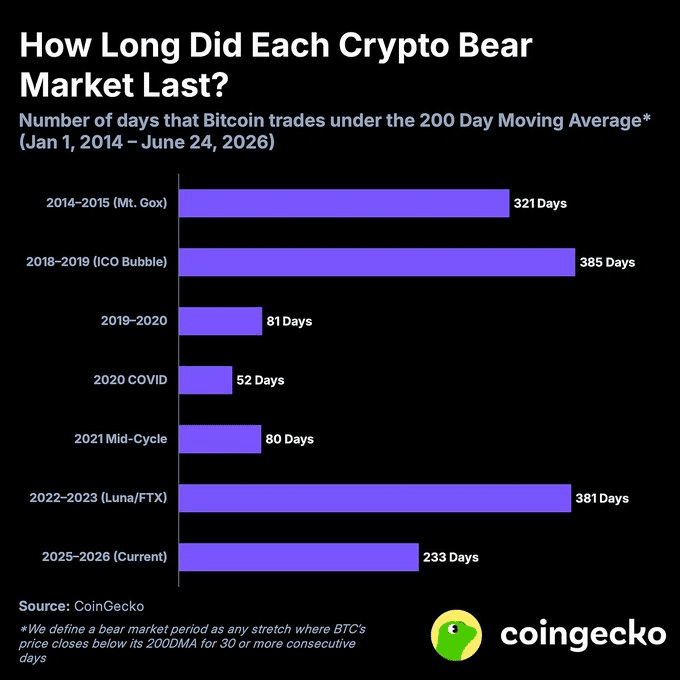
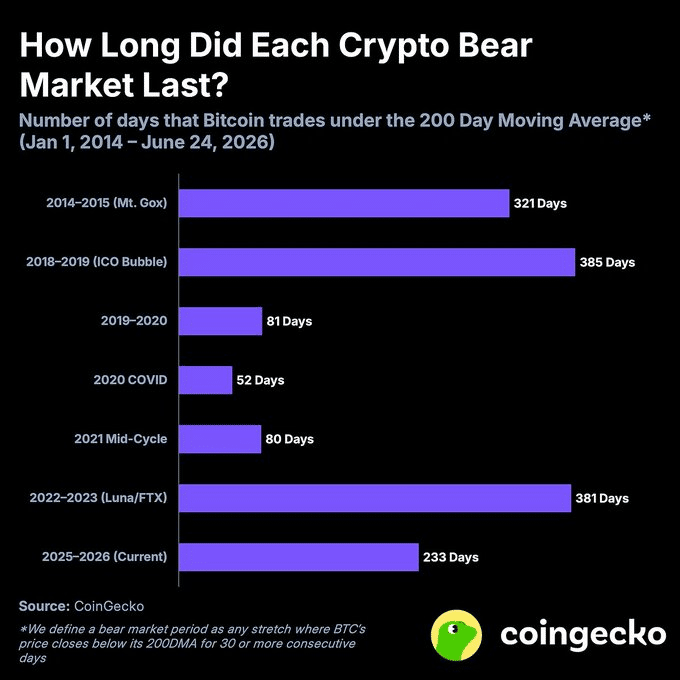
Source: CoinGecko

Institutional positioning also supports that view.

As the market flipped risk-off, spot Bitcoin ETFs saw more than $85 million in net outflows after three straight days of inflows, showing how quickly institutions pulled back as macro uncertainty returned.

Bitcoin’s Coinbase Premium Index tells a similar story.

The index has flipped negative, signaling weaker U.S. spot demand and suggesting institutional buyers have become more cautious as risk sentiment deteriorates.

Taken together, the data suggest Bitcoin is still far from a sustained risk-on environment, with the broader bear cycle remaining intact. Against this backdrop, the growing spot-versus-derivatives divergence becomes even more important.

So, what is it telling us about Bitcoin’s next move?

Bitcoin derivatives surge as spot demand lags

In a volatile market, liquidity injections can send mixed signals.

This time, the timing looks more bearish than bullish.

Tether recently minted $1 billion in fresh USDT even as the overall stablecoin market continues to shrink. Rather than flowing into risk assets, much of that liquidity appears to be sitting on the sidelines, suggesting investors are holding dry powder instead of buying Bitcoin.

The chart below shows why that matters.

Bitcoin’s 30-day cumulative demand has rebounded sharply from nearly -500,000 BTC to around -75,000 BTC, but the recovery has been driven almost entirely by derivatives. Futures demand has surged from roughly -295,000 BTC to slightly positive, while spot demand remains weak at around -78,000 BTC.
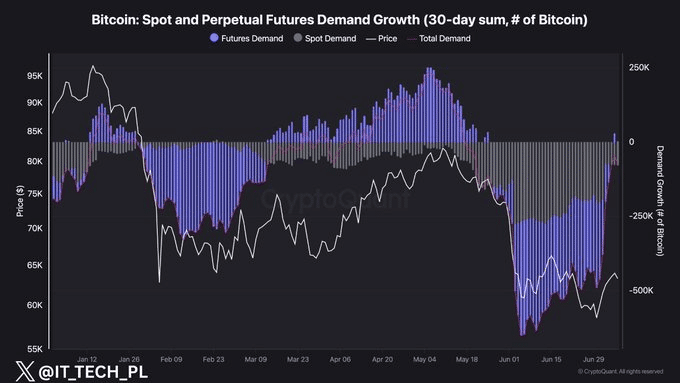
Source: CryptoQuant

Naturally, that leaves Bitcoin in a clear spot-versus-derivatives divergence.

Against this backdrop, the recent $1 billion USDT injection could add more fuel to Bitcoin’s derivatives market than its spot market.

With speculative positioning already leading the recovery, the fresh liquidity could drive leverage even higher instead of attracting real spot buyers. That would leave Bitcoin’s recovery more vulnerable to a sharp flush if sentiment flips risk-off.

In that context, Bitcoin’s bear cycle still looks far from over. If history is any indication, the current cycle has yet to reach the length of previous bear markets.


Final Summary

  • Bitcoin’s recovery is being driven by leverage, while spot demand remains weak, making the rally more fragile.
  • With macro uncertainty still high and fresh USDT liquidity entering the market, Bitcoin’s bear cycle may still have further to run.


Trending Cryptos

Related Questions

QAccording to the article, what does the divergence between spot and derivatives markets indicate about Bitcoin's current situation?

AThe divergence indicates that Bitcoin's recent price recovery is being driven primarily by increased leverage and speculative activity in the derivatives market, while underlying spot demand from institutions and investors remains weak. This makes the rally more fragile and vulnerable to a sharp correction if market sentiment turns negative.

QWhat is the significance of the recent $1 billion USDT injection mentioned in the article?

AThe $1 billion USDT injection is significant because it occurred while the overall stablecoin market is shrinking. The article suggests this new liquidity is not flowing into buying Bitcoin in the spot market but is instead sitting on the sidelines as 'dry powder' or potentially fueling more leverage in the derivatives market, which does not support a sustainable price recovery.

QHow does the article use historical bear market data to assess the current Bitcoin cycle?

AThe article compares the length of the current bear market (248 days as of the writing) to previous major bear markets in 2022 (381 days) and 2018 (385 days). It argues that because the current bear market is shorter than these previous cycles, it suggests the downturn may still have further room to run and is not necessarily near its end.

QWhat evidence does the article provide to show that institutional demand for Bitcoin is weak?

AThe article points to two key pieces of evidence: 1) U.S. spot Bitcoin ETFs saw over $85 million in net outflows after a brief period of inflows, showing institutions quickly pulled back amid macro uncertainty. 2) The Bitcoin Coinbase Premium Index turned negative, signaling weaker spot buying demand from U.S. institutional investors on the Coinbase exchange.

QWhat is the overall conclusion of the article regarding Bitcoin's near-term outlook?

AThe overall conclusion is that Bitcoin's bear cycle remains intact and is far from over. The recovery is seen as fragile due to being fueled by derivatives leverage rather than strong spot demand. Combined with ongoing macroeconomic uncertainty and historical cycle analysis, the article suggests the bear market may still have further to run.

Related Reads

Zcash's ETF Gilding: How a Privacy Coin Was Packaged by Wall Street into a Compliant Asset

The article traces the decade-long path of Zcash (ZEC), a privacy-focused cryptocurrency, to its potential launch as the first privacy coin spot ETF, with Grayscale's ZCSH filing in August 2026. It argues ZEC's suitability stemmed not from regulatory acceptance of its privacy technology, but from its centralized, institutional structure from inception—a commercial company (ECC) with venture capital backing and a Founder's Reward—making it easier to package than decentralized alternatives. Three key institutions, intertwined in a network, drove the process: Grayscale (owned by DCG, an early ZEC investor), which had held ZEC in a trust since 2017; Coinbase, providing custody, prime brokerage, derivatives, and venture investment; and ZODL, a new for-profit entity formed in 2026 when ECC's core development team split from the non-profit foundation. The major regulatory hurdle was SEC scrutiny (2023-2026) over ZEC's historical structure, which resembled an unregistered investment contract due to automatic block rewards to ECC and the Foundation. This was resolved through governance changes (NU6 upgrade in 2024) that ended direct funding and shifted control to community voting, coinciding with a broader shift in SEC enforcement policy. Notably, the law firm Davis Polk represented both the Zcash Foundation in its SEC defense and Grayscale in the ETF filing. The push is also driven by DCG's dire financial needs amid Genesis bankruptcy lawsuits, seeking high-fee products (the ZEC ETF charges 2.5%). Concurrently, major mining operations by entities like Cypherpunk Technologies (backed by Winklevoss Capital) and DCG's Fortitude Mining expanded, motivated by profitability and aiming to influence the network. The article concludes with irony: to become a compliant ETF asset, ZEC must shed its core privacy feature for the fund's holdings, which will be held in transparent, auditable addresses. Wall Street is not adopting privacy technology but packaging the *concept* of privacy into a tradable, fee-generating financial product. The transformation was not a single master plan but the result of a network of aligned interests capitalizing on regulatory, governance, and market shifts over ten years.

marsbit7m ago

Zcash's ETF Gilding: How a Privacy Coin Was Packaged by Wall Street into a Compliant Asset

marsbit7m ago

Bitcoin Core Developer Warns That Bitcoin Payments Are Disappearing at 'Bitcoin Beach'

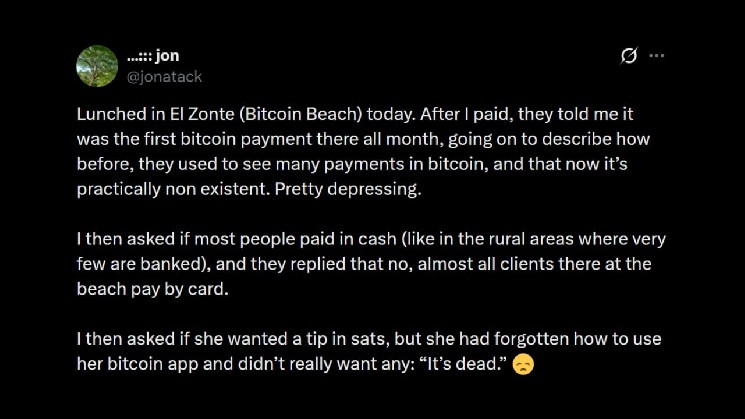
A Bitcoin Core developer, John Atack, who has lived in El Salvador since 2022, shared a concerning anecdote about Bitcoin adoption in the country. While dining at El Zonte, a region known as "Bitcoin Beach," he paid with Bitcoin and was told it was the first such payment the establishment had received in a month. Staff explained Bitcoin payments, once common, have now virtually disappeared, with nearly all customers using cards. An employee even declined a Bitcoin tip, stating she had forgotten how to use her wallet and declaring "It's already dead." Atack emphasized this was a single observation but noted the employee had witnessed the payment evolution over three years. His comments sparked mixed reactions. Some disputed his experience, with one user confirming successful Bitcoin payments in the same area. However, Bitcoin reporter Juan Galt acknowledged an underlying "economic problem," arguing that expecting price appreciation makes using Bitcoin for everyday transactions counterintuitive to economic incentives needed for a circular crypto economy. Despite the concerning report, Atack also reflected that El Salvador remains a global leader in cryptocurrency adoption and progressive legislation, sometimes causing locals to take these advancements for granted. The story highlights the ongoing challenges of mainstream Bitcoin adoption for daily commerce, even in pioneering nations.

cryptonews.ru9m ago

Bitcoin Core Developer Warns That Bitcoin Payments Are Disappearing at 'Bitcoin Beach'

cryptonews.ru9m ago

A Huge 'Sleeping' Wave of New Bitcoin Buyers Has Not Even Bought Bitcoin Yet

A recent study by the Federal Reserve Bank of Cleveland, titled "Do You Even Crypto, Bro? Cryptocurrencies in Household Finance," reveals that Bitcoin and other crypto assets are less understood than other financial assets in US households. The primary reasons for not owning crypto are a lack of knowledge and the perception that it is a poor investment. Even among owners, the main motivations are profit-seeking and portfolio diversification rather than an understanding of the underlying technology's benefits, such as independence from banks. The research found that showing respondents Bitcoin's past 12-month performance increased their desired portfolio allocation by about 47%, indicating investment decisions are driven more by recent returns than fundamental comprehension. Crypto gains are often treated like lottery winnings, leading to one-off luxury purchases rather than sustained increases in spending. While non-owners largely view crypto as high-risk, owners are somewhat less likely to do so, though they exhibit greater uncertainty about future returns compared to traditional assets like stocks or gold. This ambiguity about Bitcoin's nature and valuation contributes directly to its price volatility. The study concludes that this volatility will persist, but education efforts combined with price appreciation could convert today's uninformed non-owners into future Bitcoin holders.

cryptonews.ru12m ago

A Huge 'Sleeping' Wave of New Bitcoin Buyers Has Not Even Bought Bitcoin Yet

cryptonews.ru12m ago

Grain Prices Haven't Taken Off Yet, So Why Have Fertilizer Prices Risen First?

Fertilizer prices are rising ahead of a potential global food price surge, driven primarily by supply-side constraints rather than current agricultural demand. While a strong El Niño is forecast for late 2026, its impact is expected to be initially limited to specific crops like palm oil and rubber, not leading to immediate, broad-based grain shortages. The fertilizer market is currently propelled by its own dynamics: **Urea** faces domestic oversupply in China, with its price reliant on the potential to export to higher-priced international markets. **Phosphate fertilizers** are experiencing a rare "supply-led" cycle due to global sulfur shortages, shipping disruptions, and production cuts overseas, placing Chinese producers with integrated resources and export channels in a key position. **Potash** supply is tightening due to planned maintenance and production cuts at major global producers, underpinning its long-term resource scarcity narrative. Looking ahead to 2027, a prolonged El Niño could shift the market into a second phase of "demand-supply resonance." If extreme weather significantly impacts crop yields and global grain inventories, rising food prices and farmer income would boost fertilizer application demand. This potential demand surge, layered onto the existing supply constraints, could amplify the price cycle. The overarching theme is that **food security is redefining the strategic value of fertilizers**, particularly for resource-constrained phosphate and potash. Policy priorities balancing domestic supply guarantees with export opportunities, coupled with resource ownership and global supply chain access, are becoming critical determinants of profitability beyond short-term weather cycles.

marsbit15m ago

Grain Prices Haven't Taken Off Yet, So Why Have Fertilizer Prices Risen First?

marsbit15m ago

Trading

Spot

Hot Articles

What is $BITCOIN

DIGITAL GOLD ($BITCOIN): A Comprehensive Analysis Introduction to DIGITAL GOLD ($BITCOIN) DIGITAL GOLD ($BITCOIN) is a blockchain-based project operating on the Solana network, which aims to combine the characteristics of traditional precious metals with the innovation of decentralized technologies. While it shares a name with Bitcoin, often referred to as “digital gold” due to its perception as a store of value, DIGITAL GOLD is a separate token designed to create a unique ecosystem within the Web3 landscape. Its goal is to position itself as a viable alternative digital asset, although specifics regarding its applications and functionalities are still developing. What is DIGITAL GOLD ($BITCOIN)? DIGITAL GOLD ($BITCOIN) is a cryptocurrency token explicitly designed for use on the Solana blockchain. In contrast to Bitcoin, which provides a widely recognized value storage role, this token appears to focus on broader applications and characteristics. Notable aspects include: Blockchain Infrastructure: The token is built on the Solana blockchain, known for its capacity to handle high-speed and low-cost transactions. Supply Dynamics: DIGITAL GOLD has a maximum supply capped at 100 quadrillion tokens (100P $BITCOIN), although details regarding its circulating supply are currently undisclosed. Utility: While precise functionalities are not explicitly outlined, there are indications that the token could be utilized for various applications, potentially involving decentralized applications (dApps) or asset tokenization strategies. Who is the Creator of DIGITAL GOLD ($BITCOIN)? At present, the identity of the creators and development team behind DIGITAL GOLD ($BITCOIN) remains unknown. This situation is typical among many innovative projects within the blockchain space, particularly those aligning with decentralized finance and meme coin phenomena. While such anonymity may foster a community-driven culture, it intensifies concerns about governance and accountability. Who are the Investors of DIGITAL GOLD ($BITCOIN)? The available information indicates that DIGITAL GOLD ($BITCOIN) does not have any known institutional backers or prominent venture capital investments. The project seems to operate on a peer-to-peer model focused on community support and adoption rather than traditional funding routes. Its activity and liquidity are primarily situated on decentralized exchanges (DEXs), such as PumpSwap, rather than established centralized trading platforms, further highlighting its grassroots approach. How DIGITAL GOLD ($BITCOIN) Works The operational mechanics of DIGITAL GOLD ($BITCOIN) can be elaborated on based on its blockchain design and network attributes: Consensus Mechanism: By leveraging Solana’s unique proof-of-history (PoH) combined with a proof-of-stake (PoS) model, the project ensures efficient transaction validation contributing to the network's high performance. Tokenomics: While specific deflationary mechanisms have not been extensively detailed, the vast maximum token supply implies that it may cater to microtransactions or niche use cases that are still to be defined. Interoperability: There exists the potential for integration with Solana’s broader ecosystem, including various decentralized finance (DeFi) platforms. However, the details regarding specific integrations remain unspecified. Timeline of Key Events Here is a timeline that highlights significant milestones concerning DIGITAL GOLD ($BITCOIN): 2023: The initial deployment of the token occurs on the Solana blockchain, marked by its contract address. 2024: DIGITAL GOLD gains visibility as it becomes available for trading on decentralized exchanges like PumpSwap, allowing users to trade it against SOL. 2025: The project witnesses sporadic trading activity and potential interest in community-led engagements, although no noteworthy partnerships or technical advancements have been documented as of yet. Critical Analysis Strengths Scalability: The underlying Solana infrastructure supports high transaction volumes, which could enhance the utility of $BITCOIN in various transaction scenarios. Accessibility: The potential low trading price per token could attract retail investors, facilitating wider participation due to fractional ownership opportunities. Risks Lack of Transparency: The absence of publicly known backers, developers, or an audit process may yield skepticism regarding the project's sustainability and trustworthiness. Market Volatility: The trading activity is heavily reliant on speculative behavior, which can result in significant price volatility and uncertainty for investors. Conclusion DIGITAL GOLD ($BITCOIN) emerges as an intriguing yet ambiguous project within the rapidly evolving Solana ecosystem. While it attempts to leverage the “digital gold” narrative, its departure from Bitcoin's established role as a store of value underscores the need for a clearer differentiation of its intended utility and governance structure. Future acceptance and adoption will likely depend on addressing the current opacity and defining its operational and economic strategies more explicitly. Note: This report encompasses synthesised information available as of October 2023, and developments may have transpired beyond the research period.

2.1k Total ViewsPublished 2025.05.13Updated 2025.05.13

What is $BITCOIN

Discussions

Welcome to the HTX Community. Here, you can stay informed about the latest platform developments and gain access to professional market insights. Users' opinions on the price of BTC (BTC) are presented below.

活动图片