Bitcoin Bear Trend Remains Unchanged, But A Break Of This Trendline Could Change Everything

bitcoinistPublished on 2026-03-24Last updated on 2026-03-24

Abstract

Bitcoin is trading above $70,000 but remains in a bearish trend, according to analyst CrypFlow. The analyst notes that BTC faces repeated rejections at key resistance trendline on the RSI, reinforcing a weak price structure. The market has formed two Bear Flag patterns since the October 2025 peak near $126,000, with the latest one currently developing. A breakdown below the critical $62,650 support could trigger further declines. However, a decisive break above the descending trendline (around $73,000) may invalidate the bearish outlook. Both RSI and Stochastic RSI indicate ongoing bearish momentum, with recent signals suggesting increasing selling pressure and potential near-term correction.

Bitcoin (BTC) is currently trading above $70,000 again, after a slight recovery from its ongoing downtrend that pushed its price to $68,000 last week. Despite the brief bounce, market analysts suggest that Bitcoin’s bear trend is not over and remains broadly unchanged. The analyst believes that the world’s largest cryptocurrency could still go much lower unless it breaks a key trendline that could change its trajectory.

Why The Bitcoin Bear Trend Remains Unchanged

Market expert CrypFlow has released a fresh Bitcoin price analysis on X this week, maintaining a largely bearish outlook for the cryptocurrency unless it can break out of a critical trendline. According to the analyst, Bitcoin recently faced another rejection from the Relative Strength Index (RSI) downtrend on the three-day timeframe.

CrypFlow observed that each minor bounce into key resistance areas continues to be sold off quickly, underscoring a weak price structure. The analyst explained that Bitcoin’s continued downward trend, despite occasional relief rallies, stems from its consistent adherence to a distinct bearish structure.

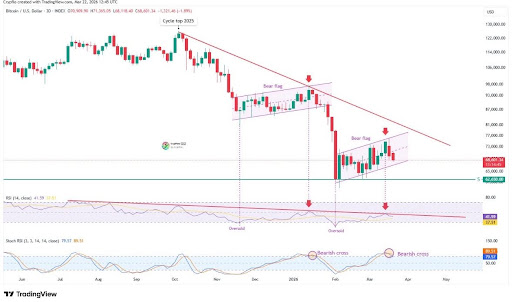
Within this structure, Bitcoin forms a Bear Flag, encounters a rejection at key resistance levels, and then resumes its decline toward lower levels. CrypFlow’s accompanying chart offers further clarity on this bearish pattern. The overall narrative is that the market has remained in a sustained bear trend since Bitcoin reached its peak.

Based on the chart, the analyst identified BTC’s cycle top around October 2025, when the price skyrocketed above $126,000. From that high, a clear descending channel formed, represented by two converging red trendlines that slope downward from upper left to lower right.
Source: X

As Bitcoin continued to decline within the descending channel, the cryptocurrency formed two distinct Bear Flag patterns. The first appeared around November to December 2025, where the price consolidated sideways within a rectangular range after a sharp drop, before breaking down violently again. The second and more recent Bear Flag is forming right now in March 2026. During this phase, BTC rebounded from levels below $65,000 and has since been consolidating within a rising wedge pattern.

The emergence of a new Bear Flag continuation pattern suggests that CrypFlow anticipates another downward move if the price breaks below the current structure. The analyst highlighted a strong horizontal support zone around $62,650, noting that this level currently supports Bitcoin’s entire structure. This support level represents a critical line in the sand for bulls and bears, and a breakdown below it could signal serious further downside.

On the bullish side, CrypFlow added that a decisive break above the descending trendline, potentially pushing Bitcoin’s price beyond $73,000, could invalidate the ongoing bearish trend and open the door to renewed momentum.

Negative RSI Indicators Signal Further Downtrend

At the bottom of his Bitcoin price chart, CrypFlow highlighted movements in both the RSI and the Stochastic RSI. At the time of the analysis, Bitcoin’s RSI stood at 41.59, confirming its dominant bearish momentum.

The analyst also identified two “Oversold” RSI readings, one in December 2025 and the other around February 2026, both of which coincided with sharp price drops. Notably, a descending red trendline across the RSI indicates that each bounce has been weaker than the last, a major bearish signal.

In addition, the Stoch RSI recorded readings of 79.57 and 89.51, placing the indicator in overbought territory. CrypFlow marked two separate “Bearish Cross” events on the Stoch RSI, one in December 2025 and the other recently in March 2026. A significant price drop followed the earlier bearish cross, and the current one forming now suggests that selling pressure may be building again, potentially signaling a stronger correction in the near term.

BTC price above $71,000 again | Source: BTCUSD on Tradingview.com

Trending Cryptos

Related Questions

QAccording to the analyst CrypFlow, what is the key condition that could invalidate Bitcoin's ongoing bearish trend?

AA decisive break above the descending trendline, potentially pushing Bitcoin's price beyond $73,000.

QWhat is the strong horizontal support zone that CrypFlow identified as critical for Bitcoin's structure?

AA support zone around $62,650.

QWhat two technical indicators did CrypFlow use to confirm the dominant bearish momentum and potential selling pressure?

AThe Relative Strength Index (RSI) and the Stochastic RSI.

QWhat pattern has Bitcoin formed twice within the descending channel, according to the analysis?

AA Bear Flag pattern.

QWhat was the price and timeframe that CrypFlow identified as Bitcoin's cycle top?

AThe cycle top was around October 2025, when the price skyrocketed above $126,000.

Related Reads

a16z: From Companies to DAOs, DUNA May Become the Next Generation Organizational Form

This article, "From Companies to DAOs: How DUNA Could Become the Next Organizational Form," traces the 500-year evolution of business collaboration. It begins with medieval structures like the *commenda* and Florentine *compagnia*, which exposed partners to personal risk. The modern corporation, exemplified by the Dutch East India Company (VOC), was a revolutionary leap, enabling large-scale, capital-intensive ventures by offering limited liability and reducing coordination costs. However, corporations introduced new challenges like principal-agent problems and bureaucratic overhead. The piece argues that software and internet-native protocols are now reducing these traditional overheads. Decentralized Autonomous Organizations (DAOs) emerged as a new model for coordination without centralized management. Yet, DAOs face a significant legal vacuum: they lack legal recognition, leaving members exposed to unlimited personal liability, and their tokens are vulnerable to being classified as securities under unclear regulations (e.g., the Howey Test). This has forced projects into suboptimal workarounds like offshore foundations. The article identifies the Decentralized Unincorporated Nonprofit Association (DUNA) as a potential solution. Recently legalized in states like Wyoming, the DUNA provides a legal wrapper for decentralized networks. It grants key protections—legal personality, limited liability, and perpetual existence—to a group without imposing a traditional hierarchical management structure. This allows token-holder communities to govern, hold assets, and contract as a single legal entity, aligning with their decentralized nature. While DUNA doesn't solve all governance challenges or magically resolve securities law questions, it represents a crucial step. It fills the legal recognition gap, offering a native legal form for internet-scale, decentralized collaboration and extending the separation of personal risk from organizational venture into a new domain.

marsbit1m ago

a16z: From Companies to DAOs, DUNA May Become the Next Generation Organizational Form

marsbit1m ago

2026 Mid-Year Report On-Chain RWA: Tokenized Stock Market Cap Doubles in a Year, But 90% of Rights Are Hollow Shells

The 2026 Mid-Year Report on On-Chain RWA highlights a significant growth in tokenized stock market capitalization, which nearly doubled from $951 million in March to $1.89 billion by July. However, the report reveals a fundamental contradiction in this "layer 2.5" ecosystem: products with the strongest legal foundation (like regulated U.S. infrastructure) lack liquidity and distribution, while freely tradable offshored wrapper products often lack substantive ownership rights. The increase is driven largely by a few products (SECZ, FGRS, STRCx) and platforms (Ondo, xStocks, Securitize collectively hold over 85% share). While distributed value across networks like Ethereum, Solana, and BNB Chain has grown, the market remains fragmented. Products referencing the same underlying asset (e.g., Apple stock) are distinct legal liabilities with different intermediaries and jurisdictional rules, offering varying degrees of legal claim. The report cautions that headline numbers are misleading, as they reflect changes in distributed token value—driven by issuance, conversions, and price movements—not pure investor inflows. True "canonical shares" with legal ownership, wide wallet distribution, institutional liquidity, and independent on-chain price discovery do not yet exist at scale. Tokenized treasuries show stronger product-market fit, and ETFs may be easier to scale than single stocks. The core takeaway is a trade-off: legal certainty versus liquidity and composability.

marsbit51m ago

2026 Mid-Year Report On-Chain RWA: Tokenized Stock Market Cap Doubles in a Year, But 90% of Rights Are Hollow Shells

marsbit51m ago

Coldcard Hardware Wallet Hacked: 594 Bitcoin Withdrawn in 25 Minutes

The Coldcard hardware wallet has been compromised, with hackers stealing approximately 594.5 Bitcoin (~$40 million) from 500 addresses in just 25 minutes. The root cause was a critical software bug, undetected for five years, which disabled the device's secure chip for generating true random numbers. This led to the creation of private keys based on predictable data like the processor's serial number, drastically reducing cryptographic security. The attackers exploited this offline by brute-forcing possible seed phrases, finding active addresses on the public ledger, and signing transactions. Initially, Coinkite (Coldcard's maker) claimed only older models were at risk but later admitted all devices running the compromised firmware were vulnerable. CEO Rodolphe Novak (NVK) apologized but ruled out financial compensation for affected users. To secure funds, owners must urgently update their firmware to specific safe versions, generate a completely new seed phrase on the updated device, and transfer all assets to new addresses created with that new seed. While a BIP-39 passphrase can help, it does not replace this migration process. Other Coinkite products like TAPSIGNER were not affected. This incident underscores that even specialized hardware requires rigorous, independent code audits, especially for cryptographic functions. It parallels past failures, like a 2006 OpenSSL bug in Debian, and raises questions about whether automated code analysis can ever fully replace human scrutiny in critical security areas.

cryptonews.ru3h ago

Coldcard Hardware Wallet Hacked: 594 Bitcoin Withdrawn in 25 Minutes

cryptonews.ru3h ago

Trading

Spot

Hot Articles

What is $BITCOIN

DIGITAL GOLD ($BITCOIN): A Comprehensive Analysis Introduction to DIGITAL GOLD ($BITCOIN) DIGITAL GOLD ($BITCOIN) is a blockchain-based project operating on the Solana network, which aims to combine the characteristics of traditional precious metals with the innovation of decentralized technologies. While it shares a name with Bitcoin, often referred to as “digital gold” due to its perception as a store of value, DIGITAL GOLD is a separate token designed to create a unique ecosystem within the Web3 landscape. Its goal is to position itself as a viable alternative digital asset, although specifics regarding its applications and functionalities are still developing. What is DIGITAL GOLD ($BITCOIN)? DIGITAL GOLD ($BITCOIN) is a cryptocurrency token explicitly designed for use on the Solana blockchain. In contrast to Bitcoin, which provides a widely recognized value storage role, this token appears to focus on broader applications and characteristics. Notable aspects include: Blockchain Infrastructure: The token is built on the Solana blockchain, known for its capacity to handle high-speed and low-cost transactions. Supply Dynamics: DIGITAL GOLD has a maximum supply capped at 100 quadrillion tokens (100P $BITCOIN), although details regarding its circulating supply are currently undisclosed. Utility: While precise functionalities are not explicitly outlined, there are indications that the token could be utilized for various applications, potentially involving decentralized applications (dApps) or asset tokenization strategies. Who is the Creator of DIGITAL GOLD ($BITCOIN)? At present, the identity of the creators and development team behind DIGITAL GOLD ($BITCOIN) remains unknown. This situation is typical among many innovative projects within the blockchain space, particularly those aligning with decentralized finance and meme coin phenomena. While such anonymity may foster a community-driven culture, it intensifies concerns about governance and accountability. Who are the Investors of DIGITAL GOLD ($BITCOIN)? The available information indicates that DIGITAL GOLD ($BITCOIN) does not have any known institutional backers or prominent venture capital investments. The project seems to operate on a peer-to-peer model focused on community support and adoption rather than traditional funding routes. Its activity and liquidity are primarily situated on decentralized exchanges (DEXs), such as PumpSwap, rather than established centralized trading platforms, further highlighting its grassroots approach. How DIGITAL GOLD ($BITCOIN) Works The operational mechanics of DIGITAL GOLD ($BITCOIN) can be elaborated on based on its blockchain design and network attributes: Consensus Mechanism: By leveraging Solana’s unique proof-of-history (PoH) combined with a proof-of-stake (PoS) model, the project ensures efficient transaction validation contributing to the network's high performance. Tokenomics: While specific deflationary mechanisms have not been extensively detailed, the vast maximum token supply implies that it may cater to microtransactions or niche use cases that are still to be defined. Interoperability: There exists the potential for integration with Solana’s broader ecosystem, including various decentralized finance (DeFi) platforms. However, the details regarding specific integrations remain unspecified. Timeline of Key Events Here is a timeline that highlights significant milestones concerning DIGITAL GOLD ($BITCOIN): 2023: The initial deployment of the token occurs on the Solana blockchain, marked by its contract address. 2024: DIGITAL GOLD gains visibility as it becomes available for trading on decentralized exchanges like PumpSwap, allowing users to trade it against SOL. 2025: The project witnesses sporadic trading activity and potential interest in community-led engagements, although no noteworthy partnerships or technical advancements have been documented as of yet. Critical Analysis Strengths Scalability: The underlying Solana infrastructure supports high transaction volumes, which could enhance the utility of $BITCOIN in various transaction scenarios. Accessibility: The potential low trading price per token could attract retail investors, facilitating wider participation due to fractional ownership opportunities. Risks Lack of Transparency: The absence of publicly known backers, developers, or an audit process may yield skepticism regarding the project's sustainability and trustworthiness. Market Volatility: The trading activity is heavily reliant on speculative behavior, which can result in significant price volatility and uncertainty for investors. Conclusion DIGITAL GOLD ($BITCOIN) emerges as an intriguing yet ambiguous project within the rapidly evolving Solana ecosystem. While it attempts to leverage the “digital gold” narrative, its departure from Bitcoin's established role as a store of value underscores the need for a clearer differentiation of its intended utility and governance structure. Future acceptance and adoption will likely depend on addressing the current opacity and defining its operational and economic strategies more explicitly. Note: This report encompasses synthesised information available as of October 2023, and developments may have transpired beyond the research period.

1.3k Total ViewsPublished 2025.05.13Updated 2025.05.13

What is $BITCOIN

Discussions

Welcome to the HTX Community. Here, you can stay informed about the latest platform developments and gain access to professional market insights. Users' opinions on the price of BTC (BTC) are presented below.

活动图片